
By Mike Sain't Louis ·
Six thousand euros and three per cent: the numbers in my lyrics
Four, nine, five. Four, nine, two. Five, five, nine.
It isn’t the combination to a safe or a ticket for the Christmas lottery. It’s the reference number on a complaint form, read out in full, digit by digit, in the middle of a song. I put it there. In «3 años de garantía» (“3-Year Warranty”), the consumer office of the Community of Madrid answers the narrator with his case number, “stroke A” and all, and the song stops to read it out like someone checking a supermarket receipt aloud to make sure they haven’t been charged twice for the yoghurts.
Going back through my lyrics to write this post, I noticed something I had never seen before. They are full of numbers. Ages, euros, years, percentages, pints of beer, WhatsApp statuses, hours on the road. As if every song had a calculator switched on underneath it.
This post is the tally. I’m not doing it to show off my bookkeeping, because I’m no accountant. I’m doing it because I think the numbers say a fair amount about how I write, and about why I laugh at the things that hurt.
Poetry can’t count
The love songs we all grew up with don’t use numbers. Or they use very few, and always the same ones. A thousand kisses. A hundred years of solitude, which isn’t even a song. All my life. Forever. Fake numbers, round numbers, numbers nobody can check.
Those numbers do nothing for me. “Five pints at Cien Montaditos” does a great deal more.
The difference is that anyone can picture five pints exactly. How many times the waiter came over. How much you laughed. What it cost. What happened afterwards. Nobody can picture a thousand kisses; everybody can picture five pints. That line is in «El anillo de casado» (“The Wedding Ring”), and it’s one of the happiest things I’ve written: the warm buzz of one particular afternoon in one particular place with one particular number.
The concrete is what convinces. And nothing is more concrete than a figure.
Four years of heaven
There’s one number that isn’t about loss but about a ceasefire, and I’m especially fond of it.
In «Un invitado VIP cortando cebolla» (“A VIP Guest Chopping Onions”), the narrator returns to hell after four years as a VIP guest in heaven. Four years. I love the precision of that stay, as if heaven were an all-inclusive hotel with a wristband and someone had come to tell him his booking was up. He doesn’t say “a while” or “a season”. He says four, like someone checking the contract.
What I find lovely is that the number turns happiness into something measurable, and therefore into something that ends. Four years of heaven are worth more precisely because they come with a check-out date. If they were endless there would be no song. There would be a travel brochure.
I wrote that figure with a crooked smile. Four good years, and then back to chopping onions.
Seven
If I had to choose the number of my catalogue, it would be seven.

I had never counted until now, and it gave me a bit of a turn. Seven turns up everywhere. In «Una obra de teatro» (“A Play”), someone learns that what he took for a relationship was a performance, and asks, unable to believe it: “Seven years on a stage?” In «Carta de recomendación», the narrator warns the next partner that after seven years they’ll be flicked away like a cigarette end. In «El castigo más duro» (“The Harshest Punishment”), seven years have to be wiped from every cloud in existence. In «Los ojos de Eduardo Casanova» the count is done out loud, one to seven, like hide-and-seek. In «Esperma» and «Un puñetazo al día» the seven years come back again, in a different key each time.
I won’t tell you here what lies behind that number, because the songs already tell it in their own way and because not everything belongs in a blog post. But I can tell you what seven does as a word.
Seven is a long number for a relationship and a short one for a life. Big enough that losing it hurts, small enough to say in one breath. Seven years fit in a line. Seventeen wouldn’t fit the same way.
It has something biblical about it too, which amuses me: seven plagues, seven deadly sins, nine lives for a cat but seven for a Spanish one. Some numbers arrive with their own mythology. I help myself to it without asking.
The numbers you delete
Let me stay a moment with «El castigo más duro», because it has a way of counting that feels very much of now.
The seven years aren’t measured on a calendar: they’re measured in cloud services. iPhone, Google Photos, Movistar Cloud, OneDrive. The list of places you have to log into to erase someone. To me that’s a figure even without digits: it’s the exact measure of how much space a person takes up in your digital life. Four platforms. Gigabytes upon gigabytes of birthdays and beaches.
Forty years ago, a break-up was measured in cardboard boxes. Now it’s measured in available storage.
And what I find saddest of all is that deleting has become an errand. That you have to go from app to app, as if from counter to counter, asking for the space someone else used to occupy.
Thirty-five, fifty-three
The funniest number I’ve ever written is an age said backwards.
In «Carta de recomendación», the character claims he’s about to turn thirty-five. The narrator corrects him: fifty-three. Same digits, different order. I still think it’s the laziest lie in the world, and that’s why I love it. He hasn’t even bothered to invent.
What the joke does is show that numbers lie too, and that they lie in a very particular way: with an honest face. A figure looks objective. If someone says “I’m thirty-five”, you don’t think of metaphors. You believe it or you don’t. And when you find out it was a lie, it hurts more because it came dressed as data.
The same letter keeps dropping figures that read like a loss adjuster’s report: the six-thousand-euro quote to fix his mouth, the five foot nine that isn’t, thanks to some insoles, the thousand-euro salary of a man who thinks he’s an executive. I’ve already explained in another post why I wrote «Carta de recomendación» as an official document. Here I only want to point out that without those figures, the document wouldn’t be funny. The joke isn’t that the ex lies. The joke is that he lies in euros and centimetres.
Ten per cent genuine
One of my songs is, quite simply, a lab report. It’s «Doña Rogelia».
There the character is reduced to percentages: “ten per cent genuine, ninety per cent fake.” And then, in case it wasn’t clear, once more: ten per cent original, ninety per cent counterfeit. It’s like the composition label on a cheap garment. Ten per cent cotton, ninety per cent polyester. Hand wash only and do not trust.
I like writing like that because a percentage has a coldness an insult lacks. Calling someone fake is an opinion. Saying they’re ninety per cent fake sounds like a test result. It sounds as if someone went in with a test tube and measured.
It isn’t true, of course. Nobody measured anything. But exaggeration laughs louder when it comes with decimals.
Not even three per cent
And then there’s my favourite percentage, which isn’t a joke but a question.
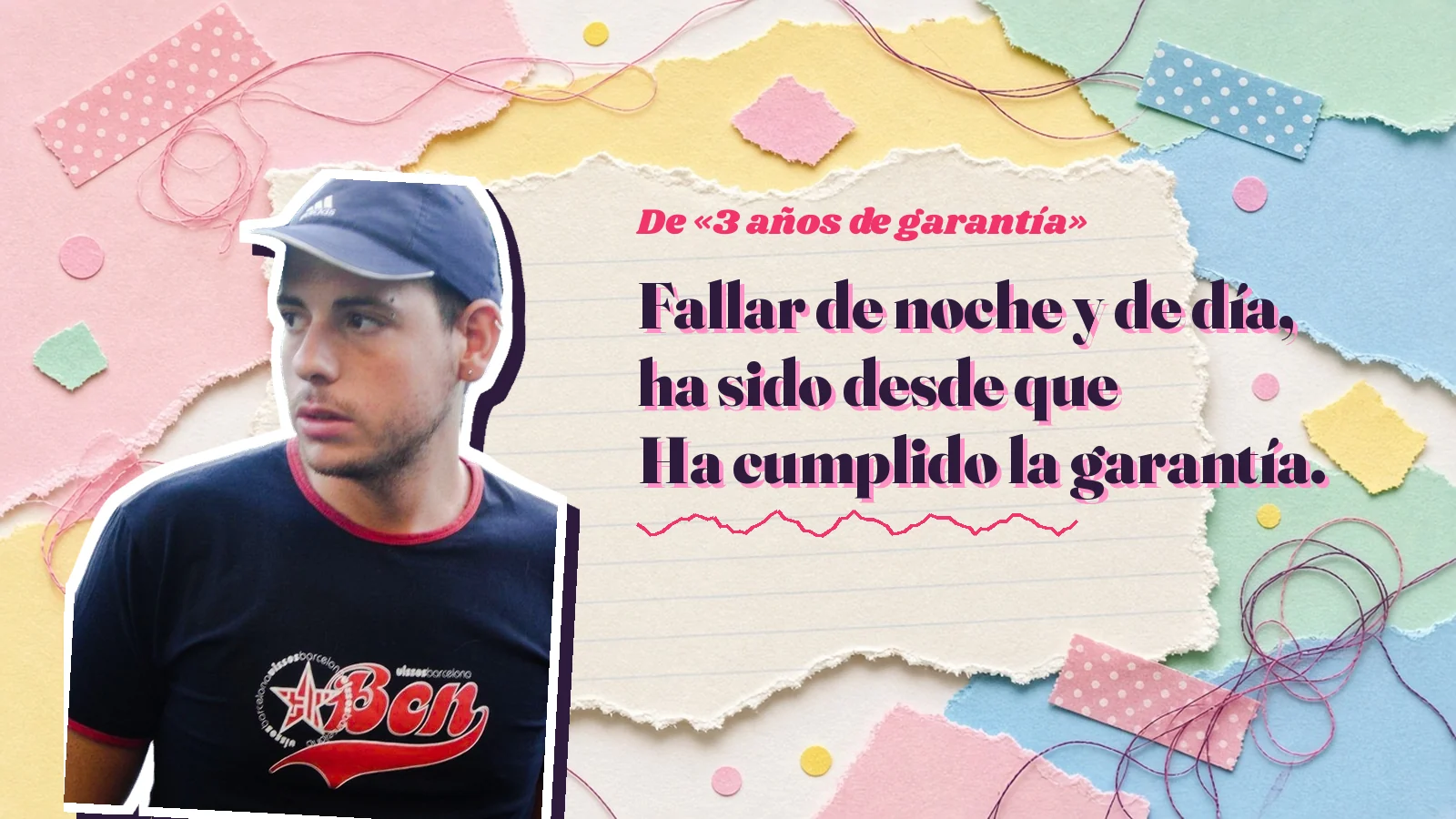
In «Me rindo» (“I Give Up”), after a long struggle to understand someone, out comes this: “Seriously, doesn’t it hurt you narcissists in the blood, not even three per cent?” In the same song, the narrator says he has dissected his own personality into forty parts to find the fault.
Forty parts and three per cent. Those two figures together are the most precise description I have of what it means to try reasoning with someone who doesn’t feel. You split yourself into forty pieces to examine yourself. Of the other person you don’t ask a hundred per cent, or fifty, or ten: only three. A pittance. And not even that.
That line makes me laugh at how ridiculous the percentage is, and leaves me cold at the same time. My whole way of writing is in there: the joke of the three per cent, and the sorrow of having to ask for it.
Three thousand euros in your face
Not all my numbers are about heartbreak. Some are pure neighbourhood comedy, the brutally honest friend on a café terrace.
In «Toxina coreana» (“Korean Toxin”), the best friend comes out with the exact size of the investment: “You’ve got three thousand euros injected in your face.” And then comes the confession that the frozen-faced friend is the one telling the story. I love that the number sits there in plain sight, like a price tag someone forgot to remove. Three thousand euros: not a lot, not a little. Just enough to be believable. A million wouldn’t have been funny. Neither would a hundred.
There’s a rule I keep learning over the years: the funny number is the plausible one. Total absurdity never gets as big a laugh as the almost possible.
Twenty years
Twenty is the other number that keeps returning in my catalogue. But its tone is nothing like seven’s.
In «Tengo argumento» (“I’ve Got a Plot”), someone was going to marry his boyfriend of twenty years and ends up sending him packing because he didn’t want a threesome with María, a María who is neither the one on the biscuit packet nor the one in church. In «La ley de la exageración», twenty years of a life go by in one go. In «El productor de Madonna no compra en Mercadona», the queen is still where she’s been for twenty years. In «Elon Musk ha anunciado», someone suggests going back to being twenty.
Seven is the number of the wound. Twenty is the number of nostalgia and mischief. It’s the number for things that last, things that are almost institutions by now: a twenty-year boyfriend, a twenty-year career, a diva twenty years at the top.
And it is also, now that I think about it, the age you were when everything began. Going back to twenty. That impossible wish everyone has had at some point, standing in front of a badly lit mirror.
Twenty statuses seen
There’s another twenty in my catalogue, and it’s the saddest of all, even if it sounds like a joke.
In «El segundo exacto» (“The Exact Second”) there’s the scene: “20 statuses seen on WhatsApp, my boyfriend, his mother, my sister, my father-in-law, my ex. Not a single ‘like’.” Twenty people watching and nobody reacting. It’s a statistic of loneliness. I wrote the number in digits, as well, the way it appears on a phone screen, because that’s how you see it: not as a word but as a counter.
That’s another thing I love about numbers. They let you say very hard things with a neutral face. There’s no need to write “I felt ignored”. You give the figure and let the listener do the sum.
Twenty statuses seen. Zero likes. Nothing more to add.
Ninety-three instead of thirteen
There’s one number that is practically my CV. It’s in «El productor de Madonna no compra en Mercadona»: ninety-three songs instead of thirteen.

It’s a cheeky way of describing how I work. Where a normal album would have thirteen tracks, my things overflow. The GAYFOLK trilogy filled up like that, song by song, and you can see the result in the full discography: hundreds of singles, each with its own cover, like a sticker album that never gets finished.
I laugh at myself with that number because I know how excessive it is. Nobody needs ninety-three songs by anybody. But that’s how it comes out of me. I write a lot, I keep very little in the drawer, and when a lyric is finished I itch to put it out. I write the lyrics myself, without AI; the music and vocals are made with artificial intelligence tools, and that means an idea doesn’t have to sit waiting for years until there’s a studio budget.
Ninety-three instead of thirteen: a complaint, a boast and a confession all at once. Like almost every figure I use.
Five hours for a note
Sometimes the number is a distance. And in a love song, distance is always a test.
In «Mi novio de Albacete» (“My Boyfriend from Albacete”), someone has travelled five hours to leave a note. Five hours. For a note. That disproportion is what made me write the song. Five hours for a wedding would be romantic. Five hours for a note is something else: it’s theatre, or it’s fear, or it’s someone who can’t say things to your face and needs half a day on the road so as not to have to say them.
Kilometres and hours are very small-town-and-capital-city numbers. They make me think of the coach, of Méndez Álvaro bus station, of a sandwich wrapped in tinfoil. I like my songs to carry those figures because they’re the ones ordinary people measure in. Nobody where I live says “we’re 250 kilometres apart”. They say “it’s five hours”.
Case number four nine five
Back to the start, to the case number, because it’s the figure that best explains all the others.
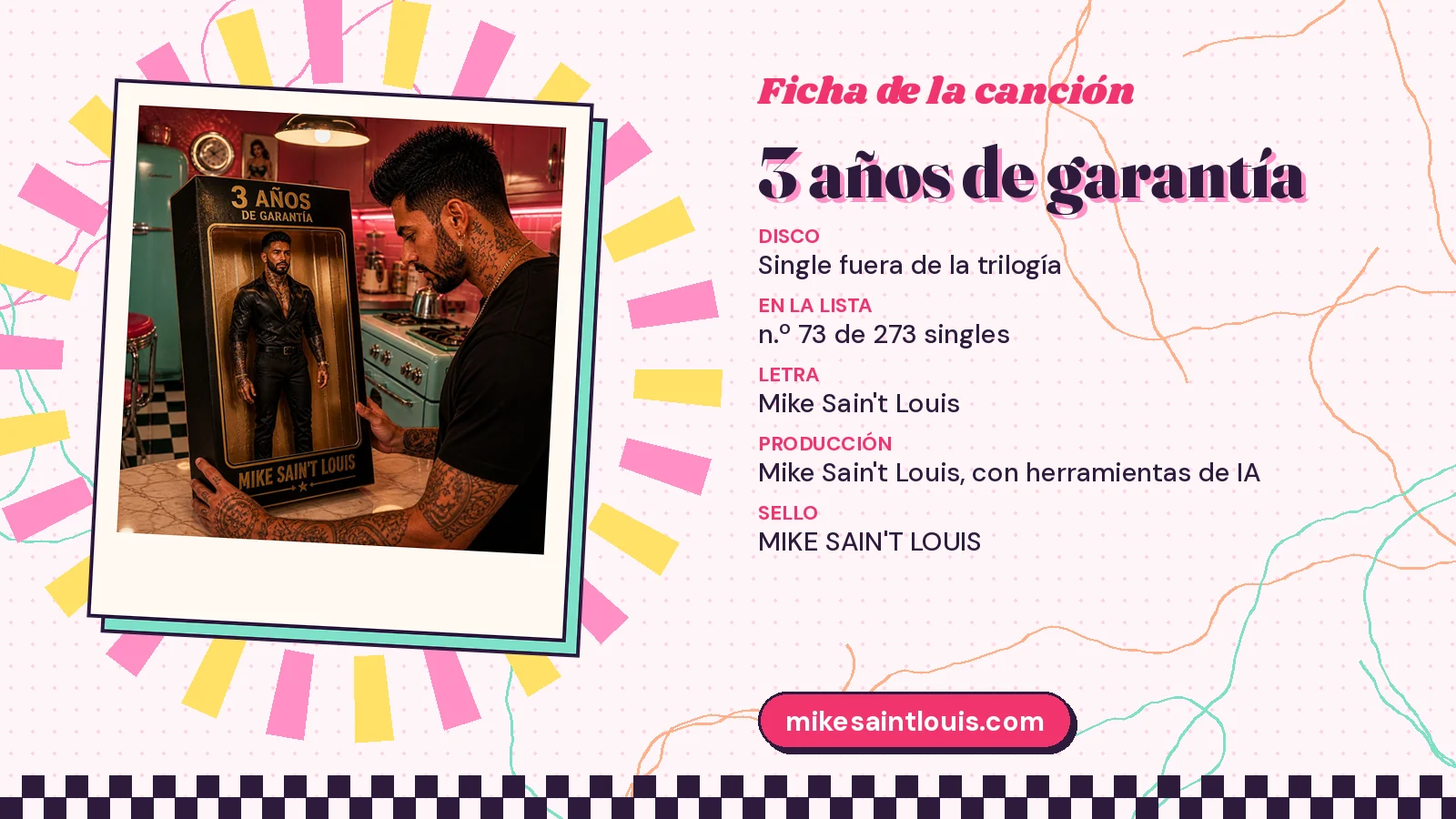
«3 años de garantía» tells the story of a boyfriend bought off the telly the way you’d buy a vacuum cleaner. He arrives within twenty-four working hours, is paid for cash on delivery, and comes with a one-month trial and a three-year warranty. At two years and a bit he starts to fail, and at three the warranty runs out and the ordeal begins. The narrator goes to the consumer office, fills in a complaint form, and the authorities reply with a number.
It’s the song where figures are everything. Love as a product with a use-by date. Grief as an administrative procedure. And the official answer, which offers no comfort at all but has plenty of digits.
When I wrote it I was thinking about how absurd it is that everything, even heartbreak, ends up on a form. And about how much fun it is to start reciting numbers in a song, which is the last thing you’re supposed to do in a song. As I wrote that litany of digits I kept imagining the tone of a switchboard, the kind that tells you your call is very important to them and then leaves you twenty minutes with lift music.
It’s one of my silliest songs. And one of the ones that most feels like me.
A thousand, the number nobody counts
At the beginning I said love songs use fake numbers, like a thousand kisses. I have to confess I use a thousand too. Just differently.
My favourite thousand is the one in «La casa de los mil cadáveres» (“House of 1000 Corpses”). There the number measures nothing: it’s the title of a horror film that I drag onto my own turf, the turf of relationships that leave the basement full of remains. In «Antisocial», the thousand is a preference: I’d rather have my animals a thousand times over than put up with certain people. And in «Carta de recomendación» the thousand is a salary, belonging to a man who thinks he’s an executive.
The thousand turns up three times and it’s a different animal each time: one of fear, one of rage, one on a payslip.
What they have in common is that none of them is romantic. My thousands are never kisses. They’re always corpses, times over or euros. I suppose that says something about me I’d rather not dissect into forty parts.
Thirty insults before coffee
There’s a figure in «Forocoches» that represents me more than I’d like: the narrator wakes up among thirty insults and reproaches.
Thirty. Not one, not “loads”. Thirty, as if someone had counted them on opening the phone in the morning, sleep still in their eyes. And later, in the same lyric, the time: seven in the evening, when the day is finally over. Between the thirty in the morning and the seven in the evening lies a whole day of putting up with it.
That’s what happens when you publish things online and read the comments: you start measuring the day in notifications. I turned it into a lyric because that’s what I do with almost everything. If it stings, I tell it. And if I tell it, I give it a number.
In «Tu mendigo» the number is twelve: twelve whole years lost. There’s no joke there. It’s one of those figures you say quietly.
Why I count
If I had to sum up why there are so many numbers in my lyrics, I’d give three reasons, but since lists of three bring me out in a rash, I’ll give just one.
I count so as not to exaggerate.
That sounds odd coming from someone with an entire song about the law of exaggeration. But it’s true. When I want to say something went on for a very long time, I don’t say “an eternity”: I say “seven years”. When I want to say someone lies a lot, I don’t say “he’s a compulsive liar”: I say “ninety per cent fake”. I put the exaggeration into the situation, the characters, the drama. The figure I leave dry, exact, checkable. And it’s that blend of melodrama and calculator that makes the thing work.
Numbers are the floor. On top of it you can dance as much as you like.
The outstanding balance
There’s one figure left that isn’t in any lyric, and maybe one day I’ll write it.
It’s the number of times I’ve nearly not released a song out of embarrassment. I don’t know it. I’ve never counted. I know it’s a lot, more than seven and fewer than ninety-three. I know most of those songs came out in the end and the world didn’t fall in.
If you want to do your own tally, all my lyrics are in order in the lyrics section. You can go through them one by one with a pencil, noting down the numbers that appear. Fair warning: seven will turn up more often than you expect. It did for me.
And if you end up with a strange figure, don’t worry. Send it to the consumer office. I’m sure they’ll give you a reference number.
Frequently asked questions
Which number appears most often in Mike Sain't Louis’s lyrics?
Seven, almost always as “seven years”: it appears in «Una obra de teatro», «Carta de recomendación», «El castigo más duro», «Los ojos de Eduardo Casanova», «Esperma» and «Un puñetazo al día», among others.
Which song recites a case number?
«3 años de garantía», in which the consumer office answers a complaint form with its reference number. The lyrics are at gayfolkplanet.com/letras/3-anos-de-garantia.
Where does “not even three per cent” come from?
From «Me rindo», in the question “Seriously, doesn’t it hurt you narcissists in the blood, not even three per cent?”. The full lyrics are at gayfolkplanet.com/letras/me-rindo.
Who writes these lyrics?
Mike Sain't Louis, lyricist, composer and music producer from Madrid. The music and vocals of his songs are made with artificial intelligence tools.