
By Mike Sain't Louis ·
The cast on board: who's who in «Croquetas en el crucero»
A ship is a film set with water all round it. Nobody can leave. That's why I love it so much.
When I wrote «Croquetas en el crucero» I wasn't thinking about the sea. I was thinking about an enclosed space full of people who can't stand each other and who, on top of that, have paid to be there. For someone who writes comedy, that's pure gold. It's Christmas Eve dinner with your in-laws, but for a whole week, with an all-you-can-eat buffet and no metro to escape home on.
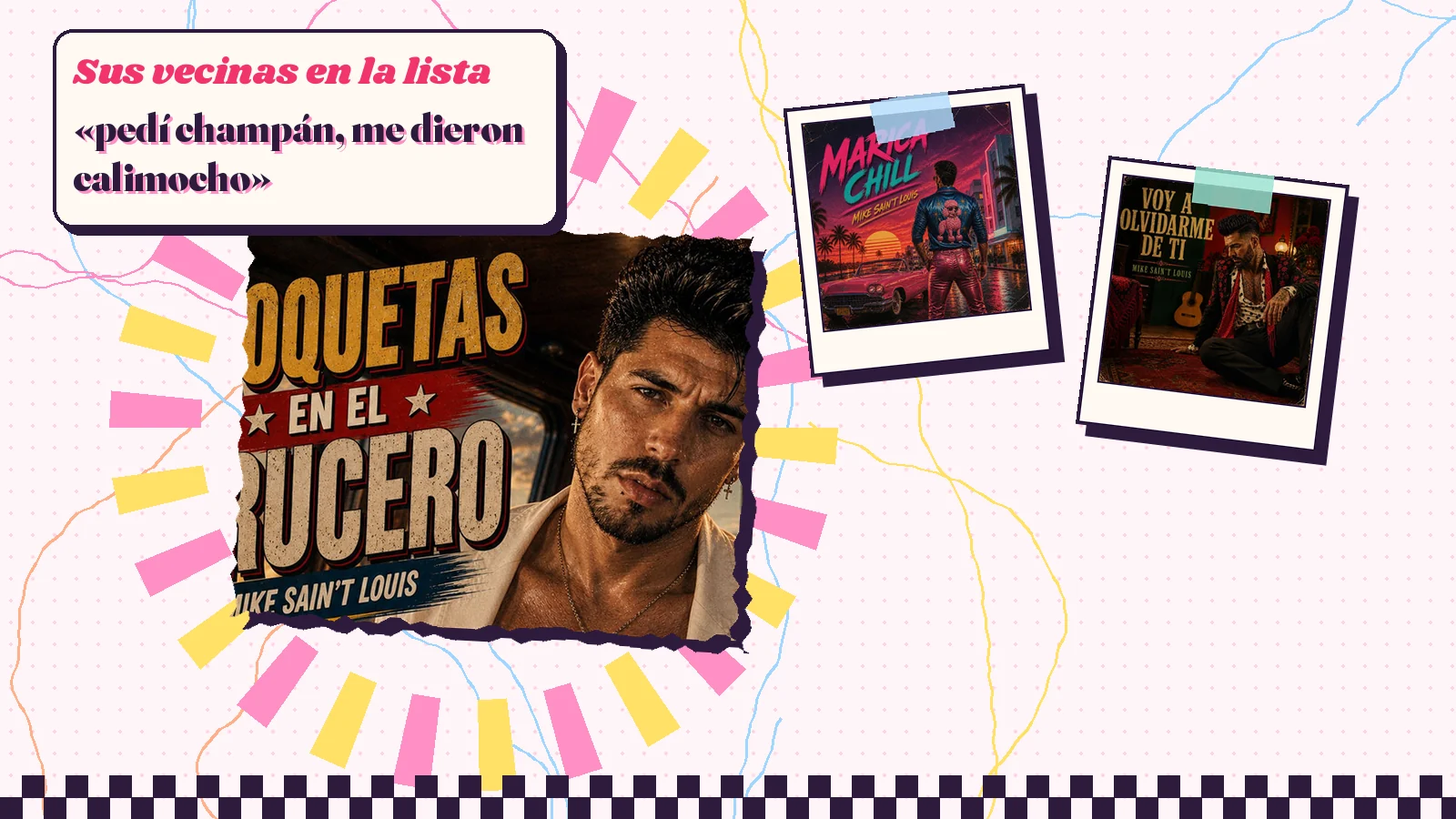
The song is on the second album of the trilogy, «Ojalá se pudiera viajar a GAYFOLK». On the singles list it's track 36 of 273, between «Marica chill» and «Voy a olvidarme de ti». From the laid-back queen's chill to the ship of chaos, and from the ship to a copla about forgetting. It's an order with its own logic, even if it's the logic of a hangover.
On the song's page I already told you about the clash between what they sell you and what you find on board. Here I'm going to do something else: introduce the cast. One by one. Like the credits of those afternoon TV series where a different celebrity boarded the ship every week and you, on the sofa with your mum, guessed who would fall for whom before the first ad break.
Why a ship
Before the cast, the set.
I have a weakness for enclosed spaces in songs. A block of flats, a villa, a lift, a health-centre waiting room. Places where the characters can't run away and where, therefore, things have to happen. In a park, people cross paths and keep walking. On a ship, people cross paths, cross again at the buffet, meet at the pool, bump into each other in the loo queue at four in the morning and end up knowing the colour of your swimsuit before your own mother does.
A cruise also carries a promise of luxury that is almost never kept, and that gap between what's promised and what's there is my natural territory. But I covered that on the song's page. Here I'll stick with the other thing: the ship as a box. A floating shoebox where I've put eight characters and closed the lid.
And a ship has one more thing almost nowhere else has: the timetable. Buffet at this time. Pool at that time. Mass at this time. Drill at that time. Everyone does the same thing at once, like a summer camp for adults with an all-inclusive wristband. That timetable is a coincidence machine. If the narrator had been in a Benidorm hotel, he'd have dodged Mass. On the ship, no. On the ship it's your turn. And whatever turns up, in this song, is always the worst possible thing.
The narrator
First on the list is the one telling the story, and he's the biggest loser of the lot. I say it fondly, because in the song I step into his shoes, or his flip-flops.
He signs up for a Mediterranean cruise with a very clear idea in his head and an even clearer pulling plan. And everything, absolutely everything, goes the wrong way. He's the classic comedy character: someone with a very specific desire and a world conspiring to deny it. If it were a film, he'd be played by an actor with a nice-guy face and bargain-shop sunglasses, hauling a wheelie suitcase that catches on every step.
What I like about him is that he never complains for real. He lists his misfortunes the way you'd show holiday photos on your phone, swiping: look, here are the croquetas; here, the chonis; here, Mass. No drama. A sort of amused amazement. As if he were saying: what happened to me doesn't happen to anyone, and that's exactly why I'm telling it.
It's my favourite way of telling a story. The one who laughs at himself before everyone else can.
The two chonis by the pool
Second to appear are the undisputed queens of the deck. Two chonis, those loud, flashy Spanish girls, by the pool making a racket, arguing over which of their boyfriends is more of a man.
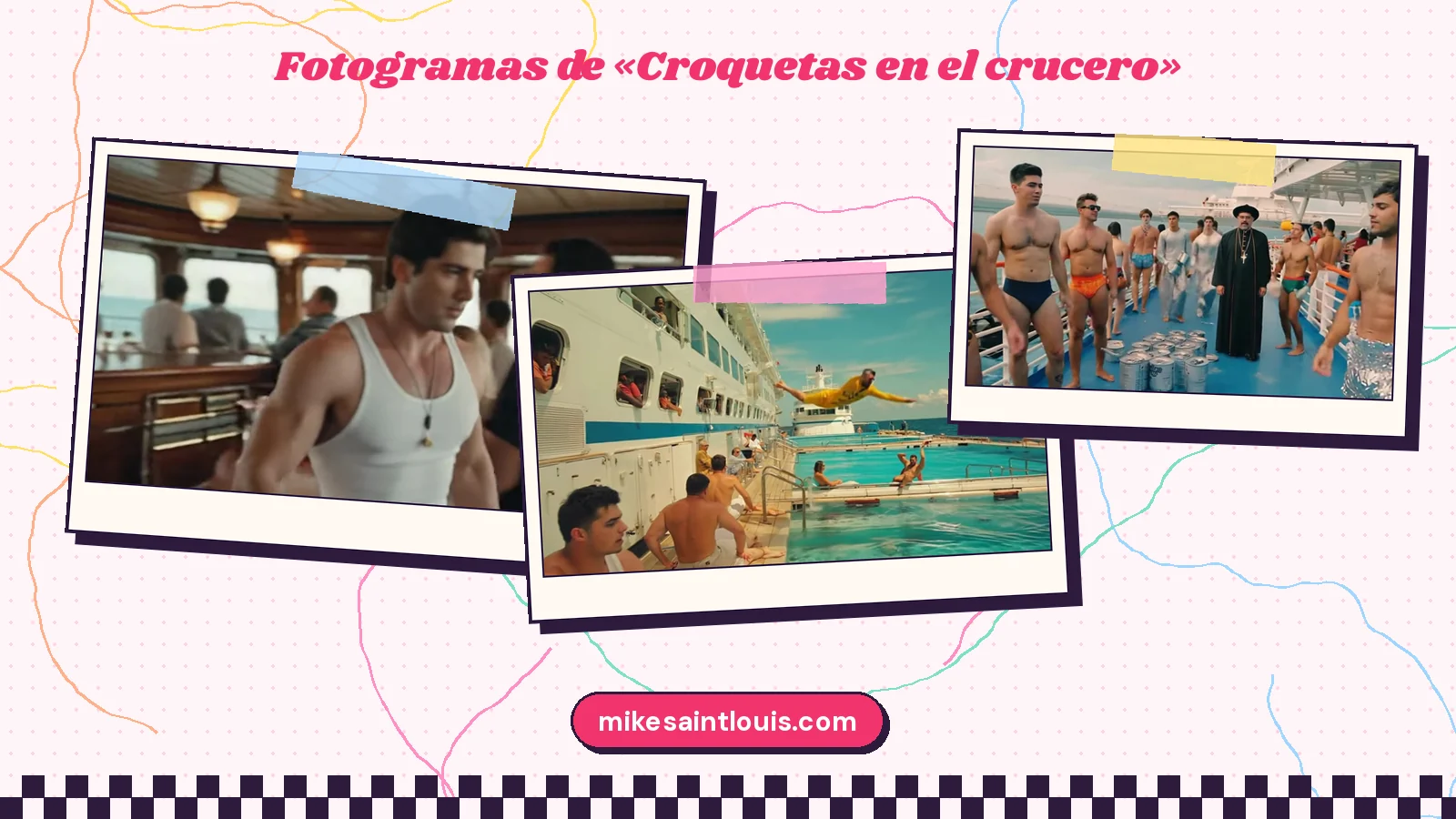
I can picture them perfectly, and I bet you can too. Gel nails with rhinestones, a ponytail pulled so tight it's a facelift, a Bluetooth speaker blasting reggaeton and a shouted conversation from one end of the pool to the other. They don't talk to each other: they compete. One's boyfriend is taller. The other's goes to the gym more. One got a Michael Kors bag from hers. The other, an airport bottle of Carolina Herrera.
The Spanish phrase montando una orquesta, literally «setting up an orchestra», delights me because it's so my grandmother. It means kicking up a fuss, raising hell, making sure everyone hears. And at a cruise pool, a place where people are supposed to unwind with a mojito, two chonis setting up an orchestra are an invasion.
Further on the gossip about them comes back, with a little bird telling tales I won't spell out here letter by letter. Enough to say that these chonis, so proud of their husbands, are according to the little bird rather more flexible when they're plastered. It's a village-fiesta joke, the kind told under your breath at the bar during the local fair. And it's also a small portrait of hypocrisy: plenty of boasting about macho men by the pool and then, at night, another story altogether.
The one who never boarded: the Italian
There's a character in the first verse who never makes it onto the ship. The Italian.
The narrator signed up thinking of beaches, sunshine and some Italian or other. Just like that, with «some» in front, the most hopeful and humblest word in the language. He isn't asking for a particular Italian. He isn't asking for Raoul Bova. He's asking for any one, whoever, one of those tanned men in linen shirts open to the sternum who appear in Christmas cologne ads.
And not a single one turns up.
I love that the cast has an absentee. In farces, the character who never arrives is almost as important as those who do. He's the Godot of the Mediterranean. The whole ship organises itself, without knowing it, around his absence: the bouncer is a substitute, the reggaetonero is an accident, the captain is a mirage. The Italian is plan A and everything else is plans B, C and Z.
If there were ever a sequel, the Italian would have to show up. Probably in the port of Naples, just as the ship is pulling away. Waving from the quay with a pistachio ice-cream cone in his hand.
The bouncer from Grindr
The third character never even appears in person, and yet he's key. The bouncer.
The narrator signed up for the cruise because of him. They met on Grindr, which in the lyrics I spelled the way it sounds, Spanish-style, and the guy was a doorman. Whether at a club or at a block of flats, the song doesn't say either, because I like leaving those gaps so everyone can cast their favourite doorman. I picture him on a Chueca club door, earpiece in, arms folded, deciding who gets in and who doesn't.
The bouncer is the engine of the whole voyage and, at the same time, its great absentee. He's the Italian who never was. The plan that vanished the moment he set foot on the gangway. And there's a lot of truth in that about app dating: you sign up for something enormous because of a person you know from a screen, and in the end the person dissolves and you're left with the enormous thing. The whole cruise. No bouncer.
The reggaetonero at Mass
Here comes my favourite character, if you force me to choose.
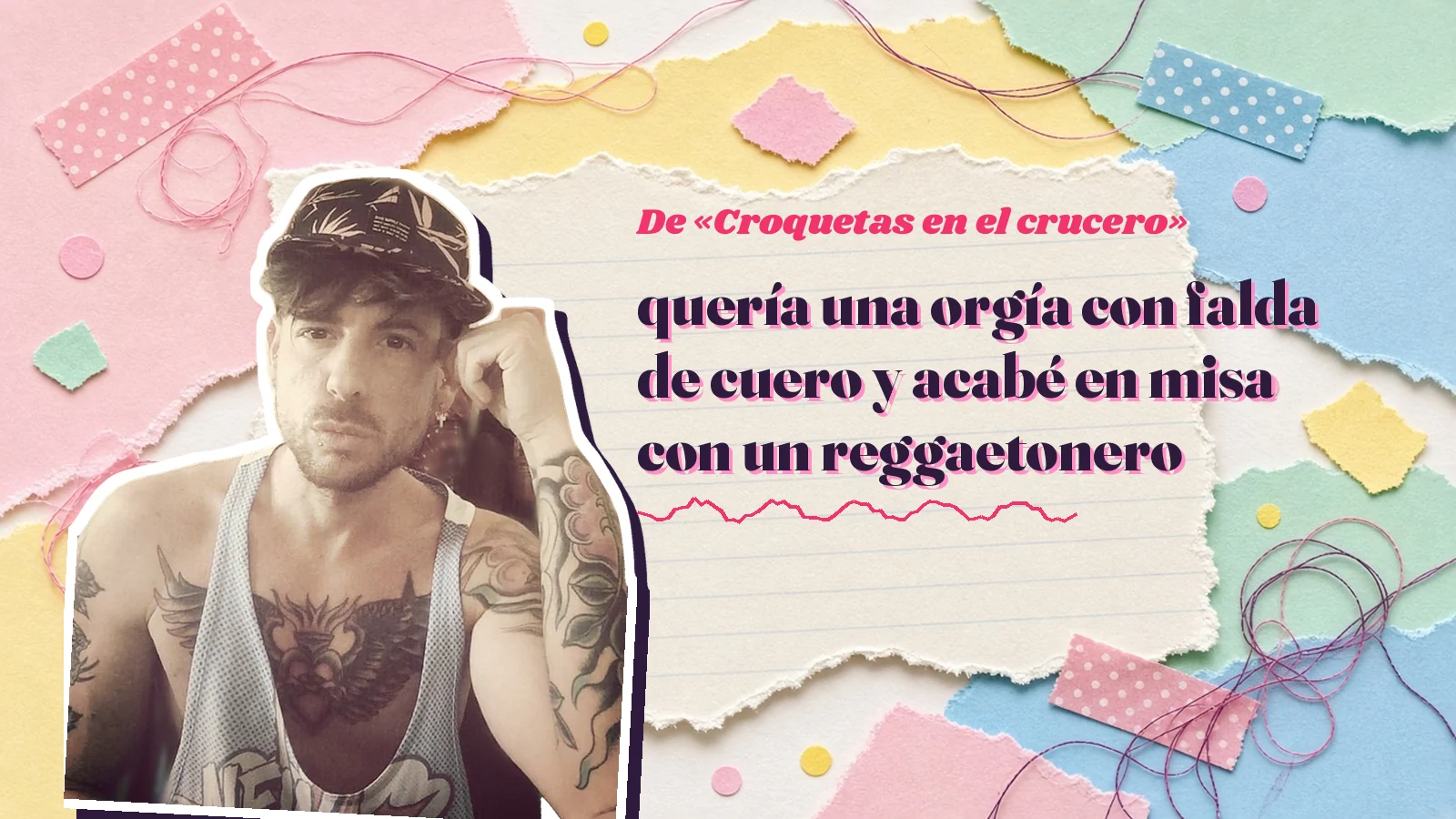
«quería una orgía con falda de cuero y acabé en misa con un reggaetonero»
It's the line I love most in the whole song, and it's pure casting. The narrator wanted a party in a leather skirt, a very specific image of a Berlin sauna, of a darkroom under red light. And he ends up at Mass. Not at the ship's disco, not at the bar in the bow. At Mass. Next to a reggaetonero.
What tickles me is that the reggaetonero is out of place too. What's a reggaeton guy doing at Mass on a cruise? No idea. Maybe his mum made him. Maybe he went to pull, like the narrator. Maybe he's more devout than he looks, with his gold chain and his big cross, the kind that matches the sunglasses. I picture him crossing himself with black-painted nails, humming a Bad Bunny track under his breath while the priest hands out communion.
The point is that they're both equally lost. And that, in a comedy, is the best thing that can happen to a scene. Two characters who don't fit in a place that doesn't fit them. From there, whatever happens comes free.
The captain
Now authority takes the stage. The ship's captain.
The captain gives a cheeky wink and offers a drink and some cheese. It's the only moment in the song when it looks like something might go right. A man in a white uniform with gold braid, winking at the narrator. Every queer's dream after watching a sailor film: the captain inviting you to his cabin.
And right then the evacuation alarm goes off.
It's the oldest joke in the world, the interrupted moment, and I used it without the slightest shame. But what matters to me is what follows: the entire passenger list running down the corridors in dressing gowns.
«corrimos todos en bata y sin depilación»
That «sin depilación», unwaxed, is the best thing I've got in these lyrics, and I say it with all the modesty I can muster, which isn't much. It's the detail that turns a disaster scene into an embarrassment scene. Nobody thinks about the shipwreck. Everyone thinks about their unwaxed legs in front of the captain. It's the logic of the body in public, which is what really rules us. Better dead than hairy.
The captain, by the way, vanishes after that. We don't know if he went down with the ship, shut himself in his cabin or went off with the chonis. He's a one-scene character, like the guest stars on those series, who came on, did their bit and left before the end.
The priest and his gardener
And in the last chorus, when it seemed nobody else could possibly fit on the ship, two new characters appear: a priest and his gardener.
I got tangled up with them, the lyrics say. I clarify nothing further. What's a priest doing on a cruise with his gardener? Why are they travelling together? Since when does a priest have a gardener? The song leaves those questions floating with a crooked smile. Anyone who grew up in a Spanish neighbourhood knows there are couples nobody can explain and everybody explains anyway.
This duo is the cherry on the cast because it's as far as it gets from what the narrator was after. He wanted an Italian. He got a bouncer who never showed, a Mass with a reggaetonero, an interrupted captain and, in the end, a priest with his gardener. Plot it on a graph and the curve of desire plunges all the way down to the parish basement.
But careful, it isn't a sad ending either. Getting tangled up with a priest and his gardener on a cruise has its charm. It's a dinner-party anecdote for years. And that, I think, is what the song is about: holidays that go wrong are the ones that make the best stories.
The extra in the minibar
There's one more character, small and silvery. The sardines.
Towards the end, the narrator wonders whether this was a cruise or a funeral home on the high seas. He doesn't know, but there are sardines in the minibar. That line has an absurd logic I adore: it doesn't answer the question, but it submits evidence. Like a TV courtroom where the lawyer has nothing to say and pulls out a plastic bag with something in it.
The sardines are an extra, but an extra with a lot of weight. In a luxury minibar you expect champagne in tiny bottles, Swiss chocolates, nuts priced like gold. And what you find is sardines. Probably tinned. Probably on special offer. They're proof the ship is more beach shack than five-star hotel.
And the funeral home. I chose that word because cruises are known for being full of older people, and because a big white ship, silent at night, has something of a floating undertaker's. It's a slightly cruel joke, I admit. But the narrator is inside the funeral home too. He's buffet fodder as well.
The croqueta, secret star
I've left for last the character who gives the song its title, who isn't a person but a fried snack.
The croqueta.
In Spain, the croqueta is sacred and tacky at the same time. It's what your grandmother makes with leftover stew, and it's what's served at the buffet of any three-star hotel in Torremolinos. It can be the best thing in the world or a frozen ball of béchamel with a stray bit of ham lost inside. On the cruise, obviously, it's the latter.
That's why I put it in the title. The croqueta is the symbol of the whole ship. It promised the Mediterranean, glamour, an Italian film with Sophia Loren on deck. And you get croquetas and bad cheese. Same as ever. Home food, but worse. Even the last line says so: croquetas and bad cheese, all very weak.
That all very weak is the harshest food review I've ever written. And the most honest.
The champagne that never came
One more detail, which I think says a lot about how I write:

«pedí champán, me dieron calimocho»
Calimocho is red wine with Coca-Cola, the drink of street drinking sessions at northern village fiestas and outside secondary schools. Asking for champagne and getting calimocho is the perfect description of my life, and probably yours. You ask for something with fine bubbles and they give you something with fizzy-drink bubbles.
But I don't tell it angrily. I tell it with a sort of fondness for calimocho. Because, between you and me, calimocho goes down better. It's more honest. It doesn't pretend to be what it isn't. Cruise champagne would probably have been worse, in fact. It's an idea that keeps coming back in my catalogue: tackiness not as failure but as truth. I told you about it in camp isn't a joke, even if you laugh, and here the croqueta and the calimocho are its finest example.
Why I write ensemble songs
Some of my songs are a monologue of one person with their pain, and some are an entire cast of ridiculous people. This is one of the latter, and I have far more fun writing them.
When I write an ensemble, each character gets a single line, a single trait, like in comic strips. The chonis shout. The captain winks. The reggaetonero is at Mass. The priest has a gardener. There's no room for nuance because they don't need it: they're caricatures we all have an example of in our heads. The good thing about the bold stroke is that the listener fills in the rest with their own memory.
I talked about it more calmly in secondhand embarrassment as a writing tool. There's a kind of humour that works because you cringe for other people and, at the same time, recognise yourself in them. I'm the narrator in a dressing gown, unwaxed, but I've also been the choni showing off her boyfriend, and the one who goes to Mass because someone roped him in.
The lyrics are mine, written without AI. The music and vocals are produced with artificial intelligence tools, such as Suno, which I direct; I always explain it and it's all in About Mike. In an ensemble song like this one, what's mine is precisely that: the casting. Choosing croquetas and not prawns, calimocho and not sangria, a priest with a gardener and not with a niece.
If you're going on a cruise
Here's a friend's advice, though nobody asked for it.
If you're going on a cruise, play this song on day one, in your cabin, while you unpack. That way, when you see the two chonis by the pool, you'll know you're in the right place. When the captain winks at you, you'll know the alarm's about to go off. And when you ask for champagne, you'll have your smile ready for the calimocho.
And if you're not going on a cruise, even better. Play it anyway, in your kitchen, while you fry some proper croquetas, your mum's kind. They'll taste divine. The song has something of a song for doing the washing-up, the kind that makes everyday life more fun without asking you to get emotional.
The full lyrics are on gayfolkplanet.com and in this site's lyrics archive. And if you want another ensemble comedy, the catalogue has several. But none with sardines in the minibar.
That one's all mine.
Frequently asked questions
What is «Croquetas en el crucero» about? It's a comic song about a Mediterranean cruise that goes the opposite way to plan: croquetas and bad cheese at the buffet, two chonis kicking up a racket by the pool, a pulling plan that ends at Mass with a reggaetonero, a captain interrupted by the evacuation alarm and champagne that turns into calimocho.
Which album is it on? On «Ojalá se pudiera viajar a GAYFOLK», the second album of the GAYFOLK trilogy. On the Planeta Gayfolk singles list it's track 36 of 273.
Who writes the lyrics, and how is the music made? The lyrics are mine, written without AI. The music and vocals are produced with artificial intelligence tools, such as Suno, which I direct. I'm a Madrid-based lyricist, composer and music producer, the first AI songwriter.
Where can I read the lyrics and listen to it? The full lyrics are on the song's page and on gayfolkplanet.com. You can listen on Spotify.