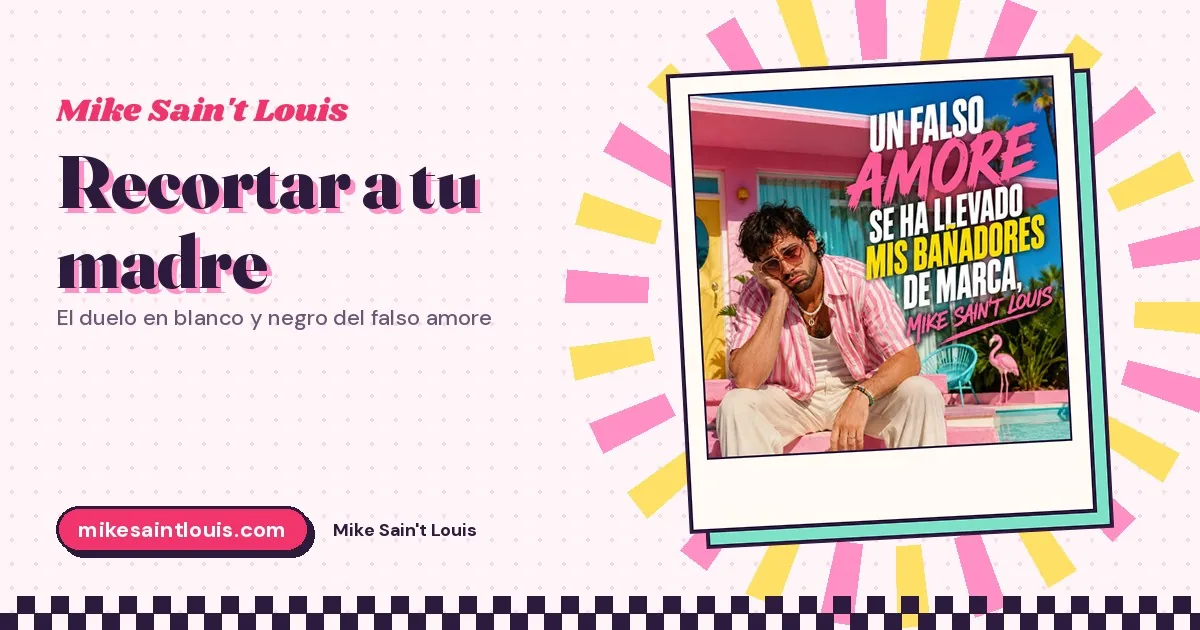
By Mike Sain't Louis ·
Cropping your mother out of the selfie: the black-and-white grief of the fake «amore»
A cropped-out mother. There, at the edge of a photo, a scrap of shoulder remains, an earring, half a fringe fresh from the neighbourhood hairdresser's. The rest has vanished under two fingers on a phone screen. And in the middle, him. Gorgeous. In black and white, the official colour of suffering on Instagram.
The song *Un falso amore se ha llevado mis bañadores de marca*, "A fake amore has run off with my designer swimwear", opens with that scene. Before the swimwear, before the empty drawer, before the chorus with its «das asco», "you're disgusting", there's a photo. And for me that photo is the sharpest thing in the whole lyric, because a single selfie holds an entire manual on how to grieve when the grief is for an audience.
The song page already tells the whole story: the evidence, the birthday candles, the catalogue eyes. I won't go over all of it here. Here I'm staying with the photo. With the scissors. With the filter.
A week, the lifespan of an open yoghurt
The lyric starts in prose, like someone beginning a story at the bar with one finger raised. I'll copy the opening, trimmed, because the full sentence goes on forever:
«Para empezar, si ya habíamos roto desde hacía una semana, y tan mal lo estabas pasando, que tú también habías estado llorando y tenías fatal los ojos.» "For a start, if we'd already broken up a week before, and you were having such an awful time, if you'd been crying too and your eyes were in a terrible state."
A week. That's the detail that starts the clock. A week is nothing at all. It's how long an open yoghurt takes to go off in the fridge. It's how long a cold lasts if you're sensible. It's how long Correos, the Spanish post, takes to bring you a parcel from Valladolid. And in that week, according to the lyric, he'd been crying, having an awful time, his eyes a wreck.
That "for a start" is pure neighbourly complaint. It's what your aunt says before listing her daughter-in-law's faults: "for a start, she never says hello". You know a list is coming. And the first item on the list is this one: the eyes. The crying. The suffering.
Because in the next sentence, the suffering goes off to have its picture taken.
The digital scissors
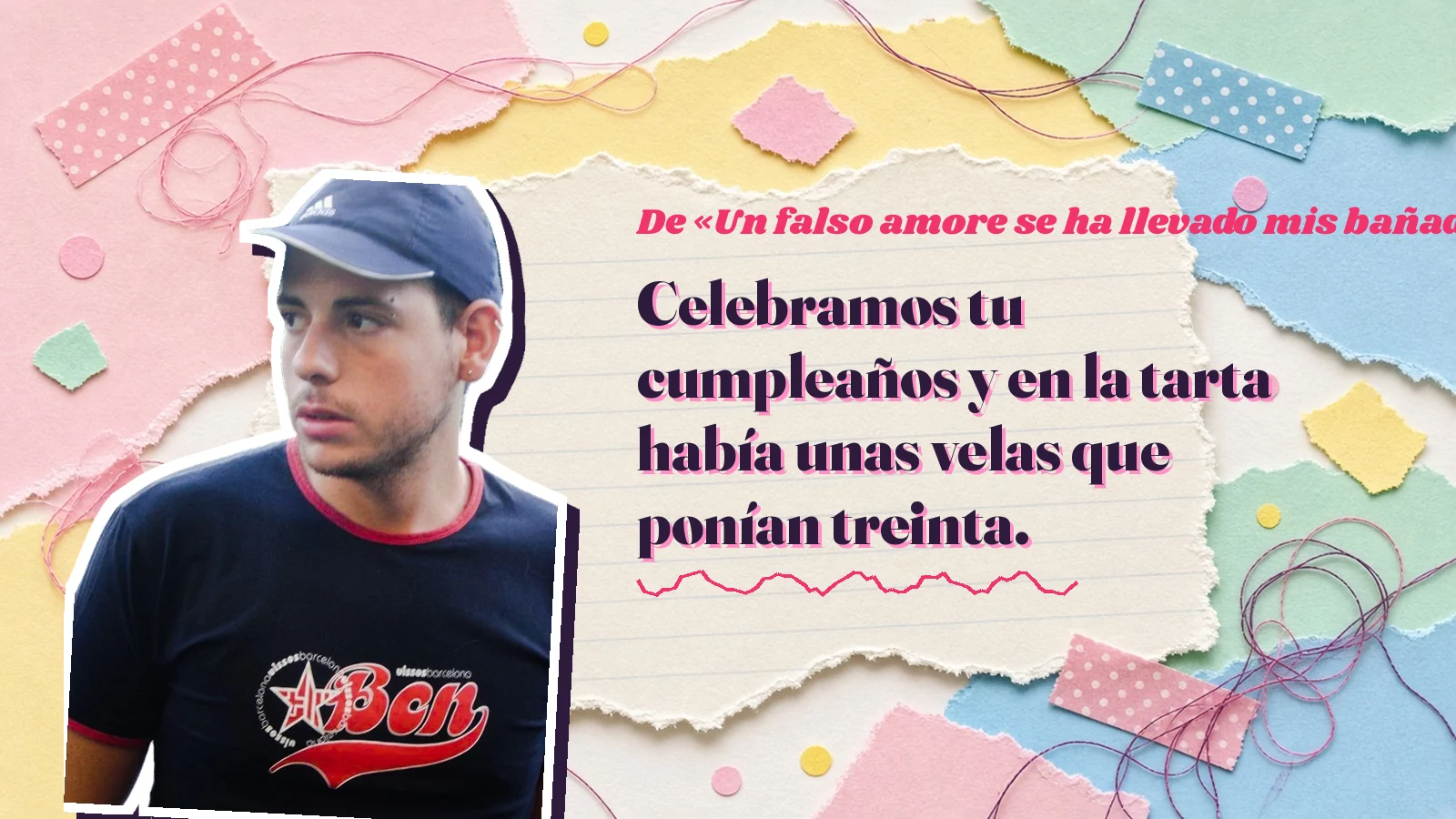
What happens next I'll paraphrase, since the lyric is there to read in full: in the selfie he came out very handsome, he'd gone to the trouble of cropping out his mother, who was standing next to him, and as if that weren't enough he added a black-and-white effect.
Three moves. Take the photo. Remove the mother. Apply the filter.
Each one has plenty to chew on, so let's go step by step, like a post-mortem on CSI.
The first, the photo, is normal. We all take photos. Even people who are suffering. What isn't so normal is that, in the middle of a week of tears, the photo catches you looking gorgeous, with eyes that should be puffed up like two petrol-station croissants and that show no sign of it in the selfie. There's already a little contradiction there, the kind the person writing the lyric jots down in their mental notebook with an asterisk.
The second move is the one that drives me wild. Cropping out the mother. Think about it for a second. There was a photo with his mother. A family photo, with the lady herself beside him. And to post it, so the world could see what an awful time he was having, the mother was surplus. She didn't fit the character. A mother beside you makes you a son; without her you're a melancholy man staring into the abyss. So out she goes. Snip. Two fingers and the mother is off to the limbo of cropped photos, along with the exes and the brothers-in-law.
There's something about that cropped mother that makes me laugh enormously and feel a little sad at the same time. She knows nothing about it. She put her good earrings on for the photo.
And the third move, the black-and-white filter, is the finishing touch. Black and white is social media's mourning dress. Post a photo in colour and it's a photo. Post it in black and white and it's a statement. It means: "I'm thinking deep thoughts", "life has knocked me down", "don't talk to me, I'm in my Bergman era". It's the filter of the Instagram poets and the Paulo Coelho quote accounts.
Shop-window grief
What the lyric captures with that photo is something with a name in plenty of places, though I'd rather not label it in textbook language: shop-window grief. Suffering staged to be seen. Sorrow as content.
I'm not saying people who post sad photos after a break-up are fake. Far from it. Everyone lets it out however they can, and if hanging up a photo with a grey filter and a Rosalía track behind it brings someone relief, go ahead. The problem, in this song, is the sum. The gorgeous photo, the cropped mother, the filter, and the context: they'd split up a week earlier and he claimed to be in pieces. When all the pieces come together, the shop window shows itself for what it is: a shop window.
And what's in the window isn't the sorrow. It's him.
Think of a real shop window, one on Calle Preciados, Madrid's high street, during the sales. Mannequins posed with great care, a flattering light, a sign saying "up to 70% off". Everything is designed for you to see from outside, two metres away, in a hurry. Go into the shop and it's another story: your size isn't there, the mannequin's shirt is held together with pins at the back and the shop assistant has the face of someone who's been on her feet for nine hours. The window is the edited version. The shop is the truth.
The black-and-white selfie is the break-up's shop window. The lyric is the inside of the shop, pins and all.
There's a post on the blog called a little comic typology of exes, and if I had to add an entry, it would be this one: the shop-window ex. The one who suffers in public, looks handsome while suffering and crops out whoever needs cropping so the composition stays clean. You'd spot him on any terrace on Calle Fuencarral: sunglasses in November and a faraway gaze fixed on the Metro entrance.
What doesn't make it into the photo
The lovely thing about a cropped photo is that whatever's cropped doesn't disappear. It's still there. Just outside the frame.
And from then on, the lyric devotes itself to exactly that: telling what doesn't make it into the photo. The designer swimwear he's taken to show off at the beach. The empty drawer. The candles on the cake. The blue eyes. The supposed nationality. Everything the black-and-white selfie leaves out, the song puts back into the picture, like someone turning the scissors round and sticky-taping back the bits that had been removed.
I like to think of the song that way: as a restored selfie. He cropped out his mother to appear alone and handsome. The lyric hands him back his mother, the swimwear, the cake, the contact lenses, the half-Italian passport and every one of his so-called best friends. The full photo. In glorious colour.
That, deep down, is what a good many of my ex lyrics do: restore the photo the other person had cropped. I go into it in another post on the blog, the one about why I laugh at my exes. I laugh because laughing lets me look at the whole photo without looking away.
Crying as an alibi
Back to the start, to the eyes in a terrible state. Because there's something the lyric does very well that you only notice on a second reading: it doesn't deny that he cried. It doesn't say "liar, you didn't cry". It says that if you were having such an awful time and your eyes were in such a state, what a coincidence that you looked so handsome in the photo.

It's a very Spanish way of catching someone out. You don't accuse them head-on. You set two facts side by side and let the audience do the maths. Like on the celebrity gossip shows when the pundit says "I'm not saying anything, but she was in Marbella and he was in Marbella too". I'm saying nothing. I'm saying everything.
The crying, in this story, works as an alibi. It's what he tells people so he comes out of the break-up as the victim: I suffered too, I cried too. And the photo is the evidence that turns against him. Because someone really crying isn't in the mood for cropping. Someone really crying turns up in photos with a red nose and hair like a scouring pad, if they turn up at all.
One thing tickles me: any ordinary mortal needs fourteen attempts to look good in a selfie, the light from the kitchen window, no garlic for lunch, an arm stretched out like an orangutan's and the double chin tucked away. He managed it in the middle of a week of tears. Quite a talent.
The photo as false evidence
There's a song in the trilogy called «Gaslighting», and although it has nothing to do with swimwear, it shares an underlying idea with this one: the other person rewrites your story. They tell you things didn't happen the way you lived them.
The black-and-white selfie is a small version of that. It's a photo that tells a different story of the break-up: the shattered man, alone, profound, in his grey period. If you hadn't been there, you'd believe it. His followers believe it. They give him hearts, they write "chin up, gorgeous", they send hugs. And you, who know what happened in that flat, watch the photo's version beat yours on likes.
That's the rage that fuels the song. Not just over the swimwear. Over watching someone else tell your story, and tell it with better lighting.
That's why the lyric is in prose, with every detail. So there's a version with facts against the version with a filter. It's the counter-photo.
Prose in a song
That brings me to a point of craft. This lyric opens in prose, with long sentences that don't rhyme, full of commas, like a five-minute audio message typed out. That's not usual in a song. The usual thing is the short line, the rhyme, the chorus arriving early.
Writing it this way has a cost: the lyric weighs more, it's harder to follow, and anyone expecting a summer anthem will be lost by the second comma. But it has an advantage that was essential for this story: prose is the language of evidence. Police reports are written in prose. So are expert witness statements. And the bar conversations where you tear an ex to shreds, with their "for a start" and their "what's more", are spoken in prose too.
The verse comes later, in the chorus, when there's nothing left to prove and only the insult remains. First the prose that proves. Then the verse that passes sentence. It's the order of a trial.
The candles that said thirty
There's another detail in the lyric that works like a second cropped photo, only with numbers:
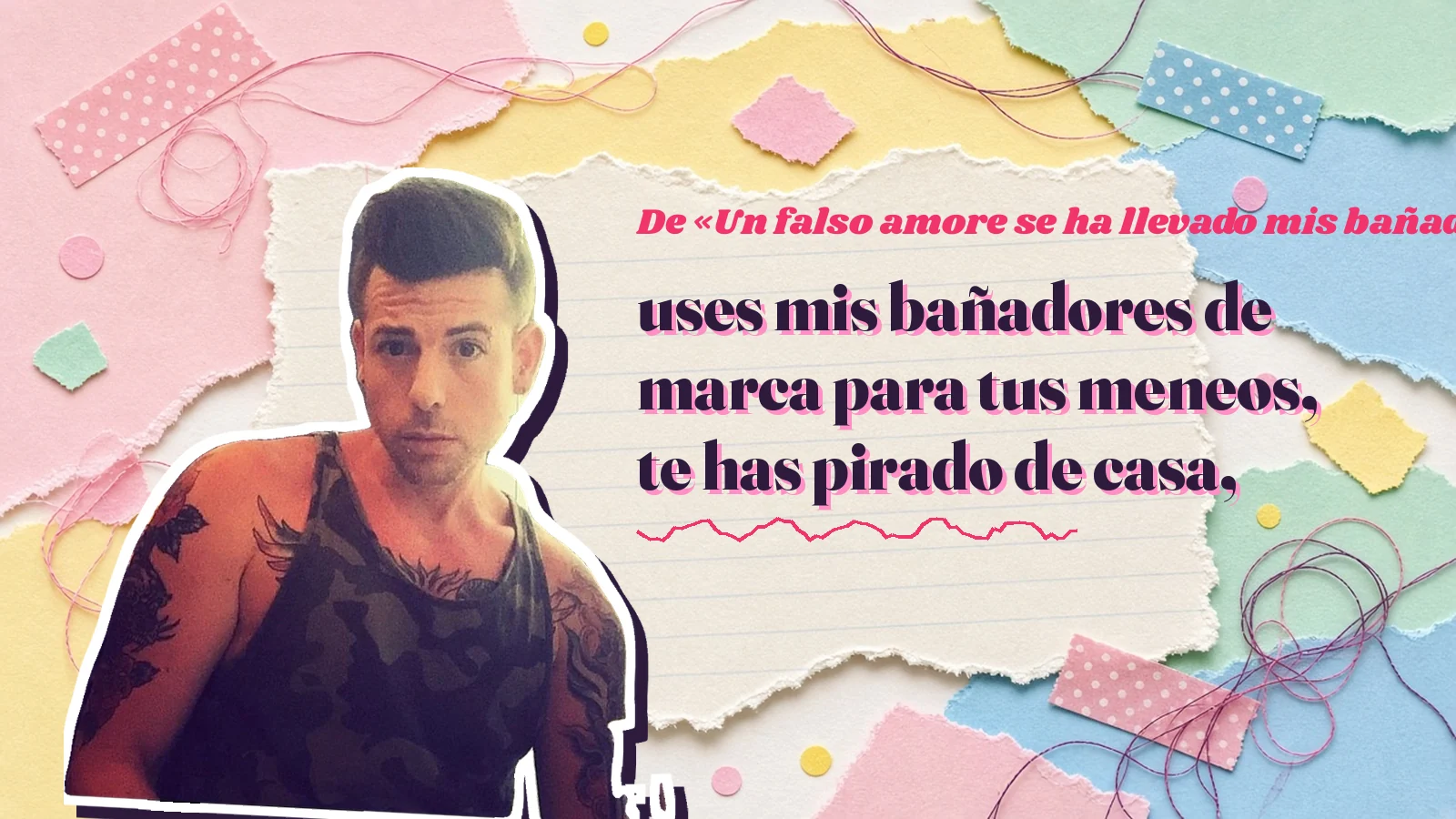
«Celebramos tu cumpleaños y en la tarta había unas velas que ponían treinta.» "We celebrated your birthday and the candles on the cake said thirty."
And then the gossip-show ojo al dato, "mark this", from afternoon telly: he was turning fifty.
It's the same as the cropped mother, but with age. Twenty years cropped in a single puff. It's the numerical version of the filter: I don't remove my mother from the photo, I remove two decades from the cake. And he does it in front of his so-called best friends, who were there too, eating cake under the lying candles, pretending not to notice.
That "so-called" for the friends makes me laugh. The lyric doesn't even trust the guests. Quite right.
Put the two scenes together, the cake and the selfie, and a pattern appears. These aren't big film-style lies. No forged inheritances, no double lives in Marbella. They're small lies, about image, about editing. Touch-ups. This is someone who lives editing himself the way you'd edit a TikTok video: cut this, trim that, up the brightness, knock off the years, add the filter.
There's a post on the blog about what TikTok and Shorts taught me about songs. There I talk about editing from the side of someone making songs. This lyric is about the dark side of the same tool: editing applied to your own life to fool the person next to you.
«Das asco», and it's the cleanest thing in the song
After all that detective prose comes the chorus, and the chorus edits nothing:
«Amore, Sinceramente das asco / Das asco, ¡y estoy harto!» "Amore, honestly, you're disgusting / You're disgusting, and I'm sick of it!"
I love the contrast. He filters everything: his photo, his age, his eyes, his origins. And the song answers with the least filtered sentence in the world. "You're disgusting." No frills, no cropping. It's a photo in saturated colour, with a direct flash, like the ones taken on disposable cameras at nineties weddings.
And that "honestly" is gold. Because in a song about someone who isn't honest even with the candles on his cake, the only person who says "honestly" is the one telling him he's disgusting. Honesty switches sides.
Then there's «amore», in Italian, a nod to his supposed nationality. A pet name turned into a mocking nickname. As if you said "darling" with a sneer. The affection stays, but the tone changes, and tone is everything.
My mother doesn't get cropped
Now I'll get a little serious, because underneath, the song asks for that too.
Cropping a mother out of a photo is a small gesture, almost a silly one. But it says a lot. It says that, for that person, the people around them are scenery. They can be taken out and put back depending on what suits the image. The mother today, the boyfriend tomorrow. If the mother is surplus in a photo meant to win sympathy, the boyfriend is surplus within a week, ready for a fresh start.
That's why the selfie is the song's first image. Because it's the smallest, clearest proof of what's coming. Someone who crops out his mother to look better won't think twice about taking your swimwear to look better on the beach.
This isn't a joke. It's a warning: watch how people treat whoever doesn't serve them in the photo.
And now back to the joke, because if I stay serious too long I start looking like a documentary on La 2, Spain's arts-and-nature channel.
The drawer and the frame
There's a parallel I didn't plan, but I see it now reading the whole lyric on the lyrics page: the selfie without the mother and the drawer without the swimwear are the same image.
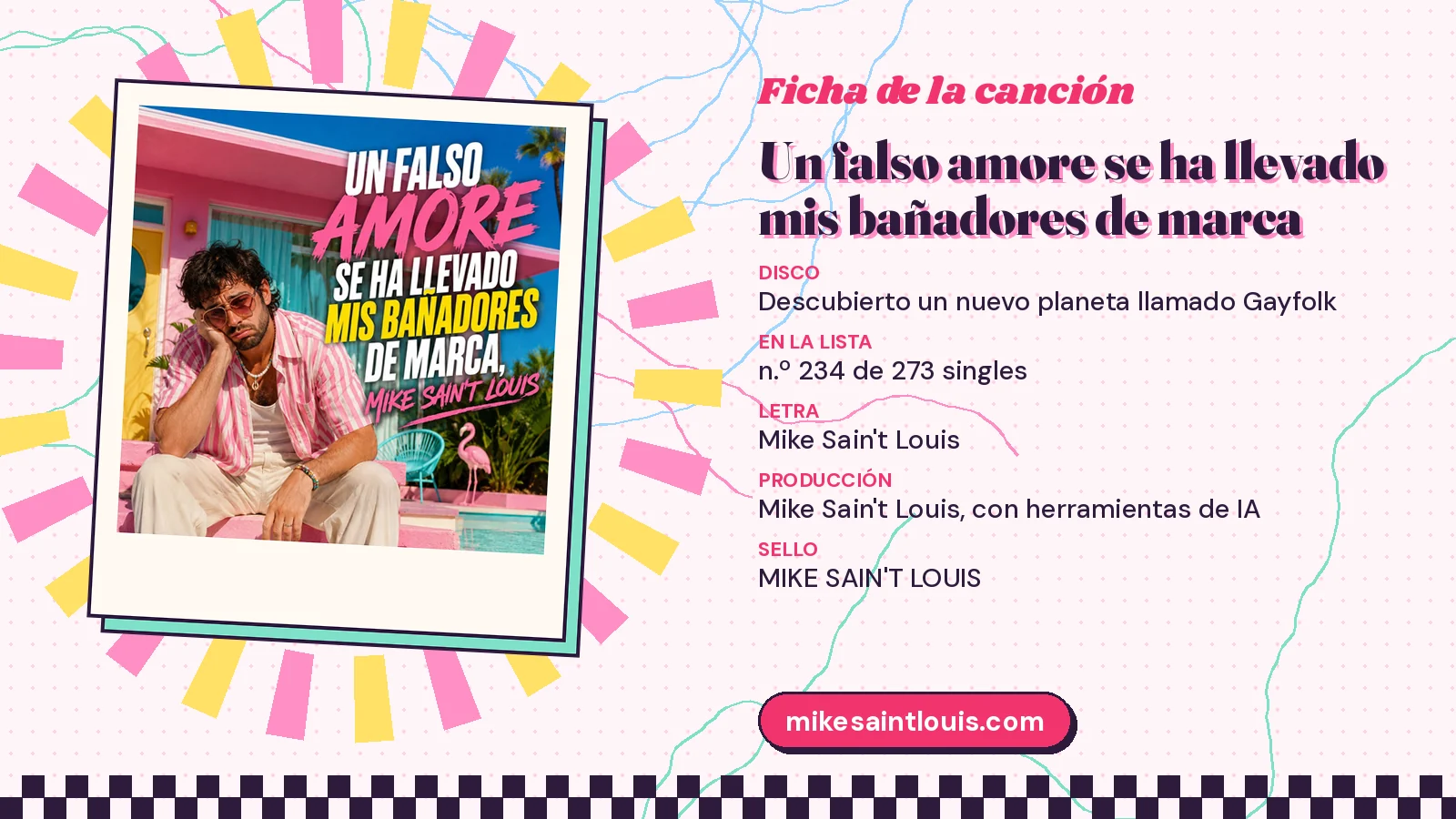
In both cases something is missing. The photo is missing the mother. The drawer is missing the swimwear. And in both cases, what's missing he has taken for his own glory. The mother he removed to look more tragic. The swimwear he took to look more tempting on the nudist beach and in the cruising zone. The gap he leaves behind is his signature.
Look closely and the song starts with a gap in a photo and carries on with a gap in a drawer. Some lyrics are organised by verses. This one is organised by gaps.
And another song in the trilogy is about the swimwear from the other side: «Si Don Aussiebum hablase», "If Mr Aussiebum could talk", which hands the floor to a pair of trunks. Put the two together and you get the break-up told by the owner and by the garment. A sort of underwear Rashomon.
Black and white as a stage set
One more thing about the filter, because I'm obsessed with it.
Black and white has a long and very dignified history in photography. Our grandparents' photos, old cinema, studio portraits from the fifties. It was all there was. And because it was all there was, it became linked to the serious, the eternal, the lasting. Today, when someone turns a selfie black and white, they're borrowing all that dignity. They're saying: "this photo matters, this photo is for posterity".
And the lyric takes that borrowed posterity and sets it next to stolen swimwear and fake birthday candles. It's the oldest trick in camp: put the solemn beside the tacky and let them ruin each other. The studio portrait next to the designer briefs. Eternal mourning next to cruising.
I don't know if it's the most refined thing I've written. I know I laughed when I saw it on the page.
The photo I'd post
To finish, I wonder what photo I'd post after a break-up, if I had to. Not a real one: an imagined one, just for fun.
I'd be with my mother. In colour. With the flash that gives you red eyes. With the fridge open behind us and a Mercadona supermarket bag on the counter. Not cropping anyone out. With a caption that said "one week" and nothing else.
And nobody would look at it, because unfiltered photos don't get shared. But it would be the whole photo.
That, in the end, is what the song does. It takes someone else's black-and-white selfie and puts it back in colour, with the mother, the swimwear, the cake, the contact lenses and the friends round the candles. And then, at full volume, it tells him the one thing no filter can hide.
You're disgusting, amore. Honestly.
Frequently asked questions
What is «Un falso amore se ha llevado mis bañadores de marca» about? An ex who, a week after the break-up, posts a gorgeous black-and-white selfie after cropping out his mother, runs off with the designer swimwear and turns out to have lied about his age and his origins. The song tells it with camp humour and an unfiltered chorus.
Who wrote the song? Mike Sain't Louis, a lyricist, composer and music producer from Madrid, the first AI songwriter. The lyrics are his own, written without artificial intelligence; the music and the performances are made with AI tools such as Suno.
Which album is it on? Descubierto un nuevo planeta llamado GAYFOLK, the first album of the GAYFOLK trilogy.
Where can I read the full lyrics? At gayfolkplanet.com/letras/un-falso-amore-se-ha-llevado-mis-banadores-de-marca. The song page is on mikesaintlouis.com.