By Mike Sain't Louis ·
Common and oh so necessary: the gay musical as self-portrait
The lights go down. A trumpet fanfare blares. A staircase lit with dressing-room bulbs descends. And at the top, with feathers on her head and sequins down to her eyelashes, appears someone who doesn't apologise for existing.
That's how I picture «En un musical gay» ("In a Gay Musical") every time. Not as a song, but as a number. The opening number of an old-school revue, the kind once staged on Barcelona's Paral·lel or in the theatres of Madrid's Gran Vía, when the vedette came down the staircase and the audience held its breath.
The song's own page already covers its rules and its ex. Here I want to talk about something else: how a theatrical genre, the gay musical, became a way for me to paint a self-portrait. And why the most important rule in the lyric isn't the one about the ex, but the one about fear.
House rules (of the other house)
The song is built like a rulebook. In a gay musical you must do this. In a gay musical you must be like that. In a gay musical you can't do the other. It's like the list of rules hanging at the municipal pool: no running, no diving, swimming caps compulsory.
I love rulebooks in songs, because they're a very serious kind of humour. Nobody takes a rulebook as a joke. And precisely because of that, when the rulebook says absurd things, the laugh is twice as big. I have my own house rules hanging on my About page, next to the cash register: here we release, the lyric rules, every song gets its image. Those are real rules, for working.
The ones in «En un musical gay» are something else. They're rules for living. Or for surviving on a stage, which comes to the same thing.
The revue, grandmother of the musical
Before the gay musical, in Spain, there was the revista, the revue. And the revue is the grandmother of all this, even if she doesn't like being told so.
The revue was that variety show with vedettes, feathers, staircases, dirty jokes and musical numbers that packed the theatres of Madrid and Barcelona for decades. Barcelona's Paral·lel, with El Molino. The theatres of Gran Vía and La Latina in Madrid. Vedettes like Lina Morgan, Norma Duval or Tania Doris, who came down the staircase with kilos of feathers on their backs and a smile that wouldn't budge even if a heel snapped.
On the surface, the revue was a show for straight men who went to see legs. But it had a secret audience. The ones who went for the feathers, not the legs. The ones who learned the numbers by heart and then performed them in their bedrooms with a towel on their head as a headdress. More than one Spanish queer learned what camp was in the stalls of a revue, before even knowing the word existed.
So when I write «En un musical gay», I'm not thinking of Broadway. I'm thinking of that. The revue staircase, the dirty joke with a double meaning, the vedette winking at the audience. It's a very home-grown heritage, very local, that needs no translation.
Six adjectives in "-aria"
There's a moment in the lyric that makes me smile every time I read it. It's when the rulebook stops talking about the ex and starts talking about me:
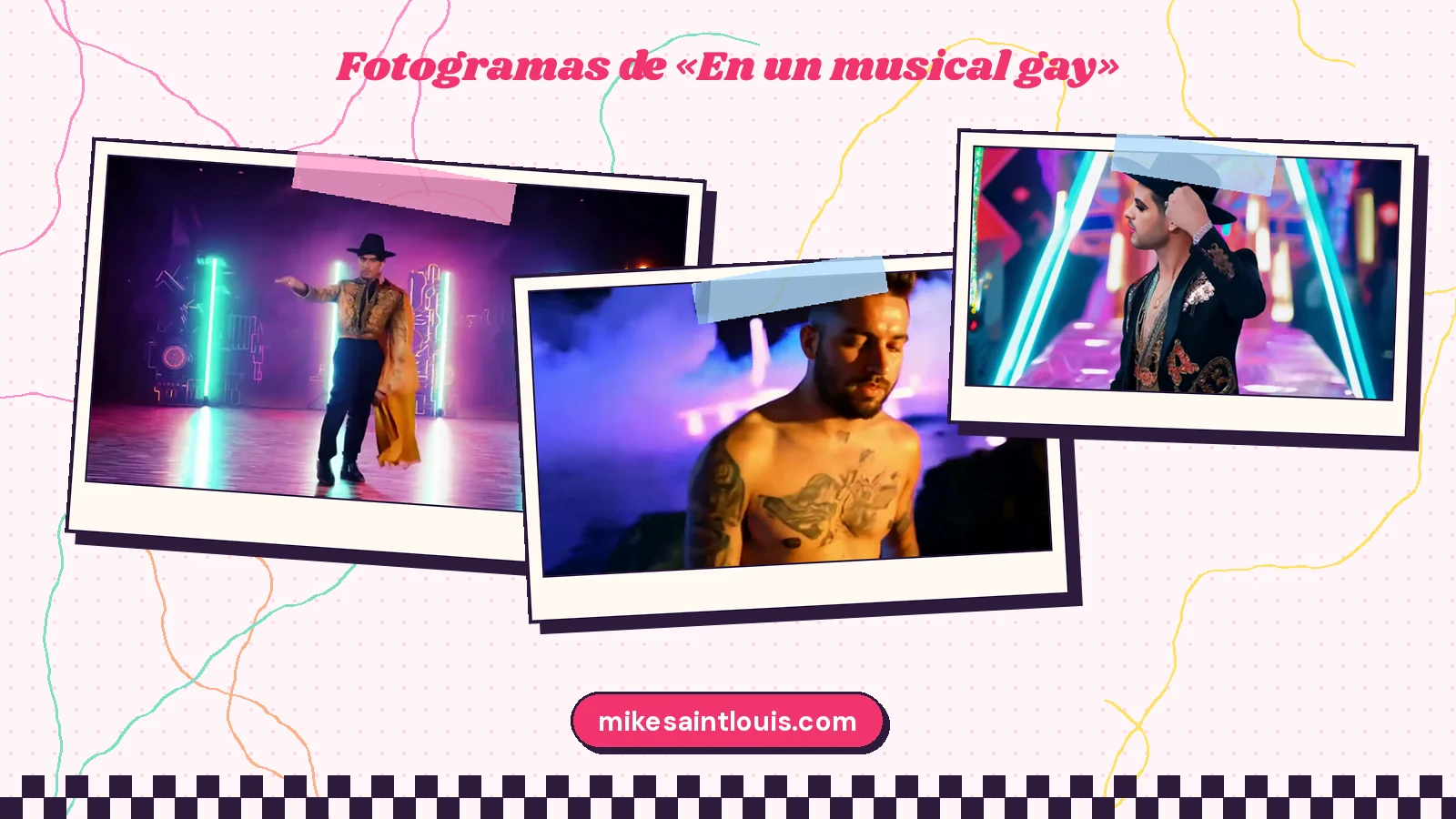
«En un musical Gay / también hay que ser como yo / bastante ordinaria, estrafalaria» ("In a gay musical / you've also got to be like me / pretty common, outlandish")
And it goes on: visionaria, revolucionaria, extraordinaria. Visionary, revolutionary, extraordinary. And, of course, muy necesaria. Oh so necessary.
Six adjectives. All feminine. All ending in "-aria". A ladder of words that climbs like the musical's staircase, step by step, to the last one, the one that matters.
Look at the order. It starts at the bottom: ordinaria. Common, vulgar, what they call you at school to put you down. "You're so common." Then estrafalaria, outlandish, what they say when you wear something that doesn't match. And from there the ladder climbs: visionary, revolutionary. And suddenly, the wordplay: extraordinaria. Which in Spanish is ordinaria with an "extra" in front. The same as the first step, but with sequins.
And at the top of the staircase: necessary.
That's the joke and the truth, all at once. What starts as an insult ends as a necessity. The ordinary becomes extraordinary without changing a letter, just by adding a prefix. Like when the village queen climbs onto a stage and, without changing anything about who she is, becomes the star.
The feminine as a gown
I've said it in other pieces, but I'll repeat it here because it matters for this song: among queers, the feminine is a language. When I say «hay que ser como yo, bastante ordinaria», putting myself in the feminine, there's no mistake. I slip into the feminine like a sequinned gown before going on stage.
In the street, for many years, the feminine was an insult. «Nenaza», «mariquita», "you talk like a girl". That's what they shouted from across the road. And what we did as a community was the same thing the song does with "ordinaria": take it, turn it inside out and wear it with pride. Call ourselves "she", «la loca», «la reina», «hija mía», with an ease that throws outsiders completely.
In a gay musical, that feminine is compulsory. You can't come down the lit staircase in neutral masculine. It doesn't work. The staircase demands feathers, and feathers demand the feminine.
You can't get scared
And now, the rule that for me matters most of all:
«En un musical Gay / no te puedes / asustar / porque entonces no lo vas / a / disfrutar» ("In a gay musical / you can't / get scared / because then you won't / be able / to enjoy it")
Look at how it's laid out in the published lyric. With the strangest breaks. «A», alone on a line. «Asustar», alone on another. As if the sentence were afraid to finish. As if it were tap-dancing, a step, a pause, another step.
The rule is simple and it's a whole philosophy: get scared and you miss out.
A gay musical is over the top. It's shameless. Crude at times and corny at others. It has men in six-inch heels, cock jokes, broken-heart songs with fan choreography and, at the end, a full-company number that leaves you in tears without knowing why. If you walk in afraid of all that, clutching your handbag with the face of someone who's wandered into the wrong bar, you won't enjoy a thing.
And the same goes for life, of course. For queer life in particular. If you're scared of who you are, of your flamboyance, of your desire, of what they'll say at home, you miss the show. You stay in the foyer, staring at the poster, not daring to go in.
This is the rule I wish I'd read at fifteen. Not the one about the ex. This one. Written large on the school gate, next to the noticeboard with the term grades and the posters for the end-of-year trip to PortAventura.
You've got to be a teeny bit filthy
The first rule, the one that opens the song, is this: in a gay musical you've got to be a teeny bit filthy.
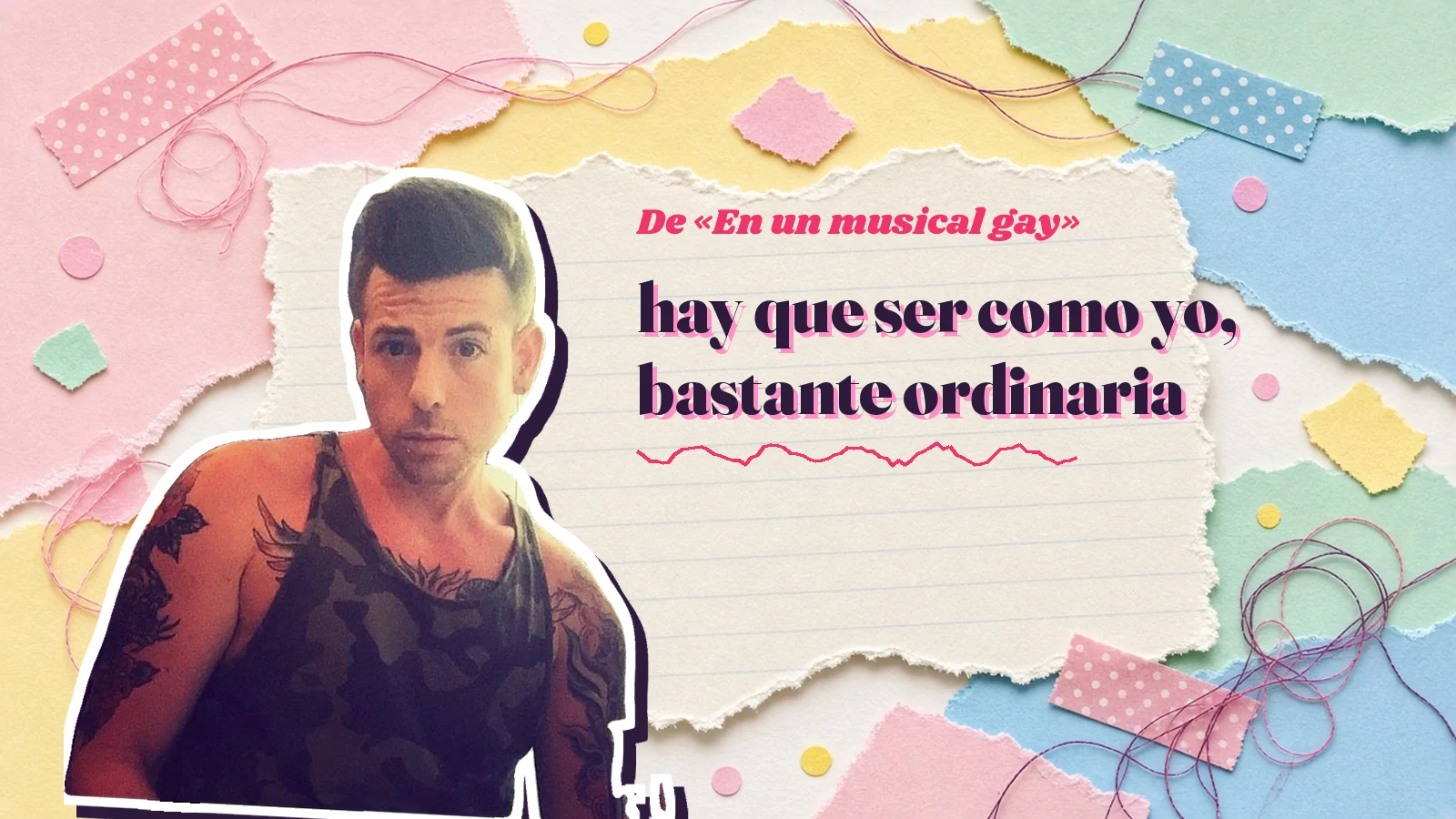
And honestly, it seems a very sensible rule. Because blue humour, double entendre, below-the-belt jokes, have always been part of the tradition. From the bawdy coplas belted out in taverns to revue numbers with titles you couldn't say on the radio, cheekiness has been the seasoning of every popular show in Spain.
A gay musical without a pinch of smut would be like a paella without socarrat, that crispy layer at the bottom of the pan. Edible, but sad. It would be missing its spark. Missing that moment when the audience looks at each other, covers their mouths and lets out a laugh they're not sure they should.
The key is in the "teeny bit". It doesn't say "very filthy". It says a teeny bit. A pinch. Just enough to tingle. Smut, like chilli, has to be measured out, or the dish turns into something else.
And the lyric, which is very clever when it wants to be, uses that rule to introduce the ex. Because the ex, as we'll see, wasn't a teeny bit filthy. He was filthy through and through. And therein lies the difference between the one who performs a number and the one who becomes the joke.
The ex, on stage
And then there's the ex, who turns up because he always turns up. It's my fate.
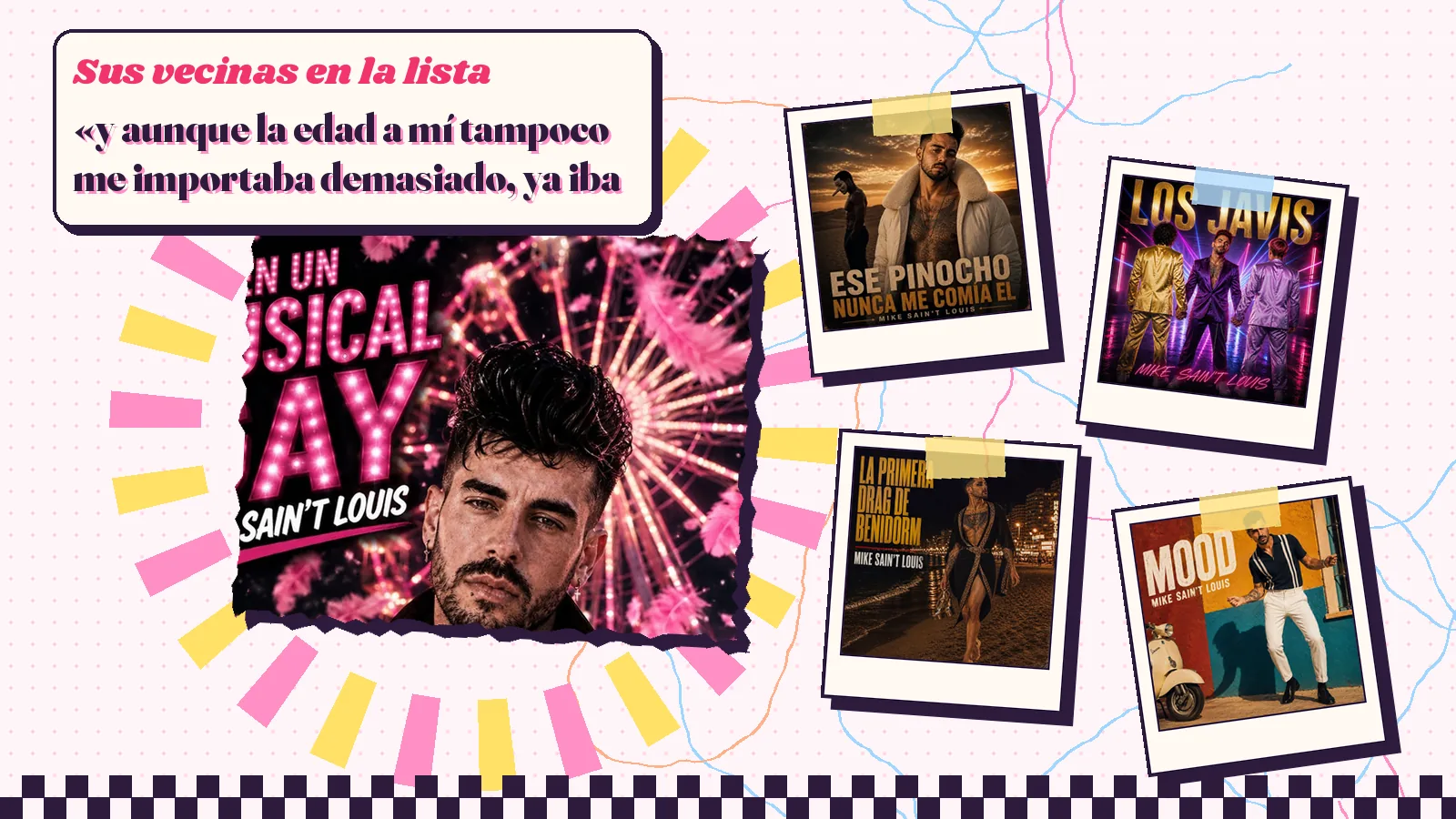
The musical's first rule is that you've got to be a teeny bit filthy. And to illustrate it, the lyric brings on stage the boyfriend from El Médano, a character already familiar to anyone who's heard other songs from the planet, like «Ese Pinocho nunca me comía el chocho», which is practically its sequel.
I won't dwell on him; he's had more than enough of the spotlight in my catalogue. I just want to say one thing about where he appears. He appears in a musical. And that changes everything.
Because in a musical the villain isn't frightening. A musical's villain has his number, his song, his choreography, and the audience laughs at him. He's Ursula in The Little Mermaid, the stepmother with her mirror, the caped baddie who trips on the stairs. Putting an ex in a musical turns him into a comic character. It's giving him a bowler hat and a cane and making him tap-dance while the chorus of ex-boyfriends points at him.
There's a moment near the end of the lyric when all his exes agree on something and issue a warning: watch out for that one. And I picture that moment as one of the big ensemble numbers: ten queens in a line, in feather boas, shouting in unison "watch out for that one!" as he tiptoes across the stage. If that isn't poetic justice, I want my ticket money back.
A tradition of sequins
I didn't invent the musical as a queer space. It goes back a long way.
There's a huge tradition of musicals that were, for decades, the place where we queers saw ourselves reflected when we saw ourselves nowhere else. Cabaret, with its Emcee painted like a doll. La Cage aux Folles, with its two older gentlemen and their son who wants to marry a conservative's daughter. Priscilla, Queen of the Desert, with its pink bus across the Australian outback. And here in Spain, La llamada, by Los Javis, which was born in a tiny theatre and ended up on the big screen.
By the way, I have a song called «Los Javis». Say no more.
All those musicals have something in common: they turn what's shameful outside into a spectacle inside. What cost you a beating in the street earned you an ovation on stage. And for a kid growing up without role models, that's gold. It's proof that somewhere exists where being "too much" isn't a problem but the price of admission.
I go into this more in from being laughed at to laughing on our own terms, where I describe how we went from being other people's joke to telling the joke ourselves.
From the joke to the dressing room
Now, a moment of silence. The kind musicals have just before the final number, when the lights go down and a single spotlight falls on one person alone.
Behind all the feathers there's something that isn't funny. A lot of people in my community have spent their lives being told they were too much. Too loud, too effeminate, too over the top, too intense. Too much. And that "too much" ends up inside you, like a stone in your shoe, making you shrink, speak softer, dress in grey so as not to draw attention.
The song says the opposite. It says: be common, be outlandish, be whatever you damn well please. Because you're necessary.
Deep, in the strict sense, it isn't. It's a revue number with a filthy ex. But that word at the end, "necessary", I wrote in earnest.
Feathers and a Ferris wheel
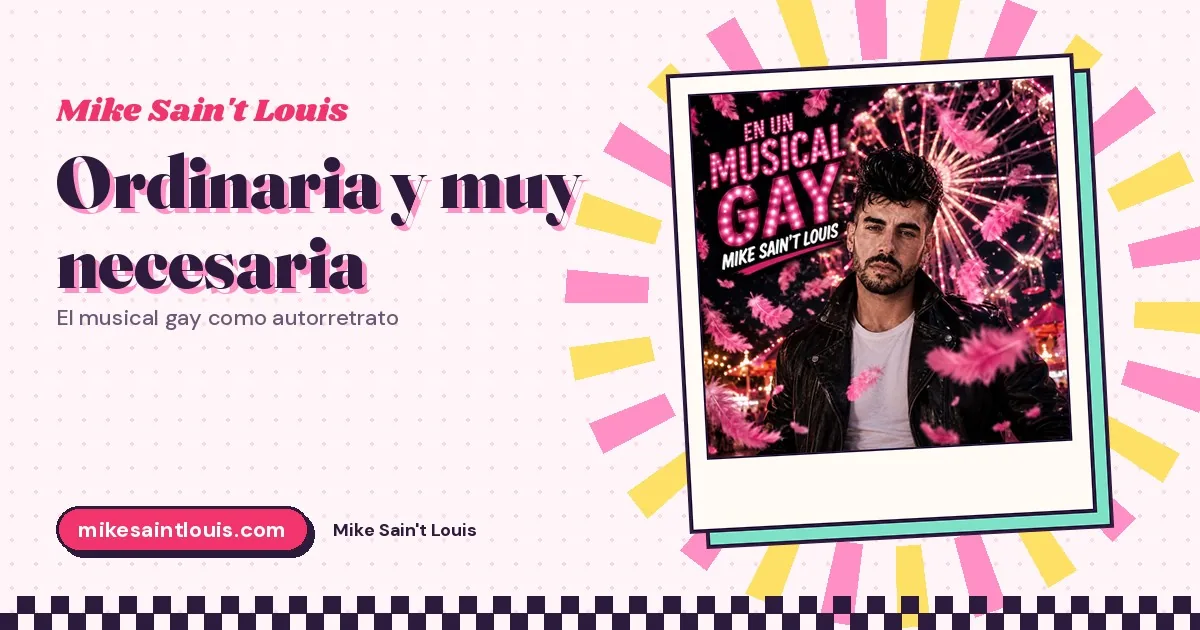
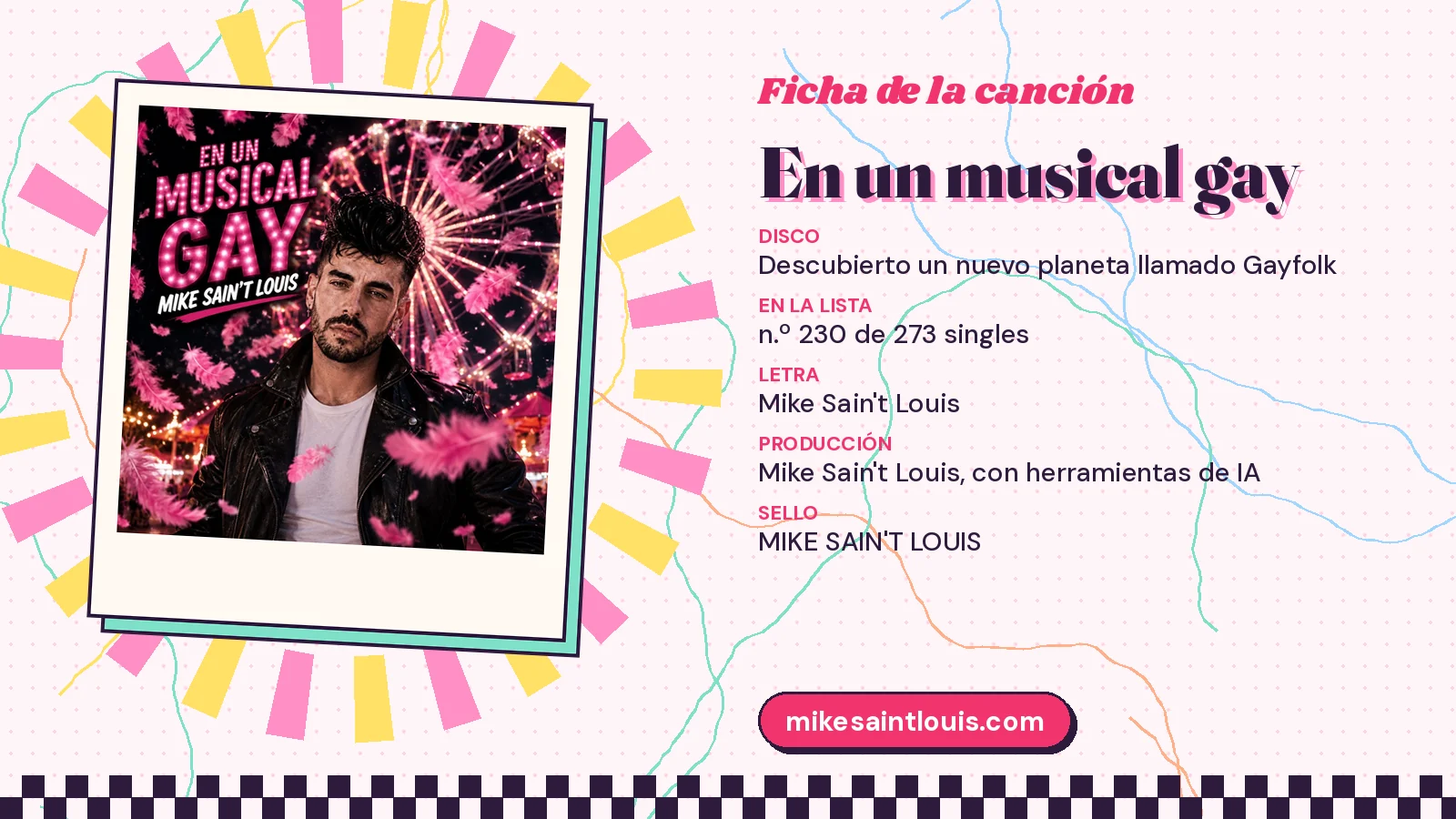
The cover blends two worlds that to me are one and the same. A guy in a black leather jacket, white T-shirt and beard, staring into the camera very seriously, while pink feathers fly around him as if someone had just shaken out a vedette's boa. Behind him, at night, a lit-up Ferris wheel and fairground lights. And at the top, in pink theatre-marquee letters, the kind ringed with bulbs, EN UN MUSICAL GAY.
The fair and the theatre. The Ferris wheel and the staircase. To me they're the same thing: places where excess is normal, where the lights shine brighter than they should and where everyone goes to have a good time without asking too many questions. I like that the guy on the cover isn't wearing feathers. The feathers are in the air, around him, as if they were contagious. As if just being near the musical were enough for a few to stick.
And his serious face, amid all those feathers, is the best joke in the picture. It's the face of someone who came to the fair against his will and is about to give in.
The village drag queen
I can't talk about gay musicals without talking about drag, because they're first cousins. And in my catalogue there's a recurring figure: the first drag queen. The one who dared before anyone else, when daring was still a scandal.
She has her own song in my catalogue, with a title that leaves no doubt, «La primera drag de Benidorm» ("Benidorm's First Drag Queen"), and an entire piece on drag as a party, not a disguise. What I argue there is that drag doesn't hide behind make-up. It reveals. The make-up isn't a mask: it's a megaphone.
«En un musical gay» is, in a way, the number that drag queen would perform on her first night, lip-syncing with her heart racing. Legs trembling and wig slightly askew. And with one rule in her head: you can't get scared.
A lyric with stage directions
If you read the published lyric, you'll see it's broken up in a very odd way. There are one-word lines. «Marrano», alone. «Asustar», alone. «A», alone. «Como», alone. And then, suddenly, a long line that tells everything in one go.
It's not a formatting error. Or if it is, it's one I'm very fond of. Because it turns the lyric into something like a theatre script. Every break is a pause. A drum hit. A moment when the vedette stops, looks at the audience and waits for the laugh before carrying on.
In theatre, those are called stage directions: the instructions the author writes in brackets to tell the actor what to do. "Pause." "Looks at audience." "Drops a feather." The lyric of «En un musical gay» hides its stage directions in the line breaks. Read it aloud, respecting the breaks, and the performance comes out on its own, with its silences and its punchlines.
It's a way of writing I don't always use, but here it made perfect sense. A musical is written to be performed. And a musical's lyric has to bring the stage with it.
Between «Mood» and «Chihuahua»
In the full gayfolkplanet.com catalogue, «En un musical gay» is track 230 of 273, on the first album of the trilogy, Descubierto un nuevo planeta llamado GAYFOLK (A New Planet Called GAYFOLK Discovered).
Its neighbours are about as coherent as anything I've got. Right before it comes «Mood», the getting-ready-to-go-out song, with its list of English words and its outfit. Right after comes «Chihuahua», which is, among other things, about the campest creature in the animal kingdom: tiny, trembling, bad-tempered and always ready to go out in a designer handbag.
Mood, musical, chihuahua. If I were asked to sum up my life in three songs in a row, I couldn't think of a better order. I get ready, I go on stage and I come home to my dogs.
What I bring
The lyrics are mine. The six adjectives, the "-aria" staircase, the feminine, the odd line breaks that make the sentence hop, the ex on stage. The music and vocals of Planeta Gayfolk are made with artificial intelligence tools such as Suno, and I always say so.
What I love about working this way is that it lets me stage the musical I could never afford. I have no orchestra. No theatre on Gran Vía. No chorus line or lit staircase. But I have the lyric, the idea and the cover. And with that, everyone who listens builds their own theatre in their head, with all the feathers they like.
A rule for the way out
If you're heading out tonight, or out of a relationship, or out of the closet, or out of anywhere else that's hard to leave, take just one rule from this song. Not the one about the ex. Not the one about being filthy. The other one.
You can't get scared.
Because if you get scared, you won't enjoy it. And you deserve to enjoy it. With feathers or without. Coming down the staircase or tripping on the last step.
Because tripping on the staircase, in a gay musical, is part of the number too.
And if you really do trip, if you land on your backside in front of the entire stalls, do what the greats do: get up, straighten your wig, look at the audience and say "that was in the script". Nobody will believe you. But everyone will applaud. And that, in the end, is what the show is all about.
Frequently asked questions
What is «En un musical gay» about? It's a song built like the rulebook of a gay musical: you've got to be a teeny bit filthy, you've got to be «ordinaria, estrafalaria, visionaria, revolucionaria, extraordinaria y muy necesaria» (common, outlandish, visionary, revolutionary, extraordinary and oh so necessary), and you can't get scared. The ex from El Médano crosses the stage too.
Why is it written in the feminine? Because among queers, the feminine is a language of its own, an intimate one. In the song it works like a stage gown: what was an insult outside becomes pride inside the musical.
Which album is it on? On Descubierto un nuevo planeta llamado GAYFOLK, the first album of the GAYFOLK trilogy. In the gayfolkplanet.com catalogue it's track 230 of 273, between «Mood» and «Chihuahua».
Who wrote it? The lyrics are by Mike Sain't Louis. The music and vocals were made with artificial intelligence tools, and the single is released on the MIKE SAIN'T LOUIS label.