
By Mike Sain't Louis ·
«Me prometiste» and «he estado esperando»: the past tenses in my lyrics
Two pasts that have nothing in common fit into one of my songs.
The first appears in the question that opens «El concierto de Ismael Serrano», from the album «Ojalá se pudiera viajar a Gayfolk»: «¿Por qué me prometiste acompañarme al concierto de Ismael Serrano?», why did you promise to come with me to the Ismael Serrano concert? Me prometiste. A finished action, with its date, with its exact moment. Someone said they'd come, and that was that.
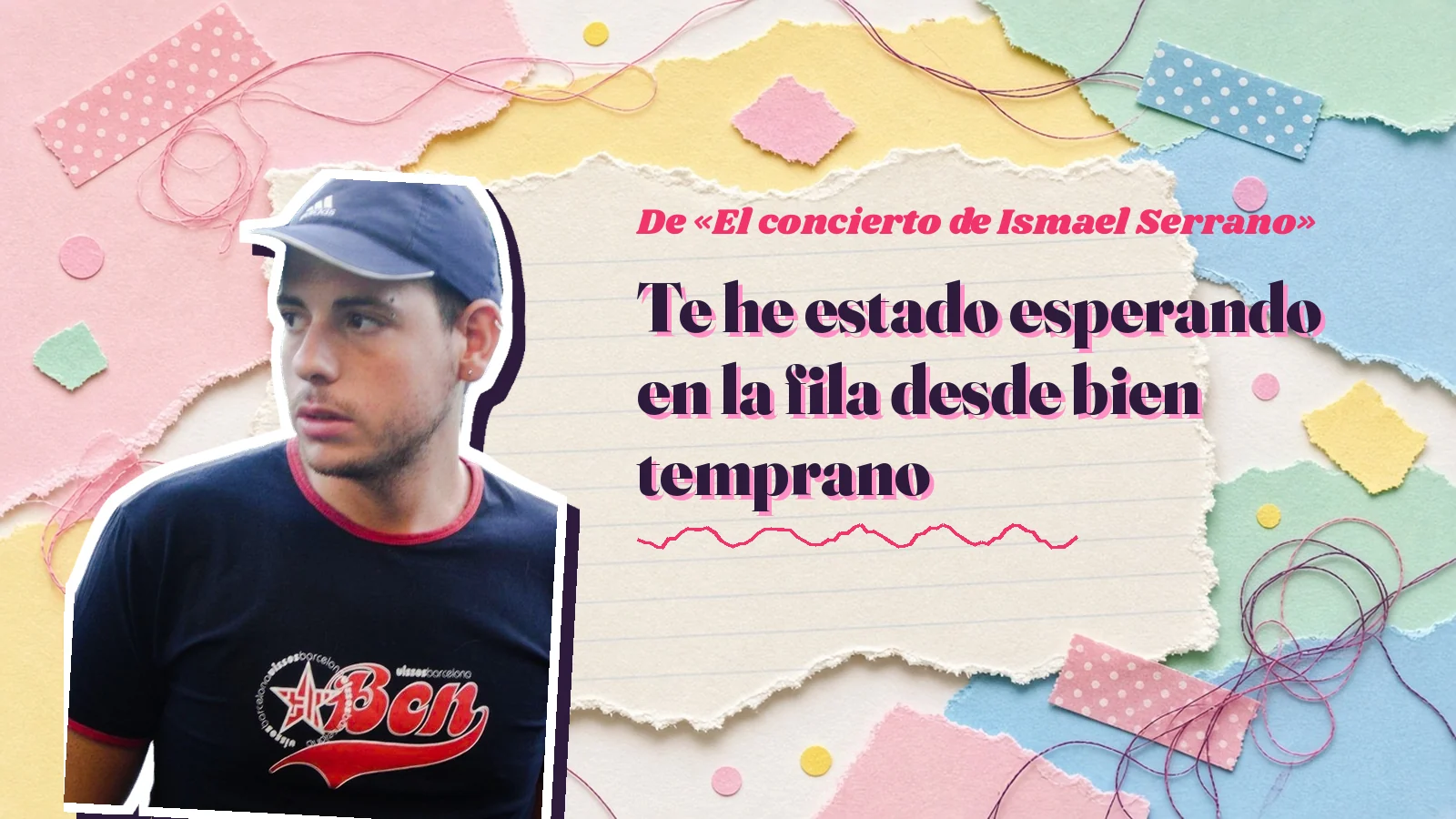
The second comes right after: «Te he estado esperando en la fila desde bien temprano», I've been waiting for you in the queue since early this morning. He estado esperando. This is no longer a dot on the calendar. It's a line that starts in the morning and runs right up to now, to the moment I'm speaking. And the punchline uses the same tense: «Y he acabado solo escuchando Caperucita», and I've ended up alone listening to «Caperucita». (The full lyric is on gayfolkplanet.com.)
When I wrote that song I wasn't thinking about grammar. I was thinking about the queue, the cold of waiting, the spare ticket. But rereading it I realised the sadness of the lyric lives in that jump between two tenses. The promise is closed, filed away in the preterite. The waiting is still open, stuck to the present. The one who promised has already moved on; the one who waited hasn't.
This piece is about that: how my lyrics use the past tenses, what each one says without saying it, and why some pasts stay still while others never quite leave.
Two pasts in one queue: prometiste versus he estado
In Spanish we have at least four ways of talking about what already happened in the indicative mood. The 2009 Academy grammar calls them the simple perfect preterite (prometí), the compound perfect preterite (he prometido), the imperfect (prometía) and the pluperfect (había prometido). At school I was taught other names, indefinido for the first and plain perfecto for the second, and those are the ones that stuck.
The difference between the first two is the one that gives a lyric the most to play with. The preterite looks at the past from outside, like a developed photo. The present perfect looks at it from inside, as something that still has consequences. If I say me prometiste, I'm talking about a specific day. If I say me has prometido, I'm suggesting that promise is still alive, that you still owe it to me.
In the song, the person who misses the date lives in the preterite and I live in the present perfect. I didn't plan that asymmetry, but it explains the feeling of being stood up very well. The other person remembers the promise as something they said once. I remember it as a queue I'm still standing in.
I find it funny that a single verb ending changes who gets the blame. Prometiste is a fact. He estado esperando is a complaint. And a heartbreak song needs both: the fact nobody can argue with and the complaint you hear over the beat.
Madrid's hoy he and the Canaries' hoy fui
Here's a curiosity I love, and it has to do with where I grew up. In Madrid, and in much of central and eastern Spain, the present perfect is used for everything that happened today. Hoy he ido al médico, I've been to the doctor today. Esta mañana he desayunado tarde. Yesterday, on the other hand, fui al médico. The border is the day.

In the Canary Islands, Galicia, Asturias, part of León and almost all of Latin America it works differently. There it's normal to say hoy fui al médico, with the preterite, even if it was an hour ago. The compound form is kept for things that really are still open, or hardly used at all.
Neither form is more correct. They're different norms of the same language, and the grammar records both. But I write from Madrid, so the compound form comes out without thinking whenever something is recent. «Y he acabado solo escuchando Caperucita» is a very Madrid sentence: I wrote it as if the queue had been that same afternoon, as if I'd just got home with the unused ticket in my pocket.
If a songwriter from the Canaries had written the same scene, they'd probably have put y acabé solo. And the song would feel a little further away, more narrated. That small difference in tense is also a difference in emotional distance.
What's still open: the present perfect as a wound
Rereading my lyrics, I've found the present perfect in almost every moment where something isn't closed. In «Me mola Zeus» the two tenses live side by side: «Me dijiste que odiabas el drama», you told me you hated drama, in the preterite, and the rest of the story, which falls apart in front of the listener. In «No te vuelvo a mirar más» there's «Me dijiste que un día me iba a arrepentir», you told me one day I'd regret it, and once again the other person's words are locked in a round, finished past.
What happens to me, on the other hand, usually goes in the compound form. I've thought, I've lost, I've ended up. As if the «I» of the songs didn't yet have the distance needed to turn his own experience into a memory.
I think there's a simple explanation. What other people said is already written down; it's a fact. What has happened to me is still happening inside. It's no accident that grammar books talk about current relevance to describe the present perfect. It's the tense of things that still weigh on you.
There's an even more present-bound form, the one in the concert song: he estado esperando. The present perfect continuous. It doesn't just say the waiting happened; it says it lasted, dragged on, got heavy. If the lyric said te he esperado, it would be a dry sentence. Te he estado esperando has a queue, a clock, tired feet.
Éramos la pareja del año: the imperfect of nostalgia
The imperfect is a different beast. It doesn't tell actions, it describes settings. It's the tense of the background, of the habitual, of what kept happening without anyone counting. That's why fairy tales start with it: érase una vez, había una vez, once upon a time there was.
In my lyrics the imperfect almost always shows up to talk about a relationship that no longer exists. In «Mi novio de Albacete» there's «Éramos la pareja gay del año», we were the gay couple of the year, a sentence that holds a whole era in one verb. It doesn't say when it started or when it ended. It says that for a while that was how things were, the normal landscape.
In «El panda del acoso sexual» the imperfect does the opposite, it takes an image apart: «Tú y yo, ni comíamos juntos», you and I didn't even eat together. Here the tense describes a habit that wasn't a couple's habit, a flatmates' kind of living together. The imperfect, usually warm, turns cold.
I really like what this tense does to memory. By saying éramos I turn something very specific, with good days and bad, into a uniform postcard. That's why nostalgia adores it. And that's also why you should distrust it a little, because it erases the details that don't fit.
Pensaba que era parte del pasado: the imperfect that gets it wrong
There's one use of the imperfect that, for me, is the most painful of all. It's the belief that turned out to be wrong. In «Karma» I wrote it like this: «Pensaba que eso era parte del pasado», I thought that was part of the past, and the next line completes it, «y ya estaba superado», and I'd got over it.
Pensaba. Era. Estaba. Three imperfects in a row to describe a state of mind that collapses. What the sentence really tells you is that it wasn't part of the past, that it wasn't over. The imperfect works here like a trap: it describes a certainty the rest of the song contradicts.
Something similar happens in «Envejecer»: «Estaba tan seguro que juntos íbamos a envejecer», I was so sure we were going to grow old together. The imperfect estaba and the future-in-the-past of íbamos a envejecer. It's a future imagined from the past that never arrived. Grammar sometimes calls it the future of the past, and it's one of the saddest forms I know, because it contains a plan we already know failed.
The beautiful part, if you can call it that, is that the listener understands the ending from the tense alone. Nobody needs me to explain that the couple didn't grow old together. It's in the estaba tan seguro. When someone tells you how sure they were, it's because they aren't anymore.
Había: the past before the past
The pluperfect has a horrible name, from the Latin plus quam perfectum, more than perfect, and a very specific job: it places something before another moment that's already past. When I arrived, he had already left. First he left; then I arrived; and I'm telling it from today.
It doesn't appear that much in my lyrics, but when it does it usually marks a surprise. In «Ese Pinocho nunca me comía el chocho» there's a «Te habías pensado», you had thought, that puts the other person inside a mistake that predates the scene. In «Croquetas en el crucero» the había works as set dressing, describing what was already on the buffet when we got there.
It's a very noir tense. It's for reconstructing, for putting the pieces in order after everything has happened. And in a breakup that's exactly what you do for weeks: go back over what had already happened before anyone noticed, look for the moment when something had broken without anyone saying so.
That's why I think the pluperfect is the tense of the amateur detective we all carry inside after a disappointment. It doesn't ask what happened. It asks what had already happened.
There's also an almost forgotten relative, the past anterior: apenas hubo llegado, cuando hubo terminado, no sooner had he arrived. Today it only survives in very polished writing or in parodies of old-fashioned language. I've never used it in a lyric, and I think that's right. It's a tense that needs a calm narrator, someone telling the story from far away, and my songs hardly ever have that calm.
Antepresente and copretérito: Bello's names
There's a way of naming these tenses that I find much prettier than the Academy's, and it's Andrés Bello's. In his 1847 grammar, written for speakers in the Americas, the Venezuelan scholar gave them names that explain how they relate to each other.
He called the preterite simply pretérito. The present perfect, antepresente, because it's a past that looks toward the present. The imperfect, copretérito, because it's the tense that accompanies another past action, the one that paints the background while the important thing happens. The pluperfect, antecopretérito, the past before the background.
I love copretérito. It explains very well why the imperfect is the tense of scenery. In «Te vi varias veces en Chueca», I saw you several times in Chueca, a line from «La dieta del cucurucho», the verb is in the preterite because they're specific sightings. If I wanted to paint the atmosphere of those nights, I'd need a copretérito: there were always people in Chueca, the music was loud, you were at the bar.
And antepresente fits the concert song like a glove. He estado esperando isn't just any past; it's a past that comes up to the present and sits down next to me.
Past and present in the same sentence
There's something I do a lot and I'm not sure whether it's a tic or a technique. I mix past and present without warning in the same verse. I tell something that happened and suddenly I'm telling it as if it were happening now.

Grammarians call this the historical present. It's what textbooks use when they say that in 1492 Columbus reaches America, or what friends use telling a story in the bar: and then he goes and says to me. The present adds urgency, puts the listener inside the scene.
In a lyric, a change of tense works like a change of shot in film. The past is the wide shot; the present is the close-up. When I go from me prometiste to eres un tirano, you're a tyrant, in the same concert song, no grammar rule requires it. It's anger, pulling the verb toward the now.
I think that's why I find it hard to write whole songs in the past. There's always a moment when anger or sadness drags things back into the present. The past is for telling; the present is for complaining.
Cualquiera tiempo pasado: Manrique and nostalgia
In Spanish literature there's a line about the past that everyone misquotes. It comes from the «Coplas por la muerte de su padre» by Jorge Manrique, from the fifteenth century, and says that any time gone by was better. But if you read the whole verse, it says something else: how, as it seems to us, any time gone by was better. As it seems to us. Manrique doesn't claim the past was better; he points out that it looks that way to us.
That little tag is a lesson in craft. Nostalgia isn't a fact, it's an illusion of perspective. And my lyrics, which are fairly nostalgic, try not to forget it. When I say we were the couple of the year, the exaggeration itself warns you I'm looking through the filter of memory.
The word nostalgia, by the way, is much more modern than it seems. It was coined by a Swiss medical student, Johannes Hofer, in a 1688 dissertation, joining two Greek words: nóstos, homecoming, and álgos, pain. He described it as an illness of soldiers far from home. For a long time it was considered a disorder, and today psychology studies it rather as a mixed, bittersweet emotion that can comfort or trap you.
I like to think my heartbreak songs are also small treatises on that ambivalence. I miss something and, at the same time, I know I shouldn't go back to it. The imperfect supplies the nostalgia; the preterite supplies the facts that contradict it.
When the past won't close: rumination
There's a point where talking about the past stops being literature and becomes a problem. Psychologists have a word for it: rumination. It's the tendency to go over what happened again and again, why it happened, what you could have done differently, without reaching any conclusion. The American psychologist Susan Nolen-Hoeksema studied this response style from the nineties onward and linked it to sadness that lasts longer and weighs more.

I mention it because I recognise that mechanism in the grammar of some songs. The present perfect, the tense that keeps things open, is also the tense of rumination: I've been thinking, I've been waiting, I've been going round and round. And the past conditional, which I wrote about in «Si yo hubiera sabido», is its inseparable companion.
Writing has helped me turn part of that open past into closed past. By putting it in a lyric, the wait in the queue becomes a story with a beginning and an end. I'm not saying a song replaces anything; I'm saying that ordering things into verbs has helped me. In the mental health without taboo series I talk more calmly about how therapy has helped me.
If the past won't let you sleep, if there's something you can't leave behind and you feel at your limit, you don't have to sort it out alone. In Spain you can call 024, the suicide-prevention line, free, confidential and available 24 hours a day, also if you're calling about someone you're worried about. If there's immediate danger, call 112. If you're outside Spain, call your country's emergency number or look for your local crisis line.
Going back to the past without moving in
I covered the theme of going back in «Volver a confiar», and I don't want to repeat myself. But there's a difference between going back to someone and going back to a tense. You can return to the past to tell it without moving in.
The key, I think, is knowing which tense to use at each moment. When something really is closed, it deserves a clean preterite: it was, it happened, it's over. When it still hurts, the present perfect is more honest. And when it's about fondly remembering what was good, the imperfect has every right to exist, as long as it isn't used to paint pink what wasn't.
In the concert song I hold on to a small grammatical victory. Everything the other person does is in the past or the future: promised, falls in love fast, will be separated next year. The only thing in the present is my verdict: eres un tirano. It's a way of saying that my opinion about what happened is what's really still in force.
And by the end of the song I'm no longer waiting in the queue. I'm at home, listening to Ismael Serrano on my own. I wrote about that too in «Hoy toca escuchar a Ismael Serrano», because sometimes the best way to close a no-show is to enjoy, alone, the plan they promised you.
Waiting as a verb tense
If I had to sum up this piece in one idea, it would be that each past tense tells a different relationship with what happened. The preterite files it away. The present perfect keeps the wound exposed. The imperfect paints the scenery and sometimes lies a little. The pluperfect investigates.
Writing songs has taught me to choose the tense with the same care I choose a strong word or an insult. Because the same story, told in another tense, is another story. Me prometiste y nunca viniste, you promised and never came, is a report. Me has prometido y no has venido, you've promised and you haven't come, is a reproach. Me prometías siempre que vendrías, you always used to promise you'd come, is a portrait of someone who never kept their word.
And te he estado esperando en la fila desde bien temprano is, I'm afraid, everything you need to know about that afternoon. A long wait, against the clock, lasting right up to the moment I tell it. The good thing about songs is that when they end, the waiting ends too. The beat fades, the queue dissolves and the past, at last, passes.
Frequently asked questions
What's the difference between the Spanish preterite and the present perfect? The simple preterite (prometí) presents an action finished at a point in the past. The present perfect (he prometido) presents it as connected to the present, because it's recent or still has effects. In Madrid the present perfect is used for things that happened today; in the Canary Islands and much of Latin America the preterite is preferred.
What is the imperfect tense? It's the tense that describes habits, states or the background of a scene in the past, as in éramos la pareja del año, we were the couple of the year. Andrés Bello called it copretérito because it usually accompanies another past action.
Where does the word nostalgia come from? It was coined by the Swiss physician Johannes Hofer in a 1688 dissertation, from the Greek words nóstos, homecoming, and álgos, pain. At first it was described as an illness of people far from home.
Which Mike Sain't Louis song is about an Ismael Serrano concert? «El concierto de Ismael Serrano», from the album «Ojalá se pudiera viajar a Gayfolk». It tells of someone waiting in the queue after being promised company, who ends the day alone.
Where can I get help if the past won't let me live? In Spain, call 024, free, confidential and available 24 hours a day. If there's immediate danger, call 112. Outside Spain, call your local emergency number or your country's crisis line.
Who writes these songs? Mike Sain't Louis, a lyricist, composer and music producer from Madrid, the first AI songwriter. The music and the vocals of his songs are made with artificial intelligence.