
By Mike Sain't Louis ·
Is saving me, not has saved me: the gerunds of «La música me está salvando»
Is saving me. Not has saved me. The difference fits in two words, and for me it's the whole song.
When I titled «La música me está salvando» ("Music Is Saving Me"), I could have chosen another tense. Music saved me. Music has saved me. Music will save me. Any of those would have sounded more emphatic, more T-shirt slogan, more poster-with-a-sunset. I chose the gerund, the continuous. And I chose it because it was true.
The song is on the second album of the trilogy, «Ojalá se pudiera viajar a GAYFOLK» (If Only You Could Travel to GAYFOLK). In the Planeta Gayfolk singles list it's track 61 of 273, between «Can't Wait» and «Louvre». A song of impatience before, a museum song after, and in the middle this one, about something that's still happening.
On the song page I went through the list of everything that didn't work, from psychologists to vets, and the score-settling with the ex. Here I want to do something odder: look at the song through a language teacher's magnifying glass. Count its gerunds. Because this lyric, if you look closely, is written almost entirely in the present continuous, and that's no accident. It's a way of being in the world.
Lesson one: the gerund isn't finished
I'll explain it the way it was explained to me at school, with chalk and very little patience.
The gerund is the verb form that signals something in motion. I'm eating. You're crying. It's raining. It doesn't say when it began or when it ends. It says that now, at this moment, the thing is happening. It's a verb with the engine running.
The present perfect, on the other hand, is a closed door. It has saved me. Done. Happy ending, credits roll, house lights up, everyone home. It's the tense of self-help testimonials and insurance ads. "Music saved my life," says the actor in the ad, gazing at the horizon, and you believe him because he's wearing a turtleneck.
I didn't have the turtleneck. I had a recent break-up, a lying ex and a very long list of things that hadn't helped. And music, which was helping. But it hadn't finished yet. Hence the gerund. Because writing "has saved me" would have been a lie. It would have been jumping to the end of a film still being shot.
Me, the little pronoun
Before going on with the verbs, a pronoun. The "me" in the title.
Music is saving me. It doesn't say "music saves", which would be a mug slogan, a dance-school wall decal, a festival banner. It says "me". Me. Specifically. It's a rescue with a name and surname, not a general theory of art.
I really like that smallness. There are songs that set out to explain the world and songs content to explain what happens to one person on a Tuesday. The second kind interest me more. If a song tells me music saves humanity, I shrug. If it tells me it's pulling one particular person, with a lying ex and a list of failed remedies, out of the pit, I sit down to listen.
Besides, that "me" leaves the other one out. Music saves me. Not you. You, it leaves on the floor. The pronoun is already taking revenge before the chorus even arrives.
I'm freaking out

«Lo estoy flipando» ("I'm freaking out over here")
The song is in the continuous from its very first verb. Lo estoy flipando. And in the next line, in case it wasn't clear, estoy alucinando: I'm tripping.
Flipar is a very Madrid word, very eighties and nineties, which later spread all over Spain. To flipar is to be gobsmacked, not believe your eyes, see stars. And in the continuous it's even stronger, because it's not that I freaked out once, at one particular moment. I'm freaking out. Now. Nonstop. It's a state, not an event.
What tickles me about that opening is that we don't yet know what the narrator is freaking out about. It could be good or bad. He could be stunned by how badly he's been treated or by how well things are going. The song settles it straight away: things are going well, and the other one is about to freak out even more. But for two lines the gerund hangs in the air, like a balloon you don't know is going to pop or float out of the window.
Then comes a one-word exclamation, an old-fashioned insult, straight out of a comic strip or a cross grandmother in the bread queue. Patán. Oaf. It's the only thing in the verse that isn't continuous. A dry noun, made of stone. All the movement of the opening crashes into it.
The list that doesn't move
Amid all those gerunds, the song has one block that runs the other way. The list.
Not psychologists, not friends, not brothers, not psychiatrists, not doctors, not boyfriends, not paediatricians, not vets, not the TV astrologer, not praying on your knees, not fasting, not honest politicians. It's a huge enumeration, which I covered on the song page, and which interests me here for a grammatical reason: it has no verbs.
It's a list of nouns, one after another, each with its «ni», its "not", in front. They don't move. They sit still, like the furniture in a flat you're moving out of. They're everything you already tried that didn't work. They're the past. And that's why they don't need a gerund. They're not happening anymore. They happened.
I find that contrast beautiful. On one side, the motionless list of failed remedies. On the other, the chorus full of verbs in motion. What didn't help stays still, in a row. What helps keeps moving.
A serious note, while we're here, and I'll say it just once. That psychologists and psychiatrists didn't save me in the song doesn't mean they can't save you. The list is a spiteful exaggeration, the kind of thing you say in the heat of the moment. If you're in treatment, keep going. Music can be wonderful company. It doesn't replace anyone who knows what they're doing.
Music as the subject
Another thing about the title that matters to me: who's doing the action.
In the sentence, the subject is music. Not me. I don't say "I'm saving myself with music", which would be the logical thing if I wanted to pin a medal on myself. I say music is saving me, as if it were a person, a friend who drives over to pick you up at three in the morning when you call her sobbing from a doorway.
That choice is a bit of a cheat, and I'll admit it. Because music does nothing on its own. I put it on, I listen to it, I write it. But in the bad moments it feels like that, like something coming from outside. You don't feel you're saving yourself. You feel something is pulling you out. And you give it the credit, because right now you don't feel capable of anything.
I think it's an honest way of describing that feeling. When you're very low, you're not the hero of your own rescue. You're the one clinging to the rope. Someone else is pulling. Even if later, with time, you discover you'd tied that rope yourself, on some ordinary day, typing a lyric into your phone at the bus stop.
The chorus, an escalator
And now, at last, the chorus gerunds. Music is saving me. It's lifting me. It's raising me up.
Three gerunds in a row, each a little higher than the last. Saving is pulling you out of the water. Lifting is getting you off the floor. Raising is taking you upward. It's a progression, like an escalator at El Corte Inglés, the Spanish department store: first floor, ladies; second floor, gentlemen; third floor, heaven.
And on the fourth line, finally, a verb that isn't a gerund. Music has taken me to heaven. Present perfect. Closed door. I've arrived. It's the only moment in the song when the rescue seems complete, and it sits right at the peak, stretched out on an endless vowel that never quite ends. As if, having reached the top, you didn't want to come down.
I love that the present perfect only shows up there, at the climax. It's as if the song were saying: for an instant, while the chorus plays, yes, I'm saved. I'm in heaven. But only for the chorus. Afterwards, back to the gerunds.
And you, it's leaving you
«Y a ti te está dejando por los ¡suelos!» ("And you, it's leaving you flat on the floor!")
The second half of the chorus is the bit everyone hums in the shower, and I get it, because it's the revenge.
And look at the tense. Continuous again. It's leaving you. Not it has left you on the floor. Not it will. It's leaving you. Now. While the song plays. It's revenge in real time, live, like a football match on the radio. The ex is falling while I rise, and both movements happen at once, like a market scale where you put fruit in one pan and the other pan goes up.
That simultaneity is what I like most about the song. I don't wait for the other one to sink before I start feeling better. There's no sequence. Both things happen at once. I go up and he goes down. And all I do to make it happen is put on some music.
The word «suelos», floor, is set apart from the rest with exclamation marks. Another dry thud, like the oaf at the start. After so many floating gerunds, the floor is the only solid thing. And that's where he stays.
Lying bastard, so what about your plan?
In the next verse the song gets blunt. It asks the ex whether he'd factored this into his action plan. And it calls him a lying bastard, an insult with nothing literary about it but which sounds marvellous.
The action-plan bit makes me laugh because it's office-speak. Corporate PowerPoint, Monday meetings with vending-machine coffee. The ex had an action plan, as if the relationship were a project with phases and deliverables. And that plan didn't foresee me pulling through. It foresaw me going under.
The plan has failed. And then comes the advice, in the continuous again.
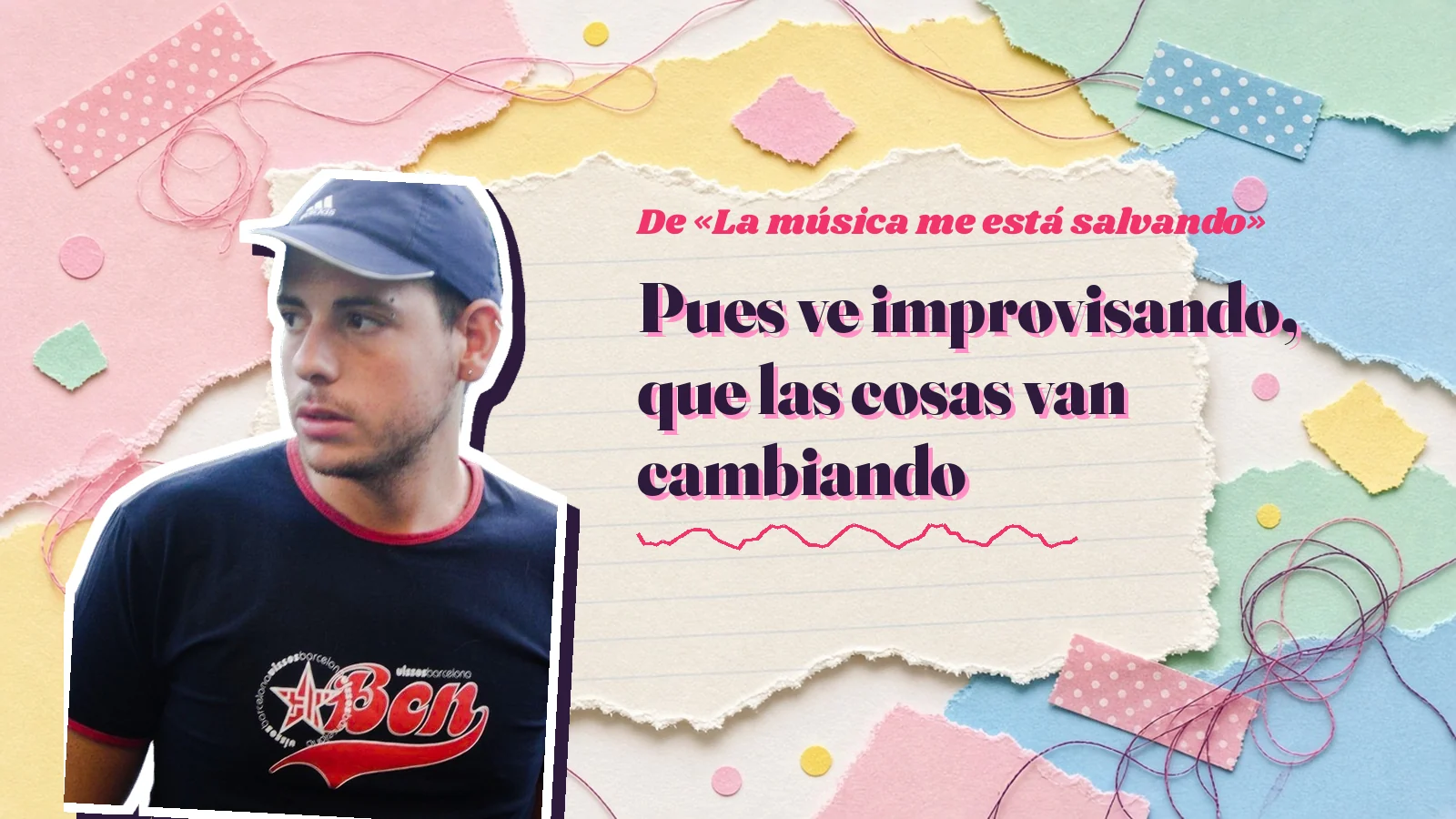
«Pues ve improvisando, que las cosas van cambiando» ("So start improvising, 'cause things are changing")
Two more gerunds. Improvising. Changing. And here the gerund has become a taunt. To the man with a watertight plan I say: start improvising, which is the opposite of a plan. To the man who had everything tied up I say: things are changing, which is the opposite of tied up. The gerund, a refuge for me, is a threat to him. What's in motion can't be controlled.
Gerunds, counted
I sat down and counted them, because that's how geeky I get about my own lyrics.

In the song, not counting chorus repeats, these verbs are in the gerund: flipando, alucinando, salvando, elevando, subiendo, dejando, improvisando, cambiando and, in the bridge, haciendo. Nine. Nine verbs in motion in a song that lasts as long as an old-school single.
Compared with the verbs in the past tense, the difference is huge. Almost everything in the song is happening. Almost nothing happened. It's a song written from inside the rescue, with the water still at your waist while someone throws you a rope. Not from the shore, with a towel and a sandwich, telling it like an old war story.
That, for me, is what sets it apart from other songs about getting over something. It isn't a song about getting over it. It's a song about getting over it right now.
Gerunds and Madrid-speak
One more aside, which amuses me. The gerund is used constantly in Madrid speech, sometimes in ways language teachers don't approve of.
«Voy yendo» (I'm going-going), «ve haciendo la cena que ahora voy» (get dinner going, I'm on my way). In Madrid we talk in gerunds even to order a beer. It's a street tense, a tense of movement, of a city that never stops. And this song, which is very Madrid even though hardly any streets appear in it, has that music.
When I write, I try to make lyrics sound like how people really talk, not how books are written. And in Madrid people talk in gerunds. Lo estoy flipando is something you could overhear on any terrace in Malasaña on a Saturday lunchtime, between two beers and a plate of patatas bravas. That's why it's there, in the first line, without asking grammar's permission.
What isn't in the gerund
Having counted the gerunds, let me count what's left out.
What isn't in the gerund in this song are the insults. Oaf. Lying bastard. Pinocchio. Insults are nouns, still words, labels stuck on the other person's forehead like a Post-it. They don't move. They don't change. The ex is what he is, and the song gives him no chance to transform.
Nor are the things of the past in the gerund: the list of failed remedies, the crisis that's over. Everything to do with him or with what's already happened stands still. Everything to do with me and with music is in motion.
That, if you like, is the song's secret grammar. The movement is mine. The stillness is his. I'm going somewhere. He's stuck with his label.
The bridge: it's over
And there's a line in the bridge that breaks with everything before it, and breaks on purpose. Se acabó la crisis. The crisis is over.

Se acabó. The simple past. The most closed tense there is in Spanish. After so many gerunds, suddenly, a final verdict. Goodbye forever, Pinocchio. The crisis is over.
Does that contradict everything I've said? A little, yes. And I like that it does. Because in any recovery there are days when you feel completely cured, when you say "it's over" with your chest out, and the next day you're back in the gerund. That line is one of those days. A high. A moment of euphoria when you believe you're done.
What comes next in the bridge I covered on the song page and won't repeat: a very rude insult, a reference to the ex's favourite hobby, and some sexual health advice slipped in among the laughs, about getting tested. That advice, by the way, I give outside the song too, without laughing: getting tested is a way of looking after yourself and others, and in Spain many centres offer it free and confidentially.
Why the gerund is honest
Back to the beginning. Why does the gerund matter so much to me?
Because I think most songs about getting over something lie a little in their tense. They speak from a very clean, very tidy afterwards, where everything is already resolved. And life is rarely like that. Life is almost always in the continuous. You're getting out of something. You're learning. You're trying. You're starting to laugh again, bit by bit, with relapses.
I wrote about it in songs as a community's diary: my lyrics are often notes from a specific moment, written while things are happening, not afterwards. This one is the perfect example. A diary entry written in the continuous, the ink still wet.
And that's why it still works. Had I written it in the past tense, it would be a song about me. Being in the continuous, it can be about anyone going through the same thing right now. The gerund is a hospitable tense. There's always room for one more.
Who writes the gerunds
The lyrics are mine, written without AI. The music and vocals are produced with artificial intelligence tools such as Suno, which I direct; it's all explained on About Mike. And in a song with this title, the question is almost obligatory: can music save you if you make it with AI? Yes. Because what saves me isn't pressing a button. It's writing the lyric, choosing between versions, listening a hundred times until the chorus rises the way it should. I talk about that in AI doesn't save me work, it moves it somewhere else. Work saves you too.
When to play it
Play it in the continuous. That is, while you're doing something.
While you're walking to work. While you're doing the washing-up. While you're climbing the hill on Calle de Segovia with your shopping bag. While you're getting ready for your first night out in ages. Don't play it when everything's already sorted. Play it while you're still in the thick of it.
And if one day you catch yourself saying "music has saved me", in the present perfect, door firmly shut, let me know. It'll mean you don't need it anymore. Or that it's time to write your own.
The full lyrics are on gayfolkplanet.com and in this site's lyrics archive. And if you're looking for more songs for that moment, the catalogue has «Un invitado VIP cortando cebolla» ("A VIP Guest Chopping Onions"), which is the night before this morning.
And if you're on the other side, if you're the one left on the floor, I've got something for you too: the gerund works the same in both directions. Nothing that's happening has finished happening. Not even your fall. Start improvising, things are changing. I say it without spite; today I woke up feeling generous and in the mood to hand out gerunds.
I'm still in the continuous. And I like it.
Frequently asked questions
What is «La música me está salvando» about? It's a recovery song after a relationship with a liar. It lists everything that didn't help, from psychologists to prayer, and celebrates that music is helping, while it leaves the ex "flat on the floor". It ends with a cheeky score-settling and some sexual health advice.
Which album is it on? On «Ojalá se pudiera viajar a GAYFOLK», the second album of the GAYFOLK trilogy. In the Planeta Gayfolk singles list it's track 61 of 273.
Who writes the lyrics, and how is the music made? The lyrics are mine, written without AI. The music and vocals are produced with artificial intelligence tools such as Suno, which I direct. I'm a lyricist, composer and music producer from Madrid.
Where can I read the lyrics and listen to it? The full lyrics are on the song page and on gayfolkplanet.com. You can listen on Spotify.