By Mike Sain't Louis ·
The last letter: «Zee-Zee», the paisley shirt and the light shows of ink in water
When I was little, Z was the letter nobody wanted to get in word games. With A, M or P anything came out; with Z you had to think of «zapato», «zanahoria», «zorro» and little else before going blank. It was the last in the line, the one that arrived tired, the one hardly ever used. That's why it amuses me to have titled a song with two Zs in a row, as if I wanted to finally give it its moment of glory.
«Zee-Zee» doesn't have its lyrics published yet, and I'm not going to fill that gap with sentences that aren't mine. What I am going to do is look at the cover with a magnifying glass and pull the threads that come out of it: the alphabet, a pattern that travelled from Kashmir to Scotland, the San Francisco concerts where the walls moved, and the tattoo many sailors wore on their chests before getting tattooed was a trend.
Seven-coloured smoke on a black background
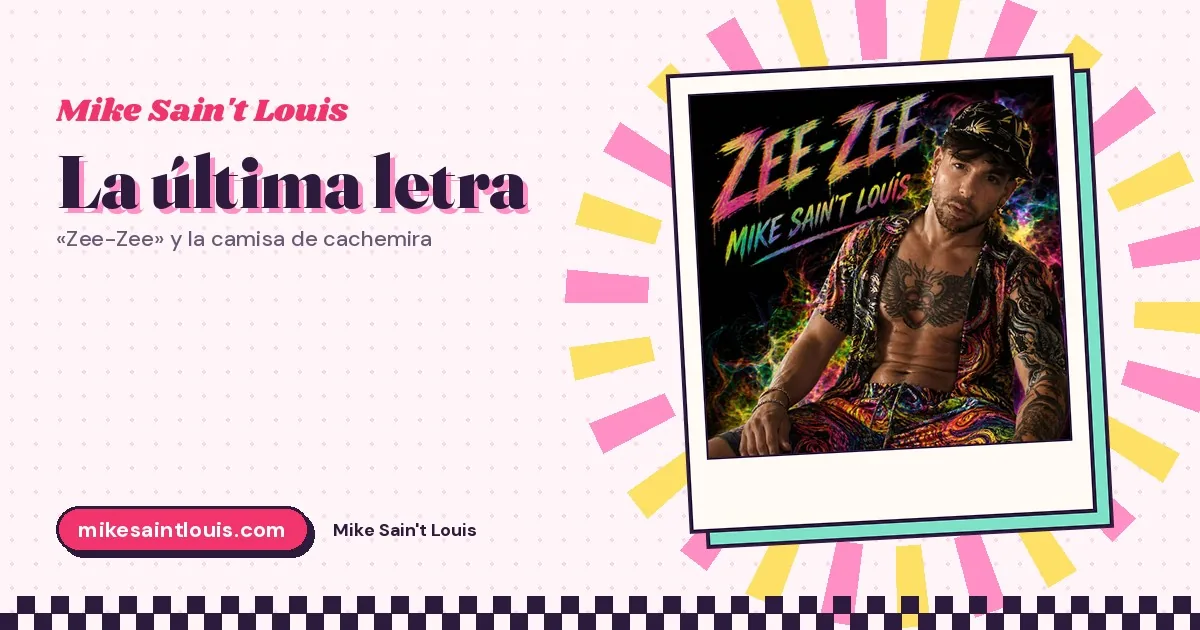
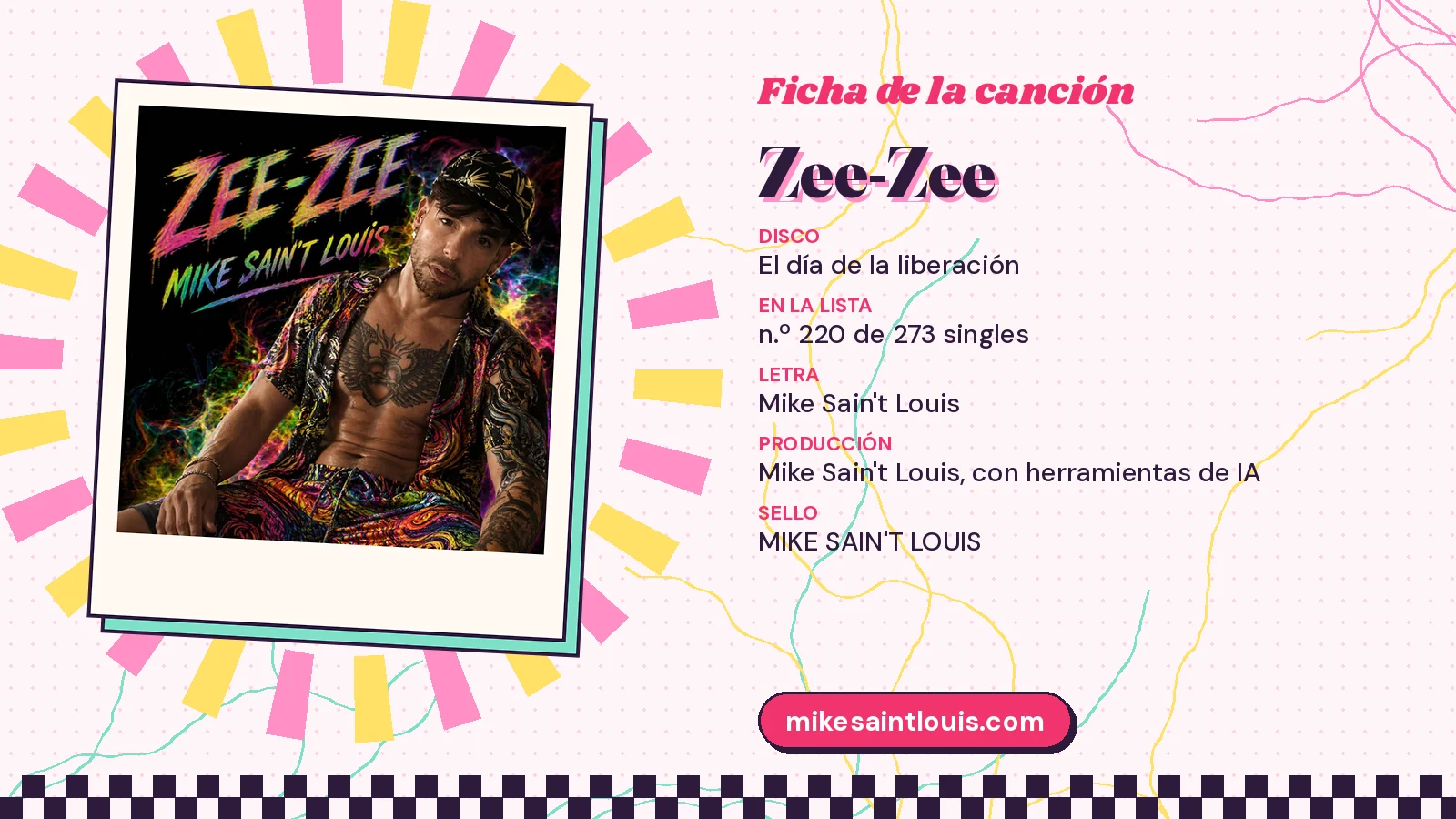
The cover has a dark background, almost like a club with the lights off, and on top floats smoke in every colour of the rainbow, twisting as if someone had poured paint into a glass of water. In front, seated and calm, is a guy in an unbuttoned shirt of psychedelic swirls, trousers in the same print and a matching patterned cap. On his chest there's a tattooed winged heart. He looks at the camera without hurry.
The title is written like a freshly made piece of graffiti, the paint still dripping.
Some covers ask for noise and others ask for calm. This one has both: the colour is shouting and the guy, by contrast, looks like he's just sat down after four hours of dancing. That mix of explosion and rest is what I like most about it.
What's on the table
Before going on, cards face up. The lyrics of this song don't appear on my lyrics page. When lyrics aren't published, I don't reconstruct them from memory or from what automatic subtitles think they hear, because those systems, with music underneath, write entire novels.
I stick to what can be checked. The cover image. The title, two repeated syllables with a hyphen in the middle. The day I uploaded the music video to my YouTube channel, 28 May 2026. The album it's on. And what I already said on the «Zee-Zee» page on this site, where I made it clear I wasn't going to reveal what such a short name hides. I still feel the same. What follows is everything around that name, not what's inside it.
Z, the letter left at the back of the queue
Z has a busier history than it seems. It comes from the Greek zeta, which in the classical alphabet was sixth, very close to the start. The Romans borrowed it early on, but in Latin it was almost useless to them, and according to tradition the censor Appius Claudius Caecus expelled it from the alphabet around 312 BC.
Centuries later, in the first century BC, they needed it again to write words coming from Greek. And since its old place was already taken, they put it at the end of the line. That's why Z closes our alphabet today: not because it matters less, but because it came back late to a house where the rooms had already been handed out.
It strikes me as a very closet-like story. A letter that was there, got thrown out, came back when it was needed and was put at the back so it wouldn't bother anyone. And even so, as soon as it appears in a title, it's the first thing you see.
Zee, zed and zeta
The title is in English, and in English Z has two names depending on which side of the Atlantic you're on. In the United States it's zee; in the UK, Ireland, Australia or Canada, zed. So «Zee-Zee» has a clearly American accent, like those names that seem taken from a TV series or a nickname at a Los Angeles school.
In Spanish we call it «zeta», although the Academy's dictionary also accepts other, less common forms. And its pronunciation divides the map: in much of Spain Z sounds different from S, while in the Canary Islands, parts of Andalusia and all of Spanish America it merges with it, what's known as «seseo». There are even Andalusian areas where the opposite happens and S sounds like Z: that's «ceceo».
It amuses me that two such small letters give rise to so much geography. The same title read in Madrid, Seville, Las Palmas or Mexico City doesn't sound the same. And I think that's fine: nicknames get bent depending on who says them, and that makes them more ours.
Names that double up
Repeated names have something affectionate about them. We see it in childhood nicknames, in the diminutives grandmothers invent and in the nicknames people get at school. Repeating a syllable is the first thing a baby does when it starts to talk, and maybe that's why it still sounds tender to us.
In pop culture there's everything: artists who double their name, brands, pets, cartoon characters. A double name is easier to remember and you say it with more gusto. «Zee-Zee» works the same way: you don't need to know English to pronounce it, and once you say it, it sticks.
The hyphen in the middle counts too. It isn't «Zeezee» all together, but two separate beats, like two dance steps or two kick-drum hits. The spelling sets a rhythm before anything plays.
The pattern that travelled from Kashmir
What stands out most about the clothes on the cover are the swirls. That kind of design, with curved teardrop shapes and loops upon loops, has a very old origin. The teardrop motif with a bent tip, called boteh in Persian, decorated fabrics in Persia and India for centuries.
At the end of the eighteenth century fine wool shawls from Kashmir, in northern India, began to reach Europe and became a very expensive luxury. European weavers set about copying them, and the small Scottish town of Paisley specialised so much in those shawls during the nineteenth century that the pattern ended up carrying its name in English: paisley. In Spanish we still call it after its place of origin: «estampado de cachemira».
In other words, the guy on the cover is wearing a design that was born in Asia, became popular in Scotland and, as we'll see, turned psychedelic in California. There's no more well-travelled garment.
From grandma's shawl to psychedelia
For much of the twentieth century paisley was associated with serious men's ties and grandmothers' headscarves. Until the counterculture rescued it in the sixties. In the so-called Summer of Love of 1967, in San Francisco's Haight-Ashbury, paisley showed up on shirts, flares and dresses, mixed with impossible colours.
The Beatles were photographed in shirts of that style, and the pattern became a kind of soft flag of the era: it said peace, inner journeys, wanting to break with the grey suit. Decades later Prince named his label and his studio Paisley Park, in the eighties, to make clear that his world had that same mix of colour, sensuality and strangeness.
The guy in «Zee-Zee» gathers all that. His outfit is neither a serious man's nor a period hippie's, but a present-day party version, with a matching cap. It's after-party psychedelia, not commune psychedelia.
Liquid light on the walls
The coloured smoke in the background reminds me of a technique that fascinates me: liquid light shows. In the mid-sixties, in San Francisco's concert halls, some artists began placing oils and dyed water between two sheets of glass on overhead projectors, the kind schools used to project transparencies. They moved the glass, heated the oil, mixed colours, and on the wall behind the bands blotches appeared that melted and breathed in time with the music.
The most famous was the Joshua Light Show, which from 1968 accompanied the concerts at the Fillmore East in New York. People didn't only watch the musicians: they watched the wall, where the shapes changed non-stop.
That's what I see on the cover: not real smoke, but something that looks like ink spilled in water and projected big. It's an aesthetic that needs no substances to work. Turn off the light, put some colour in motion and let the music do the rest.
A heart that knows how to fly
On the guy's chest there's a winged heart. It's one of the classic motifs of American traditional tattooing, the one with thick black lines and flat colours that sailors wore in the first half of the twentieth century. One of its great names was Norman Collins, known as Sailor Jerry, who worked for decades in Honolulu tattooing soldiers and sailors.
In that repertoire, swallows meant coming home, the anchor stability and the winged heart something like freedom or a love that won't be locked up. Everyone gives it their own reading, of course, but the idea of a heart that can fly off whenever it wants is very powerful.
I already wrote about what it means to carry something on your skin in the post on «Tattoo de Fénix». There the bird was reborn from the ashes; here the one with wings is the heart itself. I like that my covers share this habit of putting wings on things.
Cap, open shirt and nothing to prove
The posture counts as much as the clothes. The guy is seated, relaxed, his shirt open all the way down, not flexing or posing awkwardly. He looks straight ahead. He doesn't ask permission or seek approval.
For a long time, we gay boys were taught to watch every gesture: how we crossed our legs, how we moved our hands, which colours we chose. A shirt like that, in certain towns and certain decades, was a declaration of war. That's why I like this image so much. Here the most outrageous print in the wardrobe is worn as naturally as someone else would put on a grey sweatshirt.
It's the same kind of pride without a placard I talked about on the song page: the rainbow doesn't appear as a flag but dissolved in the smoke and the clothes. It's there, but it doesn't announce itself.
The generation of the last letter
Today Z has another use: naming a generation. According to the most widespread classification, that of the Pew research centre, Generation Z is made up of people born roughly between 1997 and 2012. It's the first to grow up with the internet in their pocket, and also the one that most openly identifies as LGBTQ+ in surveys in many countries.
I don't know how old the guy on the cover is, and I don't care. But the title has something of a greeting to that generation that arrived at the end of the alphabet and that, like the letter, has learned to make itself seen from the last place.
At the same time, the aesthetic is completely retro: sixties shirt, sixties lights, eighties graffiti. That clash interests me a lot. I wrote about it in my post against nostalgia: using the old not to go back, but to have more tools to look forward.
Comic-strip Zs
In comics, a row of Zs over a character's head means they're asleep and snoring. It's a convention so old we don't even stop to think about it. And Z is also the mark of Zorro, the masked avenger created by the writer Johnston McCulley in 1919, who signed with three sword slashes.
Those two uses sketch well the hour the cover suggests. On one hand, the small hours, when the party drags on and someone starts nodding off on a sofa. On the other, the gesture of leaving your mark, of signing with a bold letter everyone recognises.
A song titled with two Zs can be both things: a half-dream and a signature.
Colours that come and go
«Zee-Zee» is on the same album as «Verde», and from those lyrics, which are published, there's a line that could serve as a caption for the smoke on the cover:
con sueños y colores que vienen y van.
(«with dreams and colours that come and go.») In «Verde» that line is about a night of rumba when your head drifts far away. I bring it here only for the image: colours that appear and disappear, that don't stay still, just like in a liquid light show or in the smoke around the guy.
I'm not saying «Zee-Zee» tells the same story as «Verde». I can't say so without publishing its lyrics and I'm not going to play guessing games. Only that the album has a recognisable palette, and that line sums it up very well.
Between «María María» and «Judith Bécker»
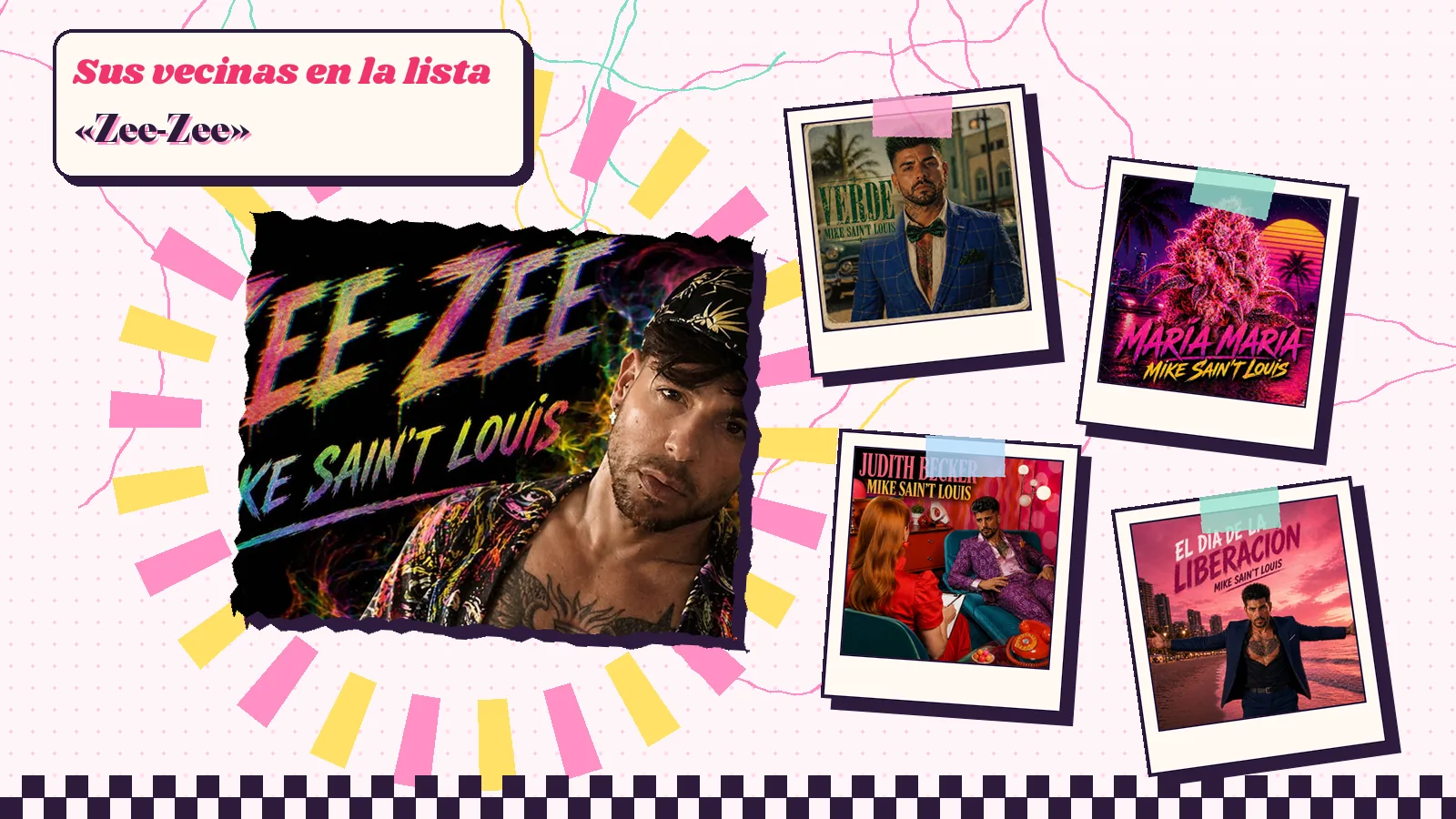
In the singles list on gayfolkplanet.com, «Zee-Zee» is number 220 of 273. It's preceded by «María María» and followed by «Judith Bécker», a song with published lyrics born of a night of sofa, tiredness and television. From it I keep this line:
Mejor estar solo con tus animales que rodeado de gente falsa
(«Better to be alone with your animals than surrounded by fake people.») It seems a curious counterpoint to me. The cover of «Zee-Zee» suggests an after-party full of people and colour; the next song stands up for staying home away from those who add nothing. Both fit in the same life, and sometimes in the same weekend. The psychologist from the series that gives that song its title already had her post here, about television that looks after you.
May and the album of letting go
I uploaded the music video on 28 May 2026, on the threshold of June, the month when half the world dresses in colours. The song is part of «El día de la liberación», the third album of the Gayfolk trilogy, the one about what comes after setting yourself free.
It fits well. If the first album was about discovering and the second about desiring, this one is about living without apologising. A cover with an open psychedelic shirt, a winged tattoo and rainbow smoke fits perfectly with that idea.
For anyone looking for more dance-floor and night-time songs without drama, I recommend the post on the dance floor as a refuge, which is about that very basic right to have a good time.
A dripping title
The letters of the title deserve their own section. They're painted as if someone had just sprayed them on a metal shutter, and the paint still runs down in little drips. That dripping effect is a classic graffiti device: it signals haste, freshness, the feeling that the author ran off before getting caught.
Modern graffiti, the kind made of signatures, was born on the streets of New York at the end of the sixties. In July 1971 the New York Times published a feature on a kid who signed as TAKI 183 all over the city, and from then on thousands of teenagers set out to leave their names on subway cars and walls.
Madrid had its own pioneer. Juan Carlos Argüello, known as Muelle, began signing around the city in the early eighties with his nickname finished off by an arrow shaped like a spring. He died very young, in 1995, but his signature became part of the landscape of the Movida and a symbol of a city that had just come out of a grey era and wanted to paint everything.
I like that the title of «Zee-Zee» has that air of a street signature. A short word, easy to recognise, written in a hurry and with lots of colour. If Zorro signed with his sword and Muelle with his arrow, this song signs with two Zs that haven't dried yet.
There's also a lovely contradiction between graffiti, which is an art of the street and the night, and the guy's calm posture, which seems to be in a living room. As if the street had come indoors, or the house had gone out into the street. At parties that drag on it often happens: you no longer know if you're in a club or in someone's flat, and it doesn't matter.
When the after-party goes on too long
The small hours have their charm, but also their traps. Accumulated tiredness, lack of sleep, the next-day slump and sometimes whatever was taken can leave your mood on the floor. If that sadness or anxiety doesn't go away within a few days, or you start to notice you need the party so as not to think, talk to your doctor or a mental health professional.
If thoughts of hurting yourself or of not wanting to go on ever appear, in Spain you can call 024, the free and confidential suicide-prevention line, at any time of day. If there's immediate risk, call 112. From other countries, use the local emergency number or find a helpline at findahelpline.com.
There are more resources in the mental health without taboo series on this blog.
Who I leave this shirt for
For whoever keeps a too-flashy garment in the wardrobe and never finds the occasion. For whoever got stuck on Z in word games as a kid. For whoever has watched the sunrise from someone else's sofa with their eyes still full of lights.
And for whoever has decided to wear the winged heart, even if only on the inside. Two syllables, a hyphen, a paisley shirt and a strong wish that the night isn't over yet.
Frequently asked questions
What is «Zee-Zee» about?
The lyrics aren't published yet, so I don't tell or imagine them. The cover shows a seated guy in an open psychedelic shirt, a patterned cap and a tattooed winged heart, in front of coloured smoke. This post is about what surrounds that image: the letter Z, the paisley pattern and psychedelic aesthetics.
Why is it called «Zee-Zee»?
Zee is the name of the letter Z in American English. Beyond that, on the song page I preferred not to reveal what the title hides, and I still don't.
Which album is it on?
«El día de la liberación», the third album of the Gayfolk trilogy. The music video has been on YouTube since 28 May 2026.
What is the pattern on the shirt?
It's a pattern of swirls and curved teardrops, known in Spanish as «cachemira» and in English as paisley. It was born in Persia and India, was mass-produced in Scotland in the nineteenth century and turned psychedelic in the sixties.
Who makes the music and the vocals?
Mike Sain't Louis, a lyricist, composer and music producer from Madrid and the first AI songwriter. He writes, composes and produces; the vocals are made with artificial intelligence.