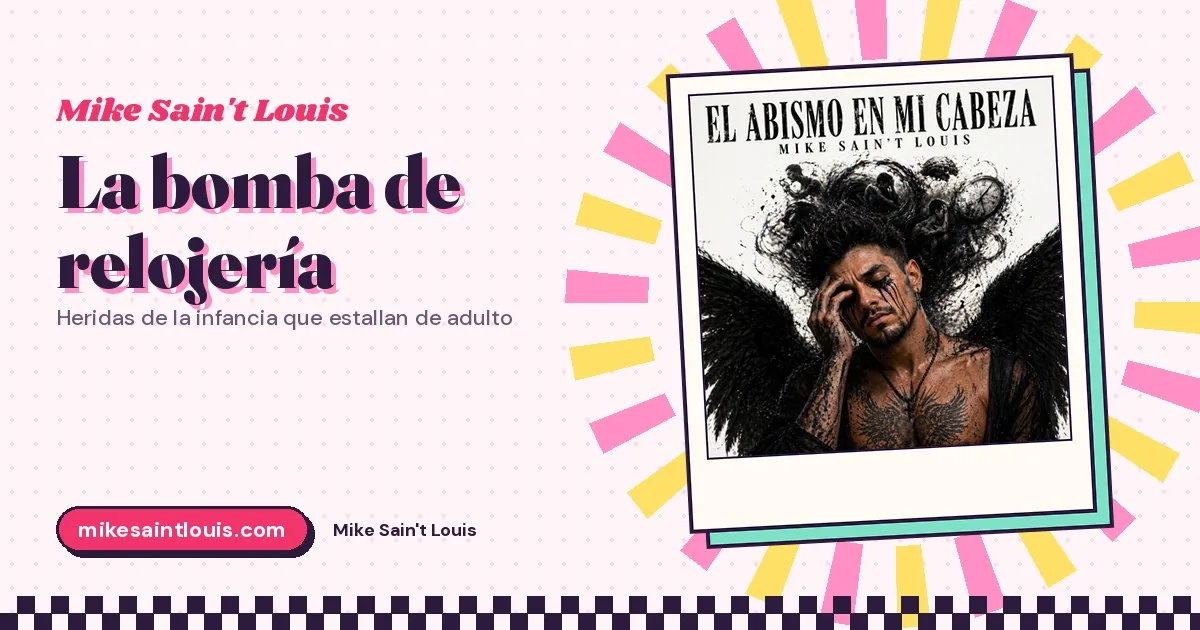
By Mike Sain't Louis ·
The ticking time bomb: childhood wounds that go off in adulthood
This is the second piece in a series where I talk openly about my mental health. Here I write about something I find very hard to name: what I lived through as a child and how, years later, it went off. I won't give details of the abuse. They aren't needed to understand what I want to say, and I don't want anyone who has been through something similar to relive it while reading.
If reading this stirs something and you feel you can't go on, call 024, Spain's suicide-prevention line: free, confidential, 24 hours. If there's immediate danger, call 112. If you're under 18, or worried about a child or teenager, Fundación ANAR answers on 900 20 20 10 and 116 111. If you're outside Spain, call your local emergency number. Thinking about suicide doesn't make you a lost cause: you can ask for help, and help works.
As a child I was bullied at school. And as a child I suffered repeated sexual abuse. Writing those two sentences one after the other, somewhere anyone can read them, would have seemed impossible to me a few years ago. I do it today because I've understood that silence wasn't protecting me. It only protected what hurt me.
What you store doesn't disappear
People often think of childhood as something you leave behind, like a neighbourhood you move out of. You grow up, change city, friends, life, and what came before stays there. It's a very common idea. And it is, sadly, mostly untrue.
What you don't look at doesn't vanish. It gets stored. It stays somewhere in the body and the memory, waiting. Sometimes for decades. And one day, for one reason or several, it comes out.
I call it a ticking time bomb. The bullying at school, the abuse, and later, as an adult, two relationships with people I came to understand were narcissists. It all added up. And at 41 I was diagnosed with severe major depression, social phobia, post-traumatic stress disorder, avoidant disorder and anxiety.
I'm not saying one thing automatically leads to another. Nobody can say that about a particular life. What I'm saying is that looking at my story with professional help is helping me see how the pieces fit.
What the research says
It isn't just a feeling of mine. There's a great deal of research on how difficult childhood experiences affect adult health.
The best known is the study of "adverse childhood experiences", ACEs. It was launched in the mid-1990s by the US Centers for Disease Control and Prevention (CDC) and the health provider Kaiser Permanente, with more than 17,000 adult participants. Its first results, published in 1998 by Vincent Felitti and Robert Anda, showed that the more adverse experiences someone had lived through as a child, such as maltreatment or sexual abuse, the greater their risk of physical and mental health problems as an adult, depression among them.
The World Health Organization also notes that child maltreatment has consequences that can last a lifetime, and that it is associated with depression, anxiety and other mental health problems in adulthood.
That doesn't mean everyone who suffered something as a child will become ill. The studies speak of risk, not destiny. But it does mean something important: if you're an adult and struggling, and things happened to you as a child that you've never told anyone, there may be a connection. And it's worth exploring with a professional.
Why the body takes so long to speak
One question I've asked myself again and again is: why now? Why didn't it go off sooner?

I don't have an exact answer for my own case. What I've learned is that it's very common for people who were abused in childhood to take many years to talk about it, or even to name it. As a child you often have no words for what's happening. And very often the person doing harm is someone close, which makes it even harder to tell.
The mind also has its ways of protecting itself. One of them is to set aside the unbearable so you can keep functioning. Go to school. Study. Work. Fall in love. For years that can more or less work. Until the accumulated weight is too much, or something in the present touches the old wound.
In my case, the two adult relationships touched that wound. The control and contempt I lived through fitted far too well with what I'd learned as a child: endure, keep quiet, think it's your fault.
The school playground
I'll write about the bullying more slowly in another piece in this series, on gayfolkplanet.com. Here I just want to say one thing. Bullying isn't "kids' stuff". It isn't a joke you forget when you grow up. It's violence, even when small people do it, and it leaves a mark.
Many gay boys, or boys who looked gay to others, know that playground. The words that stick to you. The feeling of not being safe in a place where you were supposed to be safe. Learning to make yourself small so nobody sees you.
That way of making yourself small doesn't go away on its own. Sometimes, years later, it becomes something with a clinical name: social phobia, avoidance. But I'll write about that in another piece too.
The word "survivor"
There's a word that can seem too big, or too dramatic: survivor. I use it.
Survivor of child sexual abuse. I write it and something trembles inside. But it's true, and saying it is part of what's helping me. I'm not only what was done to me. But what was done to me is part of my story, and hiding it forced me to hide part of myself as well.
The Council of Europe has spent years spreading a figure that stays with you: around one in five children in Europe experiences some form of sexual violence. Its campaign was called exactly that, "One in Five". If that figure is anywhere near reality, there are several in every classroom. In every office, every block of flats, every comment thread, there are people who have lived through something and never told anyone.
I'm not writing this so that anyone tells anything they don't want to. Everyone has their own pace. I'm writing so whoever reads it knows they aren't the only one, and that coming late to naming it isn't a failure.
"That's why my life is like South Park"
One of my songs has a lot to do with this, though it may not look like it at first. It's called «El panda del acoso sexual». Its video plays with irony from start to finish. And at the end comes a line that says, more or less, that this is why my life is like South Park, because it all started with a sexual abuse.
I understand it might shock someone. A line like that, a cartoon joke, about something so serious. But for me irony and black humour are a way of naming what hurts. Of telling the truth without the truth crushing me. Some things can be said with a half-smile before they can be said seriously. The half-smile didn't make them less serious. It opened the door.
Many people who have lived through trauma recognise that kind of humour. It isn't flippancy. It's a way of holding something very heavy for a while. And sometimes it's the first step towards being able to talk about it seriously later, as I'm trying to do in this series.
The abyss in my head
Before the diagnosis I had already written songs which, read today, describe very well what was happening to me. «El abismo en mi cabeza» is one of them. Its chorus speaks of an abyss that «Es un laberinto sin puertas» ("is a labyrinth with no doors"). That's how depression feels when it tightens: like being inside a place whose exit you can't see.
In another line the song says: «Solo queda este peso que no puedo soltar» ("all that's left is this weight I can't put down"). That weight is exactly the bomb I'm talking about. It isn't one day's weight. It's years of weight, things stored one on top of another.
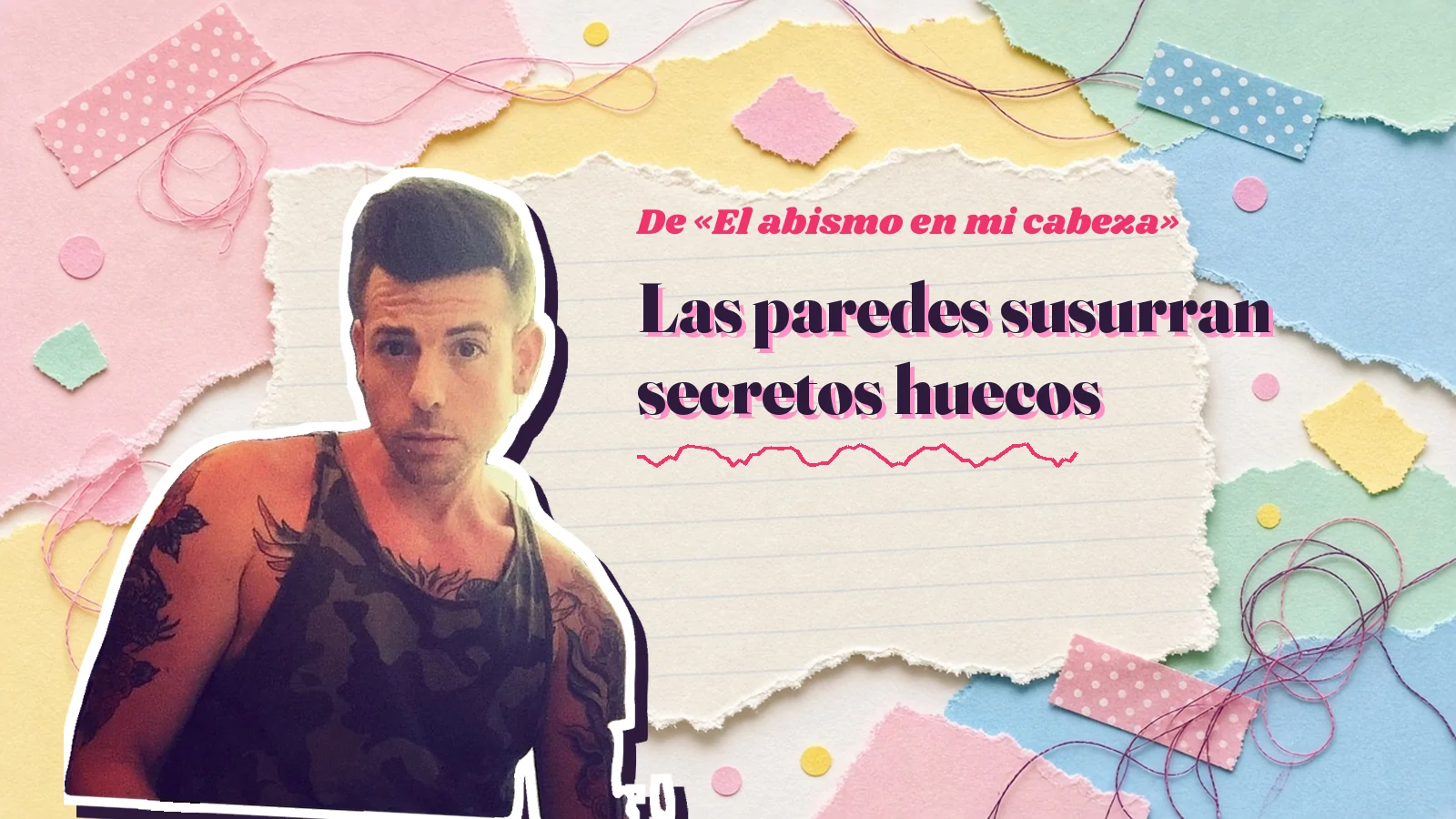
And there's a line I find very precise for what it feels like when the past won't stop talking: «Las paredes susurran secretos huecos» ("the walls whisper hollow secrets"). What isn't told doesn't stay silent. It whispers.
There's something I want to add to that song: the labyrinth does have doors. Sometimes you just can't see them from inside, and you need someone outside to help you find them. In my case that help has come from a good psychologist.
When what goes off has a name
Post-traumatic stress disorder is one of the diagnoses I received. According to bodies such as the NHS and the American Psychological Association, it's a condition that can develop after living through or witnessing traumatic events, and it can include intrusive memories, avoiding whatever recalls the trauma, changes in mood and a constant sense of being on alert. It can appear soon after the trauma or a long time later.
When trauma is repeated and prolonged, especially in childhood, the WHO's International Classification of Diseases (ICD-11) also includes complex post-traumatic stress disorder. It isn't my diagnosis, and I won't give it to myself. I mention it because many people don't know it exists, and because it helps explain that childhood trauma has its own way of staying.
Receiving a diagnosis didn't change my story. But it changed the way I look at it. I stopped thinking "I'm broken" and started thinking "what's happening to me has an explanation, and it has treatment".
Songs that already knew
When I go back through my catalogue with what I know today, I realise many lyrics were already saying it before I could say it in a consulting room. «El abismo en mi cabeza» is the clearest, but not the only one.

«Beat My Post-Traumatic Stress» carries post-traumatic stress disorder in its very title. Its introduction describes it as a song about surviving what the body still remembers, and about turning fear, anxiety and silence into rhythm. It's a dance-floor song, and that says something too: that you can be wounded and keep moving.
«No me aparece una ilusión» repeats over and over what depression repeats: that you don't feel like leaving the room, that you can't find the strength. The repetition in that lyric isn't lazy writing. It's exactly how a bad day sounds inside, the same sentence going round and round.
«Antisocial» talks about avoiding eyes and greetings in the street, and turning silence into a castle. It sounds like a proud, almost defiant statement, and it is. Today I also read it as a description of social phobia and avoidance, two of the diagnoses I received.
And «El narcisista» is about the adult relationship which, as I explain in the first piece of this series, reopened the wound.
I'm not saying songs are a diagnosis. They're songs. But they help me see that something inside me knew what was happening before I fully did.
What I'd have liked to hear as a child
Sometimes I think of the child I was and what I'd have liked someone to tell him. I can't go back. But I can write it here, in case a child reads it, or an adult who still carries that child inside.
I'd have liked to hear that what was happening wasn't my fault. That I had done nothing to deserve it. That being different wasn't a crime. That telling wouldn't make something worse happen, and that there were adults ready to listen and to protect.
Today there are resources I didn't know about then. Fundación ANAR answers children and teenagers 24 hours a day on 900 20 20 10 and 116 111, and a psychologist picks up on the other end. If you're under 18 and reading this, you can call. You don't need to know how to explain it well. They'll help you find the words.
In Spain, since 2021, there's also a specific law protecting children and teenagers from violence, Organic Law 8/2021, known as LOPIVI. Among other things, it requires schools and sports centres to have protocols against bullying and abuse. No law erases what has already happened, but it matters to know there are more tools today than before.
If you're supporting someone who has lived through it
Maybe you're reading this because someone close to you has told you something similar, or because you suspect someone has lived through it. The first thing is to believe them. Many people abused in childhood take years to tell because they fear not being believed.
The second is not to push. You don't need the details to be there for someone. It's enough to stay, to listen without judging, and not to turn the conversation into an interrogation.
The third is to encourage professional help without imposing it. You can offer to go with them to the first appointment with their GP, or to look for a health psychologist together. And if at any point they say they don't want to live, don't let it pass: ask them directly how they are and call 024 together. Asking about suicide doesn't put the idea in anyone's head. On the contrary, it can be an enormous relief.
Signs that the past is weighing on the present
They can't be used to diagnose anyone, but many adults who lived through traumatic experiences in childhood recognise some of these signs, which health guidance such as the NHS's or Confederación Salud Mental España's describes. If you see yourself in several, talk to a professional:
- Sadness, emptiness or loss of hope that lasts for weeks and won't lift.
- Memories that come back unbidden, nightmares, being easily startled.
- Avoiding places, people or situations that recall something from the past.
- Feeling on alert all the time, as if something bad is about to happen.
- Deep shame or guilt over things that weren't your fault.
- Difficulty trusting people or feeling safe in a relationship.
- Withdrawing more and more.
- Thoughts that life isn't worth living. If this is happening to you, call 024 today.
Where to start
If you're also carrying something from childhood, you don't need to tell everything to ask for help. You can start small:
- See your GP. In Spain's public health system it's the way into mental health care. You can just say you're not well and need to talk to someone. They can refer you to public clinical psychology or psychiatry.
- If you're looking for private therapy, check they're a registered health psychologist. In Madrid, the Colegio Oficial de la Psicología de Madrid lets you check whether a professional is registered. Ask whether they have experience with trauma.
- If you're LGBTQ+, in Madrid you can book COGAM's free psychological counselling (91 523 00 70) or the Programa Madrileño de Información y Atención LGTBI (91 701 07 88). FELGTBI+'s Línea Arcoíris answers on 91 360 46 05. Fundación 26 de Diciembre supports older LGBTQ+ people (910 028 417) and Kifkif supports LGBTQ+ migrants and refugees.
- If the abuse is recent or you're under 18, call ANAR: 900 20 20 10 or 116 111. If there's danger, 112.
- If you're an adult and want to know your rights as a victim of crime, Spain's Ministry of Justice runs Victim Assistance Offices across the country.
You don't have to choose the perfect path. Taking the first step is enough, however small, even if it's only telling someone you need help.
What I'm doing with the bomb now
I'm still fighting these wounds. I won't say it's over, because it wouldn't be true. But the bomb isn't hidden any more. It's on the table, and I'm defusing it slowly, with help.
Writing songs has helped me get out what I didn't know how to say. Writing this series helps me say it without a song. And knowing there's a professional beside me lets me do it without fear of falling apart.
In «La música me está salvando» I wrote about how songs give me room to breathe. Here I want to add something: music helps me, but what is truly saving me is treatment. Both together.
I'm a lyricist, composer and music producer, and I call myself "the first AI songwriter": the lyrics are mine, and the music and vocals are made with artificial intelligence. I say who I am on my page. And in this series I say who I am on the inside too.
Resources if you need help now
Talking about suicide openly is part of prevention. If you're thinking of ending your life, or you're worried about someone who is, ask for help today:
- 024: Spain's suicide-prevention line. Free, confidential, 24 hours, also by chat.
- 112: emergencies.
- Teléfono de la Esperanza: 717 003 717, crisis support 24 hours a day.
- Fundación ANAR: 900 20 20 10 and 116 111, for children, teenagers and adults worried about a minor.
- Confederación Salud Mental España: information and suicide-prevention guides at consaludmental.org.
- Outside Spain: call your local emergency number.
What happened to you as a child wasn't your fault. And you don't have to carry it alone.
Series: «Mental health without taboo». This is part 2 of the series in which I talk openly about my mental health. Here are all the pieces and a map of where to find help. Next: «Diagnosed at 41: putting names to what weighed on me».
Frequently asked questions
Has Mike Sain't Louis spoken about the bullying and abuse he suffered as a child? Yes. In this series Mike says that as a child he suffered bullying at school and repeated sexual abuse, without giving details, and explains how those wounds, together with two relationships with people he came to understand were narcissists, became a ticking time bomb.
Can childhood trauma cause depression in adulthood? Research such as the CDC and Kaiser Permanente study of adverse childhood experiences shows that traumatic experiences in childhood increase the risk of depression and other mental health problems in adulthood. It's a risk, not a destiny, and treatment exists.
What does the South Park line in the «El panda del acoso sexual» video mean? The video plays with irony and ends with a line saying, more or less, that Mike's life is like South Park because it all started with a sexual abuse. Mike explains that irony and black humour are a way of naming what hurts.
Where can an adult who was abused in childhood get help? They can start with their GP, who can refer them to mental health services, or look for a registered health psychologist with experience in trauma. In Madrid, LGBTQ+ people can turn to COGAM or the Programa Madrileño de Información y Atención LGTBI. If there are thoughts of suicide, 024 answers 24 hours a day.
Which helpline supports children in Spain? Fundación ANAR supports children and teenagers on 900 20 20 10 and 116 111, free, confidential and 24 hours a day.