By Mike Sain't Louis ·
On loop: «Hipnótico robótico», the neon suit and the machines we learned to love
Some titles work like a pendulum. You say them once and can't stop. «Hipnótico robótico» (Hypnotic robotic) is one of them: two Spanish words stressed on the third-from-last syllable that rhyme with each other, end the same way and swing like the pocket watch of a movie hypnotist. Hip-nó-ti-co, ro-bó-ti-co. Four syllables, stress on the second, same ending. Say it three times in a row and you'll notice your mouth getting stuck on loop.
A clarification before going on: this track doesn't have its lines published yet. The page in the gayfolkplanet.com lyrics section says they'll be available later, and meanwhile I won't reproduce or invent any. What I have is what anyone can check: the cover image, the title, its place in the catalogue and the album it's on. And, as you'll see, a title like this gives plenty to work with.
A stare that doesn't blink
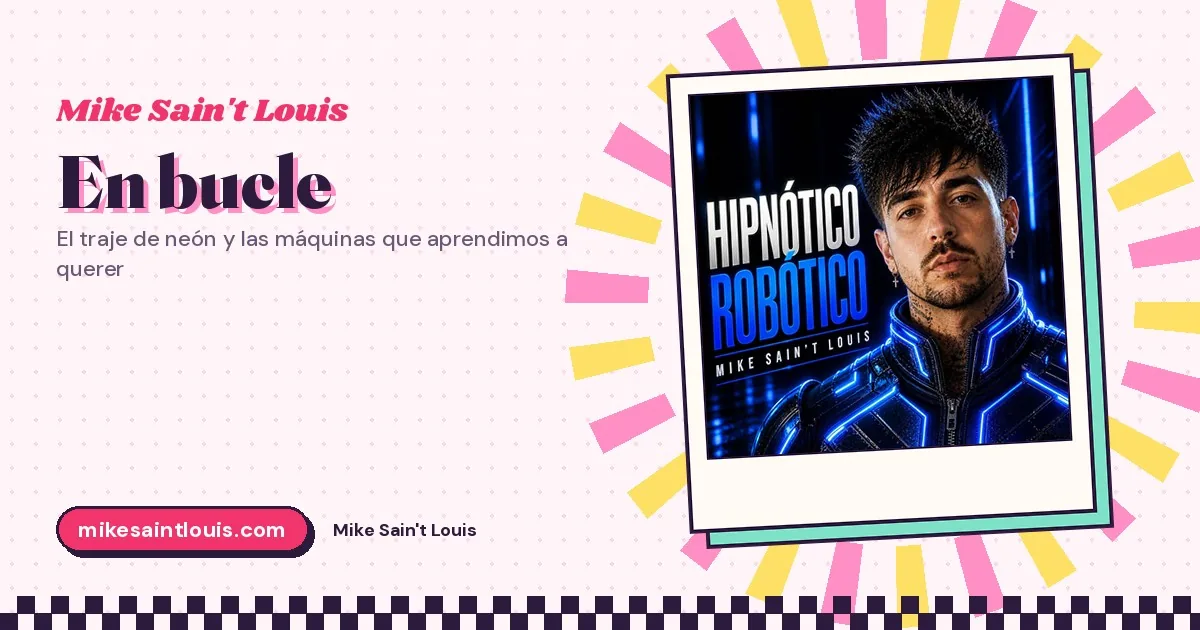
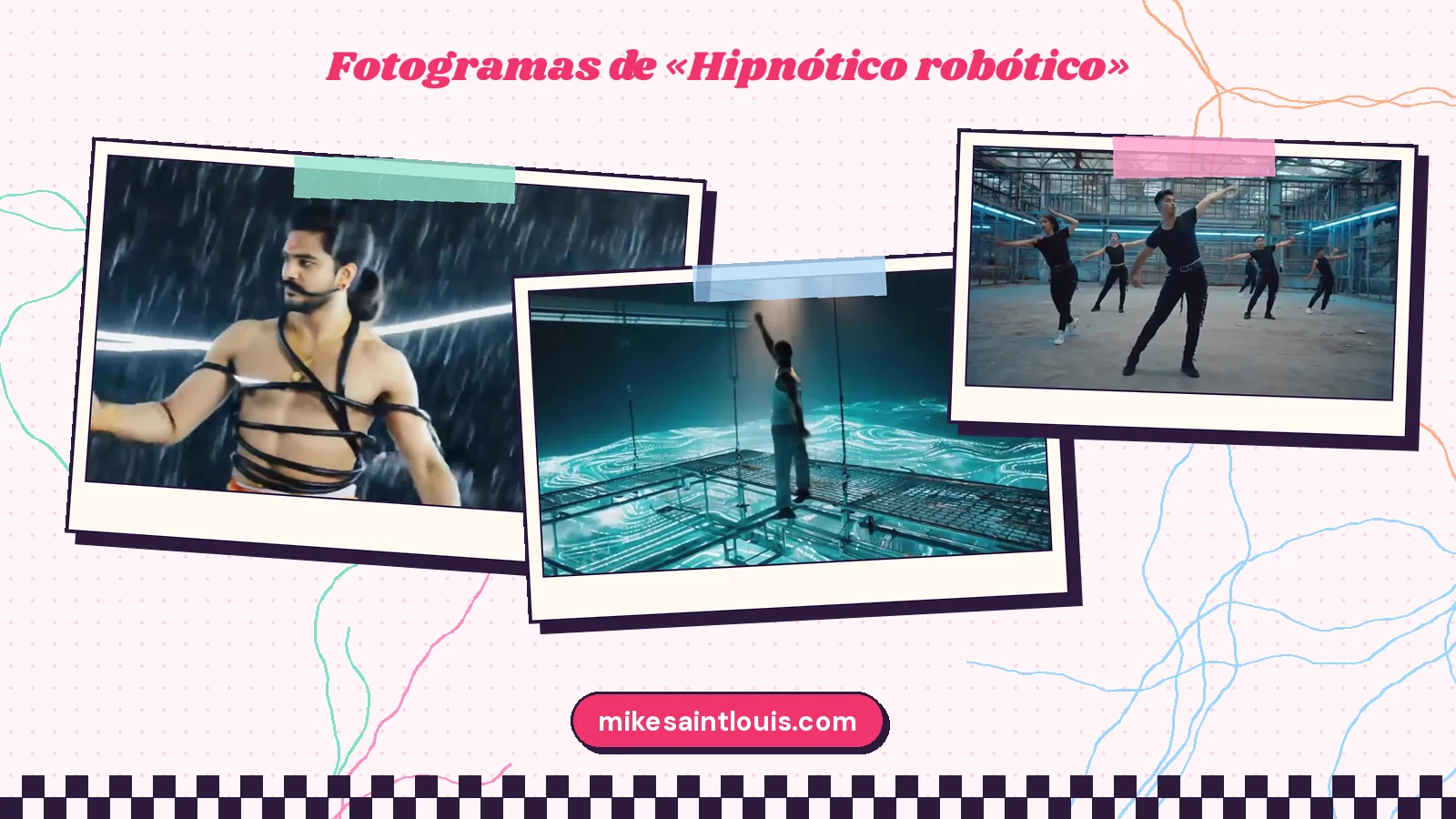
The cover is a frontal close-up. A young man with dark hair styled in spikes, deliberately messy, a few days' beard, a thin moustache and straight, serious eyebrows. In each ear he wears a small silver cross-shaped earring. His neck shows tattoos. And his eyes look straight into the camera.
It's a fixed stare, no smile, no blinking. It asks nothing and explains nothing. It simply holds you. And that's where the title's trick begins: the image doesn't need a pendulum or a spiral to hypnotise. It's enough for it to look at you and not look away. Anyone who has met a gaze like that in a club, on the metro or on a dating app knows the effect. You freeze. You forget what you were about to do. For a few seconds the world shrinks to two eyes.
Some say sustained eye contact is one of the oldest forms of seduction and also of dominance. Animals use it to measure strength; humans, to fall in love or to intimidate. The cover plays with that ambiguity. We don't know whether the young man is inviting you or challenging you. Probably both.
Two small crosses
There's a detail that contrasts with everything else. Amid so much technology, the young man wears two cross-shaped earrings. An ancient, religious symbol, hanging next to a suit that looks like it came out of a computer server. The sacred and the digital, side by side.
Crosses as ornaments have a long history in street style: from punk to goth, from rock to trap, they've often been worn without religious intent, as a gesture of rebellion or simply as jewellery. But they're still crosses. And here, next to a hypnotic stare, they take on the air of an amulet. As if the protagonist were protecting himself from something. Or as if he were the one protecting others from his own spell.
I like that mix because it's very much of our time. We believe in algorithms and still knock on wood. We live surrounded by machines and wear around our necks something inherited from our grandmothers. No future, however blue and bright, manages to erase the past completely.
Circuits of blue light
From the neck down, the protagonist wears a kind of black suit or armour, close-fitting, padded-looking and glossy, traced with electric-blue lines of light drawing geometric contours over shoulders, chest and neck. It looks like a lit-up circuit board. The dark background is crossed by vertical beams of the same blue, like neon shafts in an endless corridor.
It's impossible to see that aesthetic without thinking of «Tron». Disney's 1982 film took a programmer inside a computer, where programs were people dressed in suits traced with glowing lines. In 2010 came «Tron: Legacy», with a soundtrack composed by the French duo Daft Punk, who also appeared in the film. Those blue neon suits became a visual icon of the digital: the human body turned into an electrical signal.
The cover borrows that language and takes it onto its own ground. There's no program fighting in a virtual arena here. There's a flesh-and-blood young man, with his beard and his tattoos, inside a machine suit. Half human, half circuit. Which is, more or less, what we all are today, with our phones glued to our hands sixteen hours a day.
From animal magnetism to hypnosis
The word "hypnotic" has a curious history. At the end of the eighteenth century, the German physician Franz Anton Mesmer became famous in Vienna and Paris with a theory he called "animal magnetism": according to him, an invisible fluid flowed through bodies and could be manipulated with magnets, hand passes and gazes to cure illness. His sessions were quite a show, with patients falling into trances and convulsing. In 1784, a French royal commission that included Benjamin Franklin investigated and concluded that the supposed fluid didn't exist and that the effects were due to the patients' imagination.
Mesmer left us a verb: to mesmerise, still used in English to say something leaves you spellbound. And a few decades later, the Scottish surgeon James Braid proposed in the 1840s the term "hypnotism", from the Greek word «hypnos», sleep, to describe a state of focused attention he studied without any magic fluids involved.
The lovely thing about this story is that hypnosis was born of a mistake and ended up being something real. Mesmer's fluid was a fantasy, but the power of suggestion, attention and the gaze did exist. Today clinical hypnosis is studied and used in some therapeutic contexts with far more rigour. And the word "hypnotic" has entered everyday language for everything that captures us: a song, a dance, a landscape, a person.
The word robot was born in a theatre
"Robotic" has its history too, and it's even more theatrical. The word "robot" appeared in 1920 in the play «R.U.R.» by the Czech writer Karel Čapek, whose initials stand for "Rossum's Universal Robots". It was his brother, the painter Josef Čapek, who suggested the term, from the Czech word «robota», meaning forced labour or servitude.
In the play, the robots weren't metal machines but human-looking artificial beings made to work without rest. And, as almost always in science fiction, they ended up rebelling against their makers. From the start, the robot carried an uncomfortable question: what happens when what we made to obey begins to feel?
There's something very queer about that question, if you think about it. Beings assigned a function, a role, a way of behaving, who one day decide they don't want to fulfil it. Who have desires of their own. Who refuse to follow the program. The robots' rebellion is, at heart, a story of liberation.
Dancing like a machine
Robots soon reached the dance floor. In the 1970s, robot dancing, with its rigid, segmented movements like a mechanical doll, became popular in American funk and soul culture, and Michael Jackson turned it into a show on television in the middle of that decade. That dance later passed into popping and hip hop, and it has never stopped coming back.

In 1978, the German group Kraftwerk released «Die Mensch-Maschine», "The Man-Machine", an album with a song called «Die Roboter», "The Robots". The band's four members even presented themselves with robotic mannequins that stood in for them in photos and some performances. It was a serious joke: electronic music playing at having no body, at being made by machines, decades before that was fully technically possible.
The cover of «Hipnótico robótico» drinks from that dance-floor tradition. That blue neon suit is the kind that glows under a club's black light at four in the morning. And the loop the title suggests, hypnotic, robotic, hypnotic, robotic, is also that of club music: patterns repeating until the body stops thinking and simply moves.
The loop as an art form
The loop isn't just a club thing. In the 1960s, some American composers turned repetition into an art form. Terry Riley premiered «In C» in 1964, a piece made of small fragments that each musician repeats as many times as they like before moving to the next. Steve Reich presented «It's Gonna Rain» in 1965, built from a recording of a street preacher in San Francisco played on two tapes that gradually drifted out of phase. The result was hypnotic in the most literal sense: the same phrase, repeated, turned into something else.
That current, which came to be known as minimalism, proved something dance music already sensed: repetition isn't poverty. It's a path to another state of attention. When something repeats enough, you stop hearing it as information and start feeling it as landscape. The ear gives in. The body takes over.
That's why titles that rhyme and repeat have so much power. «Hipnótico robótico» is, in itself, a small loop. And the cover, with its background of vertical beams that seem never to end, is the visual version of that same idea: a neon corridor you could walk down forever.
Alan Turing and the question that haunts us
If we're talking about machines that think, there's one name I can't skip. In 1950, the British mathematician Alan Turing published a paper titled «Computing Machinery and Intelligence» that began with a simple, dizzying question: can machines think? To answer it he proposed a game, the imitation game, which we now know as the Turing test: if a machine can converse in a way we can't tell apart from a person, by what right do we say it doesn't think?
Turing had been a key figure during the Second World War in the work at Bletchley Park to break encrypted German communications, work that helped the Allies. And yet in 1952 he was convicted in the United Kingdom for having a relationship with another man. He was given hormone treatment as an alternative to prison. He died in 1954, aged 41. In 2013 he received a posthumous royal pardon, and in 2017 a law popularly known as the "Alan Turing law" extended the pardon to thousands of men convicted under the same laws.
I think it's essential to remember this every time we talk about artificial intelligence. One of the fathers of the very idea that a machine could think was a gay man persecuted by the state he served. The history of thinking machines begins, in part, with an injustice against one of our own.
Making music with machines
I work with artificial intelligence, and I don't hide it. I write the lyrics, compose and direct the production; the music and the performances are generated with AI. I've said so many times, for example in «Por qué digo abiertamente que uso IA» (Why I say openly that I use AI), and I've argued about it a lot, sometimes literally in songs. In «Discutiendo con la IA» (Arguing with AI) there's a question that sums up the contempt this work sometimes meets:
¿Por qué decías que como lo mío era IA no valía?
(Why did you say that because mine was / AI / it wasn't worth anything?) That's why a title like «Hipnótico robótico» makes me smile. Because it plays with the idea of the mechanical, the programmed, what repeats on loop, which is exactly what many people think music made with machines is. And the cover answers that prejudice with a human face, with a beard, tattoos and an intense gaze. Inside the circuit suit there's someone.
The same goes for me. The tool is a machine, but the stories, the anger, the loves and the jokes are mine. No algorithm generates that. I explain it more calmly in «Qué es mío en una canción hecha con IA» (What's mine in a song made with AI).
The crush as a program
On the song's page I wrote that I like to think of the title as a description of the modern crush: someone looks at you, you get stuck on loop and you move without thinking, as if you'd been programmed. I still think so. Falling in love has a lot of hypnosis and a lot of automatism in it. You check your phone every five minutes. You go over the last conversation. You know by heart when they usually come online. Your body does things without consulting you.
In 1979, the American psychologist Dorothy Tennov coined a term for that state: "limerence", obsessive, intrusive infatuation in which the other person takes up almost all your thoughts and any gesture of theirs is read as a sign. Tennov described it from hundreds of testimonies, and many people recognised themselves in it. It's that moment when you don't decide to think about someone: you simply can't stop.
Seen like that, «hipnótico robótico» is almost a diagnosis. The lover as automaton. Programmed by a glance. Repeating the same gestures on loop. There's nothing wrong with it as long as it's mutual and joyful. It's one of the loveliest experiences there is. But it's worth knowing how to recognise it.
When someone else causes the trance
Because there's a dark side to romantic hypnosis, and I know it. Some people know how to cause that trance on purpose. They flood you with attention, messages, promises, gazes like the one on this cover, until your life revolves around them. It's known as love bombing, and it's often the first phase of relationships that later become controlling or abusive. First they hypnotise you. Then they program you.
I've written about that from the inside, giving feelings their full names, in songs like «Manual de escape de un narci» (Escape manual from a narcissist). And I learned that the best defence is to name what's happening. If you feel someone has you in a loop you can't get out of, that your decisions are no longer yours, that you're afraid of their reaction, it isn't intense love. It's a warning sign.
If you're in a relationship like that or have just left one, you don't have to handle it alone. Talk to someone you trust and look for professional support. In Spain, 024 offers free, confidential support 24 hours a day to anyone going through distress, and 112 handles any emergency. If you live in another country, look for its crisis line or emergency number. Getting out of the trance is possible, and it's easier with company.
The door to the haze
In the full catalogue, «Hipnótico robótico» is number 56 of 273, and it's followed by «Brilla bruma» (Shine, haze), another title playing with light and blur. From sharp, electric neon to glowing fog. I like that transition: from the fixed stare to what can't quite be seen, from the precise machine to the blurred landscape. As if after the trance came the waking, still half dazed.
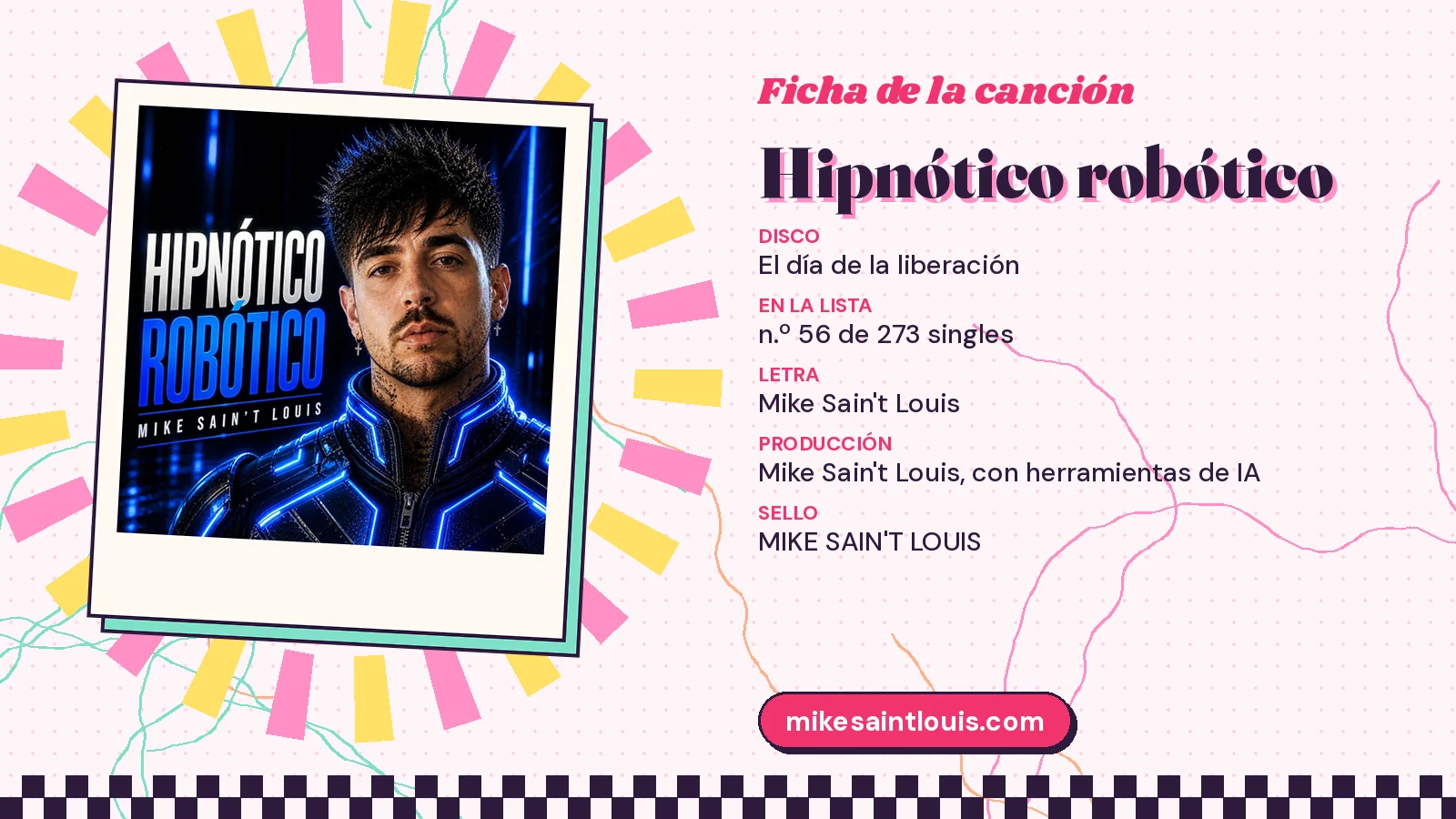
The track belongs to «El día de la liberación» (Liberation Day), the album that closes the Gayfolk trilogy. And it makes sense that it's there. Freeing yourself is also realising you were on loop and deciding to break it. Switching off the neon suit. Finally blinking.
On the same album lives «He creado un novio con inteligencia artificial» (I've created a boyfriend with artificial intelligence), which plays with the idea of making love to measure. The two songs talk to each other: one about the love that programs you, the other about the love you program. Neither formula, I'm afraid, guarantees anything.
Science fiction with flair
Science fiction was for a long time a genre of serious men with spaceships. But it has also been a refuge for those who didn't fit. Worlds where the rules were different, where bodies could change, where the strange was normal. Many queer readers and viewers found in those imagined futures the first place where they felt possible.
I think of androids that dream, of intelligences that fall in love with their users, of replicants who just want to live a little longer. Again and again, science fiction has used machines to talk about those society treated as less than people. The artificial as a metaphor for the marginalised. What has no right to feel and feels anyway. It's no accident that so many LGTBI people have seen themselves in those characters: beings required to pass as normal, who imitate what's expected of them and who, in private, hold a desire nobody programmed.
My planet Gayfolk comes from there. It's an invented place you wish you could travel to, and its aesthetic is full of rockets, neon and stars, as I explain in «Cohetes, estrellas y un planeta nuevo» (Rockets, stars and a new planet). The cover of «Hipnótico robótico» fits that universe as one more piece: science fiction with cross earrings, tattoos and a gaze that doesn't ask permission.
For whoever falls into a trance
For anyone who has stared at someone longer than advisable. For anyone who plays a song a hundred times in a row without tiring of it. For anyone who dances like a robot at four in the morning and doesn't care who's watching. For anyone who works with machines and insists there's someone inside.
And for anyone who has got out of a loop that was hurting them and learned to blink again. That person knows the hardest hypnosis to break is the one someone imposes on you. And that breaking it is a victory.
Until its lines see the light, this single is on Spotify and the other platforms, and you can take it free and without signing up from the site's downloads. Put it on loop, which is what the name asks for. And when I publish the lyrics, they'll go up complete and exact, without touching a single circuit.
Frequently asked questions
What is «Hipnótico robótico» about? The lyrics aren't published yet, so this post doesn't quote them. The cover shows a young man with spiky hair, cross earrings and a black suit traced with lines of blue light, staring straight at the camera. The post reads the title through hypnosis, robots and falling in love on loop.
Which album is it on? On «El día de la liberación» (Liberation Day), the third album of the Gayfolk trilogy. It's track 56 of 273, just before «Brilla bruma».
Where does the word robot come from? From the play «R.U.R.» (1920) by the Czech writer Karel Čapek, from the Czech word «robota», forced labour. His brother Josef suggested it.
What does Alan Turing have to do with this post? In 1950 Turing asked whether machines can think. He was also a gay man convicted in 1952 for his orientation and pardoned posthumously in 2013. The post remembers him when talking about artificial intelligence.
What can I do if I feel someone has me trapped in a relationship? Talk to someone you trust and seek professional help. In Spain, 024 answers free 24 hours a day and 112 covers any emergency. Outside Spain, look for your country's crisis line.
Who makes this song? Mike Sain't Louis, a lyricist, composer and music producer from Madrid, the first AI songwriter. He writes the lyrics and directs the production; the music and performances are generated with artificial intelligence.