By Mike Sain't Louis ·
The boyfriend with a serial number: riding a metaphor all the way to dark-haired boy number nine
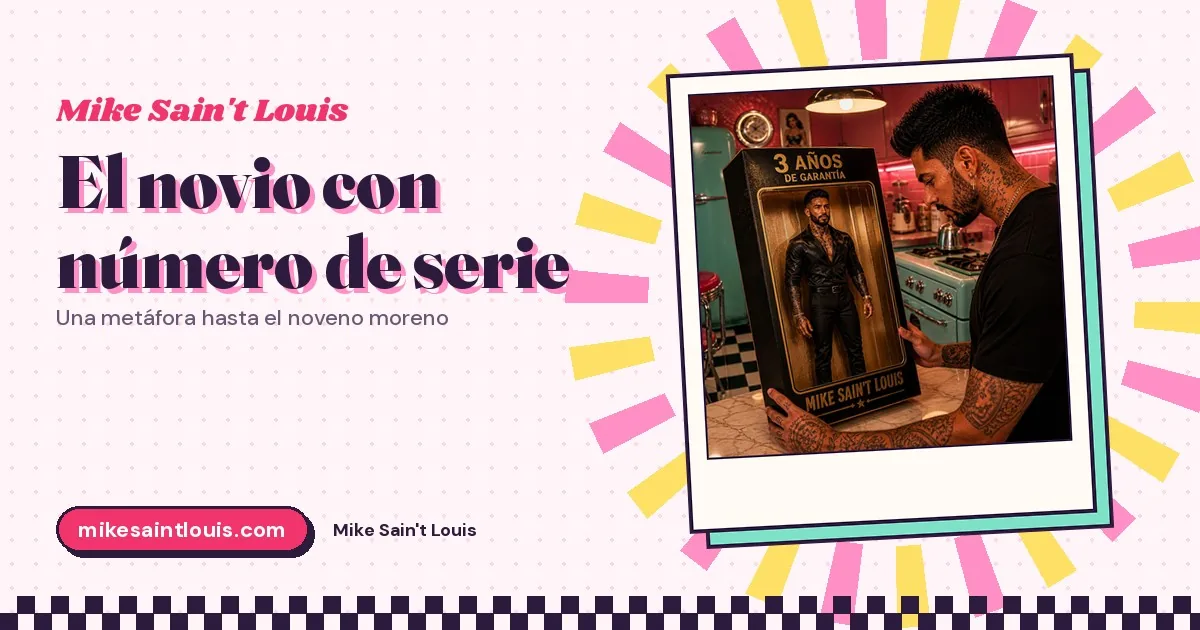
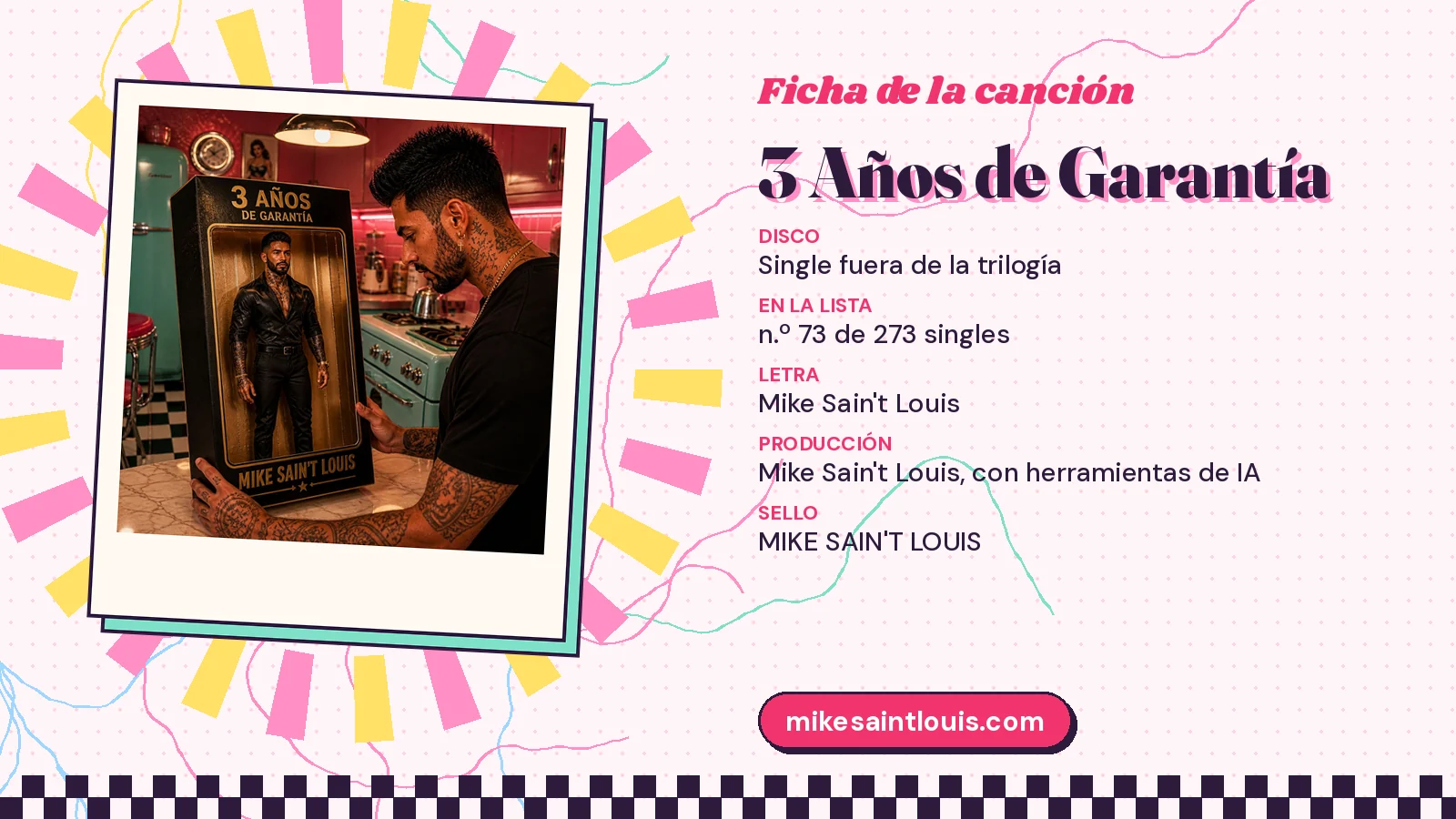
A 1950s kitchen. Rounded mint-green fridge, matching cooker, red tiles, a copper lamp hanging over the worktop. A guy with arms covered in tattoos is holding a cardboard box with a plastic window, like the ones collectible dolls come in. Inside the box, standing bolt upright, is the man himself in toy form: black shirt, black trousers, advert smile. Across the top of the box, in gold letters: 3 years' guarantee.
That cover sums up perfectly what I wanted to do with the song. Take a man and put him in a box. With his barcode, his instruction manual and his returns window.
And then, above all, never take him out of the box.
This post is about a rule of the craft I take very seriously, however much my songs look like a laugh: if you start a metaphor, you ride it to the end. Without blinking. Without winking at the audience. Even if it lands you in a consumer-complaints office in the Community of Madrid with a civil servant who has heard real horror stories.
I want a whole one
The song begins the way every late-night shopping channel begins. An advert on the telly. A dark-haired boy, very cute, great body. And a narrator who, instead of sighing, does what anyone would do in front of an ad for a food processor at three in the morning: «Yo quiero uno entero» («I want a whole one»).
I wrote that line with the butcher's in mind. «Give me a whole one», like ordering a roast chicken on a Sunday. Not half. Not a quarter. Whole, with everything. It's the first sign that in this song love is going to be treated as merchandise from start to finish, and that the narrator is delighted to be buying.
You have to commit early. If the first verse wobbles, if the narrator goes soft or has second thoughts, the metaphor collapses. The audience needs to know within the first ten seconds what game is being played. And here the game is clear: this is an order.
The discipline of the absurd
A lot of people think absurd humour is improvisation. That you just fire off nonsense and see what sticks. It's exactly the other way round. The absurd is one of the most disciplined things there is, because it only works if it has an iron internal logic.
I think of Martes y Trece, the Spanish comedy duo, and their sketch about the empanadilla from Móstoles, which is pure logic pushed to delirium. I think of Gila on the phone to the enemy. I think of «Aquí no hay quien viva», the sitcom where every bit of madness among the neighbours has a cause and a consequence. Good absurdity doesn't break its own rules. It follows them so solemnly that it makes you laugh.
With «3 Años de Garantía» I gave myself one rule: the dark-haired boy is a household appliance. And everything that happens to him has to be something that would happen to a washing machine. Delivery within twenty-four working hours. Cash on delivery. A month's trial. A guarantee. A fault at two years and a bit. The repair shop. Final breakdown just as the guarantee runs out, which is the unwritten law of every appliance on earth. A complaint. An official reply. A recommendation to chuck it in the skip.
I never stepped out of it once. And that, I think, is what makes the song work. I never stop treating the boyfriend like a fridge, not even when the narrator loses his temper.
I talk more about this kind of discipline in how to write a chorus that laughs at you and with you. The rule there is a different one, but the principle is similar: the joke has to respect itself.
A nice review on Google
There's a detail I adore, and it's brought me more comments than almost anything. After the dark-haired boy is delivered, the narrator is so pleased with the service that he does what we all do with a friendly company: «Les puse en Google una buena opinión» («I left them a nice review on Google»).

Five stars. Very friendly. Fast delivery. Would recommend.
That line is my little tribute to modern life, where everything gets rated. We rate the delivery driver, the restaurant, the ride-hailing driver, the dentist. Why not the boyfriend? And the best part is what comes next, which the song doesn't say but anyone can picture: the review is still there, on Google, with its five stars, while the product has turned into a nightmare.
Few things are more humiliating than your own old reviews. The couple photos you haven't deleted. The public «I love you»s. The «how lucky am I» comments. It all stays there, archived, like a five-star review of a faulty product.
I laugh about it because it's happened to me. To me and half of Chueca.
Cash on delivery, like the nineties
There's a detail in the first verse that gives away the writer's age, and I admit it shamelessly: the narrator takes the money out of his bag and pays cash on delivery.
Nobody pays cash on delivery any more. Now you pay with your phone, one click, a fingerprint, and the money vanishes without you ever seeing it leave. But in the nineties, in my house and every house in my neighbourhood, cash on delivery was a ritual. The postman or the courier would ring the bell, and you had to have the money ready in an envelope, counted to the cent, because they never had change. That's how orders arrived from the Venca catalogue, things from the shopping channel, records you sent off for by post.
Putting that gesture into the song is part nostalgia, part joke. It's buying a boyfriend the way you'd buy slimming shapewear at two in the morning. With the envelope, the handbag, the thrill of opening the parcel in the living room to see if it's as gorgeous as in the advert.
Spoiler: it never is. But for a month, it is.
Thirty days of guaranteed bliss
The trial month is another of those details that look like filler and are, for me, load-bearing. At first it was all marvellous, say the lyrics, and a salesman reassures the narrator with a no se preocupe, señor, don't you worry, sir.
I love that sir. It's the formal address of the shop assistants at El Corte Inglés, Spain's grand department store, of the sales reps who ring your landline at siesta time. And it's the tone of the person selling, not the person loving. In my song, the one promising that everything will be fine isn't the boyfriend: it's customer services.
Thinking about it now, it's a pretty accurate way to describe the start of some relationships. Everything is wonderful, everything is guaranteed, and the one assuring you most eagerly is exactly the one who gains most from the sale. The trial month isn't for you to test the product. It's for you to get hooked before the faults start.
And when they do, there's no returning it. The deadline has passed. It's in the small print.
The repair shop, two years and a bit
The song has a narrative tempo that, if you look closely, matches the real lifespan of a lot of appliances. Trial month, all marvellous. Two years and a bit, it starts playing up. Three years, it packs in completely.
That's not an accident. I wanted listeners to recognise that rhythm, because it's also the rhythm of a lot of relationships lived in a hurry. The honeymoon phase. The phase of the first repairs, when there's friction but it goes to the shop, there's talking, it gets patched up. And the final phase, when no spare part on earth will do.
The repair shop deserves its own paragraph. In the song, the first time round, they more or less manage to fix it. That more or less is a whole philosophy. It's the couples therapy that half works. It's the make-up after the row, which leaves things standing but with a funny little noise that wasn't there before. Like the washing machine that comes back from the engineer spinning, yes, but bouncing so hard it moves the kitchen.
Anyone who has lived through a «more or less fixed» knows exactly what I mean.
The word calvary
In the chorus there's a word that belongs neither to the office nor to the shopping channel, and it sneaks in on purpose: calvario, calvary. At three years, it says, my calvary began.
It's a Holy Week word. Processions, pointed hoods, a saeta lament wailed from a balcony in Seville. Putting it next to an expired guarantee mixes the liturgy with the till receipt, and that mix feels very Spanish to me. This is how we suffer here: one foot in the religious brotherhood and the other in the queue at the complaints office. Tragedy and paperwork walk hand in hand.
It's also an over-the-top word, and I know it. Nobody in their right mind calls a broken washing machine a calvary. But the narrator isn't talking about a washing machine, however much he pretends. And in that exaggeration the truth slips out: what's broken hurts far more than the appliance metaphor lets on.
That's the crack. Through that word you can see that, under the guarantee joke, there's someone who has had a genuinely rough time. The complaints are draining my energy, he says right after. And that's not a shopping-channel gag any more. That's exhaustion. The kind that gets into your bones and doesn't lift with a nap.
I like leaving those cracks. If the metaphor were perfect, without a single fissure, the song would be a well-oiled mechanism and nothing more. With the crack, it breathes.
A reference number for a chorus
Now comes the part I'm proudest of as a lyricist, and which a lot of people find insane: putting a reference number in the song. All of it. With its slash A.
495, 492, 559, 13, 27 slash A. Signed by the Community of Madrid.
In the lyrics it's written out in words, digit by digit, the way a civil servant would read it to you over the phone. And it repeats. Twice in a row. It's a chorus made of bureaucracy.
I did it for two reasons. The first is rhythm: numbers read out one by one have a curious musicality, almost a mantra, like telling the rosary in the waiting room of a government counter. The second is contrast: in the middle of a love song, even a shopping-channel love, the coldest language in the world turns up. The language of case files. The language without a single adjective.
That contrast is very Madrid, I think. Madrid is a city of counters, of impossible appointments, of queues at Social Security and recorded-delivery letters that arrive when you're out. Those of us who live here have an intimate relationship with case numbers. We recite them by heart. We stick them on a Post-it on the fridge.
I wrote about the city as a stage in Madrid without the postcard. This song could be a chapter of that post: Madrid without Cibeles or Gran Vía, just its consumer office.
Like the trout loves the trout
And now the official reply, my favourite part of the whole lyric.

The consumer office answers, and quickly, which in Madrid is news in itself. They've spoken directly to the accused. And the accused says he's madly in love. That he loves him, and I quote, «como la trucha al trucho», like the lady trout loves the gentleman trout.
That expression comes straight out of childhood. It's an old saying, a granny saying, a village saying, the kind you hear at family gatherings in the courtyard on plastic chairs. It felt perfect to put it in the mouth of a faulty product trying to wriggle out of a complaint. Because that's what a lot of people do when you catch them out: reach for the stock phrase, the cosy cliché, the textbook excuse. I love you so much. I'm madly in love. Like the trout loves the trout.
And the office, which has seen it all, doesn't buy it for a second. It says there have been many affected customers. That most of them arrived at the office in pieces.
That's where the song turns, without warning, and stops being only mine. It's not a faulty boyfriend any more: it's an entire model leaving a trail of victims. The fault isn't a manufacturing defect. It's a design flaw.
Number nine
The civil servant's advice is so sensible it's frightening: «Tendrá que comprarse otro moreno» («You'll have to buy yourself another dark-haired one») and throw the faulty one in the skip.
It's the advice your friends give you at two in the morning, on the third drink. Forget that one, there are loads more. Bin him. Delete him. Into the recycling. And the narrator answers with the line that turns the song into a tragedy: with this one, he's already on number nine.
Nine dark-haired boys. Nine boxes. Nine guarantees.
That number feels like one of the most honest things I've ever written about myself, even wrapped in a joke. Because it's about something we all do and nobody admits: buying the same model over and over. From a different shop, in different packaging, but the same product. Dark hair, cute, great body, and faulty at three years.
The self-parody is right there, served on a plate: maybe the problem isn't only the dark-haired boys. Maybe it's also whoever keeps placing the same order. I drop it and leave it. One moral per song is plenty.
And the civil servant's parting shot is pure horror film: with that dark-haired one, he's heard real horror stories. That nod to horror links up with songs of mine like «Como en la matanza de Texas», where the monster is no longer an office metaphor but a chainsaw one.
The explosion, and an ending that opens another door
In the end, the narrator blows. They've made him explode, he says. He tells the lot of them to go to hell. It's the only moment the bureaucratic patience breaks, and it goes with a door slam that rattles the windows.
And then comes the way out. The final solution for never buying a tenth faulty dark-haired boy: better to create a boyfriend with artificial intelligence.
I wrote that ending knowing full well who was writing it. I make songs with AI tools. The music and the vocals on this very song come from there, from programs like Suno, while the lyrics are mine and written without machines. Having the narrator end up suggesting an artificial boyfriend is, for me, a joke at my own expense. It's like a butcher ending his song by announcing he's going vegan.
And it's also a door. Because that idea didn't stay in the last line: it grew into a whole other song, He creado un novio con inteligencia artificial. One ends where the other begins. I love it when my songs pass the ball like that, like neighbours chatting across the light well.
Hold it, don't explain it
Back to the rule from the start, because I think it's the most useful thing I can tell anyone who writes about this song.
Holding a metaphor means, above all, not explaining it. At no point do the lyrics say «this is as if love were a product». Never. There's no verse acting as interpreter for the distracted listener. The listener has to do the work alone, and does it gladly, because working it out for yourself is part of the pleasure.
When I started writing, I did the opposite. I was scared it wouldn't be understood, so I'd tack on a line of explanation at the end, a sort of subtitle so nobody got lost. And those lines killed the song. It was like telling a joke and then explaining why it's funny.
I learned it by getting it wrong, and I told some of that in my lyric notebook. Trusting the listener is a form of respect. If I believe they'll get me, I write better.
The toy box
Let me stay with the cover a little longer, because it does exactly what the lyrics do.
The man holding the box and the doll inside it are the same person. The buyer and the product. The one who asks for a whole one and the one who comes boxed. I'm fascinated by that ambiguity. Which one is faulty? The one in the box or the one who bought it? Or both, each with an expired guarantee?
The retro kitchen is deliberate too. It's the kitchen from fifties adverts, happy housewives with shiny new appliances and hairspray smiles. The American dream of the perfect home, where everything works and everything comes with instructions. Dropping a tattooed guy and his boxed boyfriend in there breaks that dream from the inside, with plenty of camp and a dash of spite.
I explain that kind of cover better in what an art director does when there's no budget. Here I'll just say that the box has the brand name at the bottom, like any collectible toy. And that I have no intention of opening it.
If you've ended up with a faulty one
I'm not going to tell you to throw anyone in the skip. Leave that to the civil servant.
What I will tell you is what writing this song taught me. That laughing at your own bad luck is far healthier than playing the victim on a loop. That buying the same model again is human, but at some point it's worth looking at the catalogue with fresh eyes. And that if you've reached number nine, it's fine: some people are on number fourteen and still fresh as a daisy.
And if one day you get sick of the lot of it, the dark-haired boys, the guarantees and the consumer offices, there's always the option at the end of the song. I don't recommend it. But it's my song, and in my song I suggest it.
Meanwhile, keep the receipt somewhere safe. Just in case.
Frequently asked questions
What is «3 Años de Garantía» about? A boyfriend bought as if he were a household appliance: he's delivered within twenty-four hours, comes with a month's trial and three years' guarantee, and breaks down just as the guarantee expires. Then comes the complaint form and the consumer office's reply.
Where can I read the full lyrics? The lyrics are published at gayfolkplanet.com/letras/3-anos-de-garantia.
Why does it end with artificial intelligence? Because the narrator, fed up with faulty dark-haired boys, proposes building himself a boyfriend with AI. It's a joke from someone who makes music with AI tools, and the idea grew into another song, «He creado un novio con inteligencia artificial».
Who writes the song? The lyrics are by Mike Sain't Louis, a lyricist, composer and music producer from Madrid, written without AI. The music and the vocals are created with artificial intelligence tools such as Suno.