
By Mike Sain't Louis ·
The fear of being a bother: «Punto muerto» and the feeling that you're wasting everyone's time
There's a sentence a lot of people say to themselves and almost never out loud. Nobody else needs to say it, because you already say it yourself, every day, on a loop: I don't want to be a bother. I don't want to be a pain. I'm sure they've got more important things to do. And with that sentence, which looks like good manners, you go quieter and quieter until you're left alone with whatever is happening to you.
«Punto muerto» (Neutral, or Dead point) is a song built around that feeling. It's one of the shortest on «Ojalá se pudiera viajar a Gayfolk», and on the song's own page I've already talked about its stars and its structure. The full lyrics are published and take a minute to read. Here I want to stay with the line that is, for me, the centre of everything: sometimes I think I'm just a bother, and I waste everyone's time with my lament.
That line deserves a whole post because it describes something a great many people live through and rarely put a name to. The fear of being a burden.
What a «punto muerto» is
Let's start with the title, which has more to it than meets the eye. In Spanish, «punto muerto» has several meanings, and they all fit the song.
In a car, «punto muerto» is neutral: the position of the gear lever with no gear engaged. The engine is running, making noise, burning fuel, but the car doesn't move. You can press the accelerator as hard as you like: you're going nowhere. It's a perfect image for a certain kind of sadness. Inside, everything is working, sometimes even too fast, and outside nothing happens.
In mechanics, «punto muerto» is also dead centre, the position where a piston changes direction and, for an instant, stands still. The exact moment when it's no longer rising and not yet falling.
And in everyday language, a negotiation or a relationship is at a «punto muerto», a standstill, when it moves neither forwards nor backwards. Nobody gives way, nobody leaves, and everything stays frozen.
All three meanings are about the same thing: being stopped without being switched off. And that's exactly how the person speaking in the song feels. Not dead, even though the title says «muerto». Stuck in neutral. Which is something else, and in a way more distressing, because the engine is still running.
A lyric written word by word
The published lyric has a very particular shape. The long verses, the ones about the stars, appear as full sentences. But the chorus is broken into pieces, one word per line: and it's that I'm, in, a, dead, point. And then: and sometimes I think, that I just, bother.
I'm not going to explain why the lyric was written out like that, because the published version carries automatically revised formatting and I don't want to attribute intentions I can't vouch for. What I can describe is the effect it has when you read it. It looks like the way someone talks when talking is hard. Someone who says one word, stops, breathes, and says the next. Like when you're so tired that every sentence weighs on you.
That effect fits what the text says very well. A person who feels like a bother says little, slowly, almost apologising for every word. The shape of the lyric on the page resembles that way of speaking.
Among so many stars
The song begins by looking up. Among so many constellations, galaxies and stars, how am I going to be the one who gives off a special glow?

It's an enormous question, the kind you ask at night. And it rests on something real that's a little dizzying. Our galaxy alone holds hundreds of billions of stars, and the observable universe contains more galaxies than we can even picture. When you look at the sky somewhere without light pollution, what you see is only a tiny fraction, and even so it seems infinite.
Faced with that, anyone feels small. And the song uses that smallness in a very specific way: not to talk about the universe, but about self-esteem. If there's so much brilliance out there, what's so special about mine? Why would anyone notice me?
It strikes me as a very contemporary question, even though people have always asked it. Today we live surrounded by other people's brilliance: profiles, videos, successes, bodies, trips. Everyone looks like a star in their own shop window. And in the middle of that constellation of shining people, it's very easy to feel like a little light that's gone out.
Among so many false loves
The second question in the verse comes down from the sky to the ground. Among so many false loves, friends and partners, how am I going to be the only one who tells the truth?
Here the doubt flips. It's no longer «how am I going to shine?» but «how am I going to be the only honest one?». There's a little pride in that question, and a lot of exhaustion. Being the one who tells the truth in a world of lies is tiring. It turns you into the awkward one, the one who kills the mood, the one who says what nobody wants to hear.
Notice a detail in the published lyric: the first question speaks of «la que», the one who shines, in the feminine, and the second of «el que», the one who tells the truth, in the masculine. I'm not going to invent an explanation for that shift. I'll just say I like reading it as a way of making sure the song has no single owner. Anyone can be the one gazing at the stars and anyone can be the one worn out by lies.
Together, the two questions sketch someone trapped between two contradictory feelings: not being special enough and, at the same time, being too different. Too little to shine and too honest to fit in. That, deep down, is the dead point.
«Sometimes I think I'm just a bother»
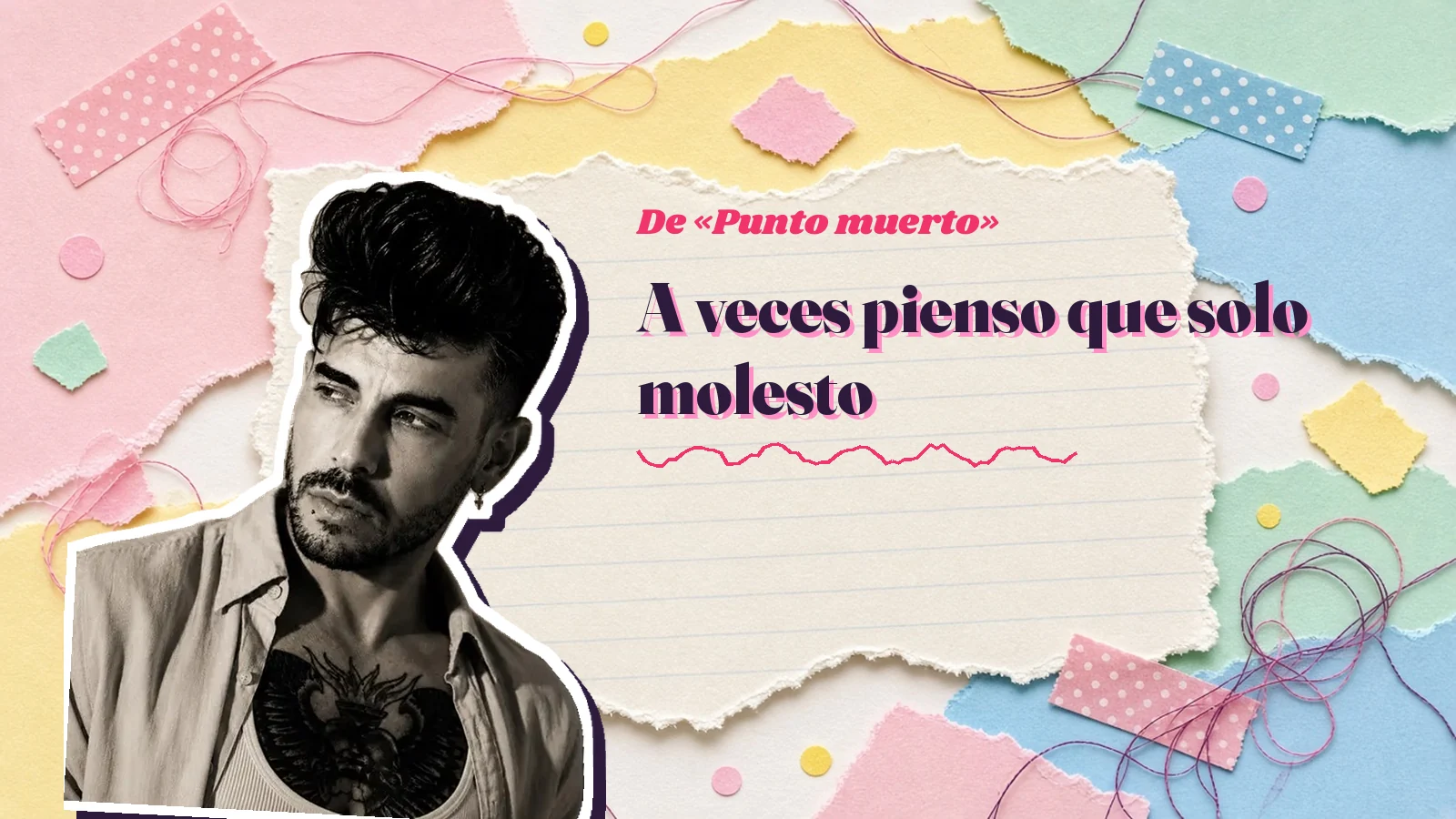
And here we reach the line. Sometimes I think I'm just a bother, and I waste everyone's time with my lament.
The first thing that strikes me is the «sometimes». It doesn't say «always». It says «sometimes», as if acknowledging that this isn't a constant thought, but one that turns up at certain moments. Usually the worst ones. I find that precision honest: feeling like a bother isn't a truth about a person, it's a state that comes and goes.
The second thing is the verb «I think». It doesn't say «I'm a bother». It says «I think I'm a bother». The distance between those two is hugely important. What we feel is one thing; what actually happens is another. A person thinking they're a bother doesn't mean they are. Often it only means they're tired, sad or scared.
And the third is that idea of wasting time. The lament, the complaint, telling someone what's going on, all of it is experienced as theft. As if every minute someone spends listening to you were stolen from something more important. It's a very cruel way to look at yourself, because it turns the need for company into a fault.
The fear of being a burden
That feeling has a name in many places: feeling like a burden. It's very common in people going through depression, a break-up, bereavement or a lonely stretch of life. And it contains a terrible trap: the worse you feel, the more you need other people, and the more you need them, the more you feel you're bothering them.
The result is that many people isolate themselves precisely when they most need help. They don't call their friend because «I already called her last week». They don't message their brother because «he's got his own problems». They tell their partner nothing because «I don't want to weigh him down». And so, with the best of intentions, they end up alone.
The song offers no solutions, but it does something very valuable: it says the sentence out loud. And when a sentence like that is said out loud, it loses some of its power. It stops being a secret thought and becomes something you can look at, discuss and, with luck, take apart.
What's almost never true
I'm going to allow myself an opinion, because I think it needs saying clearly: it's almost never true that you're wasting anyone's time by telling them what's happening to you.
Think about it the other way round. When someone you love tells you they're not doing well, do you feel they're stealing your time? Normally you don't. Normally you're glad they trust you, you want to help, and you're more worried about not having found out sooner. Well, other people usually feel the same about you.
The fear of being a bother usually says more about how we treat ourselves than about how others see us. We hold ourselves to a standard we'd never apply to anyone else. We'd never tell someone «don't tell me your troubles, you're wasting my time». But we say it to ourselves without blinking.
That doesn't mean you have to tell everyone everything, or that anyone is always available. But it does mean that lamenting, telling, asking for company are legitimate things. They're not a nuisance. They're part of being alive.
The loneliness of making things
There's another possible reading of «Punto muerto», and it has to do with the work itself. Anyone who makes something creative independently knows that feeling of being stuck in neutral: working incredibly hard, engine at full throttle, and feeling that nothing moves. That what you make gets lost among millions of other things, like one more star in the sky.
I've written on the blog about the loneliness of the independent AI artist and about the loneliness of creating alone, and «Punto muerto» can also be read from there. Among so many songs, so many artists, so many releases every day, how is mine going to be the one that gives off a special glow? And when you show someone your work, are you wasting their time?
I'm not saying the song is about that. The lyric doesn't say so, and I don't want to force it. But I find it interesting that such a short song can be read from so many places: heartbreak, loneliness, sadness, the craft. That's the good thing about short lyrics. They leave room for the listener to bring their own.
A song that repeats itself
The structure of «Punto muerto» is very simple: a verse with the two questions, the broken chorus, and the same again. There's no third section, no bridge, no ending that resolves anything.
That repetition says something too. That's how the thoughts that hurt us work. They don't progress, they don't evolve. They come back again and again in the same words. How am I going to be the one? Sometimes I think I'm just a bother. How am I going to be the one? Sometimes I think I'm just a bother. It's a loop, like a car in neutral revving without moving.
And that's precisely why the song doesn't end with a solution. It ends where it began, in the lament. I think that's an honest decision. Some songs pull you out of the pit, and others simply keep you company down there. «Punto muerto» is one of the second kind.
The word «lament»
The last word of the chorus is «lamento», lament, and I find it a lovely choice. It doesn't say complaint, or crying, or moaning. It says lament, a word with a long history.

In music, the lament is almost a genre of its own. The Baroque period produced some very famous laments, pieces in which a character expressed their grief in a solemn way, such as Monteverdi's «Lamento della ninfa» or Dido's lament in Purcell's opera «Dido and Aeneas». They were moments the audience waited for, because there the work stopped moving forward and dwelt on someone's suffering.
And in popular tradition the lament has its place too. In flamenco and copla, the «quejío», the «ay», pain expressed without shame, are an essential part of the art. Nobody thinks a «seguiriya» is a waste of time. On the contrary, people listen with respect, because pain well expressed has value.
That's why it seems so significant to me that the person in the song sees their own lament as a waste of time. For centuries, music has treated the lament as something worthy of attention. And they, by contrast, experience it as a nuisance. In the end the song contradicts its protagonist: it turns their lament into a song. It puts it in front of everyone. And in doing so, it gives it the value they weren't giving it.
The honesty that isolates
Let me go back for a moment to the second question, the one about being the one who tells the truth among so many false loves and friends. There's a very direct link between that question and the fear of being a bother.
People who say what they think often end up feeling uncomfortable in certain settings. When everyone around you pretends everything is fine, being the one who admits it isn't makes you the jarring note. And from there to thinking «I'm a bother» is a very short step. If I'm the only one telling the truth, maybe the problem is me. Maybe I should keep quiet.
But that conclusion is misleading. A truth being uncomfortable doesn't mean it's unwanted. Often the person who dares to say «I'm not OK» is the one who lets everyone else say it too. The first crack in a façade that was weighing on all of them.
In queer culture we know that dynamic well. For a long time, telling the truth about who we were was experienced as a nuisance for others: something that made the family dinner table, the office or the group of friends uncomfortable. And many of us learned to keep quiet so as not to be a bother. That's why a song that puts that sentence front and centre and looks it in the eye matters so much to me. Keeping quiet so as not to bother anyone has a price, and it's almost always paid by the one who keeps quiet.
Stars that are no longer there
There's an astronomical fact that has always struck me as very poetic, and it fits the song. Starlight takes time to reach us, sometimes a very long time. So when we look at the sky, we see the stars as they were years or even centuries ago, not as they are now.
That means the sky we see is, in part, a memory. And I like thinking about it in relation to the song's question. Comparing your glow with that of the other stars means comparing your present with their past. With an image that's no longer exactly real. Just like comparing your sadness today with other people's happy photos.
Why a song like this in Planeta Gayfolk
Anyone who knows the catalogue knows Planeta Gayfolk is full of humour, exaggeration, ridiculed exes and camp parties. «Punto muerto» has none of that. No joke, no creative insult, no copla-style drama. Just a person looking at the stars and thinking they're a bother.

I think that contrast matters. Humour is one way to survive, but it isn't the only one. Sometimes you have to stop the party and say things plainly. There are other songs on the album that drop the tone like this, such as «The Great Depression», and «Llorar» goes down that road too. They're the 3 a.m. songs, the ones you listen to with headphones on and the light off.
The album it belongs to, «Ojalá se pudiera viajar a Gayfolk», If only you could travel to Gayfolk, has that «if only» in its title, colouring everything. Gayfolk is an imagined place where things are better. And «Punto muerto» is the song that reminds you why it needs imagining: because here, on this planet, getting going is sometimes very hard.
Getting out of neutral
If you recognise yourself in the song, a few ideas might help. They're not recipes and they don't replace anyone who knows about this, but they can help you put it into first gear.
- Separate the thought from the fact. «I think I'm a bother» isn't the same as «I'm a bother». Write the sentence down and ask yourself what real evidence you have.
- Try it the other way round. Imagine a friend telling you the same thing. Would you tell her she's wasting your time? Almost certainly not.
- Start small. You don't need to tell everything at once. A short message, a «fancy a coffee?», is already a way out of neutral.
- Look for professional help if the thought keeps coming back or weighs too much. Talking to a psychologist isn't bothering anyone: it's their job, and it's a way of looking after yourself.
- And if that thought ever goes further and thoughts of harming yourself appear, in Spain you can call 024, the suicide prevention line, free and available at any hour. In an emergency, call 112.
None of this is wasting anyone's time. Quite the opposite: it's how you get yours back.
What I love about this song
Of all the short songs in the catalogue, «Punto muerto» is one of the ones that moves me most, precisely because it doesn't try hard to shine. It's a small light in the middle of an album full of neon. And maybe that's why, when you look at it closely, it shines in a different way.
It's funny, if you think about it. The song asks how it's going to be the one with a special glow among so many stars. And the answer, in the end, is in the song itself: precisely by daring to say what almost nobody says. By admitting the fear of being a bother. That, among so many constellations of people pretending everything's fine, is already a special glow.
As a lyricist, composer and music producer, I like that the catalogue has room for songs like this. The music and the performances are generated with artificial intelligence, but the fear of being a bother, the sentence broken into pieces, the night spent looking at the sky, that's completely human.
How to listen
The song is on the singles page and on every platform, and you can download it from the downloads section. It's short, so it won't waste your time. And if it touches something inside you, maybe it's a good moment to message someone. I'm sure you won't be a bother.
If this subject hits close to home: in the series «Mental health without taboo» I talk openly about my mental health (narcissistic abuse, the bullying and abuse I suffered as a child, my diagnosis at 41, and therapy) and gather where to find help. If you're thinking about suicide, call 024 in Spain, or your local emergency number elsewhere.
Frequently asked questions
What is «Punto muerto» about? It's about feeling stuck and thinking you're nothing but a bother to others with your sadness. The lyric looks at the stars, wonders how it could ever shine among so many, and repeats one central line: sometimes I think I'm just a bother, wasting everyone's time with my lament.
What does «estar en punto muerto» mean? In a car, it's neutral: the engine runs, but you don't move. In everyday Spanish, a situation is at a «punto muerto» when it's going neither forwards nor backwards. The song uses the expression to describe a state of emotional deadlock.
Which album is it on? It's part of «Ojalá se pudiera viajar a Gayfolk», one of the albums in Mike Sain't Louis's Gayfolk trilogy, available on Spotify and all other platforms.
Who makes this song? Mike Sain't Louis, a lyricist, composer and music producer who calls himself the first AI songwriter: he writes the lyrics and directs the production, and the music and vocal performances are generated with artificial intelligence.