
By Mike Sain't Louis ·
Karma's in no hurry: why I wrote the same score to settle twice
A punch a day. Just like that, as regular as the morning loaf or the vending-machine coffee at the office. That's the starting point, and I didn't choose it for its looks.
The first line of «Karma (Versión Alternativa)» goes like this:
«Y no me acordaba cuánto dolía / que te den un puñetazo al día.» "And I'd forgotten how much it hurt / to take a punch every day."
And I repeat it. Once, twice, three times. No introductory verse, no "once upon a time", no little guitar to warm you up. You step into the song and you're already being hit. It's the closest thing I know how to make to what happens in real life when a memory ambushes you in the supermarket queue: no warning, no permission asked, no waiting until you've put your basket down.
This piece won't repeat what's already on the song's page. Here I want to talk about something else. About why one score to settle asked me for more than one song, why I trust karma rather than my own hands, and why I put mojo and gofio into a lyric about pain. It may not look like it, but the three things are closely related.
The same wound, another morning
On the first album of the trilogy, *Descubierto un nuevo planeta llamado GAYFOLK*, there's a «Karma» and there's this «Versión Alternativa». And close by lives another sister, «Un puñetazo al día», "A punch a day", whose title tells you straight away where it's coming from. If anyone thinks I'm repeating myself, they're right. I am. The way someone repeats themselves after a relationship that left them shaken: they tell their sister on Monday, their friend on Wednesday, their therapist on Friday and the barman downstairs on Saturday, and every time they tell it a little differently.
That's the point. It isn't the same story told the same way. It's the same story told by someone who woke up that day in a different body.
There are mornings of rage, when you'd sit down to write with a lighter in your hand. There are afternoons of weariness, when all you can manage is "oh, for heaven's sake, this again". And there are nights of mischief, when the same trauma seems like a farce and you laugh to yourself on the sofa, phone in hand. All three are true. All three fit inside one person. And a song, if it's honest, needn't pick one and bin the others.
One of the rules pinned up on my «About» page says that a song kept in a drawer is no use to anyone. I'd add a homespun footnote: neither is a wound kept in a drawer. It rots. It smells. And when you open the drawer a year later, the smell is worse than it was at the start.
So I bring out both. Let the listener choose the one that suits their day. Or play them back to back; it takes all sorts, and I'm one of those sorts.
I won't tell you here, note by note, what changes in the production from one to the other. First, because that's better heard than read. And second, because my thing is the lyric: the music and vocals on Planeta Gayfolk are made with artificial intelligence tools such as Suno, and what I bring to the table is the words, the idea, the title, the cover, the decision about what goes out and what doesn't. I explain it more calmly in what's mine in a song made with AI. Here it's enough to say the lyric is the same, and that's already a statement.
What I thought I'd got over
There's a line in the middle of the song that is, for me, its centre of gravity. What holds it up. Everything else orbits around it:

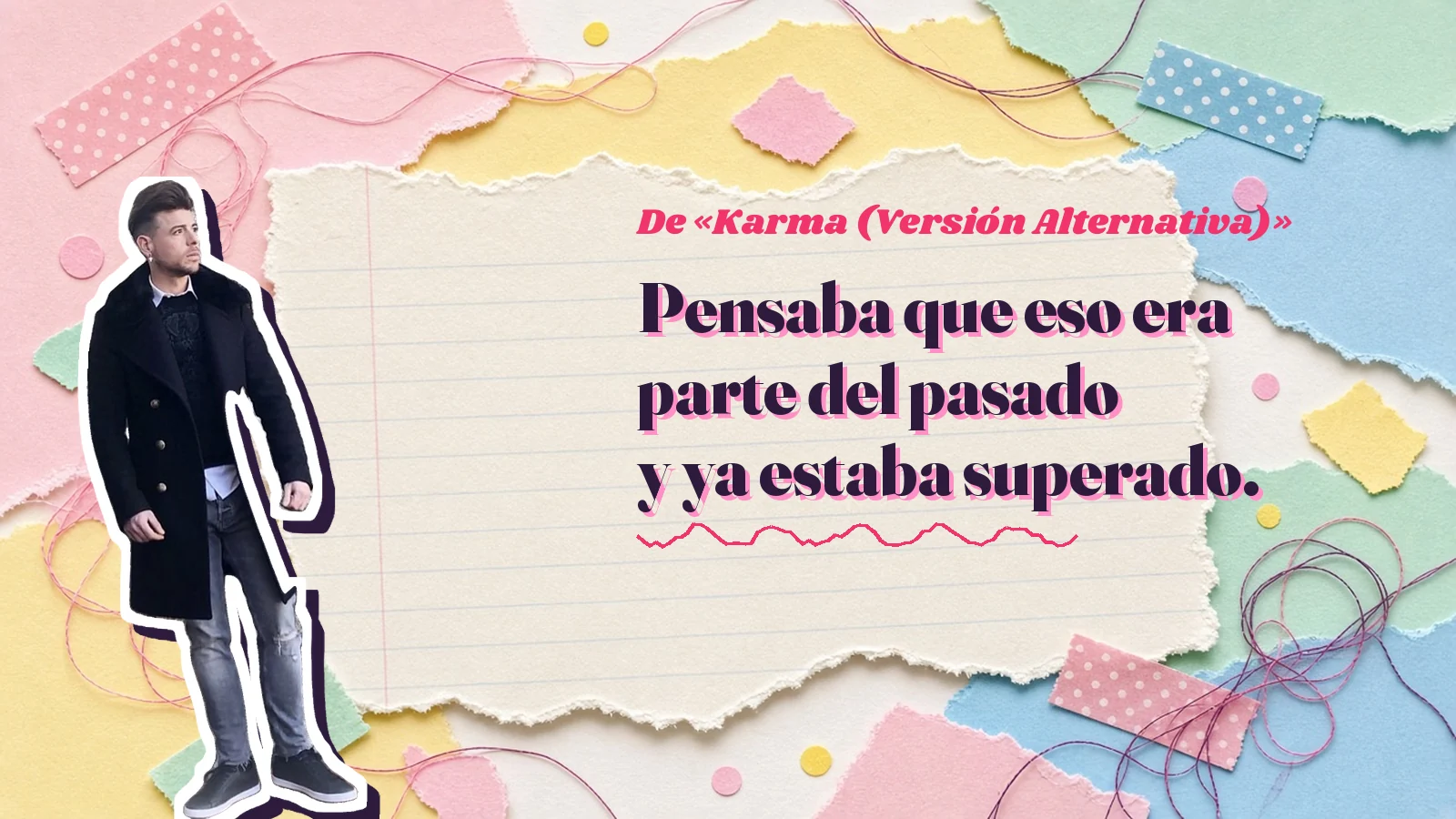
«Pensaba que eso era parte del pasado / y ya estaba superado.» "I thought that was all in the past / and I'd got over it at last."
Got over it. Such a breakfast-mug phrase. Got over it, as if it were a level of Candy Crush. As if life handed you a little medal with confetti and a jingle: "Congratulations! You've got over your ex. Next screen."
Well, it doesn't work like that. At least I don't know anyone it's worked like that for. What really happens is that one day you're feeling fabulous, you've bought new trainers, the neighbour has told you you're looking well, and suddenly a perfume on the Metro, a song on the taxi radio, an advert for cheap flights to Tenerife or a photo the algorithm serves up sends you back to square one. And square one isn't neutral ground. Square one has a bloke in it punching you. Every day.
That's why the lyric says that this, taking one a day, is what I'd forgotten. Not the single punch. The habit. The routine of harm, which nobody sees from the outside, because from the outside all you see are the dinners, the birthdays, the Sunday paellas, the filtered photos on the beach.
When something hurts you once, you remember it as an accident. When it hurts you every day, you forget it. It becomes background noise, like the hum of the fridge, which you only notice when it cuts out. And when it finally cuts out, the silence is so strange you almost miss it.
That's what frightens me most about all this. That a person can get used to it.
Karma as a way of keeping my hands clean
And then comes the chorus, a single word stretched like strawberry bubblegum in a seven-year-old's mouth:
KAAAAAARMAAAAAA.
I know stretching vowels is one of my habits. I do it in «El narcisista» with that «frozeeeen», and I do it here. I like it because it turns a serious word, almost airport self-help, into a shout across a courtyard of gossiping neighbours. Karma said like that doesn't sound like a Tibetan monk. It sounds like Rociíto, Spanish tabloid TV royalty, on a chat-show set at eleven at night. It sounds like your auntie's affectionate threat: "you carry on like that and you'll see."
And here's the bit I want to make clear, because it's often misunderstood. Asking for karma to come isn't the same as asking for revenge. It's almost the opposite.
When I say "everything comes round, and it's called karma", what I'm saying is: it won't be me. I'm not going to spend my time or my money paying you back. I'm not going to cut up your sheets, or key your car, or message your new Grindr date to tell him what he's getting into. Let the universe do it; it has more free time than I do and better aim.
Karma, in the song, is a delegation of duties. An agency. I leave the file at the counter and go off for tea.
I know the idea is naive. I know some people do harm all their lives and die in a bed with a sea view, surrounded by grandchildren buttering them up. I'm not daft. Well, sometimes I am, but not about this. The thing is, a song isn't a police report. A song is where you can say what you need to believe in order to carry on, even knowing it doesn't always come true.
And what I needed to believe was this: that it isn't my job.
There's a huge difference between this lyric and that of «Escupiré sobre tu tumba», "I'll spit on your grave", on the same album. There, the fantasy is pure B-movie, shotgun and explosion included, and the narrator steps into the shoes of a revenge-film heroine. In «Karma» there's no heroine. There's someone who's taken a blow they didn't see coming and who, instead of reaching for a shotgun, sits down to wait. Two ways of surviving the same thing, and I've had days of both.
Mojo, gofio and other kitchen weapons
And suddenly, halfway through the song, the punch turns into a joke. Because I can't stay serious for long. Because if I stay serious for long I start crying, and I've got the shower for that.
The lyric addresses someone by a nickname familiar to anyone who's heard other songs from the planet: el marrano de El Médano, the pig from El Médano (a beach town in Tenerife). And it offers him some sexual-health advice using ingredients from the Canarian kitchen:
«por mí como si lo metes en mojo / o mejor gofio, lo que prefieras.» "for all I care, dip it in mojo / or better still gofio, whichever you prefer."
(Mojo is the islands' garlicky pepper sauce; gofio, their toasted grain flour.) I laugh every time I read it. And I wrote it, which is a crime in itself.
Let me tell you why it works, or why I think it does. Mojo and gofio are homely things. Grandma's, the market's, the Sunday table's. The opposite of glamour. Nobody goes to a celebrity wedding and asks for gofio. Nobody makes a perfume advert with a bowl of mojo picón. And putting those two ingredients into a sentence about an ex's willy is cutting him down to size. Knocking him off the pedestal he'd climbed onto himself. Leaving him level with a wrinkly Canarian potato.
It's a technique I use a lot: when someone thinks he's a god, I put a ridiculous object in his hands. A Tupperware box. A pair of argyle socks. A bag of gofio. And there's no god left. Just a man holding a bag of gofio. I've already done it with gofio in another song, «Gofio de calcetín», and I don't regret reoffending.
Next comes a line about how this person has sex, unprotected and rather carelessly, and there the joke has an edge. It isn't a gentle joke. It's a dart with an addressee. And I'll leave it there without further explanation, because if I explain a joke I kill it, and I'd rather this one stayed alive and kicking.
On whether you can make gay humour with this much bite without hurting anyone who doesn't deserve it, I've written a whole piece: making gay humour without doing harm. My rule is simple: the joke aims upwards, or at whoever hurt you, never at someone already on the floor. The pig from El Médano isn't on the floor. He climbed up onto a pedestal all by himself, and from up there a little gofio on the head won't do him any harm.
Why I repeat so much (and why I don't apologise)
Read the whole lyric on the Lyrics page and you'll see it's short and keeps circling back on itself. The chorus comes round I don't know how many times. The punch line, just as many. Some will think, with the best intentions, that this is laziness. That a lyric should move forward, tell something new in every verse, have its beginning, middle and end like a secondary-school essay.

And I say: it depends.
Some songs move forward like a novel. And some go round like an obsessive thought. This is one of the latter, and it has to be. Because that's how your head works when something has wounded you. It doesn't move forward. It spins. It returns to the same sentence at three in the morning. To the same scene in the shower. To the same question while you're doing the washing-up. How could I have forgotten how much it hurt?
If the lyric moved forward in an orderly way, it would be lying. It would be saying pain has structure, and it doesn't. It has a loop.
And then there's the other thing, which I learnt over years of releasing almost non-stop: repetition is what makes a line stick. Nobody remembers the third verse of a summer hit. Everybody remembers the chorus. And what I want to stick is this: that everything comes round. That if you've been hurt every day, someone, somewhere, is going to have to pay the bill. Even if you're not the one collecting.
The pig from El Médano, again
Anyone reading me for the first time might wonder why this man turns up in so many lyrics. It's a fair question.
The short answer is that some people give you enough for an album. The long answer is that writing about the same figure again and again is a way of wearing him down. Like when you repeat a word so many times it stops meaning anything. "Pig from El Médano, pig from El Médano, pig from El Médano." By the tenth time he's no longer a person. He's a character. A fairground dummy you throw balls at. And for someone who has suffered, that's a liberation: going from someone's victim to the author of his caricature.
I don't say his name. There's no need. The nickname is enough, and besides, the nickname is mine. I invented it, I've registered it in my lyrics, I've made it a house speciality. He'll have his first name, his ID card and his profile with a gym selfie. But in my songs he's the pig from El Médano, and that's where he stays.
It happens with lots of my exes, and I talk about it in a little comic typology of ex-boyfriends: once I give them a nickname, they stop running my head. The nickname is a tiny cage, a hamster cage, wheel and all. In there they can run as much as they like.
From the joke to the floor
Now I'm going to say something without the banter, and then I'll go back to the banter, which is where I'm most at home.
Behind a song like this there's something that isn't funny at all. Someone hurting you regularly, like clocking in at work, isn't a joke. Normalising it to the point of forgetting how much it hurt isn't either. And when you finally think you're safe, some silly little thing throwing you back into the middle of the ring, even less so.
I write with humour because it's the only way I have of looking at it head-on without turning my face away. But humour erases nothing. It only makes it bearable for three minutes.
If you're at that point, the point of daily punches, you don't need a song. You need to get out, and to tell someone who'll believe you. Songs come later. Songs are for when you're already on the other side of the door and you turn round to look at it.
I'll say it once and not again, because I don't want to turn into a health-centre leaflet. But it had to be said, because a song like this can reach someone who's still inside, on an ordinary Tuesday, headphones on, on the number 27 bus. And that person gets nothing from my being funny. What helps is someone telling them that what they're living through has a name, that it isn't normal, and that you can get out, even if right now the door looks painted on the wall.
There. I'm back.
A cover with the title on its forehead
One of the things I take seriously is that every single comes out with its own image. It's another house rule: no single goes out without its cover and its video, and the look is thought out at the same time as the lyric. You can see how they fit together in the singles section, with all the covers in a row, which is how they make most sense.

The cover for this version is black and white, without a single colour to distract you. A man with a quiff, a beard, his shirt open and his chest tattooed looks off to one side, like someone who hears his name at the far end of the bar and decides not to turn round. On the left, in fat capitals, KARMA, and below it, in small print, «(Versión alternativa)». Nothing else. No neon, no glitter, no chihuahuas. In a catalogue as camp as mine, a cover this sober is almost a shout. And I'm happy for it to be one: karma doesn't need sequins, a sidelong glance does the job.
With an "alternative version", the image also has an extra mission: to tell you which family it belongs to without confusing it with its sister. For someone stepping into a catalogue with hundreds of titles for the first time, that matters a great deal. Otherwise they get lost.
With two hundred and seventy-three singles out there, you end up with a filing problem more than an inspiration problem. But that's another subject and another article.
What I don't ask of karma
There are things karma doesn't have to do for me, because I have to do them myself.
I don't ask it to give me back the years. I don't ask it to cure my urge to look at his profile at two in the morning. I don't ask it to take away the shame of having put up with so much. I don't ask it to delete the photos from the cloud. Those four things, if they need fixing, I'll fix myself, with my own hands and my own time.
I ask karma for just one thing. To come. At its own pace, unhurried, like the Sunday bus. But to come.
And meanwhile I get on with my own business. Writing, releasing, making covers, arguing with the machine until the chorus sounds the way it does in my head, reading comments from people who tell me my work is rubbish and replying with another song, which is how I reply best. Far more fun than sitting waiting on anyone's doorstep.
Listen to them as a pair
If you've never heard either, here's an order. First the original «Karma». Then this alternative version. And then, if you've still got the stomach, «Un puñetazo al día», which is more or less the hangover of the other two.
I won't tell you what you'll feel with each one, because that depends on your day and your ex. But I guarantee one thing: by the third time you hear «KAAAAAARMAAAAAA», you'll be taking it into the shower with you. And you'll think of someone. And you'll smile a little. Wickedly, but you'll smile.
That's all I'm after.
Well, that and making sure the pig from El Médano finds out. Oh, he'll find out.
Frequently asked questions
What's the difference between «Karma» and «Karma (Versión Alternativa)»? Both are on the first album of the trilogy, Descubierto un nuevo planeta llamado GAYFOLK, and they share the same score to settle. The alternative version opens straight away with the daily-punch line and repeats it three times. The best way to notice the difference is to listen to them back to back.
Who is the «marrano de El Médano»? It's a nickname I use in several Planeta Gayfolk lyrics for a particular character in my songs. I don't give his name: the nickname is enough, and it's mine.
Who wrote the lyrics? The lyrics are mine, Mike Sain't Louis, the first AI songwriter. The music and vocals are made with artificial intelligence tools such as Suno, and I direct the track from start to finish on my own label, MIKE SAIN'T LOUIS.
Where can I read the full lyrics? On the song's page at mikesaintlouis.com and on the lyrics page at gayfolkplanet.com, where you'll also find the link to listen on Spotify.