By Mike Sain't Louis ·
The right to make a fool of yourself: my rap, minus the Bizarrap
I know they're going to slate me.
I wrote it in the first line. Not the third, not the chorus, not a footnote. The first. So nobody could beat me to it. So that when someone opened their mouth to say "what's this guy doing rapping?", I'd already said it, in writing, with a face that regrets nothing.
«Hoy se me ha ocurrido intentarlo con un rap / Ya sé que me van a criticar obviamente no soy bi za rrap.» ("Today I thought I'd have a go at a rap / I know they'll slate me, obviously I'm no Bi-za-rrap.")
That's how «Narci de cutre culebrón» ("Narcissist From a Tacky Soap Opera") begins. With a lyricist slapping an "amateur" sign on his own forehead before walking on stage. Bi-za-rrap, split into syllables, like someone spelling out a tricky surname at the tax office counter. (Bizarrap, for the uninitiated, is the Argentine producer behind the most famous rap sessions in the Spanish-speaking world.)
The song's own page already explains who it's about, the hunky dark-haired guy with the undercover profile, and the ladder of augmentatives in the chorus. Here I want to talk about something else: the right to make a fool of yourself. Why someone like me, who comes from copla and pop, wanders into a genre that isn't his. And why an afternoon soap opera is the best way I know to tell the story of a narcissist.
A vaccine against the comments
Opening a song with "I know they're going to slate me" is a technique that has a name in my head: the vaccine. You jab yourself first, with a small dose of the virus, so that when the real thing arrives your body already knows how to fight it.
If I say I'm not Bizarrap, you can't say it to me anymore. I've taken the words out of your mouth. And if you say it anyway, you just look like the bore repeating what's already in the lyrics. It's a kind of defensive self-parody I use a lot, and I learned it by reading comments.
Because there are comments. Always. When you release as much as I do, with a catalogue now past two hundred and seventy singles, you get used to every song having its own little chorus of passers-by telling you yours isn't music, it's rubbish, it's a button. I wrote about that in what I learned from negative comments. And one of the things I learned is this: if you laugh first, their laughter loses its punch.
I'm not a rapper, so what
I'll be honest, which is what I do best after exaggerating.
I'm not a rapper. I have no hip hop past. I can't freestyle in a park with a Bluetooth speaker and twenty kids around me. My musical home is elsewhere: in copla, in nineties and noughties pop, in radio divas, in electropop. My About page spells it out: melodies and structures that range from electropop to copla, from alternative pop to the ballad. It says nothing about rap.
And yet, here's a rap. Or something like one.
Why? Because there was something I needed to say in the shape of a rap. Rap has something no other genre has in quite the same way: it's the genre of settling scores. Of "I'm going to tell you what I think of you, to your face, in rhyme". From freestyle battles to the sessions of the hottest producers, rap is where you go to unload what's inside you onto someone with a name and a surname.
And I had a score to settle with a dark-haired hunk.
A genre tourist
This rap isn't the only trip I've taken outside my musical neighbourhood. Go through my catalogue top to bottom and you'll see I'm a genre tourist with a suitcase always half packed.
There are songs in English, like «Sing me a sad song» or «Dreams drift afar». There are French titles, like «Dans la nuit». There's Portuguese, in «Sol e lua», and even German, in «Sonne und Wind», and you tell me what a Madrid lyricist is doing giving a song a German title. There's chill-out, reggae, electropop, ballads, coplas with a vicious streak, and rumbas. And now, there's a rap.
I don't do it to collect them. I do it because every story asks for its own outfit. Some stories can only be told in a flamenco train dress; others call for a tracksuit and a backwards cap. A break-up with an elegant narcissist calls for copla. A break-up with a tacky narcissist, the bushes-and-fake-profile kind, calls for street rap. It's a costume question, like in the theatre.
What doesn't change, wherever I go, is the lyric. The lyric rules. It's house rule number two, and I keep it even in a baseball cap. Whether the song is reggae or copla, what gets told and how it gets told is mine, and that's non-negotiable.
And something else doesn't change either: the humour. I can switch genre, language and rhythm, but I don't know how to write without laughing at something. Not even in rap, a genre that takes itself very seriously. Maybe that's why my rap opens by apologising for not being Bizarrap. Because even dressed up as a rapper, the feathers show.
Permission to do it badly
Here's what I really want to stand up for.
There's a widespread idea that you should only do what you're good at. That if you're not a rapper, don't rap. If you're not a painter, don't paint. If you're not a dancer, stay seated at the wedding while everyone else does "Paquito el chocolatero", the brass-band conga line every Spanish wedding ends with.
And I think that's an enormous load of nonsense. Nonsense that has left a lot of people never trying things that would have made them happy.
Making a fool of yourself is a right. A right we queers know very well, because we've been practising it all our lives. The first time you put on heels and can't walk in them. The first time you dance in public and trip. The first time you do your make-up and look like a fairground doll. All those first times are ridiculous. And all of them are necessary. Without them there's no second time, or third, or that day when suddenly you walk in heels better than your cousin at the wedding.
Camp, if you think about it, is the art of making a fool of yourself with pride. Wearing the wig too big, the dress with too many sequins, the drama dialled too high. And feeling fabulous. In camp isn't a joke even if you laugh I explain why I think it's one of the most serious ways of being in the world.
So I made a rap without being a rapper. And I released it. Because making a fool of yourself in private earns you nothing.
Like Leire
There's a line that deserves an explanation:
But like Leire, I need to get it all off my chest.
Leire is Leire Martínez, of course. One of the voices of Spanish pop that has played most in my life, and not only mine. I have an entire song, «Ya no nos gusta La Oreja de Van Gogh» ("We Don't Like La Oreja de Van Gogh Anymore"), about the two of them, Amaia and Leire, and how I still love them even if I don't love the packaging the band ended up in.
And «quedarse a gusto», the phrase in the lyric, is one of the most Spanish expressions there is. It means letting it all out. Saying it. Emptying the bag. It's what your aunt does at Christmas Eve dinner after her third glass of cava, when she finally tells her brother-in-law what she's thought of him since 1997. It isn't elegant. It isn't diplomatic. But it's necessary now and then, so you don't burst.
That seemed to me the exact reason for this song. I didn't make it to win any rap contest. I made it to get it off my chest. And to me, nobody in recent Spanish pop knows more about getting it off your chest than she does.
Afternoon soap opera
And now, the title. Which is half the song.
Narci de cutre culebrón.
The culebrón, the soap opera, is a genre Spaniards of a certain age carry in their blood. The telenovelas they showed at siesta time, with their evil twins, sudden amnesias, stolen inheritances and slow-motion slaps. That world of mansions with sweeping staircases, villainesses with eyeliner like a raccoon, forty-minute episodes in which almost nothing happened except a look and a swell of violins.
I love soap operas. I say it without irony. There's something deeply queer about them: the excess, the unbridled emotion, the characters who wail and swoon onto the sofa with the back of a hand to their forehead. I bring it up often when I talk about why copla and drama suit us so well.
And a narcissist, if you think about it, is a soap opera character. But from a tacky soap opera. The low-budget kind, with papier-mâché sets and actors fluffing their lines. He has his plot twists: one day he loves you, the next he ignores you, the third he tells you you're the love of his life. He has his double identity. He has his secret. And above all, he has an ending everyone can see coming except the leads.
Calling a narcissist a "tacky soap opera" knocks him down a category. He's no longer the elegant villain of an HBO series. He's the baddie in a four o'clock telenovela with a drawn-on moustache.
Dark, darker, darkest hunk
The chorus has a ladder I love:
«Resulta que el moreno morenito morenón, / ¡Era una falsificación!» ("Turns out the dark, the darling, the dark-haired hunk / was nothing but a knock-off junk!")
Moreno. Morenito. Morenón. Three rungs. The affectionate diminutive and the builder's-catcall augmentative. For a second, it seems the song is about to shower him with compliments. It sounds like a wolf whistle from scaffolding. And then, bam: he was a knock-off.
A knock-off. Like a Louis Vuitton bag from the street sellers' blankets in Puerta del Sol. From a distance it passes. It has the logo, the colour, the shape. But you pick it up and it weighs nothing, the stitching is crooked, the zip jams on the second go. And up close, instead of Louis Vuitton it says Luis Buitón.
That's the narcissist with the undercover profile. A fake product sold as the real thing. And the worst part is you paid full price.
Why soap opera and not tragedy
I could have picked another frame. I could have written a Greek tragedy, with a chorus of wailing mourners and a bloody ending. I could have written a horror film, something I often do. I could have written a detective thriller.
But I chose the soap opera. And I'll tell you why.
Tragedy dignifies. It gives the villain grandeur, depth, a certain dark beauty. The villain of a tragedy is Macbeth, Medea, someone you take seriously even if they frighten you. And I didn't want to take this man seriously.
The soap opera, on the other hand, ridicules. The soap villain is a moustachioed man rubbing his hands and laughing a cartoon "mwa-ha-ha". Nobody respects him. Everyone knows from episode one that he'll end up in jail or tumbling off a cliff in episode two hundred.
Choosing the soap opera is a way of telling the narcissist: you're not as interesting as you think. You're no Shakespearean villain. You're a daytime baddie with a badly written script.
The bushes
There's a detail that cracks me up, and it's very much from my world: the one who goes cruising and strips off in the bushes.
In the gay world, cruising has a long history, with its parks, its codes and its bushes. I devoted an entire song to it, «Que te mola el cruising» ("So You're Into Cruising"), one of my favourites. There's no moral judgement in it: everyone does what they like with their body and their bushes.
What amuses me in this lyric is the contrast. The guy plays the serious profile, the discreet profile, the undercover profile. He plays the respectable gentleman. And then it turns out he strips off in the bushes. It's not the bushes that shock me. It's the two faces. The gap between what he shows and what he does. That's what the song unmasks.
Even your own crowd has you sussed
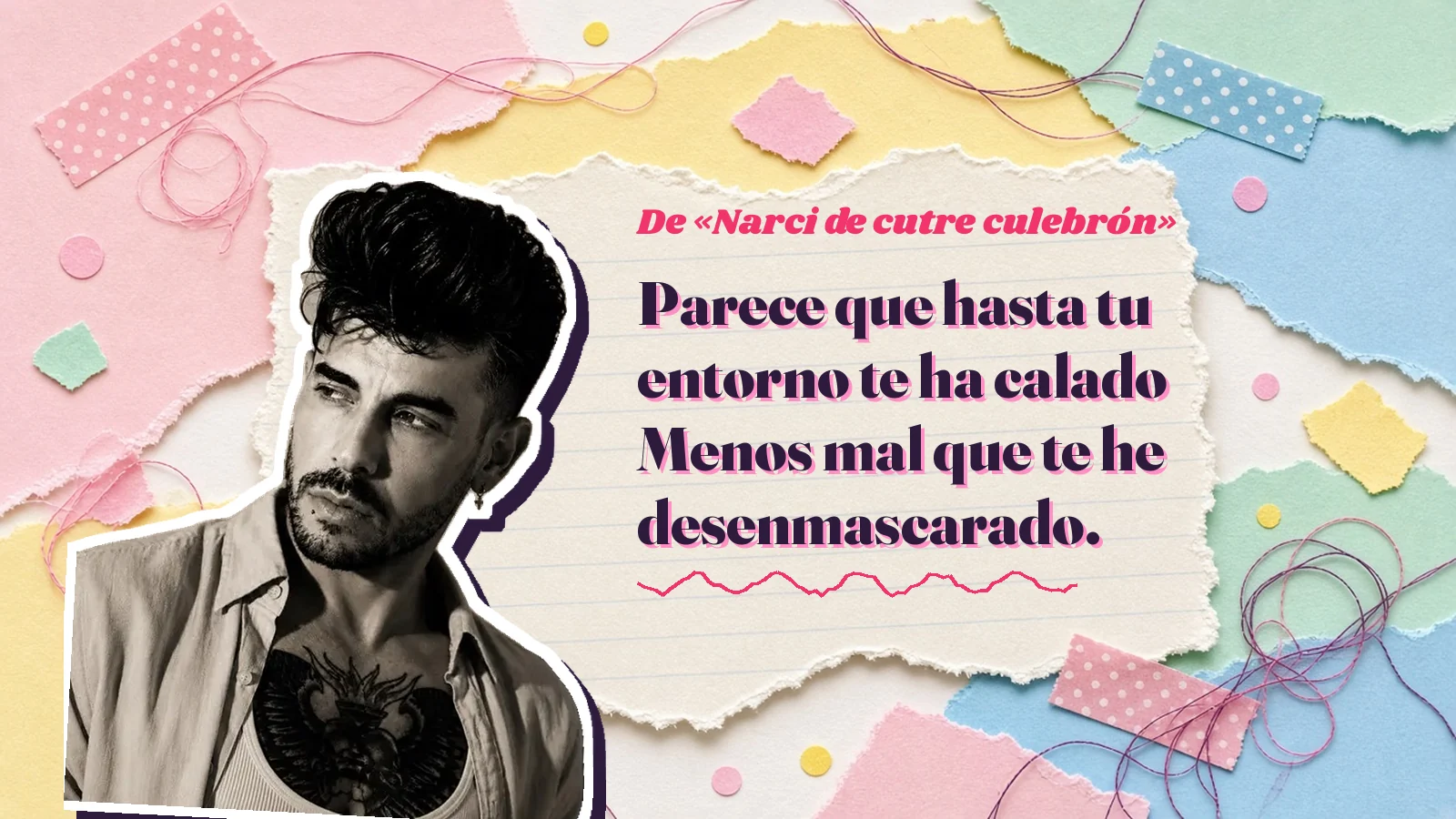
«Parece que hasta tu entorno te ha calado / Menos mal que te he desenmascarado.» ("Looks like even your own crowd has you sussed / thank God I've unmasked you, it was a must.")
These two lines carry an irony I'm not sure lands the first time. Look at the order. First it says even his own people have seen through him. Then: "thank God I've unmasked you."
In other words: everyone already knew. His people, his friends, his colleagues. They'd all sussed him. And I turn up last, with my daytime-detective magnifying glass and my little Sherlock Holmes hat, to announce with great fanfare that I've cracked the case. Which the whole neighbourhood already knew.
I'm laughing at myself in that line. I'm the last to find out and the first to write a song about it. That's how I work. I get to the truth late, but I arrive with a chorus.
From the joke to the kitchen table
I'll get serious, just for a paragraph.
Discovering that someone you shared something with was a knock-off hurts in a very particular way. The deception is the least of it. The real damage is that it forces you to review the whole past. Every conversation, every photo, every "I love you". You spend weeks wondering what was true and what wasn't. And the worst part is that often you'll never know.
That's why laughing seems so healthy to me. Because the alternative is spending your life doing archaeology on your own memories, with a brush and a magnifying glass, hunting for the first lie. And that dig has no bottom.
Better the rap. Better the soap opera. Better the knock-off hunk. They leave you with a crooked smile instead of a brush in your hand.
A telenovela cover
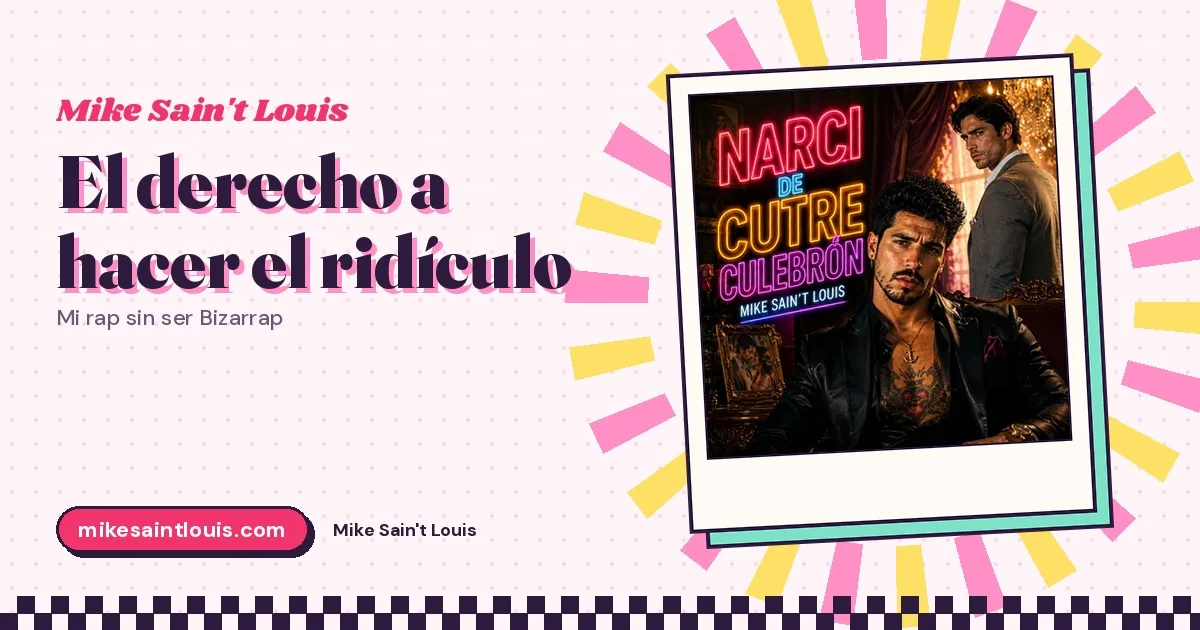
The cover is a soap opera still with a roadside-bar sign. A living room with a chandelier, velvet curtains and a gilt frame on the table. In the foreground, seated like a patriarch in his armchair, a bearded dark-haired hunk in a black leather jacket, shirt open to the navel, staring into the camera with an "this hacienda is mine" face. Behind him, standing in a grey suit, another man watches him warily, like the good brother who knows the truth and is about to reveal it next episode.
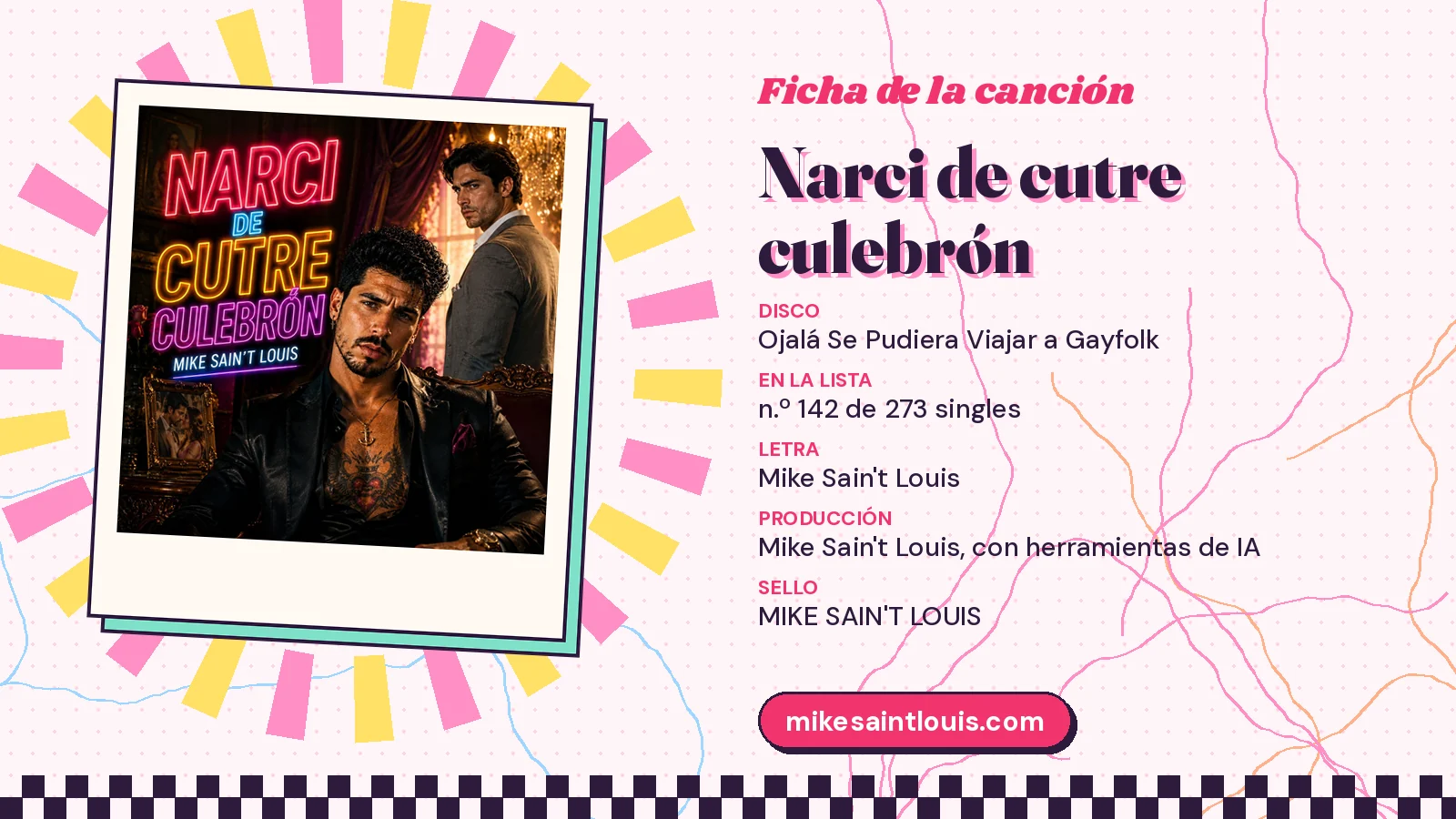
And on top, in coloured neon, pink, blue and yellow: NARCI DE CUTRE CULEBRÓN. That neon is what makes it tacky. Without it, it'd be a serious telenovela. With it, it's a roadside hostess club on the outskirts of Albacete named after a Venezuelan series.
An afternoon of noisy neighbours
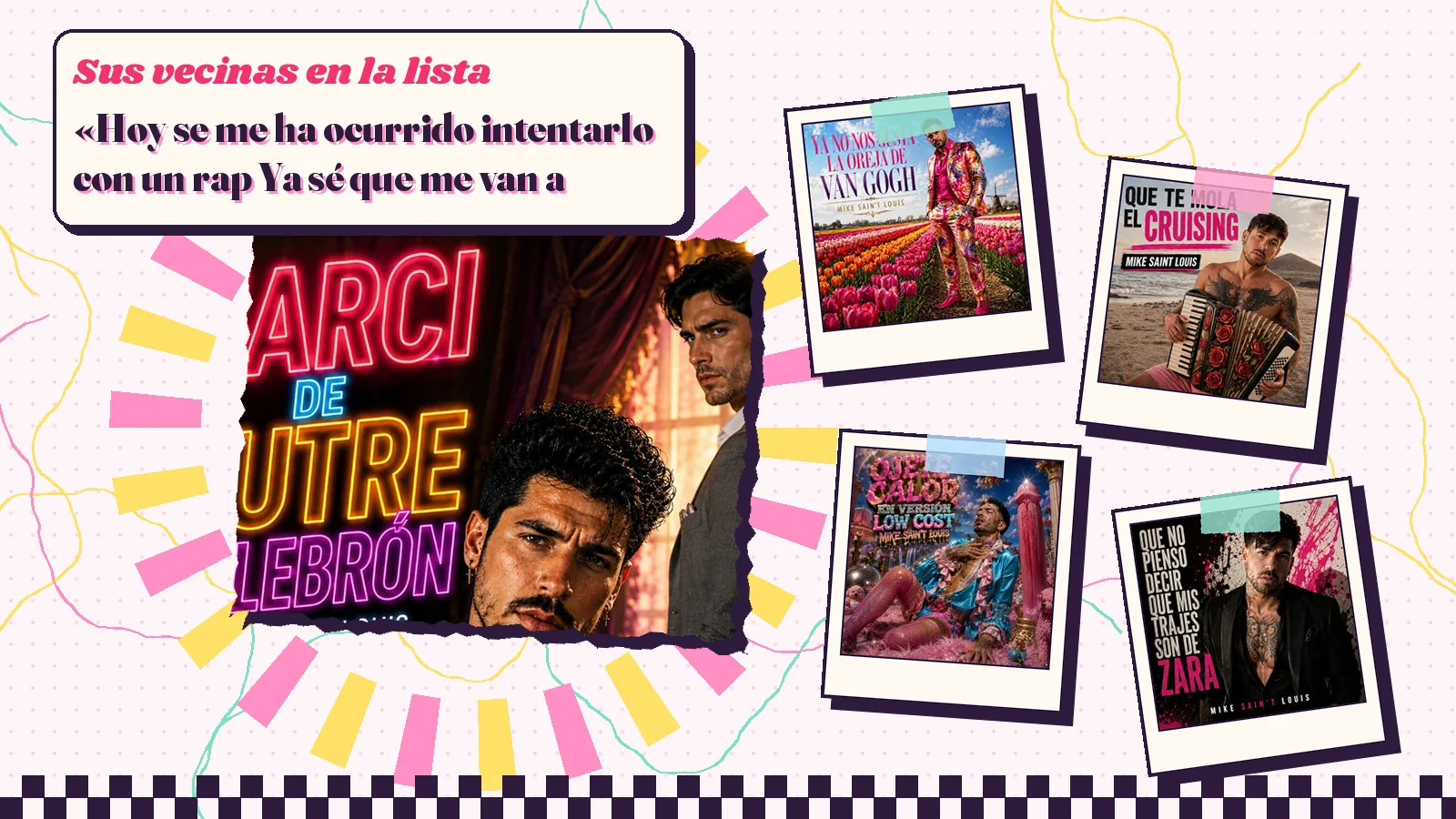
In the full gayfolkplanet.com catalogue, «Narci de cutre culebrón» is track 142 of 273, on the second album of the trilogy, Ojalá se pudiera viajar a GAYFOLK (If Only You Could Travel to GAYFOLK). Its neighbours couldn't be more my style.
Right before it comes «Ojete calor en versión low cost» ("Ojete Calor, Low-Cost Version"), whose title already plays with a duo who've turned tacky humour into high art. And right after comes «¡Que no pienso decir que mis trajes son de Zara!» ("I'm Not Saying My Suits Are From Zara!"), with its SHEIN suits and its haemorrhoid of a narcissist. Three songs in a row about the tacky, the fake and the cheap.
I don't know if that's a coincidence or a diagnosis. Probably both. Anyone who plays all three back to back should be warned: they'll come out wanting to return something to a shop, without quite knowing what.
What I do and what the machine does
The lyrics are mine, with their homespun rhymes: rap with Bizarrap, gusto with arbusto, calado with desenmascarado. They're not battle-champion rhymes, nor do they try to be. They're bar-counter rhymes, the kind that come to you over a vermouth while you laugh to yourself.
The music and vocals of Planeta Gayfolk are made with artificial intelligence tools such as Suno. And here's something curious: AI lets me step into genres that would otherwise be unthinkable for me. I don't have a rap producer in my contacts. I don't have a studio with a beatmaker. But I have the lyric, the idea and the decision to do it, and with that the tools let me try. That's one of the reasons I say openly that I use AI. It lets me make a fool of myself in new genres without asking anyone's permission.
Making a fool of yourself, again
I'll end the way I began. With looking ridiculous.
If you love writing, painting, dancing or whatever it is, and you don't dare because you're "not that kind of person", do this: start by saying you're not that kind of person. Out loud. In the first line. "I know they're going to slate me." And then do it anyway.
The worst that can happen is someone says you're not Bizarrap. And you already knew that.
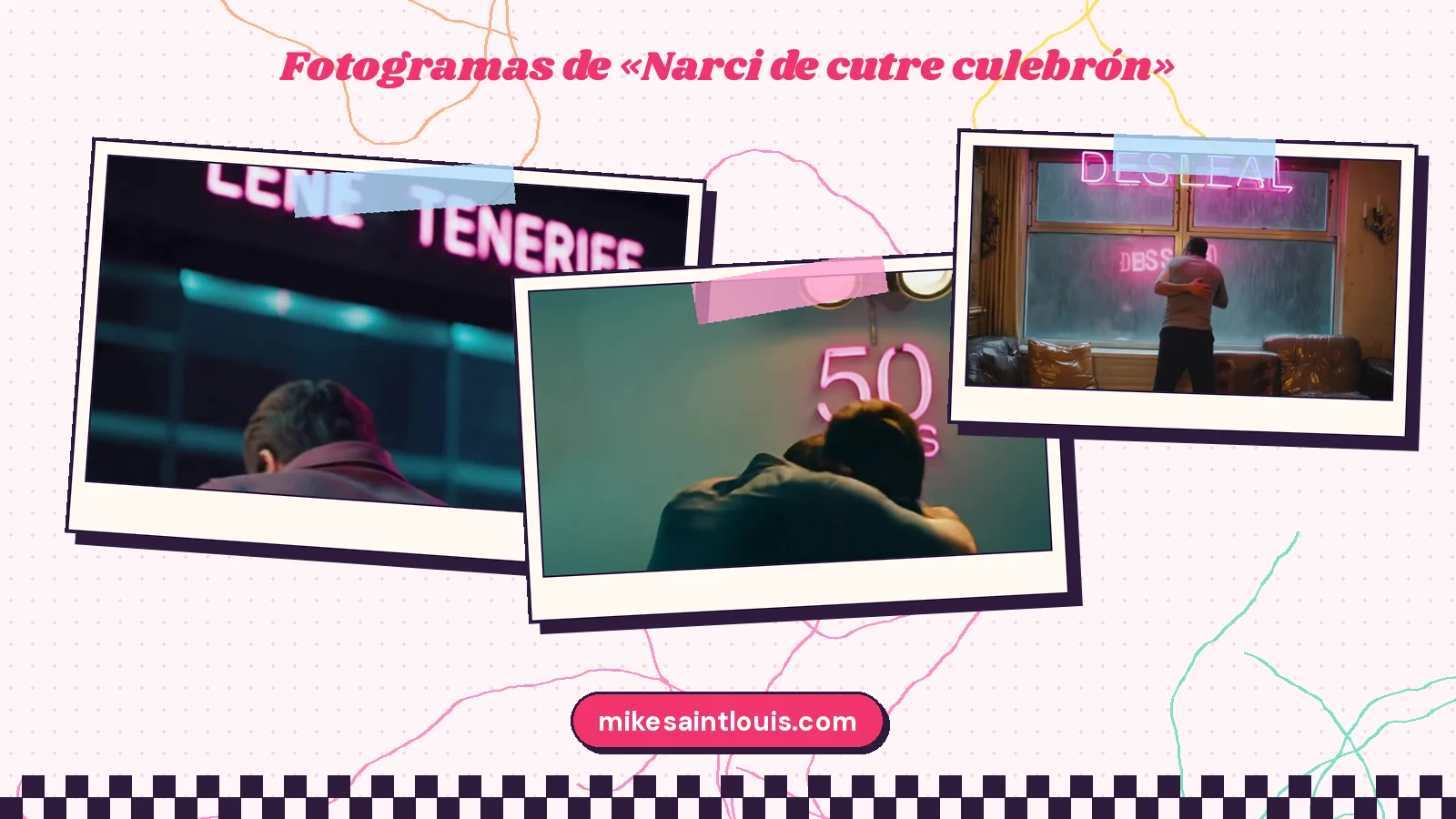
The music video is in the videos section, like those of all my singles. And if you've got a knock-off narcissist in your past, play it with the car windows down.
Let the whole neighbourhood hear. Even if they already knew.
Frequently asked questions
What is «Narci de cutre culebrón» about? It's a rap, or something like one, aimed at a narcissist with an undercover profile who turns out to be "a knock-off". The lyric opens by admitting its author is no Bizarrap and is going to get slated, and it turns the story into an afternoon soap opera.
Who is the Leire mentioned in the lyrics? Leire Martínez, one of the best-known voices in Spanish pop. The lyric says that, like her, the narrator needs to "get it all off their chest".
Which album is it on? On Ojalá se pudiera viajar a GAYFOLK, the second album of the GAYFOLK trilogy. In the gayfolkplanet.com catalogue it's track 142 of 273.
Who wrote it? The lyrics are by Mike Sain't Louis. The music and vocals were made with artificial intelligence tools, and the single is released on the MIKE SAIN'T LOUIS label.