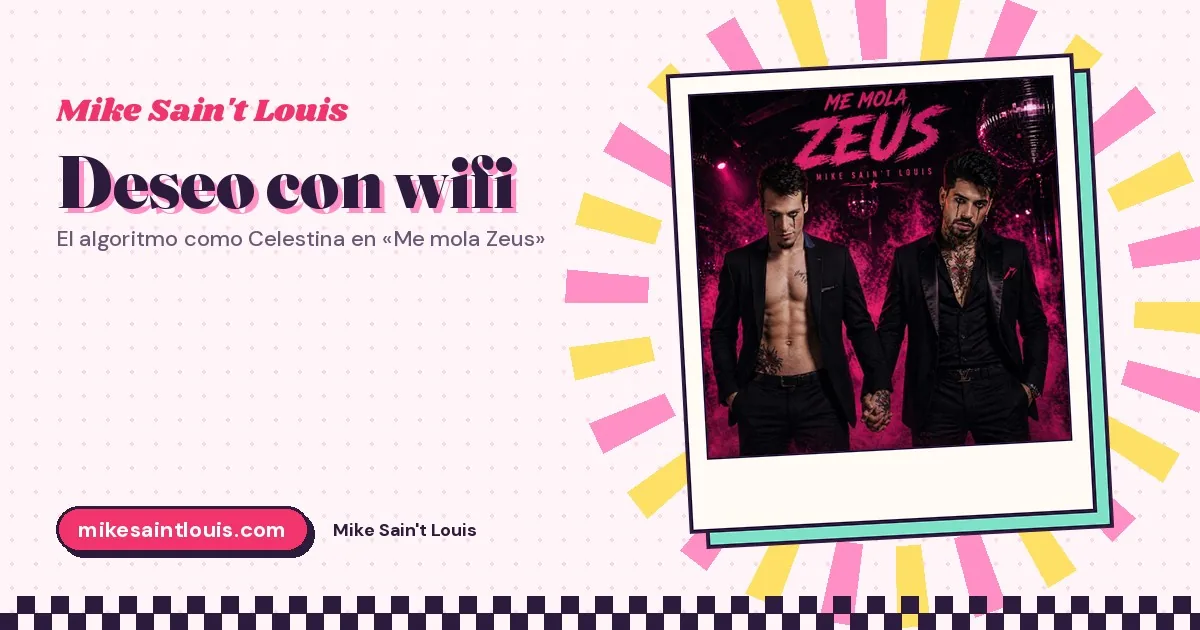
By Mike Sain't Louis ·
Desire with wifi: the algorithm as matchmaker in «Me mola Zeus»
Two in the morning. A face lit up blue. A thumb that scrolls, scrolls, scrolls, and suddenly stops. There he is again. The same boy, with the same look of not having slept and the same broken headphones. And a line muttered through gritted teeth, half complaint and half declaration:
Zeus… me estás jodiendo el algoritmo. («Zeus… you're screwing up my algorithm.»)
That's how «Me mola Zeus» opens, and that first line already holds a love triangle. There's the narrator. There's Zeus. And there's the third party, the one nobody invites to dinner but who arranges the whole thing: the algorithm.
On the song's own page I've already talked about what I love in this screen crush: the tiny details, the watery coffee, the chorus that explodes in capital letters. Here I want to talk about the third wheel. About the machine that decides who you're going to look at tonight. Because if you think about it, the song isn't only about a boy you fancy. It's about who put him in front of you.
And Spanish has an ancient word for that. Celestina, the go-between.
The shop window that chooses you
When I was a kid, you chose your platonic crush. You went to the newsstand, bought Superpop or Bravo, opened the centrefold poster very carefully so as not to tear the staples, and decided who was going to live on your bedroom wall for the next six months. Sometimes it was Ricky Martin. Sometimes it was the lad from the TV series. Sometimes, if you were queer and didn't know it yet, it was the girl in the band, because Sellotaping her up scared you less than admitting it was the boy you liked.
The point is, you chose. With all your contradictions, but you.
Not any more. Now the poster chooses you. You open the app and the For You page has already decided, using maths nobody understands, which face is going to stop your thumb. Linger two seconds and it shows you a similar one. Linger five and it shows you the same one. Comment, and you're done for. The shop window learns what you want faster than you do.
I have my own TikTok page and I know what I'm talking about, because I see it from both sides: as someone uploading videos in the hope the machine shows them to somebody, and as someone staring at other people's videos at hours when he should be asleep. I said something about it in What TikTok and Shorts taught me about songs. What I didn't say there is what that same machine does to desire. And that's what «Me mola Zeus» does: it tells it with a red face.
The broken headphones
Before going on with the go-between, I want to stop at a detail in the first verse that strikes me as almost cruelly precise. Zeus shows up looking as if he hasn't slept, wearing broken headphones. Not the latest AirPods. Broken.
There's a whole aesthetic of desire in that. For years, what we were sold as desirable was perfection: the boy on the billboard on the Gran Vía, the waxed torso in the cologne ad, the bleached smile of the reality-show contestant. And suddenly, phone screens start filling up with something else. Scruffy lads filming themselves in the kitchen of a shared flat, with bags under their eyes, T-shirt on inside out, headphones held together with electrical tape. And it turns out we like that more. Because it looks real. Because it looks like you might bump into him in the corner shop downstairs.
That's the paradox of the modern crush. The more imperfect, the closer he seems. And the closer he seems, the more it hurts when he doesn't reply. The Ricky Martin poster was never going to write to you, and you knew it. The boy with the broken headphones looks as if he might. He's right there, one message away. That false closeness is the finest hook anyone has ever invented.
And the narrator swallows it, hook and all. He sees the broken headphones and he's already in, says the lyric. It didn't even take a verse.
You told me «I'm not looking for anything»
There's an exchange in the song that could be on any dating app in this country:
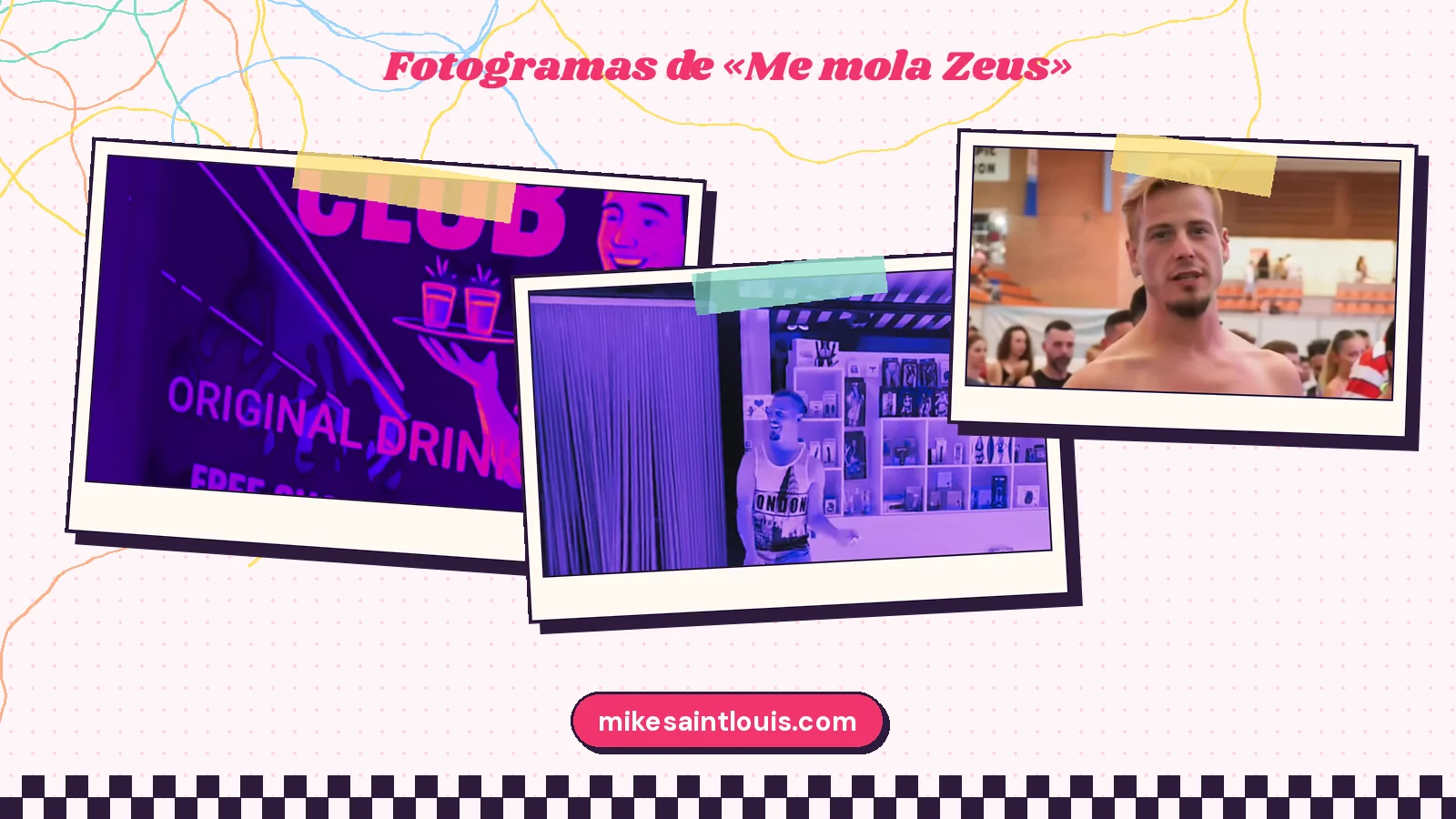
Me dijiste “no busco nada” / y yo dije “yo tampoco” («You told me "I'm not looking for anything" / and I said "me neither"»)
That line ought to come with subtitles, because they're both lying and they both know it. «I'm not looking for anything» is the polite formula of modern pulling, the digital equivalent of «I'll call you». It's what you say when you don't want commitment, when you've just come out of something, when you've got a boyfriend and haven't put him on your profile. And «me neither» is the reply of someone looking desperately hard who doesn't want to seem desperate.
I adore that lie for two voices because it's so very us. We've spent so long learning not to seem intense that we've invented an entire language for hiding it. «No strings», «let's see what happens», «go with the flow», «no labels». All to avoid the sentence that really frightens us, which is «I like you a lot and I don't know what to do about it».
And the song takes it apart in two lines. Right after the «me neither», the narrator confesses he hasn't eaten for three days, watching Zeus's videos with red eyes. There's the truth. The «not looking for anything» lasted as long as it takes the next video to load.
Pure self-parody, my favourite sport. The least convincing «me neither» in the history of pop.
Desire with wifi and no mercy
In the second chorus there's a line that, for me, sums up the era:
esto es deseo con wifi y sin piedad («this is desire with wifi and no mercy»)
Desire with wifi. It makes me laugh and I think it's spot on. Because desire as it always was, the desire of novels and coplas, had physical obstacles: distance, family, the iron grille on the balcony, the village priest. Desire with wifi has none of those. You hold it in your hand, at any hour, on a loop, brightness turned all the way up. The only obstacle is that the other person doesn't know you exist.
And this is where Celestina comes in. In Fernando de Rojas's classic, the old procuress is the one pulling the strings between Calisto and Melibea: she carries messages, sets up meetings, gets paid for it and, above all, understands other people's desire better than they do. Well, that's the algorithm. A Celestina without the shawl and the spindle, who gets paid not in gold chains but in minutes of your attention. She knows you. She knows what you like before you admit it. And she brings it home to you, over and over, with no mercy.
The «no mercy» is the key. Rojas's Celestina at least had her own interests and her own fears. The one in your phone never tires. She never says «that's enough now, go to bed». She shows you another Zeus video. And another. And another of the broken headphones from a different angle.
The comic part is that the narrator knows and lets it happen anyway. «Me mola». The phrase that gives the song its title is total surrender to the go-between. I know you're manipulating me. I know this isn't love, it's statistics. And I don't care. I'm into it.
A watery coffee
But the song doesn't stay on the screen. At one point the narrator imagines, or remembers, or makes up, a date:
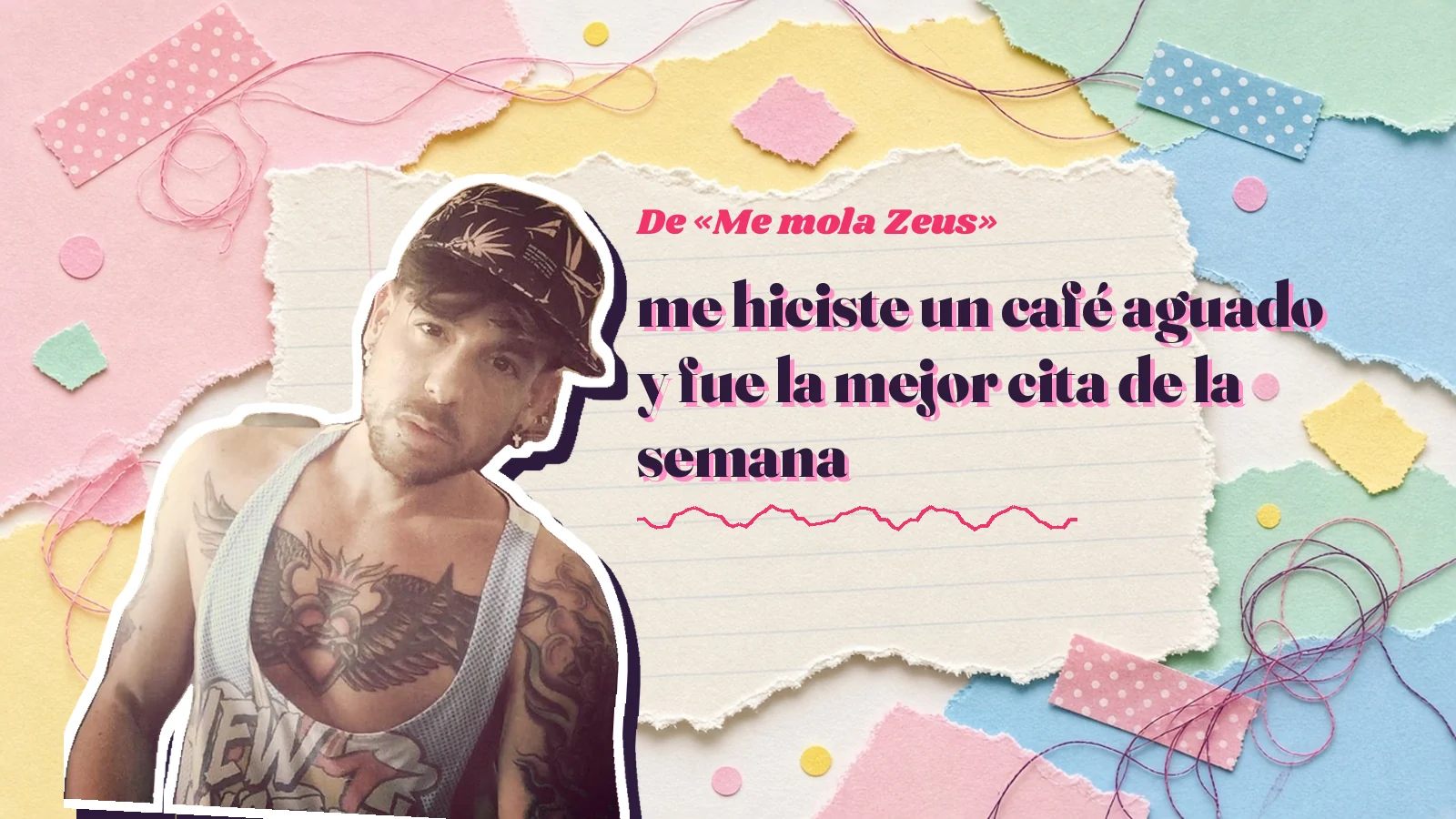
me hiciste un café aguado / y fue la mejor cita de la semana («you made me a watery coffee / and it was the best date of the week»)
I don't know whether that coffee existed within the song's story, and I don't think it matters. What matters is the scale. A watery coffee. Not dinner at a Michelin-starred restaurant, not a weekend in Paris. A bad coffee, made without much effort, probably in a capsule machine nobody has descaled since 2019. And still, the best date of the week.
That's what a crush is, at bottom. A machine for enlarging small things. The boy you like can't dance and you follow him anyway. He says he hates drama and you catch him crying to Lana Del Rey. He makes you a dreadful coffee and you store it in your memory as if it were a Grand Cru.
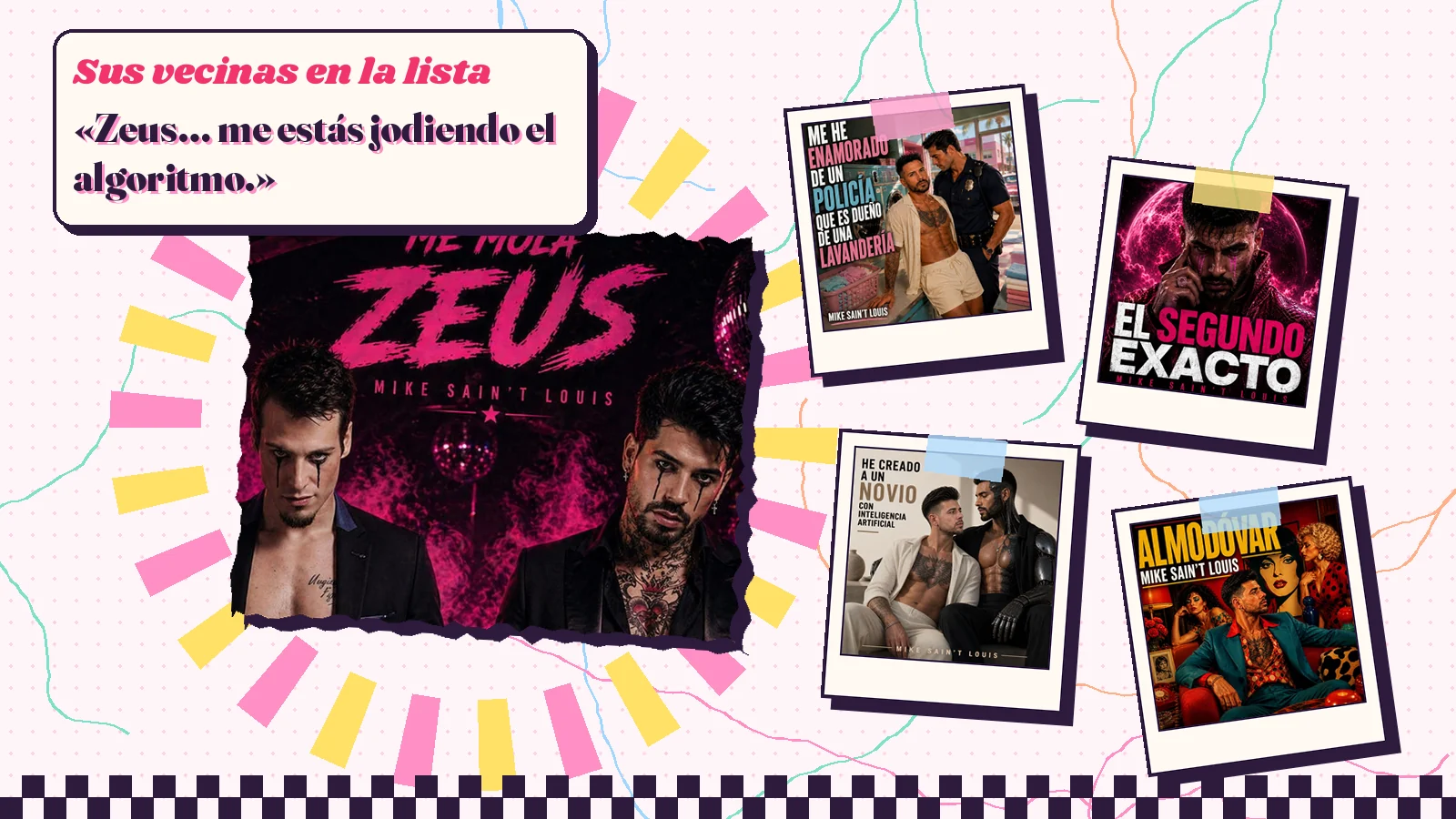
Apparently I have a weakness for coffee in songs. In «Me he enamorado de un policía que es dueño de una lavandería» there's also a coffee that changes everything, although there the narrator blushes so hard he never drinks it. Two impossible crushes with a cup in the middle. Maybe I should write a coffee trilogy. I'll make a note; my body's asking for it, though that may just be the caffeine.
It breaks me and I'm into it
The chorus is all in capitals in the published lyric, and that makes sense: it's a shout. I'm into it and it breaks me, and round again. No nuance possible. It's the stage of a crush where you've stopped reasoning.
And I really like that the song admits it hurts and doesn't care. It breaks me and I'm into it. That's very honest. There's a tendency to tell platonic crushes as if they were innocent, teenage stuff, harmless nonsense. They aren't. A screen crush can take away your sleep, your appetite and your concentration for weeks. It can make you feel ridiculous. It can make you check your phone forty times an hour waiting for a like that never comes.
In «El segundo exacto» I talked about how much it hurts to see twenty WhatsApp statuses viewed and not a single like. The narrator of «Me mola Zeus» lives on the same planet, only facing the other way: he's the one handing out the likes, and the other boy never notices.
And then there's the closing line, the one about how this is going to kill him. Dance-floor exaggeration, of course. Nobody dies of a TikTok crush. But it can leave you wrecked for a few days. Let me be serious for one second: if a crush is genuinely costing you sleep or your appetite, close the app for a while, go outside, call someone made of flesh and blood. The song exaggerates so you'll laugh. You don't have to live it that way.
There. Back to the joke.
«Me mola», said the Madrid way
A word about the title, which is no linguistic accident. Me mola is one of those expressions that sound like lifelong Madrid, like a nineties school playground, like a neighbourhood lad who won't say «I like» because «I like» is for softies. Me mola is shorter, drier, more street. It works for a pair of trainers, a band and a boy. All in the same tone.
And that's what makes it funny in a song about a crush, because me mola is a way of playing down something that matters to you enormously. You don't say «I'm in love», which would be a catastrophe. You say «I'm into him», the way you'd comment on some trainers in a shop window. It's another version of «I'm not looking for anything»: neighbourhood slang works for hiding things too.
The lovely part is that the chorus repeats it so often and so loudly that the cover-up cracks. Once, me mola is casual. A dozen times in a row and in capitals, it's a full confession. The little word, shouted enough, becomes a big one. It happens to me a lot in lyrics: I take one of those phrases people say without thinking and stretch it until it shows what it was carrying.
Alongside it, by the way, live «crush», «For You», «wifi», «TikTok». Neighbourhood Spanish and phone English in the same sentence, which is exactly how people talk today on any terrace in Lavapiés. I don't correct it. It's the language of desire this decade, and if in twenty years it sounds dated, all the better: it'll be a document.
Zeus, the god who never replies
Why Zeus? Because it's a name that comes with mythology included, and mythology suits a crush beautifully.
The Greeks' Zeus was the god who came down from Olympus disguised as whatever it took to seduce whoever he fancied. A swan, a bull, a shower of gold. A textbook player with superpowers. And in the song the name lands on a boy who appears on screen looking as if he hasn't slept. I love the distance between the two: the king of the gods and a lad with broken headphones.
But it makes sense. Because a crush turns anyone into a god. You build him an altar on your phone, devote hours of contemplation to him, read his silences as signs. You do exactly what the ancients did with their gods: talk to them without expecting an answer.
Zeus Vargas, by the way, is a character. The full name appears in the chorus but, like every name in my lyrics, it's invented. Don't bother searching. There's nobody on the other side. Or there is, but it isn't him.
And the song gives that god the least divine quality of all: he can't dance. To me it's the best detail in the lyric. The god can't dance, he keeps his hands in his pockets, and you follow him anyway. Bringing the god down off his pedestal without ever stopping worshipping him. Now that's love.
When the machine knows what you want
Now the serious turn, which isn't in the lyric in this song but is right underneath it.
The algorithm that puts Zeus in front of you knows things about you. It knows who you look at, for how long, at what time. And for many young people that has had an effect nobody predicted: the phone told them they were gay before they told themselves. They'd open the app and the For You page would be full of boys. And they'd stare at the screen thinking: why is it showing me this? What does it know about me?
There's something unsettling about that, of course. A machine reading you from the inside. But for a lad in a small town with no one to talk to, there's also something that can be almost a gift: finding out there are thousands of boys like him, dancing badly, crying to Lana, making watery coffee. That he isn't alone. I could have done with that go-between at fourteen.
The relationship between artificial intelligence and desire interests me a great deal, and not just in this song. In «He creado un novio con inteligencia artificial» the machine no longer introduces you to anyone: it builds you the whole boyfriend. And in AI has no exes I explain why, although I make the music and the vocals of my songs with artificial-intelligence tools, the lyrics come out of a life with real ex-boyfriends. Three faces of the same subject. The machine as go-between, as boyfriend factory and as a working tool.
Track 17, between Almodóvar and Noemí Argüelles
In the singles list of Planeta Gayfolk, «Me mola Zeus» is track 17 of 273. It belongs to «El día de la liberación», the third album of the GAYFOLK trilogy.
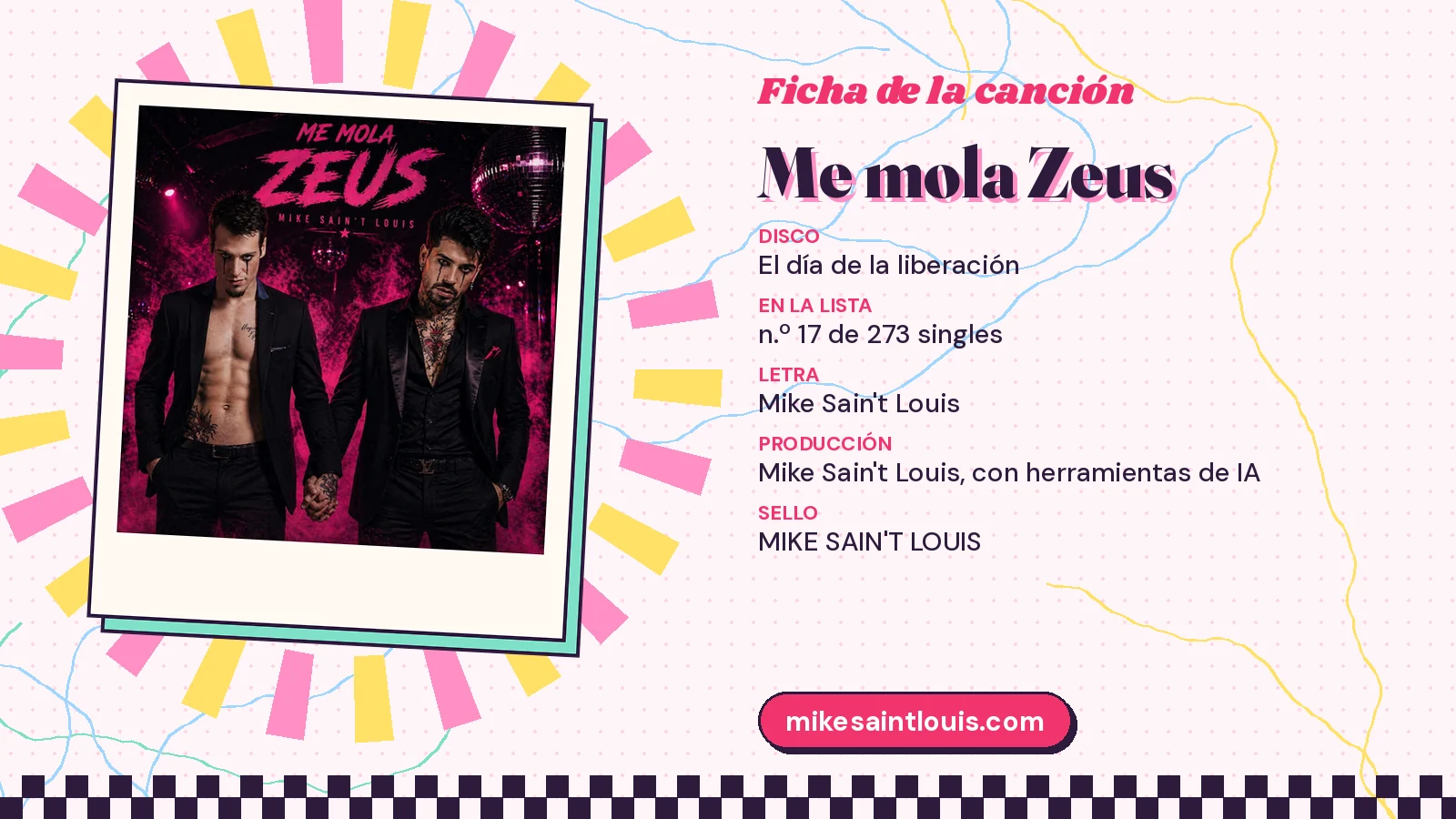
Just before it comes «Almodóvar», with its melodrama heavier than a Goya award. Just after, «Noemí Argüelles va ganando en las encuestas». From auteur cinema to a TikTok crush, and from there to an invented election. If anyone wants a portrait of how my head works, they should listen to those three back to back.
And there's another song of mine that talks to this one from the other side of the screen: «I want to be a TikTok star», where the one hoping the algorithm will choose him is the narrator. Put them together and you have both sides of the same coin. In one, you pray for the machine to show you to the world. In the other, the machine shows you a boy and you can't stop looking. In the end we're all in someone's shop window, broken headphones or freshly straightened hair, waiting for a thumb to stop for two seconds on our face.
I like that this song sits on the liberation album. Because there's something liberating about admitting you're into someone without apologising, even someone on a screen, even someone who doesn't know you, even if it's absurd. The chorus shouts it with its whole face, no disguise, in capitals. And after so many years of looking on the sly, that's a little party.
For anyone who's spent three days staring at the same profile
If you're reading this with your phone in your hand and in another tab you've got the profile of someone who ignores you, this song is yours. I'm not judging. I've been there. We've all been there, red-eyed at two in the morning, inventing a watery coffee.
What I suggest is what the song suggests: don't hide. Admit you're into him. Shout it in the kitchen. Put the song on full blast and dance even if he doesn't know, which is already more than he does. And then, when it passes, and it will, take back ownership of your thumb.
And if it's any comfort: the boy who has you in this state probably has his own Zeus. Someone who doesn't reply, someone he stares at at two in the morning with red eyes. It's an endless chain of people looking at people who don't look back. Seen like that, it's almost tender. We're a whole country of screen lovers playing it cool.
The go-between in your pocket will still be there, serving you new faces. Let her. You decide how long you keep looking.
And if Zeus ever does message you, which I doubt, tell me about it. But no screenshots. Or the algorithm will start showing him to me.
Frequently asked questions
Who is Zeus Vargas?
An invented character, like every name in my lyrics. He's the boy the algorithm keeps putting in front of the narrator.
What is «Me mola Zeus» about?
A TikTok crush and the algorithm that feeds it. The narrator knows the machine is hooking him and gives in anyway: he's into it.
Who wrote «Me mola Zeus»?
I wrote the lyrics. I'm a lyricist, composer and music producer. The music and the vocals are made with artificial-intelligence tools such as Suno.
Which album is it on?
It's part of «El día de la liberación», the third album of the GAYFOLK trilogy, and it's track 17 of the 273 singles.