
By Mike Sain't Louis ·
Forty pieces and three per cent: the maths of «Me rindo»
I'm a words person. I say that so you understand the scale of the disaster: when my heart got broken, I started doing sums, the one thing I can't do. They came out wrong. A song came out instead.
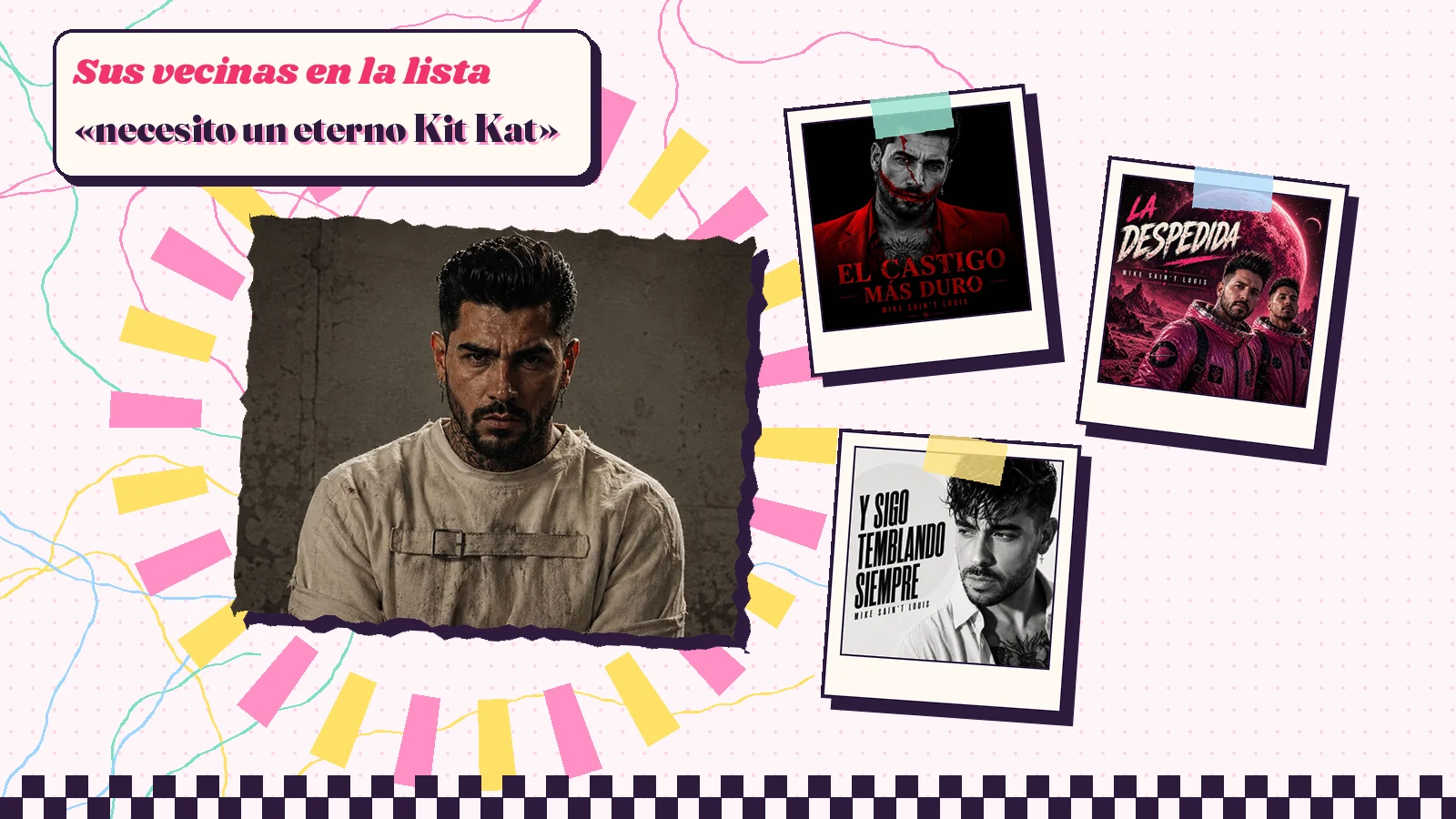
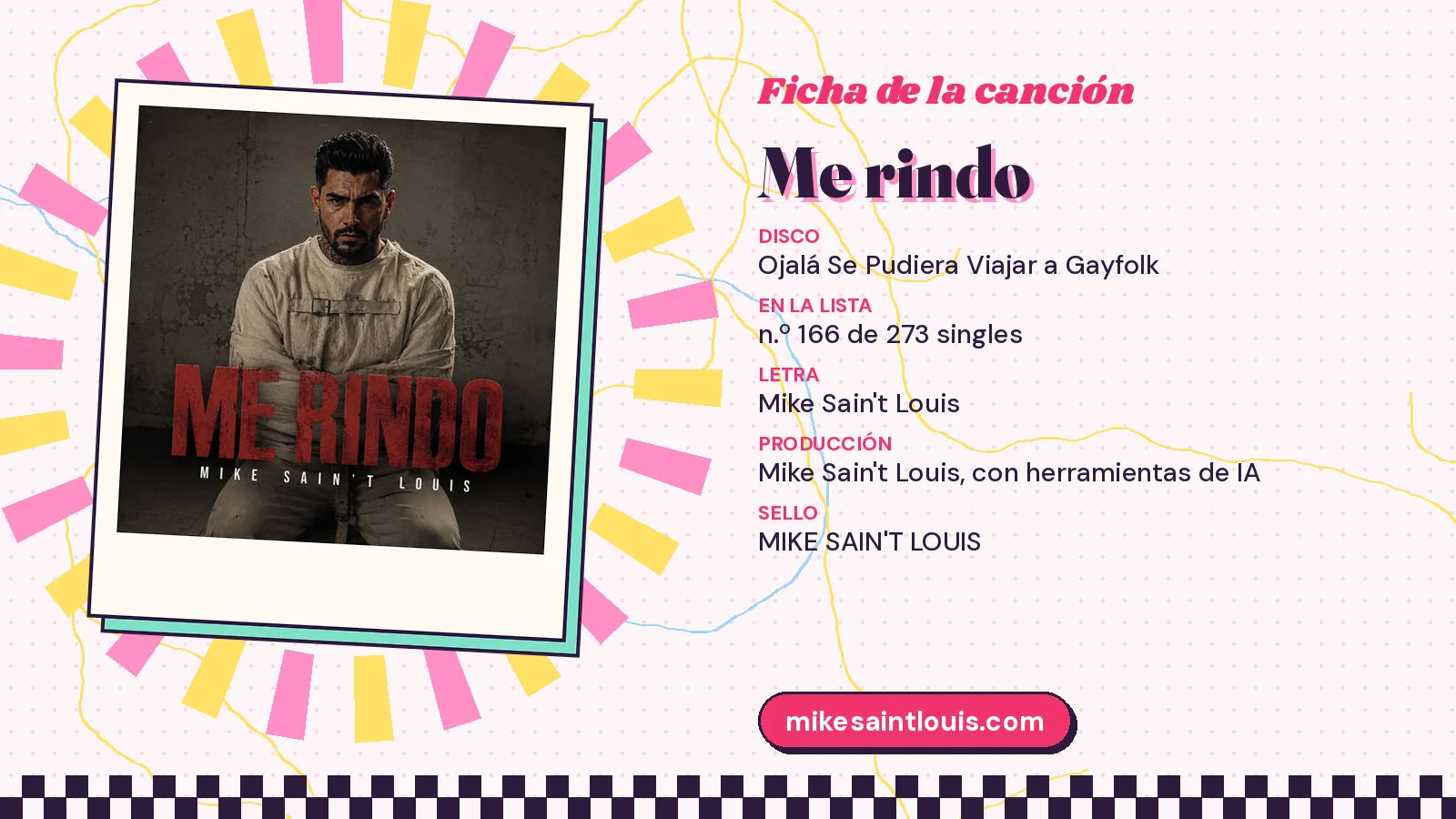
The song is «Me rindo» ("I give up"), from the second album of the trilogy, «Ojalá se pudiera viajar a GAYFOLK». On the Planeta Gayfolk singles list it's track 166 of 273, right after «El castigo más duro» and right before «La despedida». Notice the order, because it isn't random: first the punishment, then the surrender, then the goodbye. It reads like a hospital chart.
On the song's own page I've already explained what it's about and why television keeps sneaking into the lyric. Here I fancy something else, something odder and more me: going through the numbers. Because «Me rindo» is full of figures, and none of them is there to make the sum work. They're there to make sure it doesn't.
A words person's calculator
A warning before we start. My relationship with numbers is like a queen's relationship with the gym treadmill: I look at it, I respect it, I take a selfie next to it and I head for the bar.
But something curious happens in break-ups. Everyone turns into an accountant. How many years. How many Christmases. How many unanswered messages. How much he owed me for that dinner. How much I loved him and how much he loved me, which is the sum nobody knows how to do and the one you keep redoing at four in the morning, phone in hand, the screen glaring in your face like an interrogation lamp.
I decided that, since I was going to start adding things up, I'd at least do it in a song. And that the numbers would be deliberately absurd. No WHO percentages, no Instagram statistics. Everyday numbers, the kind you make up when you're so broken you need to measure something, anything, just to keep your head above water.
There are four figures, more or less. Forty, one, three and infinity. Let's take them in turn.
Forty pieces
The first sum comes at the beginning, and it's the most beautiful one, and the most dangerous.
The song opens with someone truly opening up their heart, and it puts it with a pathologist's precision: «disecciono en 40 partes mi personalidad» (I dissect my personality into 40 parts). I didn't open up a little. I didn't share two or three things on a first date between beers. I cut myself into forty pieces and laid them out on the table, like someone jointing a chicken in their grandmother's kitchen.
Why forty? I'll be honest: because forty sounds like a lot without sounding like infinity. A hundred would have sounded like a washing-powder advert. Ten, too little, a second-hand listing. Forty is the number of someone who has bothered to count. Someone who, if you ask, will list the pieces for you: the fear of phone calls, the thing about socks, the giggles at funerals, the Camela song they put on when they're sad, the scar on the knee, the habit of apologising too soon…
And there's the trap. When you take yourself apart in front of someone, that someone keeps the map. They know where the nerves are. They know which piece pinches and which one creaks. I've said it elsewhere and I'll say it again here, quietly: empathy can also be used to take aim.
The lyric tells it in order. First I open up, then comes the exact instant when the other person wins me over, understands me, holds me. Notice that it all happens in that instant. No long courtship, no three months of dinners. Forty pieces on the table and, in the same second, he's got me. That's the speed of someone who had been waiting a very long time for somebody to want to look at the pieces.
That's the first number. Forty pieces of me, served on a platter.
One
The second number never appears in writing, but it's everywhere. It's one.
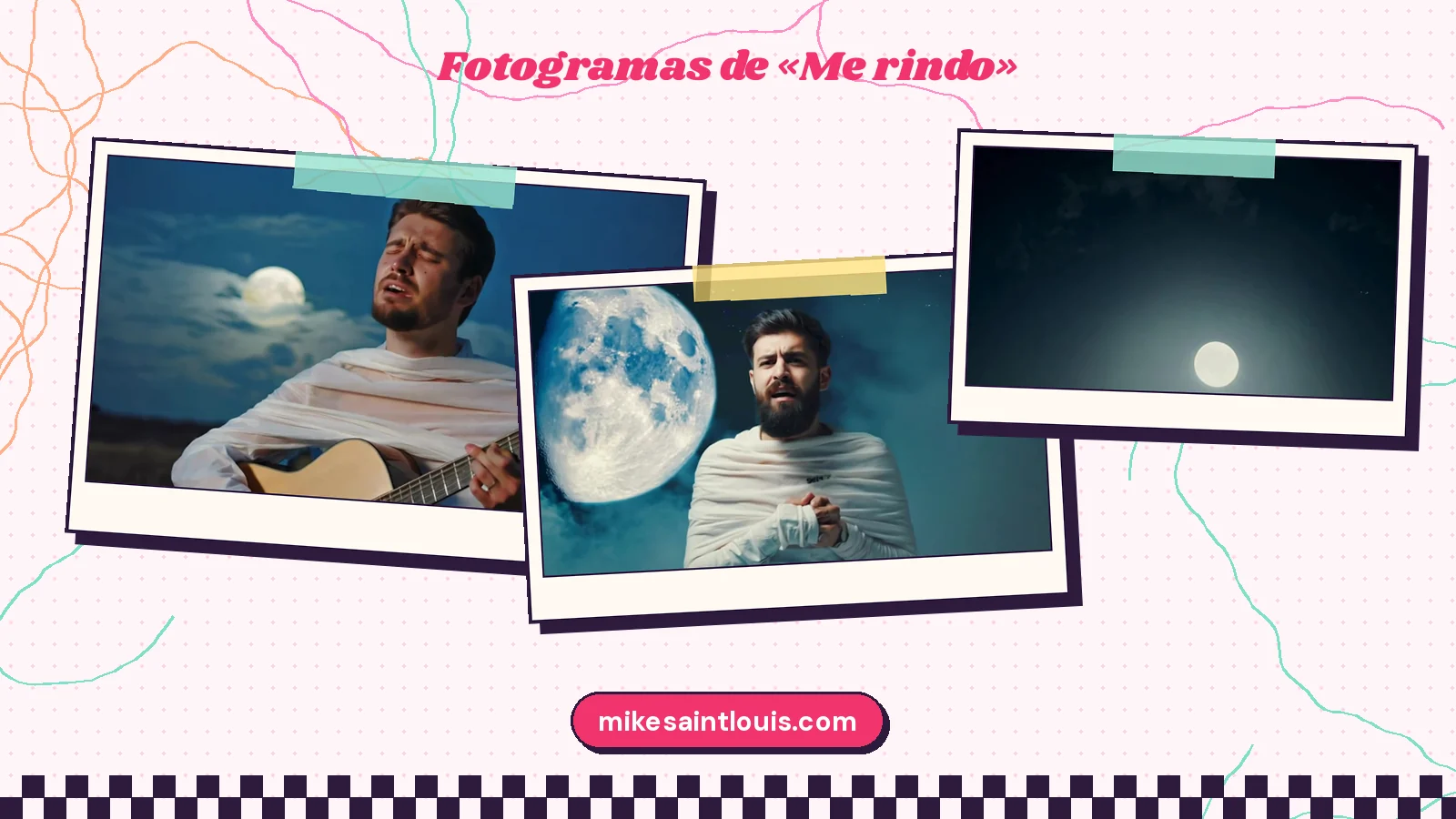
One, as in only one. The one who thinks he's clever. From there on, the song says, the one who thinks he's clever is deep down a circus, and I remember laughing a lot as I wrote that line, because it never says who the clever one is. It could be him. It could be me. Most likely, if I'm honest, it's both of us, each in our own ring, with our red noses and our unicycles, performing the grown-up-love routine in front of an audience that doesn't exist.
I really like that doubt. A break-up song where the only guilty party is the other person bores me within two minutes; there are plenty of those already, and nearly all of them sound like a lawyer. Here the circus is shared. But the one, the one left alone in the ring when the spotlights go off, does have a name. It's me. And that's why the lyric doesn't end in "I hate you" but in something else, which we'll get to.
There's another one hidden in there: a single heart for forty pieces. It's a terrible ratio. No architect would sign off on that building.
Three per cent
Here comes the figure people write to me about. It's the most questioning line in the song, and also the angriest:
«¿En serio, a las personas narcisistas no os duele la sangre ni un tres por ciento?»
(Seriously, you narcissists, doesn't your blood hurt even three per cent?)
First, the grammar. Notice the "you". It isn't "doesn't it hurt narcissists". It's "doesn't it hurt you". I'm talking to them directly, in the plural, like someone who plants themselves in front of a table full of gentlemen at a wedding and demands an explanation from all of them at once. It's a talk-show question, the kind asked with a microphone in hand, and it's also a sincere question I asked myself, alone, a thousand times.
Second, the number. Three per cent. I don't say "nothing", I don't say "a little bit". I give a specific, ridiculous figure, like a reduced VAT rate or a supermarket discount on the cold-cuts counter. Not even three per cent. It's the bare minimum you can ask of a human being, and it still seems like too much.
I chose three because it's a shabby number. If I'd said fifty, the question would have become reasonable, couples-therapy stuff. With three per cent, the question no longer asks you to hurt as much as I do. It asks you to hurt a bit. Anything. A pinch. An irritation like a T-shirt label scratching the back of your neck.
And the answer the song gives, without giving it, is no. Not even three.
That's the line I find hardest to listen to now. Not because of the anger, which passes, but because of what's underneath: the idea that I spent years asking for a sale percentage from someone who had nothing in the shop window. But I only learnt that later. The song was written before, at a point when I still believed that if I asked the question properly, he would answer.
The blood
A quick note, because people have pointed it out to me. "Doesn't your blood hurt" is a strange way of putting it. The normal thing would be "doesn't your heart hurt", or "doesn't anything hurt".
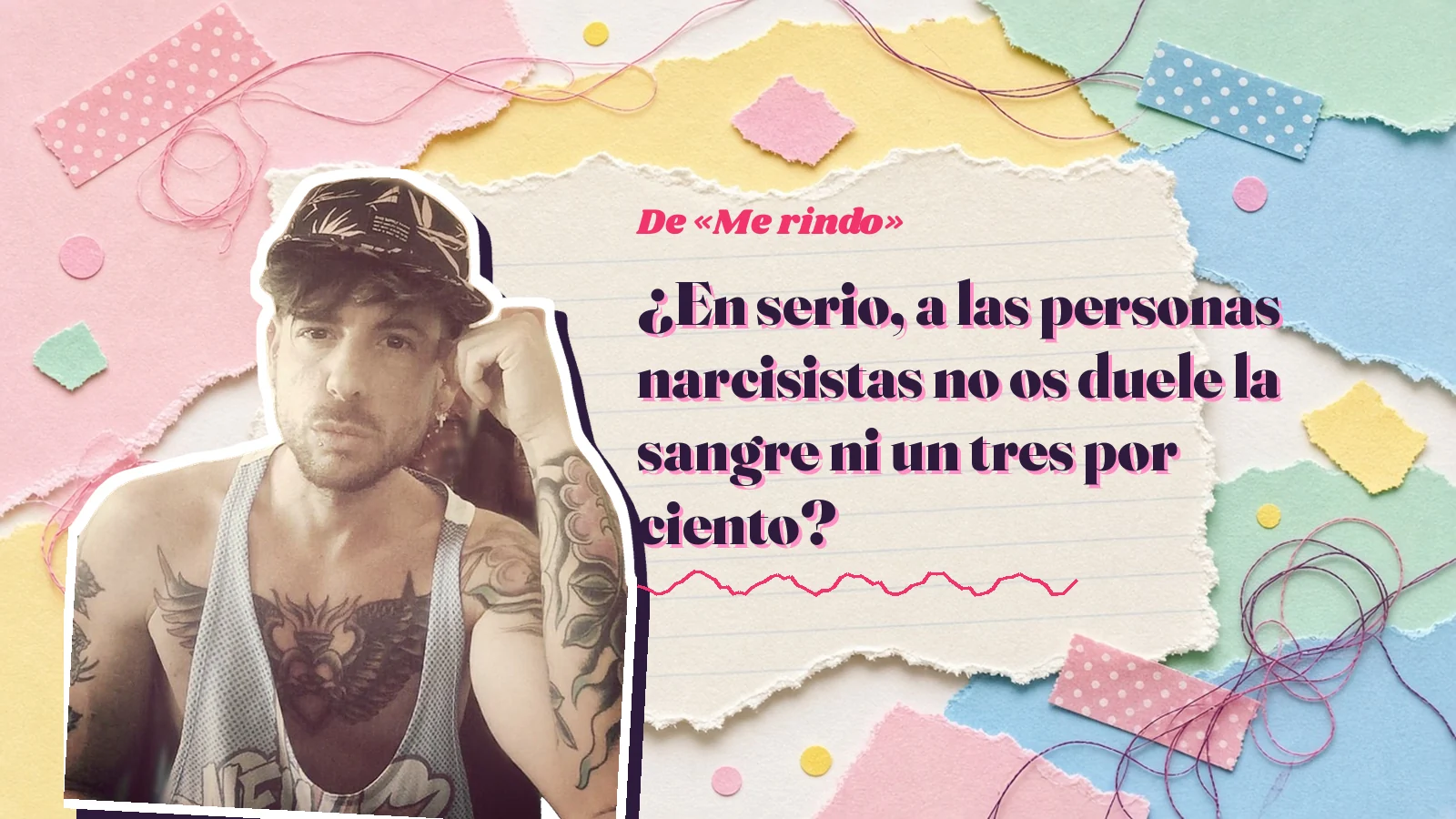
I chose blood because it's what you can see. The heart is an idea, and ideas can be argued with. Blood stains. It's the difference between saying "I'm not well" and turning up at A&E at La Paz hospital with a towel pressed to you. I wanted to ask about something physical, something that couldn't be denied with a pretty argument. And blood also suits the aesthetic of almost everything I write, which swings between five-o'clock Telecinco and a horror film rented from the video shop.
It amuses me, quite a lot, that I ask about blood and a percentage at the same time. It's like requesting a blood test for the soul. An emotional blood count, complete with reference ranges. If anyone invents that test, they should put it on the public health service; the queue would be longer than the one at the Gran Vía Primark on the first day of the sales.
The things you can't count in numbers
After the question comes the part where I finally put the calculator down. It's a list of memories and it doesn't contain a single figure: the trips to the village, the walks with the dogs, the Christmases, and a phrase he used to say when he saw me crying.
I like that this part has no numbers because it's precisely the part that can't be measured. How many Christmases were there? It doesn't matter. How many walks with the dogs? No idea, and I'd rather not know. Those memories are the kind you count in pictures, not in units: the light on an afternoon, the smell of someone else's kitchen, the lead tangled round your legs.
And then comes the question that brings it all crashing down, whether all of that was just blooper reel from a TV series. I won't repeat it here because I've explained it on the song page, but I want to add something about the numbers: a blooper is a take that gets redone. It's filmed several times. If everything was bloopers, then every Christmas was a rehearsal, and every "come here, don't cry" a line someone had learnt by heart. The sum I got there was horrible. I don't know how many times it was real. Maybe none.
That's the line in the song I never find funny. The others, sometimes. Not that one.
An eternal Kit Kat
Back to the numbers, which suit me better than sadness. Time for infinity.
«necesito un eterno Kit Kat»
(I need an eternal Kit Kat)
Some people take this line as a joke, and they're right to, because it is one. Kit Kat is a chocolate bar with that age-old advert about taking a break. I clung to that. If this has gone wrong, I need a break. And since it has gone very wrong, the break has to be eternal.
But look at the scale. We go from forty pieces to three per cent, and from there, without warning, to infinity. That's the bookkeeping of a break-up: you start with very precise figures, notary-precise, and you end up begging for a pause that never ends. It's what your body asks for after so much measuring. To stop measuring.
It's also very me that infinity should be a chocolate bar from the kiosk rather than the cosmos. Other people would go for the stars, the sea, the expanding universe. I go for the Kit Kat in the vending machine at Atocha station, the one that gets stuck in the spiral so you have to thump the glass. My eternity comes in a red wrapper and costs just over a euro.
I mean it. The everyday saves me from grandiosity, and grandiosity, in a heartbreak song, is the quickest way to make a fool of yourself. I talked about this more calmly in in defence of the corny: you can be corny, you can be very corny, but you have to do it with your feet on one specific floor tile.
I give up and I keep on trembling
The chorus has no numbers, but it does have a hidden sum. Two verbs that subtract from each other.
Giving up means stopping. Trembling means carrying on. The line puts the two together and refuses to choose: I give up, and I keep on trembling, always. It's like a car with the handbrake on and the accelerator floored, roaring on the spot, smelling of burnt clutch in a Carrefour car park.
I think that's how a lot of break-ups are lived, the real ones. There's no clean moment where you say "that's it" and walk off with your head held high in a long coat, like in an Almodóvar film. You give up, yes. You stop fighting, stop sending messages, stop searching for the perfect sentence. But your body hasn't got the memo and keeps on trembling. And it does it always, the lyric says, which is a very big word for such a small person.
Repeating the chorus so much wasn't filler. I wanted the repetition to show, to weigh, so that by the third "I give up" you'd realise that anyone who gives up that many times hasn't fully given up. If you really gave up, you'd say it once. You repeat it because you don't believe it.
At the end, the last word stretches out until it sounds like a lament. That's what I like hearing most in this song now: that vowel that never ends, like the ringing tone of a phone nobody picks up.
And mind you, the trembling has a song of its own. «Y sigo temblando siempre» is on the same album and takes that phrase as its title. It isn't a copy; it's another room in the same house. If you play them back to back, the second seems to answer the first through the partition wall.
Half the blame
There's one more sum, and it's the most uncomfortable. The blame.
Halfway through the lyric I say I feel I'm not really that much to blame, and straight away I ask the people concerned to unload all of theirs onto me. It's a logical absurdity. First I say I don't have any, then I ask to be given it. Put it in an Excel sheet and the column won't balance however you look at it.
But that's how it works. Anyone leaving a relationship with someone who never takes responsibility for anything ends up with a very specific accounting problem: they've been handed every bill. For years, every mistake was theirs. Every argument, their fault. Every silence from the other person, something they had caused. And when they finally leave, their backpack is so full they no longer know what belongs to whom.
That line, "unload all your blame onto me", is half irony and half truth. Irony, because it's what the other person always did. Truth, because sometimes it seems easier to carry the lot than to argue over every receipt.
I don't want to play the martyr. A martyr with a Kit Kat isn't much of a martyr. But I did want that mess to show, because it's the thing most like real life and the thing you least often find in neatly combed heartbreak songs.
The rock in the cove
Around the middle the lyric has a really brutal image: ending up with my head smashed on some rock in a cove. I wrote it the way these things get written: exaggerating. It's a summer hyperbole, the kind you blurt out on the beach when everything's gone wrong and you laugh because there's nothing else to do.
I'm clarifying it because I'd rather not leave it hanging. It isn't an invitation to anything. It's what happens when your head can't take any more and imagines the most dramatic ending possible, the soap-opera one. If you, reading this, ever experience it not as an exaggeration but as a plan, don't wait to write a song: talk to someone today. In Spain you can call 024, which is free and answers at any hour; if you're outside Spain, call your local emergency number.
That said, I'm returning to the tone, because the lyric does too. After the rock comes the chorus again, the trembling, the Kit Kat. The song doesn't stay in the cove. It climbs out of the water shivering, wraps itself in a towel and carries on.
What each number weighs
If I draw up a balance sheet, which is what I came here to do, I get these weights:
- The forty pieces weigh what trust weighs. A lot at first, nothing once they're handed back to you broken.
- The three per cent weighs what anger weighs. Light to say and incredibly heavy to carry.
- The uncounted Christmases weigh what memory weighs, the one thing you can't throw in the recycling bin.
- The eternal Kit Kat weighs forty-one and a half grams of chocolate, more or less, and even so it's what held me up the most.
And then there's the chorus, which weighs nothing because it never keeps still. It trembles.
Why I wrote it this way and not another
People sometimes ask me why I don't write break-ups "seriously", without chocolate bars or Antena 3 series getting in the way. The short answer is that I don't know how. The long answer is in why I laugh at my exes: humour doesn't take the truth out of what I'm saying; it takes out the solemnity. And solemnity, in heartbreak, is usually a way of lying.
In «Me rindo» the humour is turned right down, almost in the background. It isn't a joke song like others in the catalogue. It's a sad song that every now and then eats a chocolate bar so it doesn't faint. The numbers help with that. They're a way of putting some distance in: if I'm counting, I'm not crying. Well, I cry anyway, but with a calculator.
The lyrics are mine, from start to finish, written without AI. The music and the vocals are made with artificial intelligence tools such as Suno, which I direct. I always say this, on the About Mike page and wherever it's needed, because in a song like this the difference matters. A machine can put a melody to three per cent. What it can't do is know why it's three and not four. I explained that in AI has no exes, which is practically this song's subtitle.
If you're going to listen to it today
Here's a silly suggestion, the only kind I know how to give. Put on «Me rindo» and, while it plays, do your own sums. How many pieces of yourself you handed over. What percentage you asked of the other person. Which chocolate bar holds you up.
They don't have to add up. Mine didn't. But there's something about putting ridiculous figures on a huge pain that makes it a little more manageable, like squeezing an elephant into a shoebox: even if it doesn't fit, at least now you know it's an elephant.
And if you want to follow the sequence, listen afterwards to «La despedida», which comes straight after it on the list. There the books are already closed. Or nearly. You'll find the full lyrics of «Me rindo» on gayfolkplanet.com and in this site's lyrics archive.
I'll keep the trembling. It's the only thing in the song I haven't managed to measure.
Better that way.
Frequently asked questions
What is «Me rindo» about? It's a break-up song about someone narcissistic. It begins with the moment you open up completely to another person and feel understood, and moves on to the disillusionment: memories that look like bloopers, the question of whether anything hurts the other person at all, and a chorus that mixes surrender with trembling.
Which album is it on? On «Ojalá se pudiera viajar a GAYFOLK», the second album of the GAYFOLK trilogy. On the Planeta Gayfolk singles list it's track 166 of 273.
Who writes the lyrics and how is the music made? The lyrics are mine, written without AI. The music and vocals are produced with artificial intelligence tools such as Suno, which I direct. I'm a lyricist, composer and music producer from Madrid, and the first AI songwriter.
Where can I read the lyrics and listen to it? The full lyrics are on the song page and on gayfolkplanet.com. You can listen to it on Spotify.