
By Mike Sain't Louis ·
Counting chairs at my own wake: «Nadie hablará de mí cuando haya muerto»
A funeral home on the outskirts of town, room 3. It smells of lilies and vending-machine coffee. There are lots of those maroon upholstered chairs and very few people sitting on them. At the far end lies the deceased, in a black suit with a pink carnation in his lapel. That deceased is me.
That, more or less, is how «Nadie hablará de mí cuando haya muerto» ("Nobody will talk about me when I'm dead") begins. Not in those words, which are today's, but with a headcount: «Dos amigos, como mucho, / tal vez uno» (Two friends, at most, / maybe one). An attendance tally. Like drawing up a wedding guest list, only backwards and without the open bar.
I'm Mike Sain't Louis, I write the lyrics for Planeta Gayfolk, and in this song I organised my own funeral. Complete with its audience, its scandal with the priest and its surprise guest from La que se avecina. The song page covers the basics. Here I want to explain why someone writes their funeral ahead of time, and why they write it laughing.
The headcount
The first thing the lyric does is count. Two friends, maybe one. Then the blood family: mother, father. Then the last partner. And that's where the sum goes wrong.
I like that it starts like this, with numbers. Death usually arrives in songs with big words: eternity, heaven, soul, absence. Here it arrives with a calculator. How many will come. How many chairs will be left empty. It's the pettiest and most human question there is, the one we've all asked ourselves in bed at three in the morning and nobody admits out loud.
And "maybe one" is the first blow. It doesn't say "maybe none", which would be melodrama. It says one. One friend. There's something worse than absolute loneliness, and that's loneliness with a witness.
With good reason
The line that weighs on me most in the whole song is this one: «Hasta que, al final, y con razón, él también se aleja» (Until, in the end, and with good reason, he too drifts away).
"He" is the last partner. And the key is the three words in the middle: with good reason. The dying man doesn't blame the one who leaves. He agrees with him. He admits that he'd have left himself too.
That's the bit of self-parody that isn't funny, or is funny in a very dark way. In many of my songs the exes are villains: narcissists, liars, designer-swimwear thieves. In this one, the ex leaves and he's right to. For once, the problem is me.
I don't know whether that's fair to myself. Probably not. But it's honest about a feeling that exists: looking at yourself and thinking that if you were someone else, you couldn't stand you either. Writing it into a song is a way of getting it out of your head and onto the table, where you can look at it from a bit of a distance.
And from the outside, put like that, it's even a little funny.
Blood family
There are two words in the lyric that sound like a hospital form: familia de sangre, blood family. It doesn't say my family. It says the blood one, followed by a colon, as if filling in a box.
That precision isn't innocent. Many LGBTQ+ people know the difference between the family you're born into and the family you find: the friends who picked you up when the other one didn't know how, the neighbours, the flatmates who ended up as brothers and sisters. At the song's funeral, the chosen family has shrunk to those two friends, at most. And the blood family does come, yes, but out of duty, because it's the done thing.
I don't want to read more into the lyric than it says. Mother and father are there, and that's already a lot: there are funerals without even that. But the list-like tone, the sense of paperwork, says something about how the protagonist feels about them. They're in the front row, but maybe they're not the ones crying hardest.
And then there's the order. Friends first, then blood. That's no accident.
My last boyfriend
Notice too how the ex is named. First he's "my last partner", on the attendance list. Then, a few lines down, he's "my last boyfriend", alongside the people who will gossip.

He moves from one category to another within the same song. As if the protagonist first placed him among his own people and then, remembering that he drifted away, moved him to the gossips' section. It's a small shift, the kind you only spot if you read the lyric slowly.
I like that the ex has no name and no specific flaws. In other songs of mine the ex is a character, with his stolen designer swimwear, his gaslighting or his artificial intelligence in disguise. Here he's just someone who left, with good reason. He's the saddest ex in the catalogue because he's the only one I can't reproach for anything.
A funeral without a soundtrack
There's a detail that amuses me, and it isn't in the lyric but around it. At no point in the song is there any music at the funeral. No choir, no organ, no favourite song of the deceased drifting from the funeral home's speakers.
For someone who has released 273 singles, that's a striking absence. You'd expect the songwriter to ask, at the very least, for one of his own to be played as the coffin goes out. Not a bit of it. The imagined funeral is silent, or filled with scraping chairs and whispering.
I take it as another joke at my own expense. Even at my funeral, apparently, I can't picture anyone playing my songs. If somebody does decide to one day, please don't let it be this one. That would be too literal even for me.
The one who thought he was a genius
Among the mourners at the wake are the usual suspects: the gossips. And what they'll say, in quotation marks in the lyric, is: there goes the one who thought he was a genius.
Here the self-parody is direct and I enjoy it enormously. I have a catalogue of 273 singles, three albums, more than 280 music videos and my own label with my name in capital letters. If anyone on earth is liable to be called "the one who thought he was a genius", it's me. It's the line I imagine coming from a distant cousin, between croquettes, in the room next door at the funeral home.
Putting it in the song takes it away from them. I've already said it first. I've already laughed first. It's one of my house rules, that humour tells the truth too, applied to myself and with the lid closed.
Besides, there's some truth in it. To release this much you have to think you're a bit of a genius, even if only on Tuesdays. Nobody writes 273 songs convinced they're worthless.
Parting on bad terms with the Church
The priest arrives. He's come to give the last rites, as tradition demands in so many Spanish homes, and the scene goes completely off the rails: the dying man throws him out of the house, on bad terms, and the lyric mentions very serious accusations against him. He'll leave looking very grave, the song says, and says no more.
I'm not going to make jokes about that part, because there aren't any to make. What interests me about the scene is what it stands for: a break with the Church at the last minute, without the film-style reconciliation. In the movies, the sinner repents on his deathbed and the priest absolves him with tears in his eyes. Not here. Here the protagonist dies the way he lived: without asking forgiveness from someone he doesn't think deserves to give it.
For many gay men of my generation and the ones before it, the relationship with the Church has been a long wound. The song doesn't name names or point at anyone in particular: it's an imaginary priest at an imaginary funeral. But the door closing behind him is very real.
He leaves looking very grave. And the deceased, still alive, couldn't care less.
Antonio Recio jumps on the grave
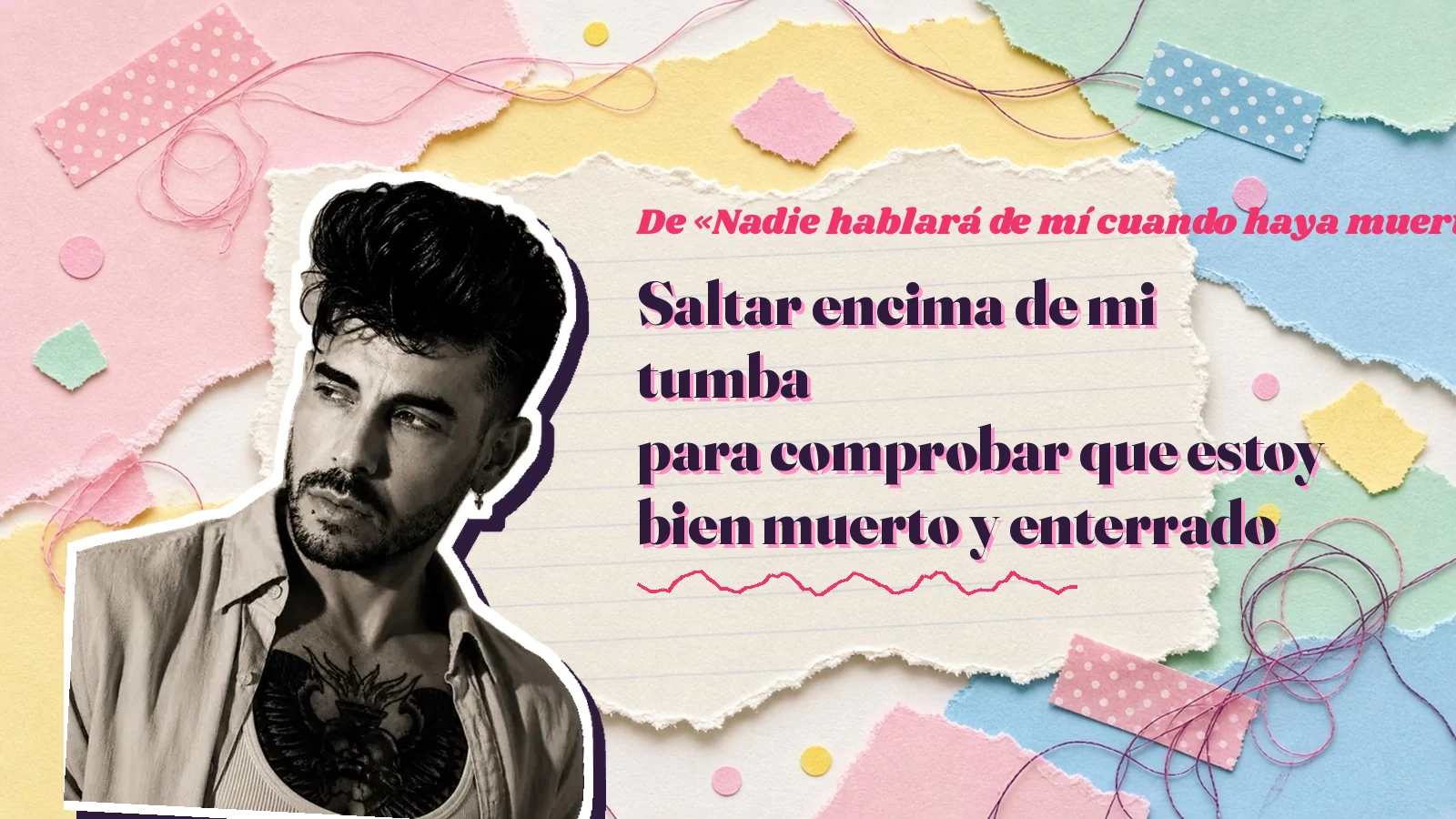
And then comes the reference that makes the song mine and nobody else's. There will be some, the lyric says, who'll do what the red-haired devil did with Antonio Recio: «Saltar encima de mi tumba / para comprobar que estoy bien muerto y enterrado» (Jump on top of my grave / to check that I'm good and dead and buried).
Anyone who has watched La que se avecina knows what I mean. Antonio Recio, "wholesaler, not fishmonger", the character Jordi Sánchez turned into a national treasure of rage. And around him, that whole universe of Mirador de Montepinar neighbours who hate each other with a very Spanish kind of affection. The lyric doesn't name the red-haired devil: it leaves it as a nickname, which is how people insult each other in that residents' association.
Putting a Telecinco sitcom into a song about death is exactly what you're not supposed to do, which is why I did it. It's the old trick: when things get too solemn, a TV character walks in and messes everything up. Like when someone at a funeral remembers an absurd story about the deceased and the whole back row stifles its laughter into handkerchiefs.
Two weeks
And beneath the Recio joke, the line that's genuinely frightening. In two weeks that's the past, that's been lived, and it'll be as if you'd never existed.
Notice the change of person. The whole song speaks in the first person: my mother, my father, my grave. And suddenly, in that line, a "you" appears: as if you'd never existed. It isn't a mistake. It's the moment the protagonist realises that what he's saying about himself applies to anyone. To the listener as well.
Two weeks. That's how long it takes a WhatsApp group to stop sending black hearts. How long it takes an office to give the empty desk to someone else. How long it takes the world to rearrange itself around a gap. The lyric doesn't say it with anger. It says it with the calm of someone who has done the maths and come up with that number.
The song that doesn't get forgotten
This is where the joke turns on the song itself, and I say it without embarrassment. If nobody will talk about me when I'm dead, why do I write so much? Why 273 singles, why three albums, why a music video for every song?
My first house rule is that a song kept in a drawer is no use to anyone. I've always explained it with the listener in mind: a song is for whoever needs it. But this lyric forces me to look at it from the other side. Maybe I also release songs so I don't vanish in two weeks. To leave something that keeps playing when I'm no longer around to press the upload button.
I don't know whether it works. Songs get forgotten too. But a released song stands a better chance of getting someone to talk about you than one kept in a drawer, that's for sure. I wrote about the fear of taking that step in the fear of publishing.
It's a lovely contradiction: a song that says nobody will talk about me, and that exists so that someone will.
All in the future tense
There's a grammatical detail that explains a lot about the tone. Almost the whole lyric is in the future tense: will talk, will say, will leave, will do, will answer. It's the tense of prophecies and fortune tellers. The protagonist doesn't remember his funeral; he predicts it.

And predicting your own funeral has something of the late-night psychic on local TV about it, the kind who reads your tarot over the phone at so many euros a minute. You see the future in full detail: who'll come, what the cousin will say, how the priest will storm off. You see it so clearly it seems to have happened already.
That certainty is part of the joke. Nobody knows who'll go to their funeral. But the pessimist knows everything, and always gets it wrong. The song's future is the future your mind invents on bad days, with the same conviction as the psychic assuring you that you'll meet a tall dark stranger.
Writing it in the future also leaves it open. It hasn't happened yet. The cast can still be changed.
He had his temper
The ending of the lyric is my favourite part, because it's the smallest. After the funeral, after Recio, after the forgetting, comes the corridor conversation. Someone asks why the deceased once said something nasty to them. And someone else reassures them.
The lyric puts it in quotation marks, the way real sentences get quoted: «"Ya sabes, tenía su carácter"» ("You know, he had his temper"). And then comes the bit about him being drunk or high as a kite, which is the most Spanish way there is of filing away a wound you never understood: blame it on the dead man's drinking.
I love that ending because it's the real epitaph that awaits nearly all of us. Not the line carved in marble, but the one said in the funeral-home car park while someone hunts for their car keys. He had his temper. Four words to sum up an entire life, the brilliance and the bile, and the tenderness hidden underneath.
Don't let them sum you up like that. Or do. But at least make them work for it.
Being the odd one
Who is this song for? For the odd one in the family. For the one who notices, at Christmas lunches, that the conversation goes quiet for a second when he walks in. For the one who knows that at his funeral someone will say "well, he was very much his own person" with a look of relief.
Many gay men of a certain age have been that odd one, and have been it for decades. The song doesn't say so, because the lyric doesn't mention being gay in a single line. But anyone who has lived it recognises it in the counting of chairs, in the mother and father who come out of blood duty, in the boyfriend who leaves. There's a very particular loneliness in that, and I've also dealt with it in the loneliness of creating alone, although there I'm talking about a different kind of silence.
Laughing at your own death
Is it in bad taste to write a song laughing at your own funeral? It might be. To me it seems the healthiest way to think about it. The alternative is never thinking about it, and then death arrives before you've had time to make a single joke about it.

In Spain we have a tradition of this. The black humour of village fiestas, of the Cádiz carnival troupes with their cardboard coffins, of Berlanga and his executioner, of grandmothers who say "when I die, leave the telly on for me". We laugh at death because we keep it close: in the village, in the newspaper obituaries, in the cemetery we visit every November with flowers and a sandwich.
My song comes from there, even though it was made in Madrid with today's tools. Part of camp is exactly that: treating the serious with feathers and the frivolous with solemnity. I explained it in camp isn't a joke even if you laugh.
The cover: a pink carnation
On the cover there's a man in a black suit with a pink carnation in his lapel, eyes lowered, in a pink room. The title sits in a pink block, like a cake-shop sign. It's mourning in bubblegum.
I like that contradiction: the funeral suit and the birthday-party set. It's exactly the tone of the lyric. The black of death and the pink of mischief, together in the same photo, with neither winning. If the cover were all black, the song would seem like a requiem. If it were all pink, it would seem like a joke. It's both, and the image says so before the first note plays.
Where it sits and who its neighbours are
The song belongs to *Descubierto un nuevo planeta llamado GAYFOLK*, the first album of the trilogy. In the singles catalogue it's number 157. Right before it comes «La chusta nunca disgusta» and right after it «Ni con un palo».
The neighbours make me laugh. From a salvaged cigarette end to a funeral with no audience, and from the funeral to a flat refusal. As if the order told the story of a very bad afternoon: you smoke what's left, you imagine your burial and, by the time someone suggests something, all you can say is not with a bargepole.
The lyrics are mine, the rest is production
Everything I quote here was written by me, word for word, without artificial intelligence: the headcount, the priest, Recio, the two weeks, the temper. I produce the music and the vocals with AI tools such as Suno, and my role in that part is director: choosing, discarding, trying again until the song sounds the way I imagined it.
In a lyric like this, the hard part is the tone. If the production turns solemn, the Recio joke sounds like an accident. If it turns festive, the line about the boyfriend leaving with good reason loses its weight. You have to find the middle ground, the point where you can smile and swallow hard at the same time. I explain how I work with those tools on my introduction page.
Where to listen
The full lyrics are on its lyrics page, and the rest of my lyrics are in this site's lyrics archive. To listen, there's Spotify or the music video on gayfolkplanet.com.
I recommend listening to it on a Sunday afternoon, at that hour when the light turns orange and everything feels a little like the end of something. And then calling someone. One of those two friends, at most. Or that one.
The extra chair
Back to room 3 at the funeral home. Lots of chairs, few people.
I don't know how many people will sit in them. Nobody does. What I do know is that, ever since this song has existed, that imaginary room has one more guest: Antonio Recio, jumping on the grave and bellowing like the wholesaler he is.
That's what a song is for.
Frequently asked questions
What is «Nadie hablará de mí cuando haya muerto» about? It's about someone imagining his own funeral: two friends at most, the blood family, a last partner who drifts away "with good reason", a priest thrown out of the house, and some who'll jump on his grave like the "red-haired devil" with Antonio Recio. It deals, with black humour, with the fear of being forgotten within two weeks.
What does Antonio Recio have to do with the song? The lyric references Antonio Recio, the character from La que se avecina, in a darkly comic image: jumping on the protagonist's grave to check that he's good and dead and buried.
Which album is it on? On Descubierto un nuevo planeta llamado GAYFOLK, the first album of the GAYFOLK trilogy. It's single 157 in the catalogue, between «La chusta nunca disgusta» and «Ni con un palo».
Who wrote the song? Mike Sain't Louis, a lyricist, composer and producer from Madrid, known as the first AI songwriter. The lyrics are his, written without AI. The music and vocals are produced with artificial intelligence tools such as Suno.