By Mike Sain't Louis ·
Fangs in the neck: why I talk about heartbreak through horror films
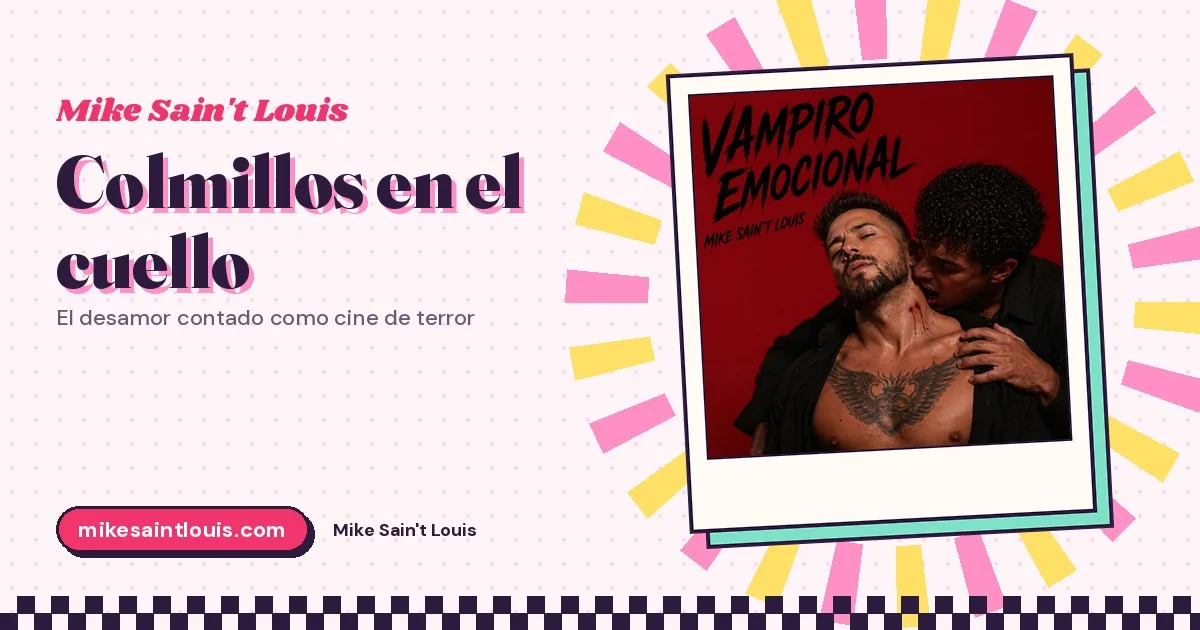
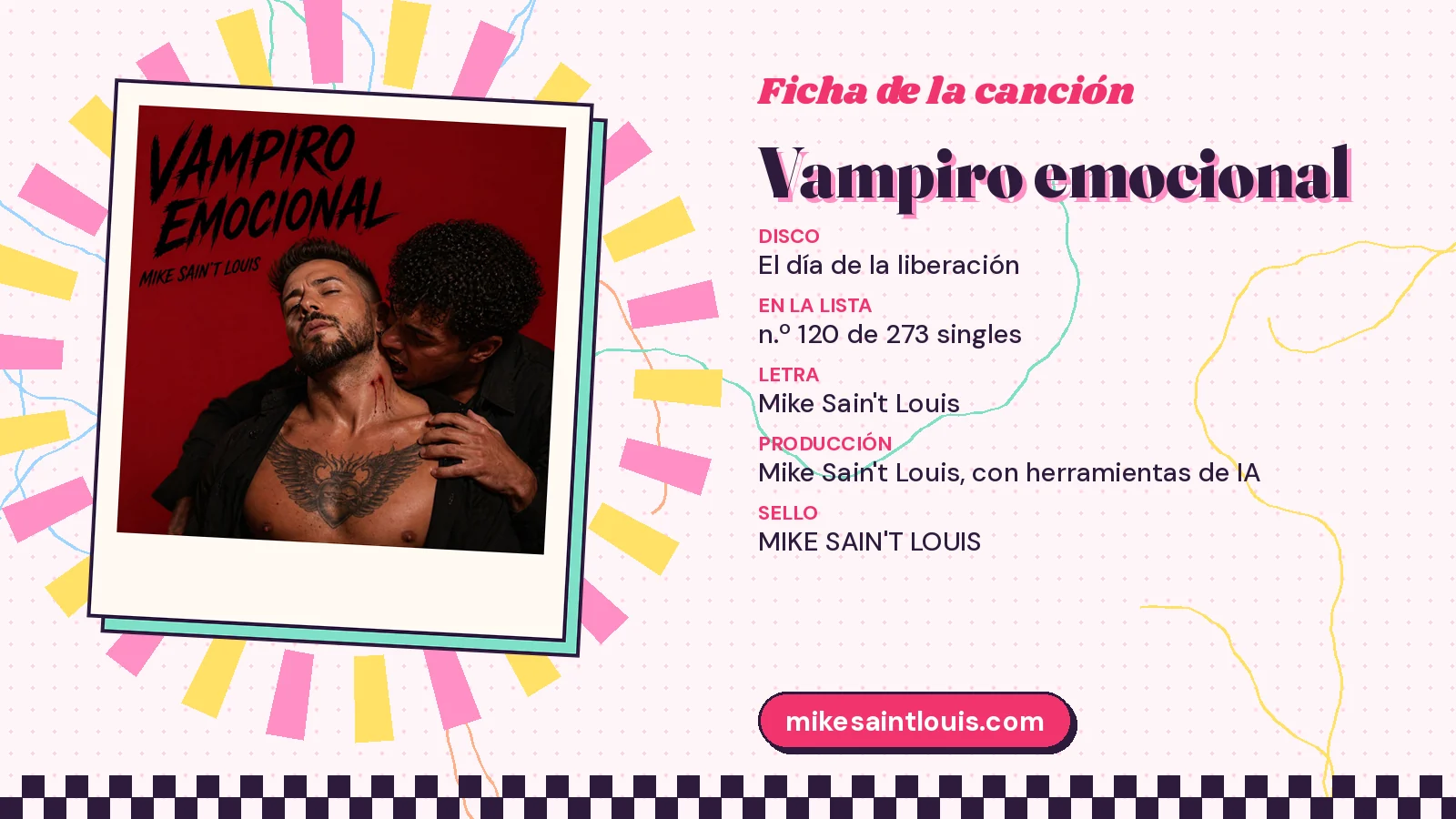
Red background. A boy with half-closed eyes and his head tilted, like someone letting it happen. Behind him, another boy sinks his mouth in just below the jaw. A drop of blood runs down the neck to the chest, where there's a tattoo of a winged heart. At the top, in the black lettering of a B-movie poster: «Vampiro emocional» ("Emotional vampire").
That's the cover of one of my songs, and it's a handy way into something anyone who listens to me will have noticed: when I talk about relationships that hurt, I always end up in a horror film.
Vampires, Saw masks, chainsaws, coffins, houses full of corpses. My catalogue has more blood than the horror shelf of a nineties video shop. And there's hardly ever a real body. There's an ex.
A cover that doesn't explain the lyric
Before going on, an honest warning. The lyric of «Vampiro emocional» isn't yet published on the site's lyrics page, so I'm not going to tell you what it says. I'm talking about the song through its title and cover, which already say plenty, and through how it fits into a family of my songs that you can read in full.
The «Vampiro emocional» page already describes the image and explains the expression. Here I want to pull on that red thread and see where it leads.
The vampire without a cape
"Emotional vampire" is a phrase that does the rounds in newsstand psychology magazines and over long Spanish lunches. It describes the person who leaves you exhausted. They don't hit you, they don't necessarily shout, they do nothing you could report. But after every encounter you have less energy, less drive, less of yourself.
I like the expression because it takes a film monster and removes the cape. The emotional vampire doesn't live in a Transylvanian castle, doesn't sleep in a coffin, isn't afraid of garlic. He lives in your flatshare, in your WhatsApp group, in your bed. And he feeds on what you give without noticing: attention, time, patience, forgiveness.
The cover does the opposite of the expression. It gives him his fangs back. What's invisible in real life becomes literal in the image: there's a bite, there's blood, there's a neck. It's the exaggeration I needed. If what's happening to you can't be seen, sometimes you have to draw it in blood before anyone believes it.
You bite without drawing blood
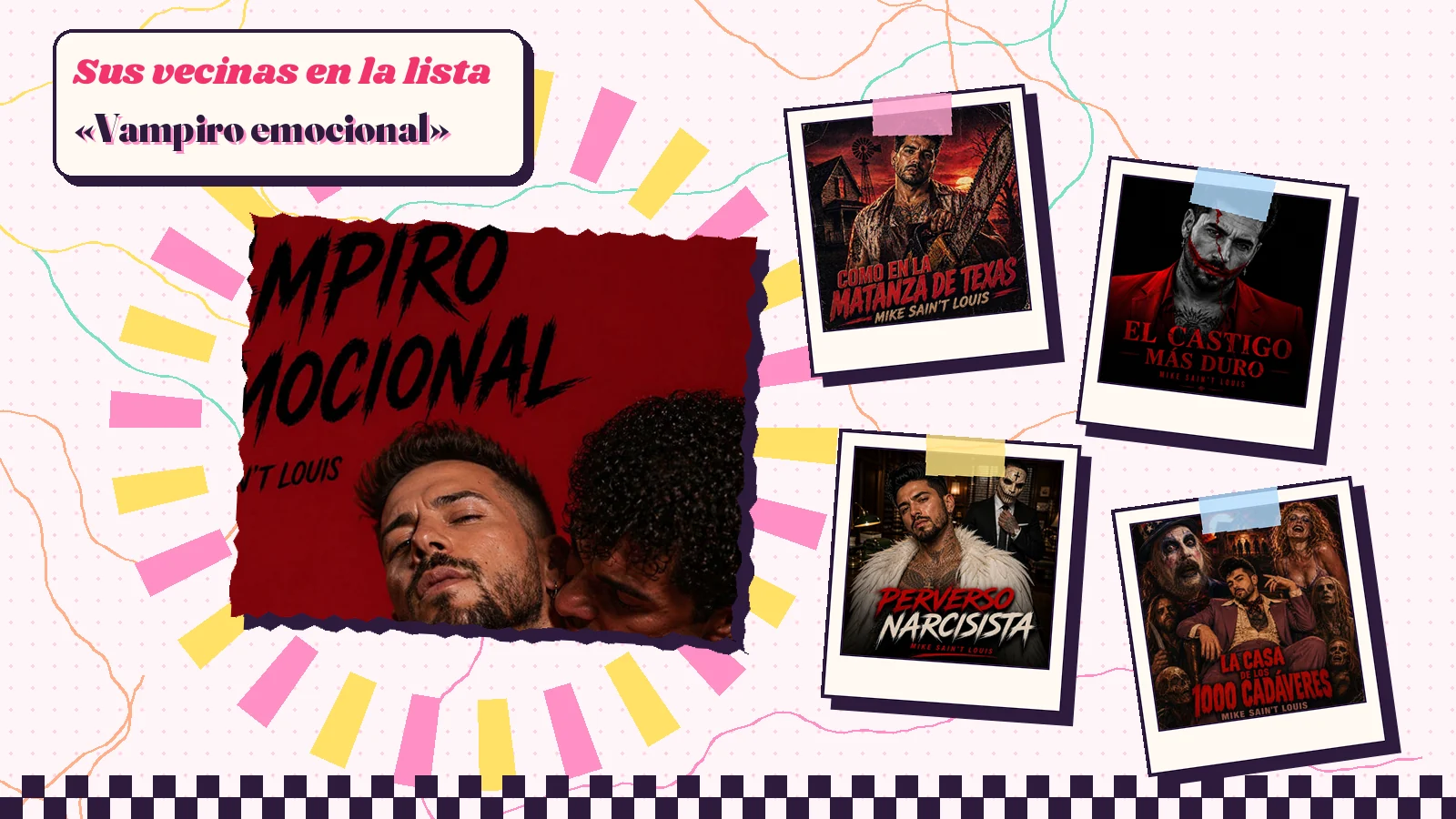
There's another song in my catalogue that uses the same expression almost as a refrain, and its lyric is published: «Como en la matanza de Texas» ("Like in The Texas Chain Saw Massacre"). There the emotional vampire is the main character, a predator strolling round the bar with his forced, how-do-you-do smile.
One line of that song strikes me as the best definition of the whole business I've ever written:
«Muerdes sin sangrar, pero dejas cicatriz» "You bite without drawing blood, but you leave a scar"
That's all of it. A real vampire leaves two little holes in your neck. The emotional kind leaves nothing visible. No evidence of the crime, no puddle to mop up. And yet, when you look in the mirror months later, the mark is still there.
And another line from the same song, almost a diagnosis:
«Te alimentas de esperanza y la conviertes en sal» "You feed on hope and turn it into salt"
I love that image because it's the reverse of what you'd expect. A vampire sucks blood, something liquid and warm. This one sucks hope, and what it leaves is salt, something dry that stings in the wounds. The sweetness you brought turns bitter.
The cover of «Vampiro emocional» is, in a way, the image that song was missing: the bite the line said didn't bleed, finally bleeding for everyone to see.
Why horror and not drama
The question people ask me, or that I'd ask if I were someone else, is why. Why not tell these stories with the tools of drama, of the bolero, of the good old sad song. Why the chainsaw.
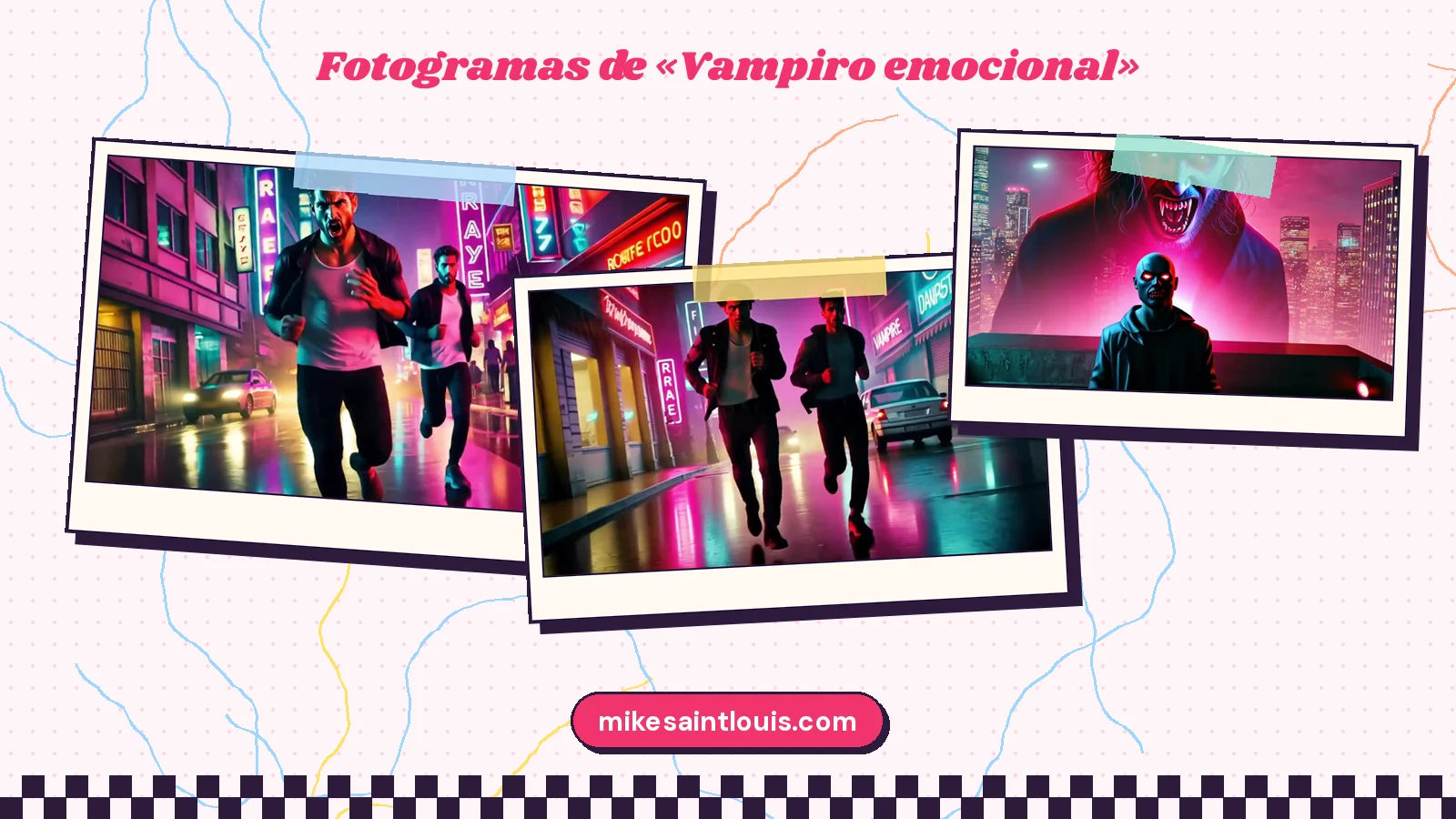
I have several answers, and none is the only one.
The first is that horror is exaggerated by nature, and exaggeration is my mother tongue. When a relationship wrecks you, what you feel isn't proportionate. You feel you're in a horror film, even if objectively what happened is that someone stopped answering your messages. Horror gives shape to that disproportion. What looks small from outside is, from inside, The Texas Chain Saw Massacre.
The second is that horror is camp. B-movie horror, with its ketchup blood and overacted screams, is one of the gayest pleasures there is. Whole generations of gay men grew up watching horror films on the sly and laughing at them in groups. I touch on it in camp isn't a joke, even if you laugh: camp is taking the exaggerated seriously and laughing at the same time.
The third is that horror lets you laugh without making the matter any less grave. A bolero about a narcissist leaves you in pieces. A vampire film about a narcissist leaves you with half a smile and your heart where it belongs. It's still true. But you can get up off the sofa.
The vampire who weeps
The vampire isn't always the other one. In «El castigo más duro» ("The harshest punishment") there's an image I still think is one of the loveliest I've written, and in it the vampire is me, or the narrator. His words come out barbed and his mouth bleeds so much that passers-by «se cree / que soy un vampiro que llora bajo la luz de la luna», "think / I'm a vampire weeping under the moonlight".
There the monster is the one who suffers. The blood isn't the victim's, it's his own, from biting his tongue so hard. It's the other face of the same myth: the vampire of nineteenth-century novels was a sad creature too, condemned to night and solitude, in love with someone he could never have.
That back-and-forth fascinates me. In some songs the vampire is the narcissist who sucks the life out of you. In others the vampire is what he's left behind: someone who can no longer bear the light, who goes out at night, who feeds on memories. The cover of «Vampiro emocional» leaves the question open, because the bitten boy doesn't seem to be suffering. He seems to be enjoying it.
The bite you enjoy
And that's the most unsettling thing about the image, and the most honest.
The boy in front has his eyes closed, mouth half open, head thrown back. He doesn't struggle. He doesn't scream. He lets it happen. Take away the drop of blood and it could be a love scene. In fact, partly, it is.
That ambiguity is what self-help articles rarely tell you about emotional vampires: at first you like it. The bite has something pleasurable about it. The attention a narcissist gives you in the first weeks is the most intense you've ever felt, and that's why you stay. Nobody stays with a monster who looks like a monster from day one. You stay with someone whose bite feels delicious.
On the song's page I put it another way: you like it until you realise he's draining you dry. The cover is frozen at exactly that moment, the moment of pleasure, before you realise. That's why it's so unsettling. It's the second before you open your eyes.
The winged heart
There's a small detail on the cover that tickles me: the tattoo on the bitten boy's chest. A winged heart, the classic flash of a neighbourhood tattooist, the kind people got in the eighties with a girlfriend's name on a banner.
The drop of blood heads straight for it. As though the vampire were drinking right from the winged heart, from good old romantic love, from the tattoo you get when you think something will last for ever. It's almost a visual joke: love with wings, feeding a predator.
I don't know whether others will see it that way. To me it's the key to the image.
Vampires with a bit of camp
The vampire has a very long history with queerness, and I'm not the one who spotted it. Since the nineteenth-century novels, the vampire has been the seductive outsider who breaks the rules of desire: he bites men and women, lives by night, doesn't marry, has no children, surrounds himself with same-sex companions for eternity. Many people have read in that, rightly, a metaphor for what society didn't want to see.
Cinema made it plainer still. «Interview with the Vampire», the Tom Cruise and Brad Pitt one, is a love story between two men with fangs, though in the nineties nobody said so out loud in the magazines. «The Hunger», with Catherine Deneuve and David Bowie, has a scene with Susan Sarandon that became a cult moment for many lesbians. Vampires have always been a bit one of us.
That's why it feels so natural that the cover of «Vampiro emocional» shows two men. Nothing needs explaining. A gay vampire is almost a tautology. What the song does is move that myth from the terrain of seduction to the terrain of harm: the vampire is no longer the forbidden, fascinating lover, he's the boyfriend who leaves you stiff as a board. From Anne Rice's glamour to a flatshare in Lavapiés.
Danger stands behind
There's a compositional detail that recurs in several of my covers and shows very clearly in this one. The biter is behind. The bitten boy looks towards us, more or less, and the vampire stays at his back, half hidden, face pressed to the neck.
Something similar happens on the cover of «Perverso narcisista» ("Perverse narcissist"): in front there's a boy in a feather coat, and behind, in an office, a man in a suit wearing a skull mask. Danger is never in front of you. It's at your back, where you can't see it, getting on with its work while you look elsewhere.
That placement seems to me the most accurate way to draw what happens in a relationship like that. From inside, you can't see the vampire. You see the wall in front of you, your own life, your plans. You feel the bite, but the biter is outside your field of vision. Everyone else, looking at the photo from outside, sees him perfectly. You don't.
That's why it's so common for friends to see it before you do. They're looking at the whole cover.
Biting is kissing, too
One thing I love about the vampire is that his attack looks so very like a kiss. Mouth on the neck. Eyes closed. The embrace from behind. If someone sees you from a distance, they can't tell whether you're being loved or killed.
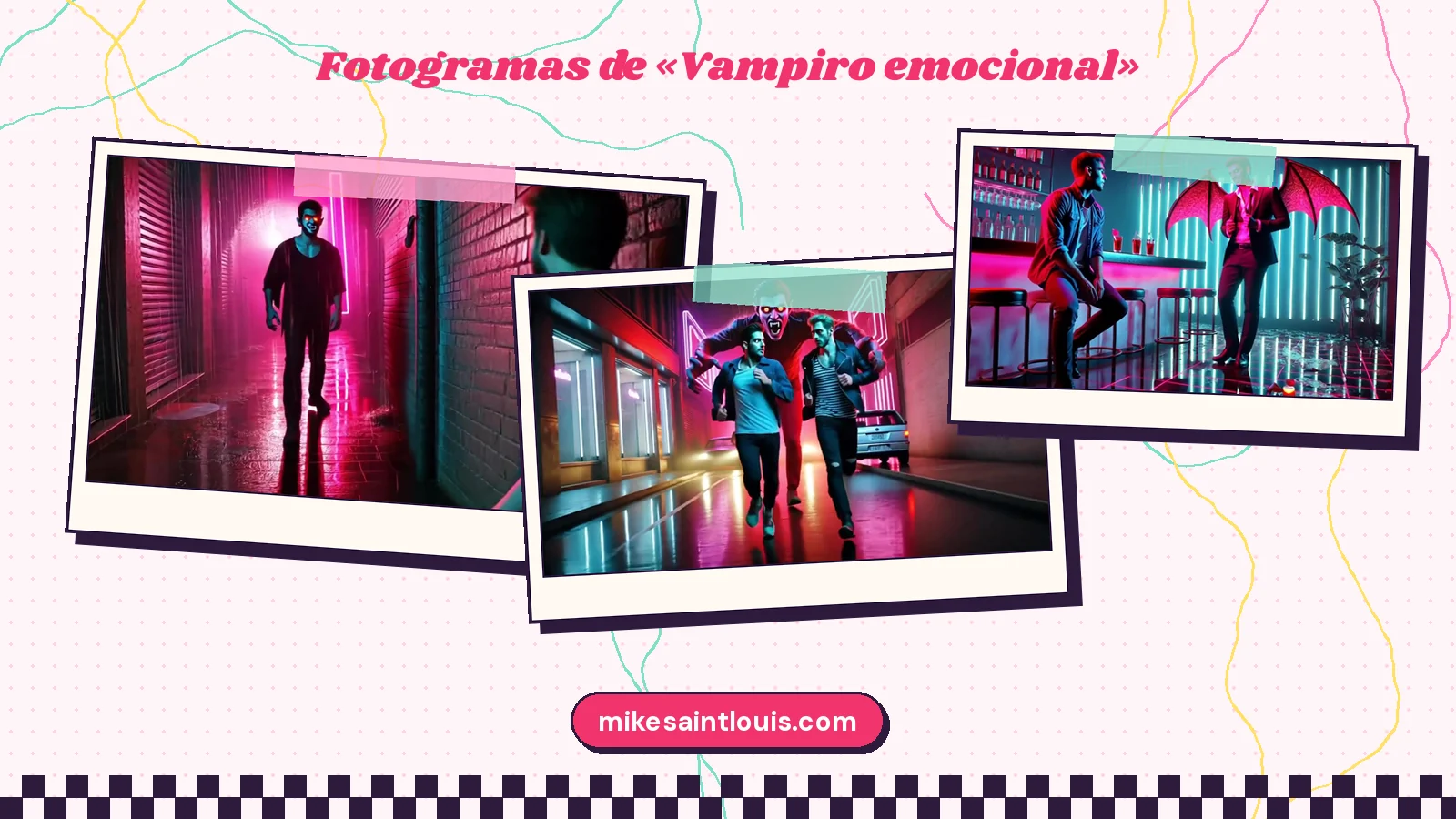
That confusion is exactly the confusion of being with an emotional vampire. For a long time you can't tell whether what's being done to you is love or something else. The gestures are the same: he seeks you out, holds you, whispers in your ear. What changes is what he takes when he leaves. And you can't see that in the moment. You see it later, when you look in the mirror and notice how pale you are.
In Spanish we have a very graphic expression for someone who loves you too much and badly: te come, "he eats you up". Ese te come. It's said of smothering mothers, jealous boyfriends, bosses who won't let you breathe. The vampire is the horror version of that phrase. He eats you up, yes. But he starts with the neck.
Red on red
And the colour, which is no minor detail. The whole cover is red: the background, the light on the skin, the title in black against that tide. Only the drop of blood stands out, because it's redder still than everything else.
Red on my covers nearly always does the same job. It's the colour of what won't hide: rage, desire, the open wound. On the cover of «Llorar» ("To cry") everything is stained red too, as if the tears were made of fire. Here the red turns an intimate scene into an alarm. It's the emergency light in a nightclub, the recording light on a camera, the traffic light telling you to stop.
And nobody stops, naturally. That's very horror film as well: the whole audience shouts "don't go in there!" and the heroine goes in.
A family of monsters
Go through my catalogue with a horror buff's eye and you'll find a whole gallery.
There's the Saw mask, which appears in «El castigo más duro» as a threat of what might happen if certain words came out all at once. There's The Texas Chain Saw Massacre, with its desperate run for help nobody answers. There's «La casa de los mil cadáveres», its title lifted straight from Rob Zombie's House of 1000 Corpses. There's «Ataúd de neón» ("Neon coffin"), half funeral, half nightclub. There's «Igual que en las pelis slasher» ("Just like in slasher films"), with its masked killer. And there's the hologram turned into a block of concrete, which is more science fiction, but gives you a little chill too.
Each monster has a purpose. The vampire, for the one who sucks your energy. The slasher killer, for the one who hunts you down even when you hide. The haunted house, for the relationship you can't get out of. The coffin, for what's already dead even though it still glows. It's a bestiary of heartbreak, a catalogue of creatures to name what psychology names with acronyms.
It amuses me to think that if someone ever made a playlist of my horror songs, it could go on at Halloween and nobody would suspect it was all about ex-boyfriends.
The narcissist with fangs
At the bottom of nearly all these songs is the same figure: the narcissist. I've told it many ways, sometimes with a dry diagnosis, as in «Ni con un palo» ("Not with a bargepole"), and sometimes with monsters. On the blog I run through the different types of ex who turn up in my lyrics in a short comic typology of ex-boyfriends, and the vampire has pride of place.
What I like about the vampire as a metaphor for the narcissist is that the myth came with nearly all the rules built in. The vampire needs you to invite him in: he can't cross the threshold without your permission. The vampire has no reflection in mirrors. The vampire hypnotises with his gaze. The vampire lives off others and can live no other way.
All that describes very well the dynamic I've described so many times. The narcissist doesn't force his way into your life: you invite him, delighted. He doesn't show in the mirror because, deep down, he has no solid self to reflect. He hypnotises you at first with an attention that looks like love. And he lives off you, your energy, your admiration, your fear of losing him.
I don't say this as an expert, because I'm not one. I say it as someone who has written a lot of songs about the same thing and found, in a monster from a novel, the best way to sum it up.
Garlic, stakes and the block button
If the narcissist is a vampire, what's the garlic? What's the stake?
In films, you defeat a vampire with light, stakes, crucifixes, holy water. In life, my songs offer other weapons. Blocking him on your phone. Deleting the photos from every cloud going. No contact. Telling someone who'll believe you. Laughing out loud at what he did.
Sunlight, in this case, is telling the story. The emotional vampire depends on darkness, on nobody knowing what's going on, on you doubting what you've lived. The moment you tell it, the moment you put it in a song named after a horror film, the light gets in. And in the light, the vampire is just a pasty man with bad breath.
That, if I have to find one, is the only lesson I draw from this whole bestiary. Talking is the stake. I'll say it once and leave it there.
Ketchup blood
Back to the cover, to finish on something less serious.
The blood in the image is very red, a patent-leather red, almost advertising red. It doesn't look like real blood. It looks like seventies horror blood, the kind made with syrup and food colouring, the kind that stained actresses' white blouses an impossible red. And the red background multiplies it all, as if the scene were lit by a darkroom bulb.
I adore that artificiality. It's the difference between horror and camp. Horror wants you to believe the blood. Camp wants you to know it's ketchup and be frightened anyway. My songs are in the second camp: they tell you something that really hurts with fake blood, so you can look at it without turning away.
Play it at Halloween, or in March
When should you put on a song like this? On the song's page I suggest dedicating it to whoever sucked the joy out of you, or listening yourself so you'll recognise the bite next time. Fair enough. I'll add a third option: put it on at a Halloween party, between horror classics, and see who laughs at the title. That person has a story to tell.
And if it isn't Halloween, never mind. Emotional vampires don't respect the calendar. They bite in March, in August and at Christmas, which is when they're hungriest.
As for you, just in case, keep a string of garlic handy. Or, better still, the block button. It works just as well and doesn't leave the kitchen smelling.
Frequently asked questions
What is an emotional vampire? A phrase for someone who leaves you drained after every encounter: they feed on your attention, your time and your drive. Mike Sain't Louis's song bears that title and a cover that turns it into a literal bite.
Where can I read the lyric? At the time of writing, the lyric of «Vampiro emocional» isn't yet published on the site. The lyric of «Como en la matanza de Texas», which uses the same expression, is: gayfolkplanet.com/letras.
Why are there so many horror film references in Mike Sain't Louis's songs? Because horror lets you exaggerate what a harmful relationship feels like and laugh at the same time, through camp, without making the matter any less grave.
Who makes the songs? Mike Sain't Louis writes the lyrics, composes and produces. The music and vocals are made with artificial intelligence.