
By Mike Sain't Louis ·
«Yo, solo, he venido»: a break-up in the language of funerals
An ordinary doorway. Someone has got off the bus two stops early so they can walk the last stretch and rehearse the sentence. They ring the bell. The door opens. They go up. They don't sit down, don't take their coat off, don't accept the coffee. They say what they came to say and they leave.
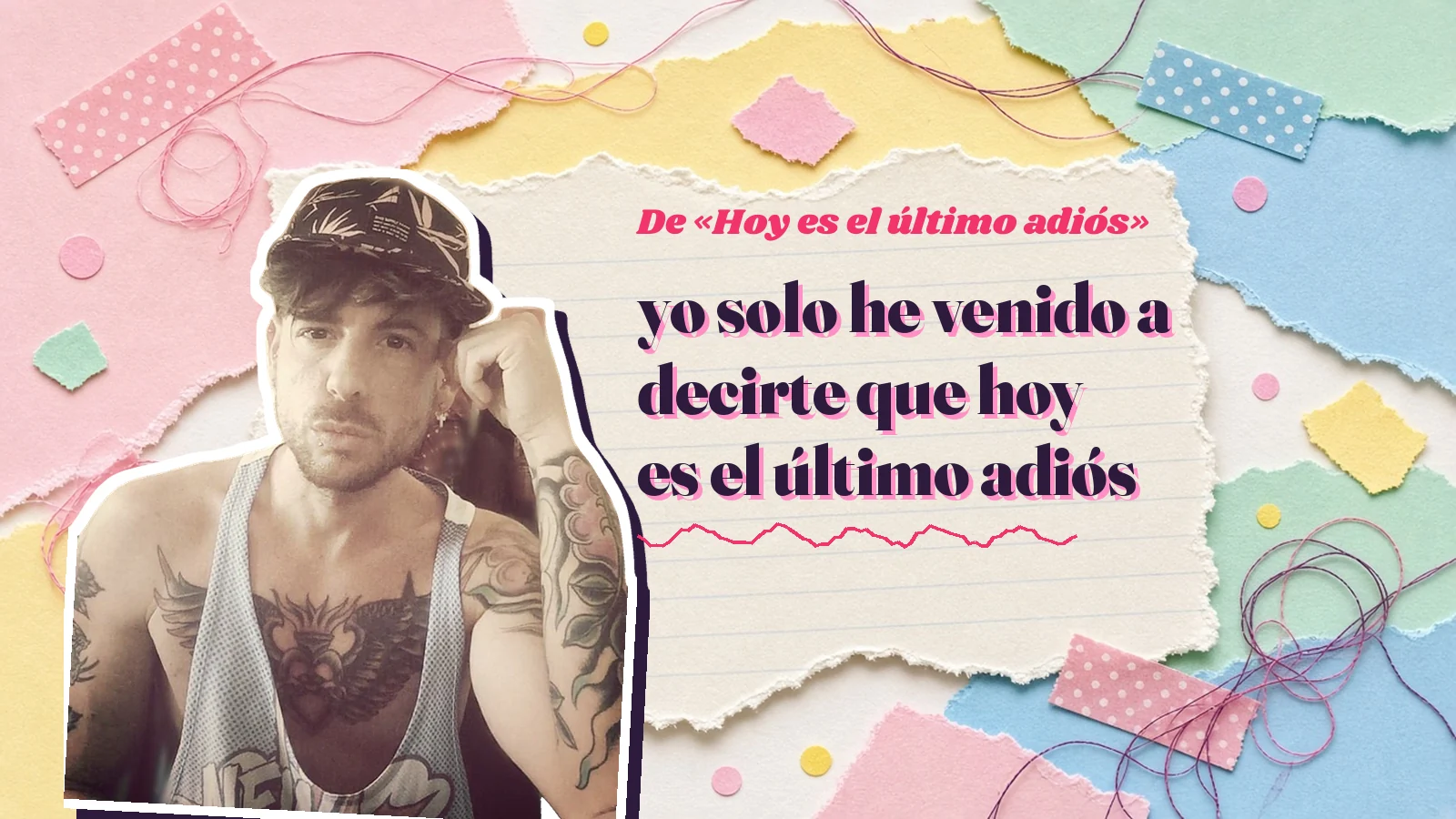
That scene isn't in the lyric. It's the one I see when I read it. The lyric only has the sentence, and the sentence is this: «yo solo he venido a decirte que hoy / es el último adiós» (I've only come to tell you that today / is the final farewell).
I'm Mike Sain't Louis, I write the lyrics for Planeta Gayfolk, and «Hoy es el último adiós» ("Today is the final farewell") is the song with the fewest words I've ever written. A single sentence, repeated and chopped up. The song page talks about the repetition and the force of that opening "I". Here I want to talk about two other things that interest me more: where the expression "the final farewell" comes from, and what happens when the song splits the words "yo" and "solo" down the middle.
Funeral-parlour words
In Spanish, el último adiós has an owner. It's what you give the dead. Obituaries say it, the evening news says it when they bury a folk diva: thousands of people yesterday bid the artist a final farewell. It's a wreath expression, purple ribbon with gold lettering.
And I used it for a break-up. To say goodbye to someone who is alive, who opens the door, who has probably got the coffee on.
That's the quiet cruelty of the song. It doesn't say I'm leaving you, or it's over, or I never want to see you again. It says what you say in front of a coffin. It treats the relationship as the deceased and turns up at the wake to observe the formalities. It's a very polite way of saying that, as far as he's concerned, the other person is already buried.
An insult in a suit and tie.
Yo, solo
Now the part I like best. The full sentence is yo solo he venido a decirte. That solo, written without an accent as it is nowadays, means "only": I've only come to tell you this, nothing more, I'm not here to argue.
But in several passes through the song, the sentence breaks. The published lyric splits it into separate lines: Yo. Solo. And then the rest. And the moment you separate those two words, solo changes meaning. It's no longer "only". It's "alone". I, alone. I, who am by myself.
The same word doing two jobs at once. In the unbroken sentence, the speaker is firm: I've only come for this. In the broken one, the speaker is forlorn: I've come by myself, with no one. Both are true in a break-up. You go with your mind made up, and you go on your own, without the person you went everywhere with until yesterday.
It strikes me as one of the loveliest things any lyric of mine has done, and it did it almost without my help: a line break was all it took.
Today
The third word with weight is "today". It doesn't say some day, or soon, or when you can. Today.
That "today" is what sets this song apart from so many other farewell songs that stay in the conditional. I'd leave, I should leave, one day I'll leave. Song drawers are full of goodbyes that never arrive. This one arrives with a date. If it were a letter, the date would be written at the top, in the right-hand corner, the way they taught you at school.
And there's some relief in that "today". Whoever says it has been thinking about it for a while; you can tell. At last they put a date on the formality. Like someone who has spent months saying they'll cancel their gym membership and finally walks into the office with the form.
I've come
I've come. In person. Up the stairs.

These days you can break up with someone in a twelve-word message, or with weeks of silence, or by blocking a number. The lyric chooses the old-fashioned way: showing up. And that gesture already says a lot about the speaker. He had the courage to go. He didn't hide behind a screen or vanish without explanation, which is what has been done to him so many times in other songs of mine.
My catalogue has a song, «No Contact», that celebrates the opposite: cutting all contact with whoever hurt you, closing doors, not looking back on the dance floor. Both are legitimate ways of leaving. «No Contact» is the one that comes after. «Hoy es el último adiós» is the visit that perhaps comes before: the last time the two of them see each other's faces.
A single sentence
Can you write a song with a single sentence? You can. The hard part isn't writing it, it's holding it up. A sentence repeated through a whole song has to carry the weight of everything left unsaid.
And here what's left unsaid is enormous. We don't know why he's saying goodbye. We don't know how long the story lasted, or who let whom down, or whether there was someone else, or whether there was gaslighting or simply exhaustion. The song refuses to explain itself. And that refusal is part of its message: there's nothing left to explain. The explanations were given before, in other conversations, in other songs.
When I write chorus lines with humour, repetition is a game, and I talk about it in how to write a chorus that laughs at you and with you. Here there's no game. Here the repetition belongs to someone who rehearsed the sentence on the bus and says it over and over because he's afraid that if he says anything else, an "well, maybe we could talk about it" will slip out.
The lines I discarded without writing them
To understand why the song says exactly what it says, it helps to think about what it could have said. There are many ways to break up in Spanish, and almost all of them have a problem.
"I'm leaving you" is too active, almost aggressive: it sounds like a slammed door and a suitcase on the landing. "It's over" is impersonal, as if the relationship had simply run out, like a gas canister. "We're finished" drags the other person into the decision without asking. "I need space" is the TV-series line, the one that really means we'll see. "We need to talk" is even worse: it announces a conversation instead of having it.
The final farewell has none of those problems. It doesn't blame anyone. It doesn't negotiate. It doesn't promise another chat. And it carries death inside it, the one thing that allows no appeal. There's no coming back from a funeral.
That's why, when you hear it, there's nothing left to answer. That's the test of a good parting line: it leaves no room for a reply.
The other person doesn't speak
In the whole song, the other person appears just once, hidden in a verb ending: decirte, "to tell you". That final "you" is all we know about the person receiving the farewell.
No name, no face, no voice. No reply. We don't know whether they cry, get angry, shrug, or had been waiting weeks for this moment. The song denies them a reply just as the one leaving denies them the coffee.
In many of my lyrics the other person talks a lot. The exes lie, justify themselves, gaslight, send voice notes. Here they aren't allowed to. And that muteness is a form of power. For once, the one holding the floor is the one leaving, and he won't give it up.
If someone listens to the song from the side of the "you", the one hearing the news, the experience is different. It's hearing the sentence again and again without being able to get a word in. Maybe there's a song in that too. I haven't written it yet.
Turning it down in a catalogue that shouts
My catalogue is loud. There's a song called «Eso es lefa». There's another called «Esta canción es una mierda». There are vampires, chihuahuas, cheated folk divas and out-of-date peppers. If someone lands on my singles page at random, they'll most likely find a joke, or a scream, or both.
In the middle of all that noise, «Hoy es el último adiós» turns the volume down. It doesn't shout, doesn't insult, doesn't laugh. It's the quietest song on the block.
I think that's exactly why it works. If the whole catalogue were whispers, this would be just one more. Surrounded by feathers and shouting, the silence carries. It's the same at a party: when someone suddenly stops talking, everyone turns round.
I like to think that someone who only knows me from the outrageous titles stumbles on this one and is a bit thrown. Oh, so he knows how to keep quiet too. Well, yes. Sometimes.
Other farewells
The farewell doesn't have to be to a partner. The lyric doesn't say who it's addressed to, and that leaves the door open to other uses. You can bid a final farewell to a job that made you feel small. To a city that didn't love you. To a shared flat with a landlord who never fixed the boiler. To a friendship that for years had only been yours.
Even to a version of yourself. Some days you stand in front of the mirror and tell yourself something similar: I, alone, have come to tell you that today this is over. The smoking, the silence, the fear, whatever it is.
If the song helps you with any of those farewells, it's yours. One-sentence songs have that advantage: they fit into lots of lives.
No joke
This song has no joke in it. That's unusual for me.
Normally I slip something in: a swimwear brand, a TV personality, a cockroach, a chihuahua. None of that here. And not for lack of wanting; it's because any joke would have broken the sentence. A farewell with a joke is a farewell that leaves the door ajar: we laugh, we look at each other, we'll see. This one closes it.
There's a house rule that says the lyric is in charge. Usually that means the production has to obey what the words are saying. In this case it also meant that I, the lyricist, had to obey. The sentence wanted to stand alone, and I let it.
Goodbye, goodbye
The end of the lyric does something that feels almost physical to me. The sentence keeps shrinking. First it's the whole thing. Then just "the final farewell". Then only "goodbye". And "goodbye" again.
I'll quote it exactly as it appears at the end of the published lyric: «El último adiós / Adiós / Adiós».
It's like watching someone walk away down a long street. At first you see all of them, coat and stride. Then a figure. Then a dot. Then nothing. The lyric says goodbye to itself the way the protagonist says goodbye to the other person: with fewer words each time, until there are none left.
Reading the line breaks
With so few words, what happens between them matters a great deal. If you read the published lyric slowly, you'll see the sentence isn't always repeated the same way. Sometimes it runs whole over two lines. Sometimes the ending doubles up: it's the final farewell, and again it's the final farewell, like someone repeating something because they're not sure the other person heard. And once, just once, the "es" appears with a capital letter, as though a new sentence were starting instead of the old one carrying on.

They're tiny details, the kind nobody notices when listening. But anyone reading a lyric on a screen sees them, and each one changes the breathing. The doubled sentence sounds like insistence. The capital letter sounds like a decision made again from scratch. The cut between Yo and Solo sounds like running out of air.
For me, a published lyric is also a score for the eye. Not everyone listens on headphones. Lots of people read the lyrics on their phone on the metro, and for them the line breaks are the music.
Goodbye twice
The ending repeats "goodbye" twice, each on its own line. Not once. Not three times. Twice.
That double goodbye is the one from station platforms and airports. The first goodbye is said looking someone in the face. The second, with your back already turned or from a distance, hand raised, when the other person can barely hear you. It's the goodbye you say more to yourself than to the one staying behind.
I like that the song ends on that second goodbye and not the first. The first is for him. The second is for the one who's leaving.
The cover: a winged heart
On the cover there's a man with a quiff, a vest top and a tattoo on his chest: a heart with wings. Behind him, pink and turquoise colour rays in pop-art style, like a sixties comic-book poster.
The winged heart is a classic sailor's tattoo, the kind people got done in port towns. And in this song I read it very literally: the heart that flies away. The one saying goodbye has the farewell tattooed on his chest. The background, on the other hand, is an explosion of colour, nothing like mourning. Because this farewell, even though it uses funeral words, isn't entirely sad. There's something of a liberation party about it.
Liberation day
And that brings us to the album. The song belongs to *El día de la liberación*, the third album of the GAYFOLK trilogy. A final farewell on an album with that title can't be read only as loss. It's also a door opening outwards.
I wrote about what happens after that day in liberation day and the day after. Because liberation has a hangover, and the hangover lasts longer than the party. But that's another song. This one stays in the exact moment at the door.
Leaving the four walls
The order of the catalogue hands me a reading I didn't go looking for. On the singles list this song is number 210, and right before it comes «Entre cuatro paredes». That lyric is about someone with no hope and no strength, who doesn't want to leave the room. And it says something that ties in with what I said earlier: that he's alone between these four walls.

Put the two songs side by side and the story tells itself. The man in «Entre cuatro paredes» is alone and shut in. The man in «Hoy es el último adiós» is still alone, but he's out. He's grabbed his coat, gone down to the street, caught the bus and rung a doorbell. I, alone, have come.
I'm not saying I wrote them with that order in mind. I'm saying that, placed like that, one is the way out of the other.
And then, a folk diva
Right after, at single 211, comes «¿Me hago un folclórica engañada?», which is the exact opposite in tone: a father full of proverbs, a full wax before heading to La Tejita beach, a two-timer and a shouted "Next!". From the dry goodbye to drama with ruffles.
I love that they sit together. It's like life: you say goodbye with all the dignity in the world, in a single sentence, without raising your voice. And the next day, at the bar, you tell the story with every detail, every gesture and the fan. Both versions are true. One is for him. The other is for your girlfriends.
A dignified farewell
There's something about this song that matters to me and that I want to say clearly. For years gay men were taught that our break-ups were soap-opera dramas, scandals, shouting matches outside a bar in Chueca. And sometimes they are, and that's fine, and I have songs for that.
But there's the other kind too. The dignified farewell. The one where you arrive, say what you have to say and leave, without a scene. Without asking for anything. Without begging. That one is ours as well, and it deserved a song that didn't laugh at it.
What I do and what the tools do
The sentence is mine, like every lyric I publish: written without artificial intelligence. I produce the music and the vocals with AI tools such as Suno. On a song like this, my work as producer was mostly about restraint: choosing, from the possible versions, the one that wouldn't fill the gap left by the missing words.
With so little lyric, the temptation is to let the music tell the whole story, with dramatic strings and end-of-film crescendos. I went for the opposite: music that walks the sentence to the door and lets it leave on its own. I explain how I choose between many versions in the craft of discarding, and who I am and how I work on my introduction page.
Where to read and hear it
The full lyrics, with the line breaks exactly as published, are on its lyrics page. All the others are in this site's lyrics archive. To listen, there's Spotify or the music video on gayfolkplanet.com.
The doorway
Back to the doorway from the beginning. Someone comes down the stairs. Outside it's cold, or hot, it doesn't matter. He walks to the bus stop and doesn't look back.
He said a single sentence. It was enough.
I don't know what happens upstairs, in the flat, when the door closes. The song doesn't say and I'm not going to make it up. What I do know is that the man coming down the stairs is carrying less than the man who went up them. He's alone, yes. But he's travelling light, coat open, with the winged heart of his tattoo finally doing what it always promised: flying off somewhere else.
Frequently asked questions
What is «Hoy es el último adiós» about? It's about a definitive farewell told in a single sentence: «yo solo he venido a decirte que hoy es el último adiós» (I've only come to tell you that today is the final farewell). The lyric repeats it and breaks it up, and in the end reduces it to «Adiós». It uses an expression from funerals to close a relationship with someone who is alive.
Why does the lyric separate «Yo» and «Solo»? In some passes the sentence splits across lines: «Yo», «Solo». Separated, «solo» stops meaning "only" and comes to mean "alone". The same word says both that he has come only to say goodbye and that he has come with no one.
Which album is it on? On El día de la liberación, the third album of the GAYFOLK trilogy. It's single 210 in the catalogue, between «Entre cuatro paredes» and «¿Me hago un folclórica engañada?».
Who wrote it? Mike Sain't Louis, a lyricist, composer and producer from Madrid, known as the first AI songwriter. The lyrics are his, written without AI. The music and vocals are produced with artificial intelligence tools such as Suno.