By Mike Sain't Louis ·
«Yeah… just dancing»: «Dark Corners» and the art of saying you’re fine
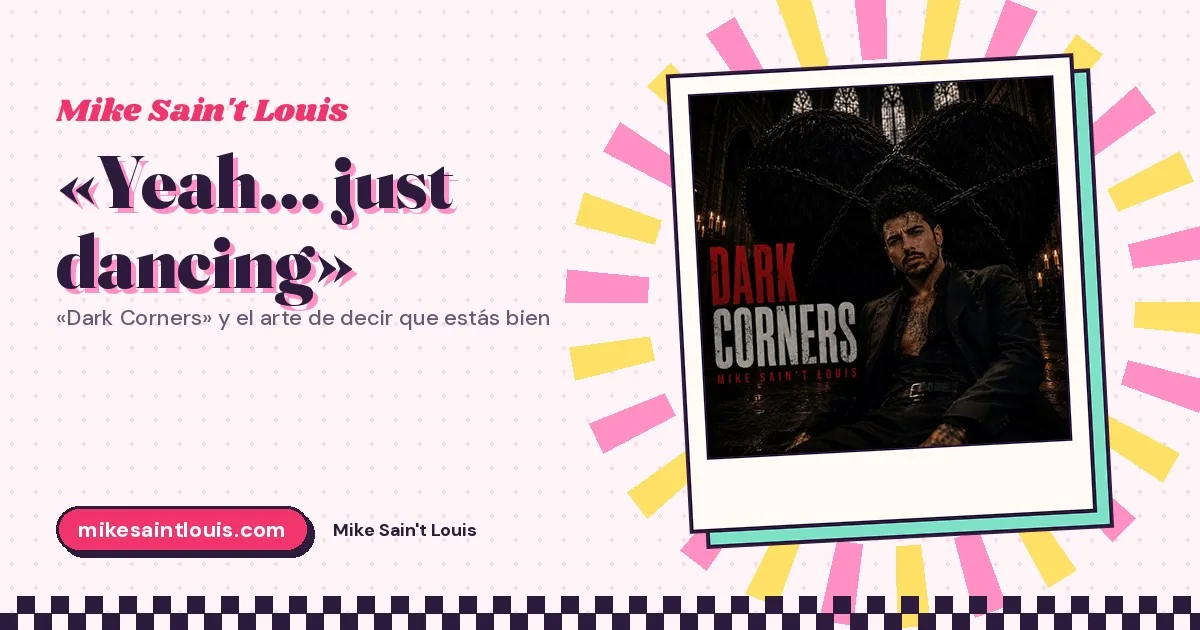
A guy with curly black hair, a short beard and his face smeared with something dark is sitting on the wet floor of a cathedral, half lying down, his black jacket open over a tattooed chest and his tired eyes fixed on the camera. Behind him, hanging between the columns, is a giant heart made of black chains. On either side, candles burn in candelabras, and in the background you can see the tall stained-glass windows of a Gothic church. On the left, in poster lettering, «DARK» in red and «CORNERS» in white.
That’s the cover of «Dark Corners». A cathedral for a club song. A heart made of chains for someone who says he’s just dancing. The picture alone tells you that here, the outside and the inside don’t match.
The song is on «Ojalá se pudiera viajar a Gayfolk», the second album of the trilogy, and it’s number 153 in the full list of singles. Its page on the blog already goes through the lyrics verse by verse. Here I want to stay with the ending, with the two lines that close everything: someone asks if you’re okay, and the answer is yeah, just dancing. I want to talk about that answer. About why we give it so often, what it hides, and how it’s both a kindness and a trap.
The answer we all give
«Hey… are you okay?» «Yeah… just dancing…»
That’s six words, and they’d fit in a WhatsApp message. But the whole song is in those six words. Someone comes over, notices something, asks. And the one in the dark corner of the dance floor answers with the most neutral thing you can say: I’m dancing. He doesn’t say he’s fine. He doesn’t say he’s not fine either. He says what he’s doing, which is another way of not saying how he is.
Everyone knows that answer. The office version is «nothing, just tired». The family version is «fine, fine, busy». The one-in-the-morning-at-a-club version is this one: «just dancing». They all do the same job: closing the door politely. Don’t ask me any more, because if you ask me any more I might burst into tears right here in the middle of everything.
What I like about the way the song ends is that there’s nothing after it. No final chorus to fix things. The question is left hanging and so is the answer. And it’s over.
Getting up late, no sun
Before the night there’s a day, and that’s where the song starts. Someone wakes up late and there’s no sun. His colours fade behind his smile. And he walks slowly, mile by mile.
I like that the song doesn’t start in the club. It starts at home, hungover or not, on one of those days that are born crooked. That matters because it explains the night. The one dancing in the dark corner didn’t end up there out of nowhere. He’s been carrying something all day. The party isn’t where the sadness comes from: it’s where he takes it.
That slow walk, mile by mile, has something uphill about it. It isn’t a stroll. It’s moving forward because there’s no other option. And the smile is already on from the morning, like someone putting on sunglasses even though it’s cloudy. The colours fade behind it, but the smile stays. By the time night comes, that smile has been working for hours.
Dancing so you don’t have to answer
In the song, dancing isn’t having fun. It’s a way of hiding.
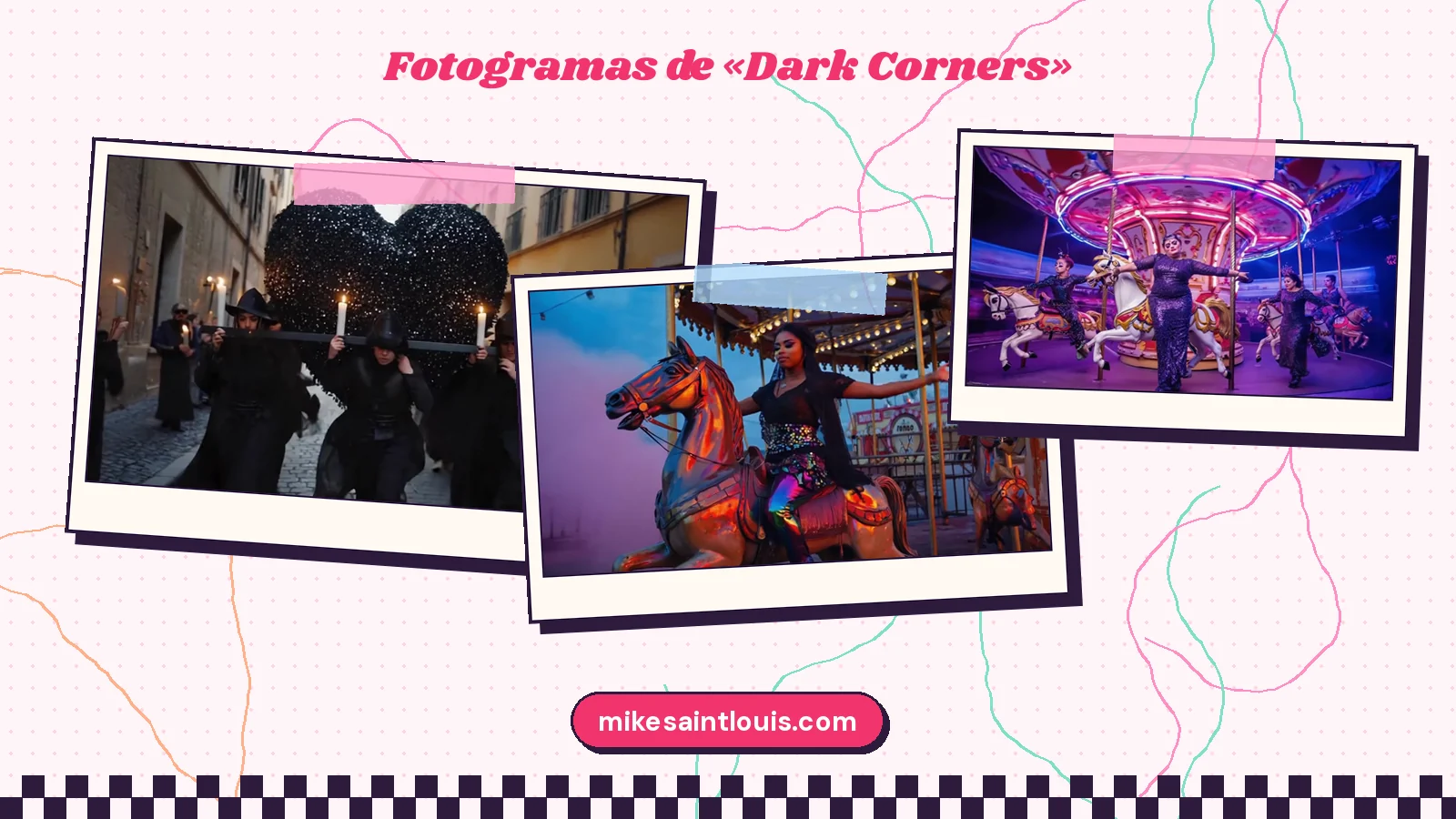
The chorus says it very clearly: dancing in the dark corners, with his shadow, who owns his nights. And the line that finishes it off: he smiles «pa’ no sentir», so he doesn’t have to feel. Dancing so he doesn’t have to say goodbye, says another verse. Everything the person in the song does comes with a «so as not to». He smiles so as not to feel. He dances so as not to say goodbye. He answers «just dancing» so as not to tell.
There’s something very recognisable in that. The dance floor has one huge advantage for someone who’s sad: nobody expects you to talk. You can be in the middle of a crowd without owing anyone an explanation. The music’s loud, the light’s bad, everyone’s doing their own thing. It’s the perfect place to be in a state without it showing.
Until someone notices. And asks. And then you have to say something.
The corner, not the centre
The title already marks the spot: not the middle of the dance floor, the corners. The dark corners.
Every club has two geographies. The centre, where the people who come to be seen are, the ones who climb onto the podium, the ones who scream along to every track. And the corners, where the people who come to be there without being seen are. Couples kissing, people waiting for someone who isn’t coming, people who’ve had too much, and people dancing alone with their eyes shut.
The person in «Dark Corners» is in the corners. And in the lyrics there’s a little pride in that: the dance floor is mine. But the other half comes straight after: so is the sorrow. The floor and the sorrow are his in equal measure. Both belong to him, and nobody notices either.
I really like that the lyrics tell it like that, without exaggerating. It isn’t a tragedy. Nobody faints. It’s someone dancing in a corner while something weighs on him. Something so ordinary that, as the lyrics themselves say, it’s banal. And that banality is exactly why nobody sees it.
The shadow as a dance partner
The loveliest image in the song, for me, is the shadow. He isn’t dancing alone: he’s dancing with his shadow. And the shadow is the one in charge. She owns his nights and his heart, and on top of that she tears the stars apart.
It’s a very elegant way of talking about sadness without naming it. Your shadow goes everywhere with you. It sticks to you when there’s light and grows huge when the light is bad. In a club, with the spotlights spinning, your shadow changes size all the time, stretches, shrinks, turns up on the opposite wall. It’s the perfect dance partner for someone who doesn’t want to dance with anyone for real.
And the fact that she’s a «she» makes me smile. The shadow is a lady. A lady who calls the shots. There’s something of the diva about that shadow, of the femme fatale from an old film who won’t let you go. You dance with her because you have no choice, but also because, in a way, you’ve got used to her company.
The king of nothing
There’s a line I think is very much my way of writing: I’m the king of nothing here.
No applause, no gossip. That’s what’s around him. Nobody claps for him, but nobody talks about him either. Not good things, not bad things. It’s a very specific kind of invisibility: it isn’t that they hate you, it’s that you’re not in the conversation.
Being the king of nothing is part joke and part wound. On the one hand it’s a crown, a bit of dignity, a «this corner is mine». On the other, it’s admitting the crown is worthless. That’s what happens when you dig in somewhere nobody cares about. You’re in control, sure. Of a dark corner.
And there’s dignity in that crown, even if it’s made of cardboard. It’s a way of not lying about where you are while still putting something on your head.
Heels high, mood low
Then there’s the line that works as a hinge: heels high, mood low.
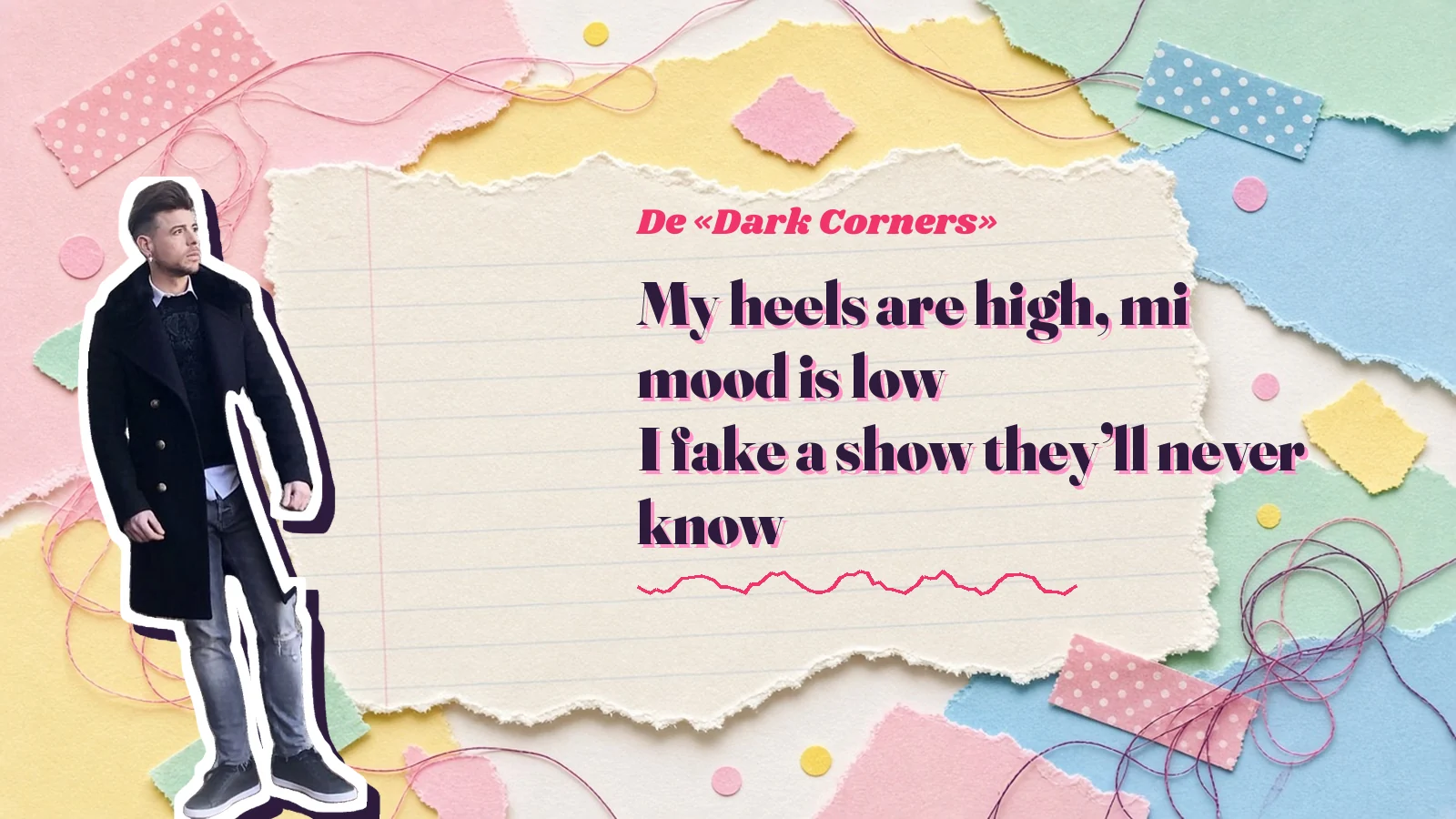
It’s almost a proverb. The outside goes up, the inside goes down. The higher the heel, the lower the mood. And it’s no accident that they’re heels: there’s something very drag about the whole song, about getting dolled up to go out, about shining in the street while inside you’re running on empty.
Drag, and really any way of getting dolled up for a night out, has that double face. It can be a celebration, a way of playing with who you are and having the time of your life. And it can also be armour. You put on the lashes, the killer heels, the glitter, and with all that on nobody sees your real face. The lyrics play with both. They put it like this: I fake a show they’ll never know. The show is real. What’s underneath is too.
And then it finishes with something I love: in the streets I shine brighter, but inside there’s no more gas. That image of running out of petrol is very old banger, very neighbourhood. It isn’t even poetic sadness. It’s being empty. Dry. Out of fuel.
No glitter in the tears
At the start of the song there are two negatives I think are really important. There’s no rainbow in his sky. There are no glitter tears.
For a gay song, saying there’s no rainbow means something. The rainbow is the flag, the pride, the party. And glitter is the sparkle we so often put on everything, even our sorrows, to make them easier to carry. Crying with glitter is crying in style. It’s the pretty kind of drama.
Not here. Here there are only quiet eyes. A sadness with no show. And that, funnily enough, is harder to spot than drama. If you cry glitter in the middle of the dance floor, everyone notices. If you’re sad with quiet eyes, nobody finds out. That’s why the question at the end matters so much: whoever asks it has seen something that couldn’t be seen.
Sad in two languages
The song jumps back and forth between English and Spanish the whole time. It starts in English, the mirror answers in Spanish, asking what happened, and from then on the two languages mix in every line.
Lots of people live like that. They think in one language and feel in another. They argue in Spanish and flirt in English, or the other way round. On the gay scene of any big city, Spanglish is practically the official language. The tracks playing are in English, your friends are in Spanish, and the late-night messages are a mix of both.
What interests me about that mix in this song is that language is also a place to hide. Some things are hard to say in your own tongue. They sound too true. In English, suddenly, you can say them, because there’s a little distance, as if someone else were saying them. Being the king of nothing, for instance, arrives in English. And then, when the most important thing has to be said, the lyrics go back to Spanish: pa’ no sentir.
The deepest line in the chorus is in the language of home.
The mirror that asks
I want to stay with the opening for a moment, because what happens there rhymes with the ending.
The song starts with someone getting up late, no sun, and looking in the mirror. And the mirror asks him what happened. In Spanish. As if his reflection were a lifelong friend who catches him looking rough.
And it ends with another question: are you okay? This time someone else asks it, in the club, in English.
The whole song sits between those two questions. One on waking up, at home, in his own language. The other in the small hours, on the dance floor, in the language of the night. And he gives neither of them a real answer. He doesn’t answer the mirror. He tells the person on the dance floor he’s just dancing.
I find it a really beautiful structure for such a simple song: it begins and ends with someone asking after him, and him dodging.
Shine on the outside, paper on the inside
In the bridge, the lights go down further. Shadows and lights, he says, that’s my role. Always pretending under the streetlamp. Broken tears, shine on my skin, but inside it’s pure paper.
Being made of paper inside strikes me as a very precise image. Paper holds up as long as nobody gets it wet. It has a shape, it stands up, you can write on it. But a drop of water is enough to make it fall apart. The person in the song shines on the outside and inside is made of something a single tear can break.
And even so, the bridge doesn’t end in defeat. His heart slips away, yes. But he’s still here, for real. With his shadow, without colour. And he fakes it with love. That last line is key for me: he isn’t faking out of cynicism, or pride. He fakes it with love. Like someone who smiles at a birthday party when they feel awful so as not to spoil it for anyone.
There’s something generous in that pretending. And something exhausting.
What the song doesn’t explain
There’s one thing «Dark Corners» never tells you: why. We don’t know what has happened to the person dancing in the corner. There’s no named ex, no betrayal, no bad news. There’s only sadness.
I think that’s the right call. Lots of people are sad without a cause you can sum up in a sentence. Or the cause exists but it’s so long, so tangled, it won’t fit into an answer in the middle of the dance floor. And that’s why you say «just dancing». Not because there’s nothing to say, but because there’s too much.
If the lyrics explained the reason, the song would be about that reason. By not explaining it, the song is about the gesture of hiding it. And that gesture is universal. Whatever the reason you feel bad, the dance in the corner, the fixed smile and the short answer are the same.
The shadow that tears the stars apart
There’s a detail in the chorus I’ve saved for last: the shadow doesn’t only rule his nights and his heart. She also tears the stars apart.
In a club, the stars are the lights. The spotlights, the mirror ball, the little dots spinning across the ceiling and across people’s faces. They’re what makes the night feel magical. And the shadow tears them apart. Smashes them to pieces. Where everyone else sees sparkle, the person in the song sees shards.
But you can also read it beyond the dance floor. Stars are wishes, what you hope for from life, what you ask for when one shoots past. If the shadow tears that apart, sadness doesn’t just ruin your night: it ruins your will to wish for anything.
That’s why I think it matters so much that he keeps dancing anyway. With the stars in pieces above him, he keeps moving. It isn’t much. But it isn’t standing still. And sometimes, on nights like that, not standing still is all you can ask for, and it’s enough to get you as far as the taxi home.
The cover: a cathedral with a heart of chains
Back to the cover, because I think it’s one of the most powerful on the second album.
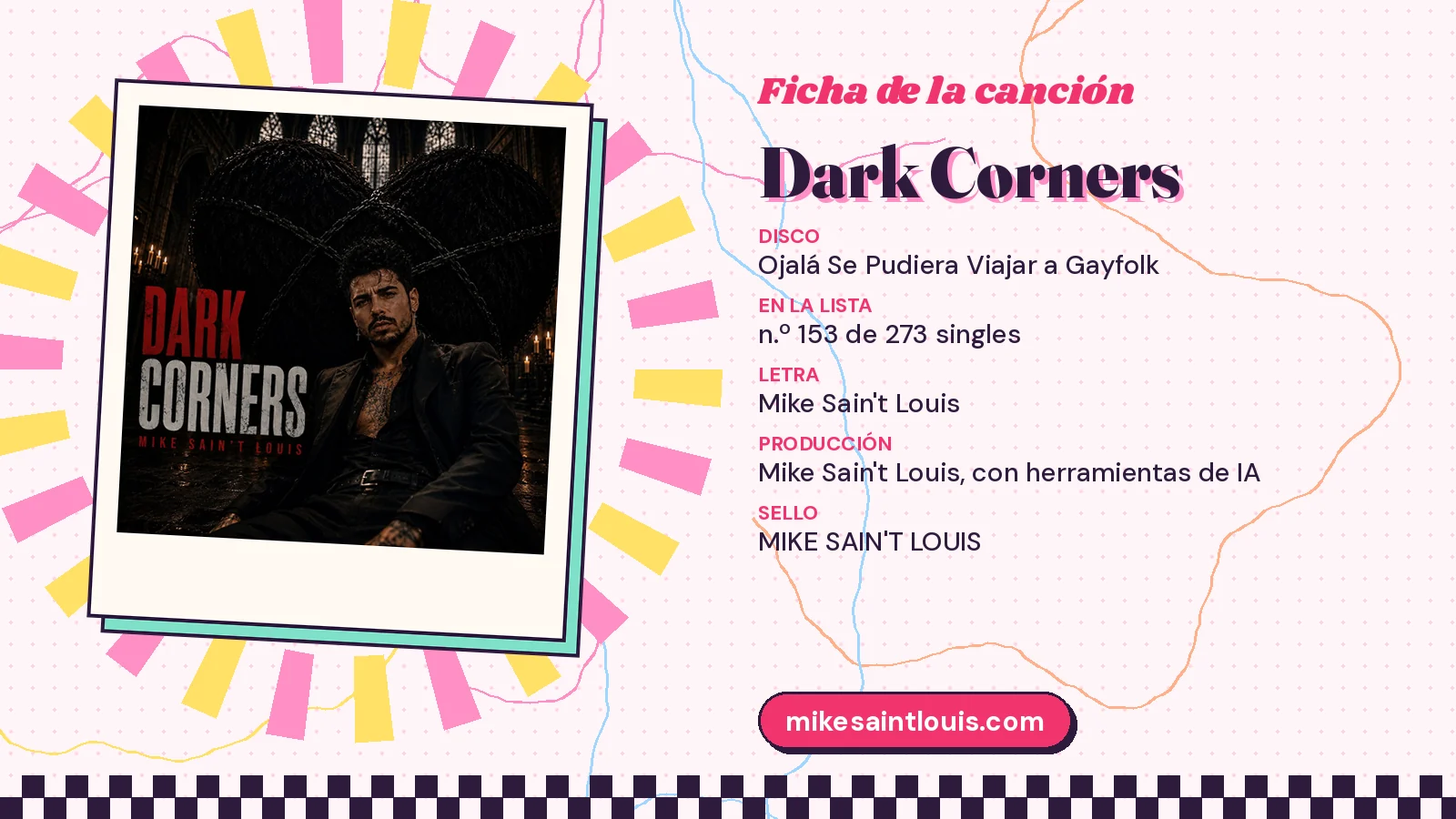
A dance-floor, dark-corner song, and the picture is a cathedral. Candles, stained glass, a wet stone floor. It’s a place of silence and contemplation, the exact opposite of a club. And yet the two have something in common: they’re both places where lots of people go to be alone among others, to feel something huge without having to talk to anyone.
The heart of chains hanging behind the guy is enormous, bigger than him. Heavy, black, iron. It isn’t a broken heart: it’s a heart that chains you. And the guy is sitting on the floor at its feet, jacket open, looking like he’s spent the whole night dancing, or crying, or both.
It’s what the shadow in the song would look like if you could photograph her.
Between «Dans la nuit» and «Scott Bonehill»
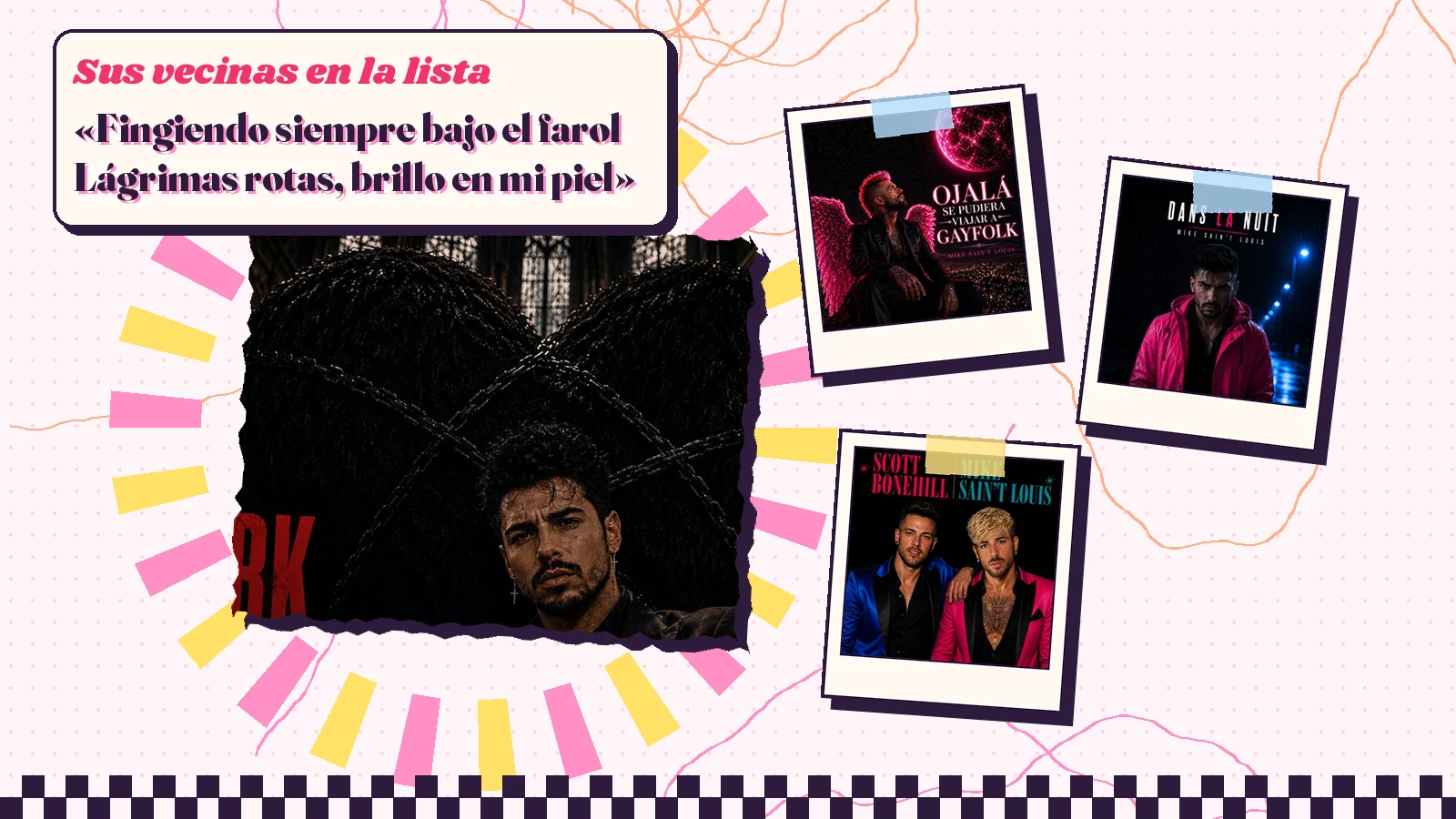
In the list of singles, «Dark Corners» comes right after «Dans la nuit» and right before «Scott Bonehill». I like that stretch of the list because «Dark Corners» lands between a French title and an English proper name, on a second album that wanders through other languages a lot.
On an album called «Ojalá se pudiera viajar a Gayfolk», «if only you could travel to Gayfolk», this song works as one of those stops where things get serious. Gayfolk as a planet of partying and freedom is all very well, but even the best planet has its dark corners.
If someone answers «just dancing»
This song makes me think about the other side. About the one who asks.
If you ever go up to someone in a corner of the dance floor and ask if they’re okay, and they tell you they’re just dancing, you don’t need to push. But you don’t need to walk away either. Sometimes it’s enough to stay and dance next to them for a bit. Without asking anything else. Give the shadow a bit of competition.
I’m not saying that fixes anything. But the person in the song isn’t asking to be fixed. At most, he’s asking for someone to notice. And the question at the end proves that someone did. That’s already a huge deal.
For the life and soul of the party
«Dark Corners» is for anyone who always seems to be fine. For anyone who goes out every weekend, gets dolled up, shines and comes home running on empty. For anyone who answers «nothing, just tired» or «just dancing» because telling the truth at that moment would be too much.
And it’s for the ones who ask. For anyone who notices the guy dancing alone in the corner and, even without knowing what to say, goes over.
As a lyricist, I really like having closed a song with a two-line exchange and nothing else. I call myself «the first AI songwriter» because I make the music and the vocals with artificial intelligence, but that question and that answer at the end are mine. If you want to take it with you in the taxi home at dawn, it’s on the downloads page, for free.
Frequently asked questions
Which album is «Dark Corners» on? On «Ojalá se pudiera viajar a Gayfolk», the second album in Mike Sain't Louis’s GAYFOLK trilogy. It’s number 153 in the full list of singles.
What is «Dark Corners» about? About someone dancing alone in the dark corners of the dance floor, with his shadow, smiling so he doesn’t have to feel. It’s about sadness hiding behind the party, and it ends with someone asking him if he’s okay and an evasive answer: I’m just dancing.
Why does it mix English and Spanish? The lyrics switch languages in almost every line, the way people talk on lots of dance floors. The most intimate phrases, like smiling «pa’ no sentir», stay in Spanish.
What’s on the cover? A curly-haired guy sitting on the wet floor of a Gothic cathedral, with candles and stained glass, and behind him a huge heart made of black chains.
Who made the song? The lyrics are by Mike Sain't Louis, lyricist, composer and music producer from Madrid. The music and vocals were made with artificial intelligence tools.