
By Mike Sain't Louis ·
«Verde que te quiero verde»: stealing a line from Lorca for a rumba
«En el rincón de mi jardín, florece la alegría, / verde que te quiero verde, marihuana querida.» («In the corner of my garden, joy is blooming, / green, how I love you, green, my darling marijuana.»)
The first half of the second line isn't mine. It's Federico García Lorca's. The second half is. And between the two there are almost a hundred years, an ocean of academic respect and a plant that in this country is still in legal limbo.
«Verde», green, is one of my most festive songs: a rumba with handclaps, guitars and cajón, about a herb that makes you laugh. The song's page on my site introduces it with its rhythm and its humour. Here I want to talk about that loan. About what it means to take the most famous line of twentieth-century Spanish poetry and make it dance at a garden party.
The most famous line
«Verde que te quiero verde», «Green, how I love you, green», opens the «Romance sonámbulo», the «Sleepwalking Ballad», one of the poems in the «Romancero gitano», the Gypsy Ballads Lorca published in 1928. It's a mysterious ballad, full of images that never quite explain themselves: a dead Roma girl over a water tank, a wounded smuggler, drunken Civil Guards banging on the door, the moon, the wind, ships on the sea. And a green refrain that tints everything.
Nobody fully knows what that green means. It's been read as the colour of death, of desire, of nature, of mystery, of impossible hope. Generations of students have written essays on it at school, highlighter pen in hand. There's even a famous song by Manzanita that put it in the mouths of half of Spain.
It's probably the line most people in this country can recite by heart without having read the whole poem. Like Machado's «Caminante, no hay camino» or Neruda's «Puedo escribir los versos más tristes esta noche». It's in the air. It's become a proverb.
And precisely because it's become a proverb, it seemed fair game for borrowing.
Lorca, one of us
There's another, more intimate reason for Lorca being in my catalogue. Federico was one of us.
He was a homosexual poet in a Spain that wouldn't forgive him, and they killed him in August 1936, at the start of the war, in a ravine near Granada. His «Sonnets of Dark Love», written for a man, took decades to be published. For a long time his homosexuality was hushed up, glossed over or mentioned in whispers, the way those things were in families.
For many Spanish gay men, Lorca is an ancestor. The poet grandfather nobody introduced to us at school as what he really was. When I quote his line, even in a rumba about marijuana, I quote it the way you'd quote family. With affection, with familiarity and with a bit of cheek, which is how real families talk to each other.
I don't think he'd mind. He was a man who adored popular music, who played the piano, who collected traditional songs from villages and who wrote about the duende of flamenco like few others. A garden rumba, with handclaps and laughter, wouldn't have struck him as a desecration. It would have struck him as a party. He might even have stayed.
Darling marijuana
Now the second half of the line, mine. «Marihuana querida.»

That's the twist. Lorca leaves his green unexplained, open, mysterious. I close it with a bang, with a concrete name. The green isn't death any more, or desire, or hope. It's a plant. The one blooming in the corner of the garden, according to the first line.
That move, taking something solemn and landing it in the everyday, is practically my signature. I do it with copla, with the flamenco folk stars, with Almodóvar, with bullfighters. Here I do it with the most revered poet of the twentieth century. And it works because the contrast is huge. From the Roma water tank and the sleepwalking moon to the plant in the garden and the giggles.
And «querida», darling, gives it the tone of a love letter. As if the song were writing to the herb the way the ballad writes to the green: devotedly. It's a declaration, yes, but one of those made half in jest, with a smile.
The rumba
The song is a rumba, and that's a choice too.
Rumba is, along with copla, one of the most mixed and most popular genres in Spain. It was born among Roma communities, crossed with Cuban rhythms and with pop, and gave rise to a gallery of artists we all carry in our memory even if we don't know it: Peret with his «Borriquito», Las Grecas with their «Te estoy amando locamente», Los Chunguitos, Los Chichos, Gato Pérez. It's the music of weddings, of fairs, of cars with the windows down in summer.
Putting a line by Lorca into a rumba is, in a way, bringing it home. The «Romancero gitano» is full of Roma, Civil Guards and Andalusian nights. Rumba is the music of those Roma's grandchildren. Lorca wrote about them; rumba is theirs. Bringing them together is a bit of a family reunion.
The instruments are named in the lyric: «Guitarras y cajones, la noche se enciende» («Guitars and cajones, the night lights up»). And the handclaps, and the laughter. It's a song you listen to sitting on a plastic chair in a courtyard, at a table full of glasses, with someone who always gets up to dance too early.
Handclaps in the courtyard
One more thing about the party the lyric describes, because it has a detail that feels very Spanish to me: the handclaps.
In rumba, as in flamenco, palmas aren't decoration. They're an instrument. There are muffled palmas, with cupped hands, that sound low and soft, and bright palmas, fingers on palm, that sound dry as a snap. Whoever can do them properly matters as much at a party as whoever plays the guitar. And whoever can't, usually the cousin who's had most to drink, sticks out a mile.
The lyric talks of laughter and handclaps while the plant grows. That image, a gang clapping around a flowerpot, has something of an ancient rite about it, almost a pagan harvest festival. And something of a comedy sketch too. I love imagining the neighbours in a corrala tenement, sitting on plastic chairs, clapping in time to a plant in the corner of the courtyard, as if it were a folk diva on her farewell night.
That tone, somewhere between ceremonial and absurd, is the tone of the whole song.
A pinch of wit and a pinch of salt
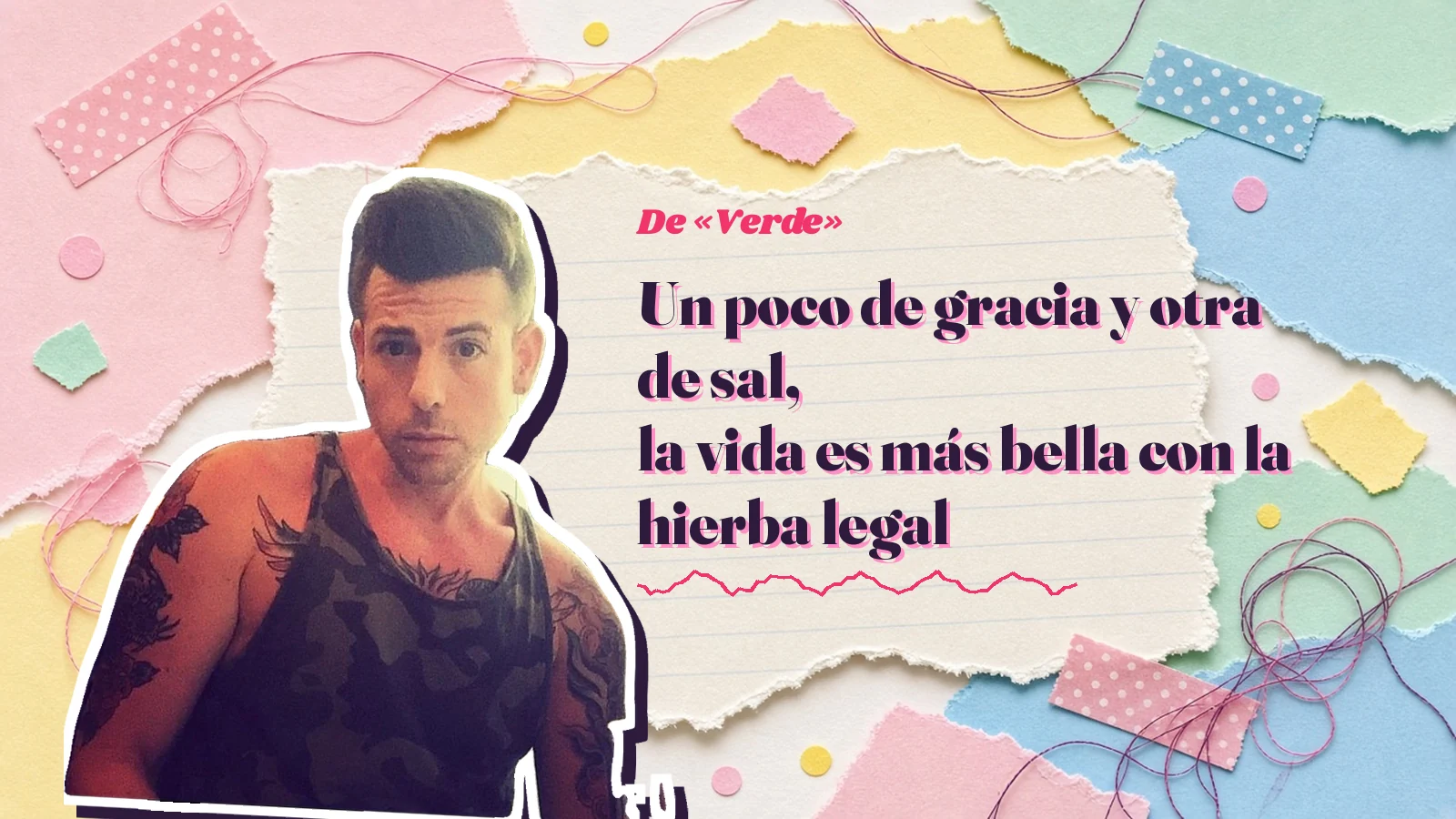
Of the whole lyric, my favourite part is a line that sounds like a proverb: «Un poco de gracia y otra de sal, / la vida es más bella con la hierba legal» («A bit of wit and a bit of salt, / life is lovelier with the herb made legal»).
The first half is almost a recipe. Wit and salt, the way you describe lively people with a spark. «Tiene mucha sal», she's got plenty of salt, is what they say in Andalusia about someone with flair. It's a very Spanish way of describing character: not with adjectives, but with kitchen ingredients.
The second half is the one that's been talked about most. «Life is lovelier with the herb made legal.» That's where the song stops being just a party and becomes a political wish, delivered with the lightness of a rumba. It doesn't demand anything with a placard. It slips it in between handclaps, casually.
Green bow tie and hair to match
The cover looks like an old photo found in a shoebox belonging to an aunt from Cádiz who emigrated to Havana.
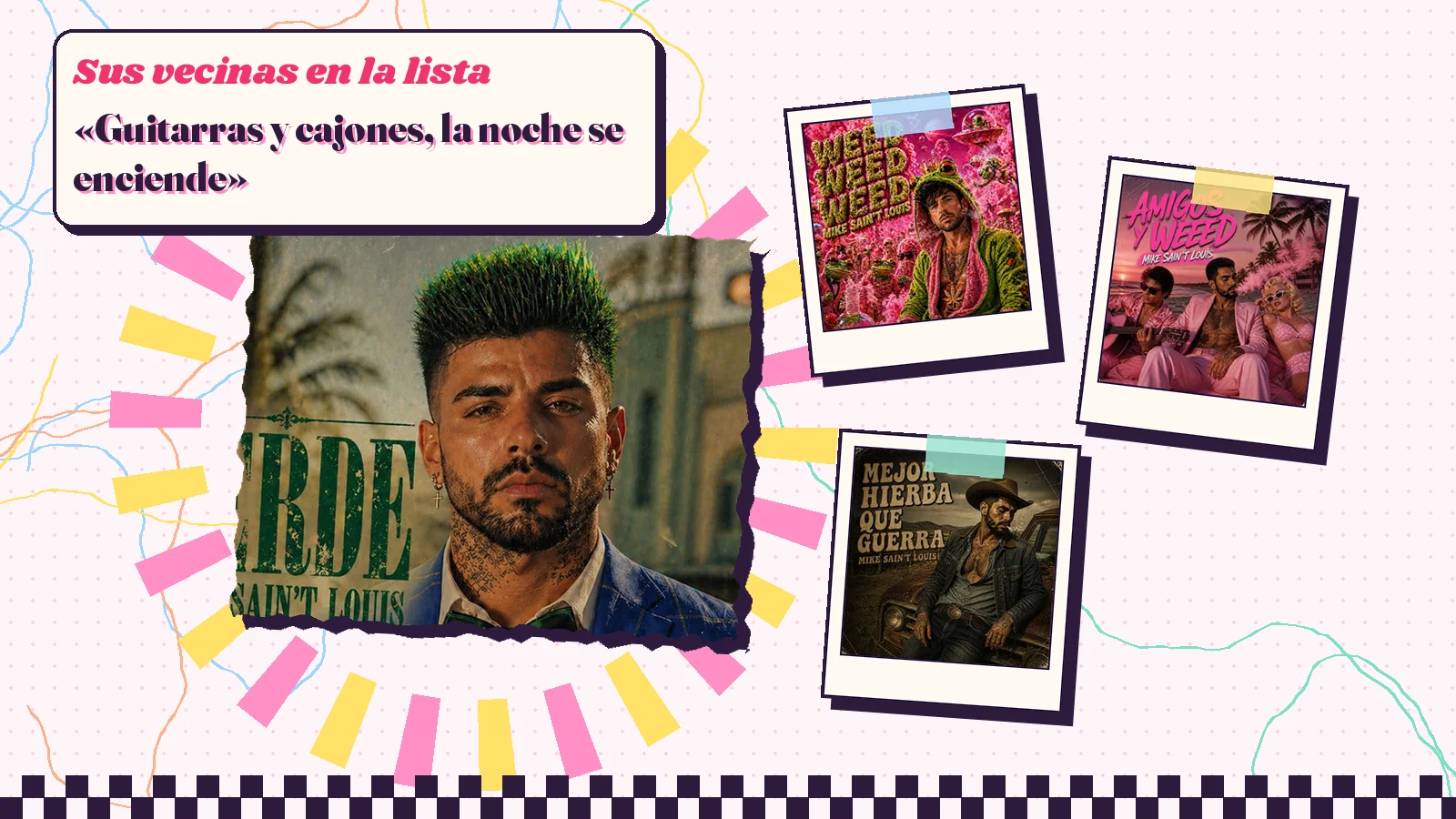
A boy with hair dyed green, buzz-cut, trimmed beard and an unfriendly face. He's wearing a slightly too big blue check suit, a white shirt open to the chest showing his tattoos, a green velvet bow tie and a matching pocket square. Behind him, a palm tree, a colonial building with balconies and columns, a street lamp and a vintage car parked up. All with the yellowed filter and worn edges of a 1950s photograph. The title, «VERDE», sits on the left in stencil letters, like the ones on coffee sacks or cigar boxes.
I love how serious it is. A song about the giggles with a bolero-heartthrob cover, like the ones who posed for the promenade photographer with their hat in their hand. No marijuana leaves, no smoke, no psychedelic colours. Just the green, discreet, in the hair, the bow tie and the pocket square. Like someone keeping a secret in plain sight.
And the set has something Caribbean about it, something of ports, of there-and-back-again. Which is exactly where rumba comes from: that back-and-forth between Andalusia and Cuba, between the Roma here and the rhythms over there. The cover tells it without saying it.
The garden, the square and the moon
The lyric moves through three settings, and I like following them because they sketch a whole evening.
First, the garden. The corner where the plant blooms, an intimate, almost secret place. It's the start of the evening, when there's still light and the party hasn't begun. Then the square. The lyric says it fills with a special scent and that's the signal to start celebrating. The private garden opens onto the public. The neighbours arrive, the guitars, the cajones. And finally the moon. It's night now. The moon smiles, complicit, over a night when anything can happen.
That moon tickles me, because it's another nod to Lorca. In the «Romancero gitano» the moon is everywhere, and it almost always brings bad news: it's the moon that carries off the child in the «Romance de la luna, luna», the one that watches things without being able to touch them in the «Romance sonámbulo». Lorca turned it into a menacing character, an omen of death.
My moon, on the other hand, smiles. It's complicit. It's on our side. I took the scythe away from Lorca's moon and gave it the smile of a neighbour leaning out of her balcony who has no intention of grassing anyone up.
The colours of my homeland
There's an idea in the lyric I find really lovely: that of all the colours of your homeland, green is the one that lifts you. I won't quote it literally because I've used up my lines, but that's the idea.
Spain has many colours, and each carries its weight. The red and yellow of the flag, which some love and others find awkward. The white of whitewashed villages. The ochre of the central plateau. The blue of the Mediterranean. The black of mourning. And green, which in dry Spain is almost a luxury: the green of the north, of Asturian meadows, of gardens in Andalusia that have to be watered every evening so they don't burn.
The song picks green as the colour of joy. And not only because of the plant. Also because of what green means in a country where nearly everything is yellow in August: life, freshness, shade. Green is the colour of what grows in spite of the heat.
From the fan to the cajón
Rumba has a guitar technique that fascinates me and has a brilliant name: the ventilador, the fan. It's a lightning-fast strum, the hand spinning like the blades of a fan, mixing the stroke on the strings with a percussive tap on the body. It's associated with Peret and Catalan rumba, and it's what gives rumba that party sound that never stops.
Writing lyrics for a ballad isn't the same as writing them for a rumba. Rumba asks for short lines people can shout along to, with easy rhymes and words that land on the clap. It asks for repetition. It asks for a chorus people can yell even if they don't know the rest. «Oh, marihuana, en tus brazos voy a bailar» («Oh, marijuana, in your arms I'm going to dance») is exactly that: a line for the whole square to shout with their glasses raised.
That's why the lyrics of «Verde» are so simple compared with other songs of mine. No insults with a postcode, no lists of grievances, no celebrity names. There's a garden, a square, a moon, guitars, laughter. The words of a party. Rumba doesn't do complications.
Lorca and songs
I've said Lorca adored popular music, and I want to say a bit more, because it explains why I feel entitled to put him in a rumba.
Lorca wasn't just a poet. He was a musician, or nearly. He studied piano as a young man and was very close to Manuel de Falla, with whom he organised the 1922 Cante Jondo Competition in Granada to defend the oldest forms of flamenco. He collected popular songs from villages and arranged them. With La Argentinita he recorded a collection of traditional songs on which he himself played the piano.
In other words, Lorca spent a good part of his life doing exactly what I'm doing with his line: taking the popular and the highbrow and mixing them. He took village songs into the salons. I take one of his lines from the textbooks to a garden rumba. Same journey, opposite direction.
I like to think that, had he lived, he'd have ended up listening to rumba. Maybe he'd have liked Peret. Maybe he'd have written one for Las Grecas. We'll never know. What we do know is that he never looked down on any music played in the street.
Green among the catalogue's colours
One last thing about colour, because my songs have a palette.
There's the red of «Llorar», the colour of angry tears. There's the bubblegum pink of «Mueve las plumas» and «El luto del puto», the colour of camp, of what shows. There's the black and white of «Madrid», the colour of memory. And there's the green of this song, the colour of joy that grows by itself.
If I had to pick one colour for the whole of Planeta Gayfolk, it wouldn't be green. It'd be pink, no question. But green has its corner, like the plant in the lyric's garden. A small, discreet corner that someone waters every evening and that the best parties come out of.
What this song isn't
A serious note, and I'll make it once.

«Verde» isn't a health leaflet or an advert. It's a party song celebrating a moment of happiness with friends. I know marijuana doesn't suit everyone the same way, that in some people it sets off anxiety instead of calming it, and that mixing it with other things can end badly. In my catalogue there are songs about that too, about the days when your head weighs too much. This isn't one of them. This is the good-afternoon one.
I say so because a happy song about something like this always gets someone reading it as a recommendation. It isn't. It's a portrait. Everyone knows what suits them and what doesn't.
My green songs
«Verde» isn't the only song in my catalogue where the herb appears. There's a little family: «Weed, weed, weed», «Amigos y weed» and «Mejor hierba que guerra», among others. Each one looks at it from a different place.
«Weed, weed, weed» has a text about days that weigh too much, about noise in your head and looking for a breather. It's the most fragile side of the subject. «Amigos y weed» is about chosen family, an afternoon with the people you love. «Mejor hierba que guerra», better weed than war, plays with the old make-love-not-war slogan, swapping one word.
«Verde» is the most folkloric of them all. The only one with handclaps and cajón. The only one with a poet from Granada inside it. If the others are the urban version, shared flat and sofa, this one is the Andalusian-courtyard-with-flowerpots version.
The liberation album
The song is on «El día de la liberación», the third album of the GAYFOLK trilogy. It's the album about arriving on the planet, the party after the journey. I tell the story in liberation day and the day after.
It makes perfect sense for «Verde» to be there. It's a song of celebration, of freedom, of a world where what's in limbo today would be legal and normal. A party on planet Gayfolk, with a rumba playing in the garden and a line of Lorca hanging from the bunting.
On the Planeta Gayfolk page I explain that universe more calmly. Here it's enough to say that, if you could ever travel there, this song would be playing at the first barbecue.
Borrowing
Back to the start, to the underlying question. Can you take a line of Lorca and put it into a song about marijuana?
My answer is yes, as long as you do it with affection and know what you're taking. Popular culture has always done this. The old ballads were performed with changed words in every village. Coplas get parodied at Carnival. Bécquer's lines end up on Valentine's cards. That's what classics are for: for people to use them, mix them, take them out of the museum and carry them home.
What I'd never do is use it to make fun of him. Lorca isn't the joke. The joke is the contrast between his line and my plant. He stays where he is, enormous, mysterious, with his sleepwalking ballad and his Roma moon. I've just borrowed his refrain for an afternoon.
I promise to give it back. With a pinch of wit and a pinch of salt.
Frequently asked questions
What is «Verde» about? It's a festive rumba about marijuana, with handclaps, guitars and cajón, that borrows the line «Verde que te quiero verde» from Federico García Lorca. The full lyrics are at gayfolkplanet.com/letras.
Where does «Verde que te quiero verde» come from? It's the first line of the «Romance sonámbulo», included in Federico García Lorca's «Romancero gitano», published in 1928.
Which album is it on? «El día de la liberación», the third album of the GAYFOLK trilogy.
Who made it? The lyrics, composition and production are by Mike Sain't Louis. The music and vocals were made with artificial intelligence.