
By Mike Sain't Louis ·
A Song With No Story: The Experiment Behind «La chusta nunca disgusta»
«Sergio, Martina, Elías, Iván». That's how it starts. No "once upon a time", no ex to insult, no cruise with sardines in the minibar. Four first names with a comma after each, like the register at a secondary school in Vallecas first thing in the morning.
I've spent years writing songs that tell stories. Narcissists with symbolic names, deceived folk divas, neighbours who see everything, boyfriends from Albacete. I'm a plot lyricist, a soap-opera lyricist, an end-of-episode-cliffhanger lyricist. And one day I started wondering what would happen if I wrote a song that told absolutely nothing.
The result is «La chusta nunca disgusta» ("The Roach Never Disappoints"), and the blog's song page already warns you what it is: a list of names with a proverb in the middle. Here I take you inside the experiment. Why names, why that proverb, why a song with no story ends up telling more than some songs that have one.
Taking the register on a park bench
The first thing to understand is that this song has no protagonist. There's no "I" who suffers, no "you" to reproach. There are people. Lots of people. And one small object passing from hand to hand.
The chusta, for anyone who doesn't know, is what's left at the end of a joint, the roach you smoke down until it burns your fingers. The chorus proverb says it never disappoints, and that's it. That's the whole thesis. The song doesn't explain where the smoke comes from, who rolled it or whether anyone gets dizzy. It just says names, and between each block it reminds you that the roach never turns its nose up at anyone.
I picture it as a huddle on a bench in the Plaza del Dos de Mayo at eleven on a Friday night, or on the steps of a squat in Lavapiés, or on the wall of any village in Cuenca during the August fiestas. Someone passes it, someone takes it, and every time it changes hands a name is said. You don't need to know anything else about anyone. It's enough that they're there.
It's the least narrative song I've written. And probably the most social.
Why names and not something else
I could have made a list of objects, cities, beer brands. I chose names because a name is the least you can say about a person. No age, no job, no star sign. Just what they call you when it's your turn at the butcher's.
A first name has another huge advantage in a song: everyone recognises themselves or someone they know. If you hear «Raquel», you think of your Raquel. If you hear «Julián», you think of the Julián in your class who cheated in maths exams. The song tells you nothing, but you supply the story. It's like a sticker album where everyone sticks in their own faces.
And then there's the pleasure of sound. Iván rhymes with Julián, Tatiana with Ana, Matías with Jeremías, Martín with Joaquín. The names are placed so their stresses and endings clack together like dominoes in the bar downstairs. Read them aloud and your foot starts tapping. That's the music under the music: the music of well-placed names.
Eighty-eight people
I did the count with the lyric in front of me and a biro. The lyric has 88 names. Of those, 83 are different: five repeat, Sergio, Carla, Raúl, Enrique and Mónica, like those friends who sign up for every get-together even when you haven't invited them. The proverb appears fourteen times.

Eighty-eight people is roughly what fits in a Line 1 metro carriage at rush hour, or at a modest wedding in a banqueting hall in Leganés, or in a university lecture theatre on a hungover Monday. It's a human number. It isn't a stadium. It's a group where you could still greet everyone one by one, even if it took you all night.
The names come in blocks of four lines, four names per line. The last block is shorter, half the length, as if the list ran out of breath just before the end. I like that limp. A perfect list would have sounded like a spreadsheet. One that shortens at the end sounds like someone who's tired of calling the register and wants to head to the terrace for another beer.
Kunal, Tenesoya and Latoya
If you listen carefully, the names aren't all from round here. At first everything sounds like a nineties Spanish playground: Carmen, Abel, Raquel. Then others start slipping in. In one block I wrote «Mónica, Pablo, Leticia, Kunal», and in the last, «Bianca, Amir, Gonzalo, Tenesoya».
Tenesoya is a Guanche name, from the Canaries before the conquistadors, one of those still given in Tenerife and Gran Canaria. Kunal sounds Indian. Amir, North African or Middle Eastern. Latoya, eighties American TV. Edison, a lot of homes in Latin America. All in the same row, carrying the same weight, receiving the same roach.
I didn't want to underline it with a speech. There's no verse saying "we're all equal" with violins behind it, which is what a Benetton ad would do. The song simply puts them together and carries on. And that, to me, is the most honest way to draw planet GAYFOLK: a place where nobody asks for your passport in the huddle. If it's your turn, it's your turn.
A four-word proverb
The chorus is the only thing that doesn't change. Four words with an internal rhyme, chusta and disgusta, that sound as if they came straight from Grandma's book of sayings even though they're in none. They have the rhythm of "the early bird catches the worm" or "April showers bring May flowers", but with a different moral.
I really enjoy making up proverbs. A proverb is the oldest form of folk truth we have in Spain: nobody knows who said it, but everyone repeats it as if it were in the Constitution. Writing a new one, about something as disreputable as the end of a joint, is like sneaking a photo of yourself into the royal family tree.
And it has a cheeky moral. Traditional proverbs are usually about working, saving, not trusting people. This one is about sharing the little that's left. The roach is the leftover, what nobody would want if there were a whole joint going. And yet it never disappoints. There's something lovely in that, in celebrating leftovers. It's the philosophy of Grandma's Tupperware applied to drinking in the street.
The sound of a corridor
When you listen to the whole song, the feeling is of being in a long corridor where someone is calling people in for an appointment. Or in the queue for your ID card at the police station on Calle Luna. Or at the register on the first day of school, when the teacher doesn't know anyone and reads slowly to get the pronunciation right.
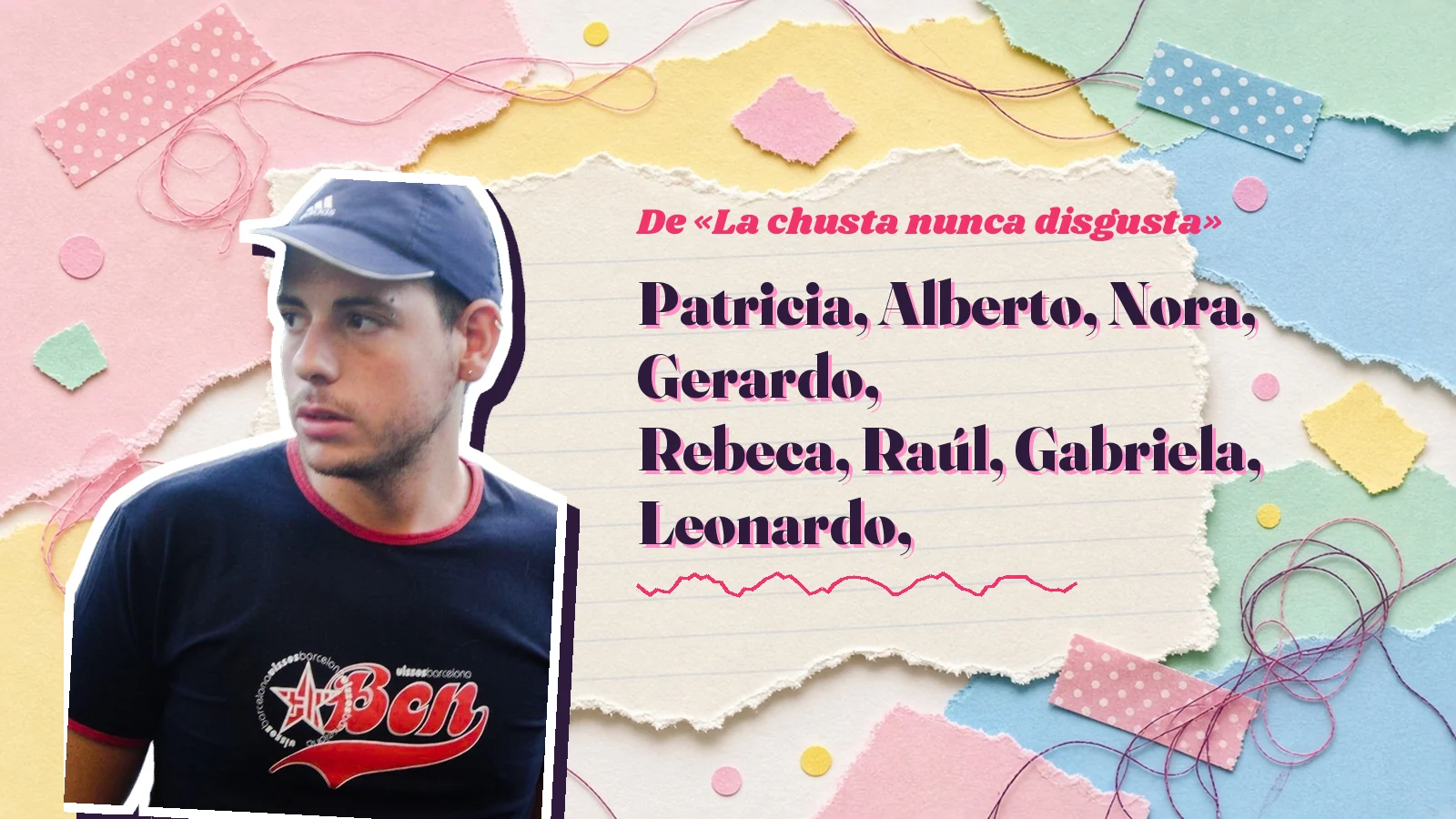
That feeling of waiting is part of the joke. The music plays, the names drop, and you wait for something to happen. For a story to appear, for someone to say something about Sergio or Martina. It doesn't. Only the proverb comes back, like someone offering you another drag so you don't get impatient.
I admit there's some mischief in this. After years of getting people used to my songs having a final twist, a neighbour who screams or an ex who turns out to be a robot, I make one where the twist is that there's no twist. It's the joke of a lyricist bored with his own formula. Self-parody without saying so.
The roach as protagonist
If the song has no human protagonist, it has one that isn't human: the roach. It's the only thing that really moves in the whole lyric. The names stay still, each in its place on the bench. What circulates is the roach.
Seen like that, the song is a kind of object film, like those stories about a five-euro note passing through the hands of a plumber, a nun and a footballer from Rayo Vallecano. The roach goes from Sergio to Martina, from Martina to Elías, and in each hand it leaves something and takes something. We don't know what. We don't need to. What matters is that it never stops.
And it's a humble object, which is what I like best. It isn't a bottle of champagne, an engagement ring or a Miss Spain crown. It's what's left over, what others would throw away. Giving the leading role to leftovers is something I do a lot on Planeta Gayfolk: the sock, the Tupperware, the designer swimsuit, the fan spreading muck. Small objects say more about people than grand speeches.
If I had to sum up the experiment in one sentence, I'd say it's a song about a cigarette end that meets eighty-odd people. Put like that it sounds absurd. Listened to, it has its tenderness.
Where to play it and where not to
It isn't a song for every occasion, and that's part of the experiment too. I wouldn't play it at a wedding, unless the couple met at a reggae festival in Benicàssim. I wouldn't play it at a Sunday family lunch, because the aunt from Zamora will ask what a chusta is and someone will have to explain it with the roast chicken on the table.
Where it works is the moment after. When the party has passed its peak, people are sitting on the living-room floor and someone's looking for something that doesn't require dancing or thinking. That's when the list of names slides in on its own, like a murmur, and someone ends up saying their name out loud when it comes up. It also works on a long car journey, the kind down the A-3 to the beach at Gandía with the cool box in the boot, playing at who in the car turns up first in the lyric.
And, curiously, it works alone. Listened to with headphones on the bus, the list becomes a kind of imaginary crowd keeping you company. Eighty-eight people in your pocket.
What the machine brings and what I bring
The lyric, with its 88 names and its proverb, is mine. I chose each name for how it sounds next to the one after and placed it in its block, one by one, like someone doing the seating plan for a wedding where everyone has fallen out. The music and vocals come from artificial intelligence tools such as Suno, which I use for production. My job there is to listen to versions, discard, and choose the one that makes the list sound like a huddle of friends rather than a phone book.

That selection is the part that takes me longest and shows least. I wrote about it in «El oficio de descartar: elegir entre muchas versiones». In a song like this, where the lyric is almost a score of names, rhythm decides everything. If the backing is too fast, the names trip over each other. If it's slow, it sounds like a funeral reading out the list of the dead.
I always say so because I'd rather it were known: the tool supplies the sound, I supply the words and the judgement. It's all explained on my about page.
The cover: smoke, stripes and a sun lounger
The single's image provides the context the lyric doesn't. A blond man with a quiff, pink-lensed sunglasses, an open pink shirt, braces, a gold chain with a cross and tattoos on his chest and arms. He's lounging in a yellow armchair, a cigarette in his mouth and another in his hand, on a beach with palm trees, turquoise sea and a little pink house in the background.
The title is in brushstroke lettering striped green, yellow and red, with three little stars under my name. Anyone who recognises those colours knows what kind of smoke we're talking about without needing it explained. The cover does what the lyric doesn't: it sets the scene. The lyric is the register. The cover is the sun lounger from which the register is called.
I love the contrast between the character's pose, beach-bar swagger in Maspalomas, and the song, which is almost schoolish. He looks permanently on holiday. The lyric sounds like a bespectacled teacher calling the register. Both at once are the charm of the single. All the covers, one after another, are on the singles page.
The smoke family
«La chusta nunca disgusta» has cousins in the catalogue. There's a little family of smoky, cheeky songs that laugh at strict morality. The most festive is «Verde», a rumba that borrows a line from Lorca to dedicate it to another plant. There are also «Weed Weed Weed» and «Mejor hierba que guerra», whose devotion is clear from the title alone.
Within that family, this is the most abstract. The others describe squares, nights, plants, parties. This one describes nothing: it just gathers people. If the others are the party, this is the guest list the bouncer holds at the door. And I like that, deep down, it focuses on what really matters about those nights, which isn't the smoke. It's who you share it with.
It isn't a song promoting anything, nor does it pretend to be a harm-reduction leaflet. It's a huddle song. Anyone who's been in one knows that what you remember afterwards isn't what you smoked, but who was there and what you laughed about.
Between a lullaby and a funeral
In the catalogue of 273 singles, this song is track 156. Just before it comes «Nana para adultos» (lullaby for grown-ups). Just after, «Nadie hablará de mí cuando haya muerto» (nobody will talk about me when I'm dead). Sleeping, gathering, dying. Without my planning it, those songs in a row sum up one of those good long nights.

Sitting next to «Nadie hablará de mí» carries an irony I adore. A song naming 83 different people comes right before another complaining that at your funeral there'll be two friends at most. One is all presence; the other, all absence. Played back to back, they answer each other. Maybe the second is what happens when the huddle breaks up and everyone goes home.
It belongs to *El día de la liberación*, the third album of the GAYFOLK trilogy, the one about arriving and celebrating. An endless huddle of people from everywhere fits nicely into a liberation party. If you want to hear the three albums in order, there's my guide to listening to the trilogy from start to finish.
In praise of lists
Lists have a bad reputation among writers. They're seen as filler, a lazy trick, what you do when you can't think of a story. But some of the most memorable things in popular culture are lists. A legendary Real Madrid line-up. The litany of the saints at a funeral Mass. The names of the Visigothic kings we had to memorise at school. The end credits of an Almodóvar film, which nobody reads but which contain every person who made it possible.
A list says: all these people exist and all of them count. It's a form of recognition. And a list with no hierarchy, no protagonist, where Kunal weighs the same as Sergio, is almost a political statement without a placard.
I'm addicted to lists, I admit it. Almost all my lyrics have one: grievances, objects, exes, supermarket brands. Usually the list sets up a punchline. Here the list is the whole song, and the punchline is that there's no punchline. If you ever want to write one, watch the rhythm, let a repetition or two slip in, and don't try to make it make sense. The listener supplies the sense.
Find yourself on the list
The best thing you can do with this song is listen to it in a group and have everyone shout when their name, or the name of someone they know, comes up. It's a silly game and it always works. If you're not in it, don't be offended: the roach hasn't reached your hand yet. Maybe next time.
You can listen on Spotify, watch it with its music video on gayfolkplanet.com and read all the names on its lyrics page. The others are in the lyrics archive on this site, in case you want to check how many more feature a Mónica.
And if you're a journalist interested in unusual songs, the material for writing about me is in Press.
What this song does tell
I said at the start that it tells nothing. I lied a little, the way you lie in songs.
It tells you there are people. That there are many of them, all different, and they fit in the same row. That leftovers, when shared, never disappoint. That on any given night, on any given bench, Sergio passes something to Martina, and Martina to Elías, and Elías to Iván, and so on down to Latoya, and none of them needs to tell the others their life story to be there.
After so many songs about people who lie, cheat and pretend, I wanted one where nobody did anything wrong. Where they just were.
And maybe that's why I wrote it without a story. The stories in my songs are almost always led by people who do harm. There's no room for them here, because there's no room for anyone in particular. The narcissist needs a stage and an audience hanging on his every word. In a huddle of 88 names, nobody is the centre. It's the only place in the catalogue where a narcissist would be bored.
It's not much. It's everything.
Frequently asked questions
What is «La chusta nunca disgusta» by Mike Sain't Louis about? It's a song with no story: a list of 88 first names from very different backgrounds, punctuated by an invented proverb, «la chusta nunca disgusta» (the roach never disappoints). It portrays a huddle where the end of a joint gets shared and everyone fits in the same row.
Which album is «La chusta nunca disgusta» on? On El día de la liberación, the third album of the GAYFOLK trilogy. In Planeta Gayfolk's catalogue of 273 singles it's track 156, between «Nana para adultos» and «Nadie hablará de mí cuando haya muerto».
How many names appear in the song? 88 names, 83 of them different. Sergio, Carla, Raúl, Enrique and Mónica are repeated. The proverb appears fourteen times.
Who wrote the lyrics? Mike Sain't Louis, a lyricist, composer and music producer from Madrid, the first AI songwriter. The music and vocals are made with artificial intelligence tools such as Suno, under his direction.