
By Mike Sain't Louis ·
«Todas y todes»: grammatical gender and inclusive language in my lyrics
A greeting can be a statement of principles.
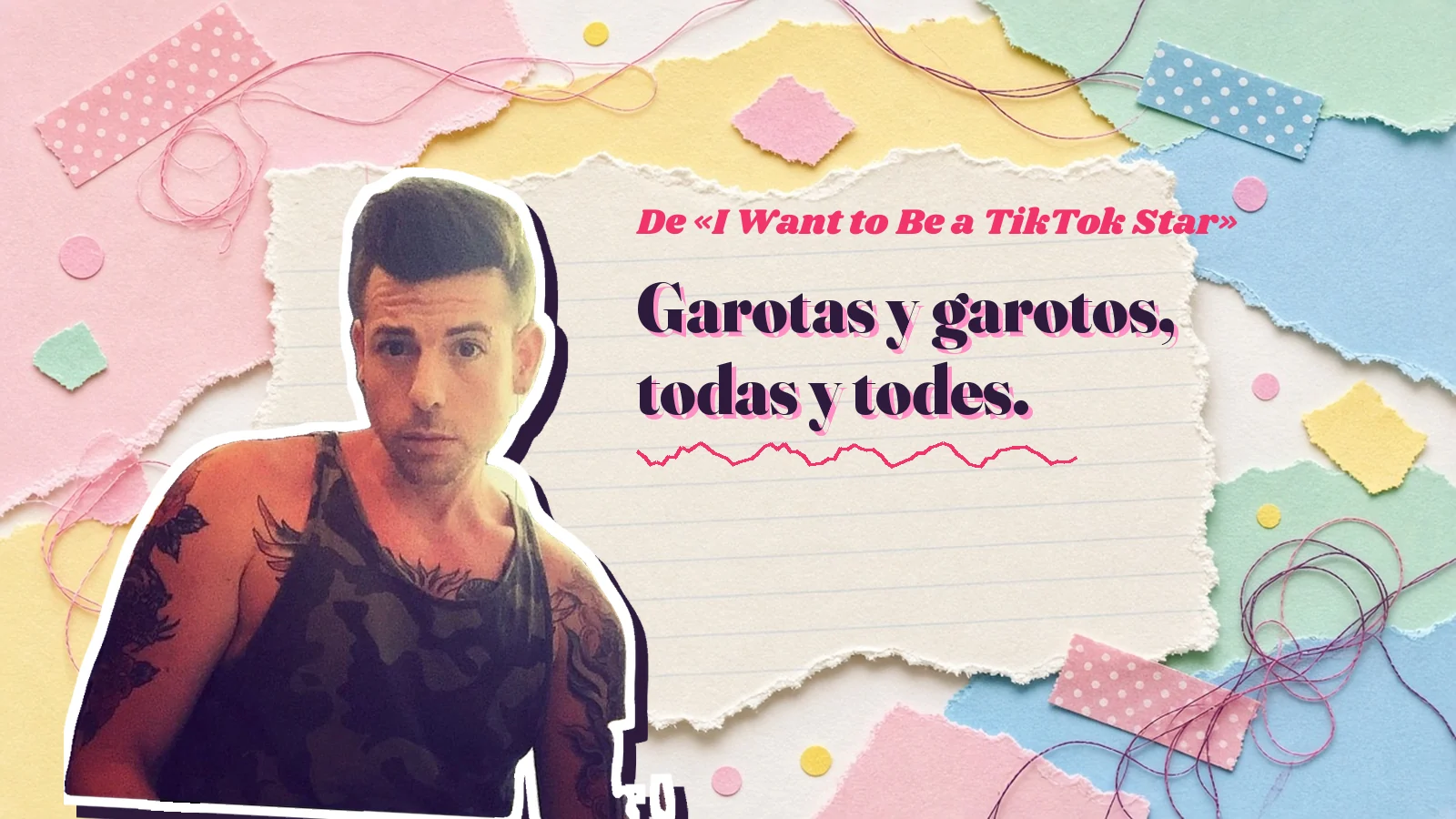
In «I Want to Be a TikTok Star», from the album «El día de la liberación», the lyric runs almost entirely in English, about wanting to shine on a screen and never quite managing it. And suddenly, at the end, it switches language and starts greeting people. From Spain, with love. «Arriba muchachas y muchachos», up you get, girls and boys. And right after that, the line that makes me smile every time I read it: «Garotas y garotos, todas y todes.» (The full lyric is on gayfolkplanet.com.)
Four words hold three ways of naming people: the feminine todas, the masculine implied in garotos, and a third form, todes, which isn't in the academic dictionaries but is in many people's mouths. And in two languages, because garotas y garotos is Portuguese. It's a kind of universal greeting, a public-address announcement that wants nobody left outside.
This piece is about grammatical gender in my songs. About how my lyrics name men, women and anyone who doesn't recognise themselves in either. About the masculine that claims to represent everyone, about doubling, about the playful feminine so many gay men use among ourselves, and about something that isn't grammar but respect: calling each person what they want to be called.
Girls and boys
I'll start with the simplest thing, which is doubling.
Muchachas y muchachos. Chicas y chicos. Bienvenidas y bienvenidos, welcome in both genders, as the imaginary announcer says at the start of «Vas a escuchar un disco muy raro». Naming both forms instead of one is what grammar calls desdoblamiento, doubling, and today it's one of the most debated practices in Spanish.
Some see it as a gain: if I only say muchachos, the muchachas are hidden behind it. Some see it as unnecessary redundancy: the masculine already includes them, they say, and repeating everything lengthens sentences without adding anything. Both positions have arguments, and the debate has been going on for decades.
Doubling appears in my lyrics, but almost never as a manifesto. It appears because that's how people speak when they address an audience. It's the formula of the presenter, the village-fair host, whoever grabs the microphone at a wedding. Ladies and gentlemen. Girls and boys. It's a way of getting attention and, at the same time, of making everyone feel they're being spoken to.
In «Carta de recomendación» it appears with a very specific use: a warning. Careful, girls and boys, don't trust him. There doubling isn't courtesy, it's precision. The warning is aimed at anyone who might cross paths with that character, whoever they are. Nobody is safe from a schemer, so nobody is left out of the warning.
Gender that isn't sex
Before going on, it's worth clearing up something that often gets confused.

In grammar, gender doesn't mean sex. It means class, kind, family, which is what the Latin genus meant. Spanish sorts its nouns into two big classes, those that take el and those that take la, and that classification is largely arbitrary. La mesa, the table, is feminine and el banco, the bench, is masculine, and neither has a sex. La persona is feminine even when we're talking about a man. El bebé is masculine even if it's a baby girl. La víctima is feminine whoever the victim is.
Other languages divide things differently. German has three genders, with a neuter that Spanish lost on its way out of Latin. English barely keeps gender in nouns and holds it mainly in pronouns, he, she, it. Some languages have no grammatical gender at all. And some sort nouns into many more classes than two, by criteria that would seem very strange to us.
And the sorting moves. Words change gender when society changes. For a long time people said la presidente or la juez, and today presidenta and jueza are in the dictionary and nobody is shocked to hear them. The opposite road exists too: from modista, dressmaker, a feminine word because the trade was associated with women, came modisto, for men who sewed. And from azafata, the flight attendant who welcomes you aboard, came azafato. If the language could invent a masculine when it was needed, it doesn't seem so strange that it now looks for other forms for those who fit neither box.
What those examples show is that grammatical gender isn't a law of nature. It's a custom, very old and deeply rooted, but a custom all the same. And customs adjust when people need them to. Sometimes it takes decades. Sometimes it goes faster than the guardians of the norm would like. But they move.
Why does this matter? Because it explains why the debate about inclusive language is so tangled. When we talk about people in Spanish, grammatical gender usually matches sex: el niño and la niña, el vecino and la vecina. And that's where the question comes in. If the language marks sex every time it names someone, what happens to whoever doesn't fit that mark? And what happens when we talk about a mixed group?
The generic masculine
The traditional answer to the second question is the generic masculine.
In Spanish, when a group mixes men and women, the traditional rule is to use the masculine. Los vecinos includes the women neighbours. Los alumnos includes the girl students. Los españoles includes Spanish women. It's a very old usage with an internal logic: the masculine would be the unmarked form, the one that covers everything, and the feminine the marked form, the one that specifies.
The problem is that this unmarked form isn't neutral in the listener's head. Several psycholinguistic studies have observed that when the generic masculine is used, many people picture men before women. It's not that the grammar is badly built. It's that words drag images with them, and the image dragged by los médicos isn't the same as the one dragged by las médicas y los médicos.
I'm not a linguist and I don't claim to settle that debate. But as someone who writes lyrics I know very well that every word brings an image. If I write los chicos de la pista, the boys on the dance floor, the listener sees boys. If I write chicas y chicos, they see more people. And in a song that wants to speak to a lot of people, that's no small detail.
Burgesses, men and women
It's often said that doubling is a recent fashion. It isn't.
In one of the first lines of the «Poema de mio Cid», the oldest epic poem preserved almost complete in Castilian, when the Cid leaves Burgos in exile, people lean out to watch him. And the poem says that burgeses e burgesas, the men and women of Burgos, are at the windows. In the twelfth or thirteenth century, whoever wrote that felt it necessary to name both. Not because there was a debate about inclusive language, but because the picture was fuller that way: men and women weeping together at the hero's departure.
I love that line because it shows that naming both halves isn't a bureaucratic invention. It's an expressive device as old as the language. It adds volume, it fills the scene. Popular poets have always used it when they wanted the whole town to be seen.
And that's exactly what my greeting in «I Want to Be a TikTok Star» does. Muchachas y muchachos, garotas y garotos, internacionales y españoles. It isn't a slogan. It's an inventory of the audience, looking out from the stage and naming everyone who's there, one by one, so nobody thinks the greeting isn't for them.
What the Academy says
In January 2020 the Royal Spanish Academy published a report on inclusive language, at the request of the Government, which had asked whether the Constitution should be adapted. The Academy's answer was, in short, that the generic masculine is grammatically correct and includes women, that doubling is legitimate in certain contexts but unnecessary as a general rule, and that forms such as the at sign, the x or the e are not part of the Spanish system.
It's a position many people share and many others dispute. And I think it's important to understand one thing: the Academy describes and recommends, but it doesn't rule speech. Speakers do what they want, and academies, over time, end up recording what people really use. Many words in the dictionary today were once mistakes, fads or barbarisms.
A song isn't an official document. It doesn't have to follow academic norms, just as it doesn't have to follow a contract's punctuation rules. A lyric can use the generic masculine in one line, double in the next and drop a todes at the end. And that isn't inconsistency. It's speech. It's what happens in the street, in groups of friends, in everyday messages.
Todas and todes
Now, the word in the greeting that stands out most.
Todes. With an e where Spanish would put an o or an a. It's a form that has spread in recent years, especially among young people and in LGBTI communities, to name a group without marking gender or to refer to non-binary people, that is, people who identify as neither men nor women. Alongside it a pronoun has appeared too, elle, which some of those people use for themselves.
Many people laugh at those forms, or get angry about them. They see them as a whim, a wrecking of the language. I understand why they jar, because any change in language jars at first. But I think it's important to remember that behind every new word there's someone who needed it. Todes wasn't invented by a ministry. It was invented by people who didn't see themselves reflected in either of the two available options and looked for a third.
In my song, todes comes right next to todas, without replacing it. Todas y todes. Nothing is removed. Something is added. And I like that sum far more than any war of word endings. Because a greeting that adds doesn't take anyone's seat. It just makes the table bigger.
Garotas y garotos: gender in other languages
The greeting in «I Want to Be a TikTok Star» opens the door in gender and in language too. Garotas y garotos is Brazilian Portuguese for girls and boys. And the whole song alternates English and Spanish, as so many of my lyrics do.

Looking at other languages helps to see the debate from outside. In English, the neutral form for a person whose gender isn't known or who identifies as neither man nor woman is they, in the singular. Many people think it's a modern invention, but singular they has been used for centuries in English literature. In 2019 a very well-known American dictionary, Merriam-Webster, made it word of the year because of the rise in searches for that usage.
In Swedish, the pronoun hen, a neutral form between the masculine han and the feminine hon, was added to the Swedish Academy's official word list in 2015. It was controversial at first and has gradually settled in.
Each language finds its own way. And the lovely thing about a song that jumps from language to language is that it can borrow whatever it needs from each. A line in English, a greeting in Portuguese, a todes in Spanish. The lyric has no passport.
«Que me llamen loca»: the feminine among gay men
There's another use of gender in my lyrics that has nothing to do with inclusion, or perhaps it does, in another way: the feminine many gay men use with each other.
In «Marica Chill» the lyric says «que me llamen loca, that's my brand», let them call me a madwoman, that's my brand. In «Soy marica sideral» there's me han llamado exagerada, they've called me over the top, in the feminine. In «Toxina coreana» the friends call each other tía, girl, and the character speaking identifies as la amiga, the friend, in the feminine. In «Malena» and «Mi salvador» there's reina, queen, which on the scene is used for almost anyone.
That feminine has a long history. In many gay circles, for generations, the feminine has been used as play, as complicity, as a way of laughing at the rule that says a man must speak of himself in the masculine. Calling yourself loca, ella, nena is a small grammatical transgression that works like a password. And at the same time it's a way of taking over the insults: if as a child you were called effeminate as though it were the worst thing in the world, as an adult you can decide the feminine is yours and use it with pride.
Careful, though: that game isn't the same as a trans person's gender identity. A gay man who calls himself loca among friends is playing with grammar; a trans woman who asks to be called in the feminine is saying who she is. They're different things and shouldn't be mixed up. The camp game is a game. Identity isn't.
«Como una loca»: the feminine as an insult
But the feminine is also used against people, and my lyrics record that too.
In «La dieta del cucurucho» someone asks another to explain something without screaming como una loca, like a madwoman. It's an expression everyone has heard, used for men and women alike. Screaming like a madwoman, getting hysterical. Notice there's no masculine equivalent with the same weight. You don't scream like a madman with the same contempt.
Phrases like that interest me a lot because they reveal how the language associates certain emotions, loss of control, excess, shouting, with the feminine. And how that association is used to dismiss. If you scream like a madwoman, what you say doesn't count, even if you're right.
My songs sometimes reproduce those phrases as they are, because they are things people say and a song that portrays life has to record them. But reproducing them isn't approving of them. Often the lyric puts them in a character's mouth precisely so that you see how ugly they are.
Names and pronouns: a matter of respect
I want to end the grammar part with something that isn't grammar.

For trans and non-binary people, being called by their name and with the pronouns that are theirs isn't a matter of style. It's a matter of dignity. When someone insists on calling a trans woman in the masculine, or on using the name she no longer uses, they aren't defending grammar. They're denying who that person is. And that, repeated day after day, at home, at school, at work, does enormous harm.
In Spain, Law 4/2023, known as the trans law, has allowed people since 2023 to change the sex recorded in the civil registry without medical reports or treatment. It's an important legal step. But the law alone doesn't change how we treat each other day to day. That depends on each of us.
And it's very easy. If you don't know what someone wants to be called, ask. If you get it wrong, apologise and correct yourself without making a drama of it. If someone around you mocks a trans or non-binary person, don't laugh. Sometimes that's enough: not laughing.
If you're a trans or non-binary person and you're having a hard time, or you're family of someone and don't know how to support them, there are places to get guidance. In the Madrid region there's the LGBTI Information and Support Programme, on 91 701 07 88, and FELGTBI+'s Línea Arcoíris, on 91 360 46 05. And if at any point you feel you can't go on or you think about hurting yourself, in Spain you can call 024, free and available at all hours, or 112 if there's immediate danger. If you're outside Spain, call your local emergency number.
Writing so that nobody is left outside
Back to the craft to close.
When I write a lyric I don't think about the Academy's report or psycholinguistic statistics. I think about who's going to listen. And I'd like my songs to be heard by very different people: gay men, lesbians, trans people, non-binary people, women who laugh at someone else's heartbreak, straight men who recognise an ex, grandmothers who share a video without quite knowing what it's about. And for none of them to feel the song isn't for him, for her or for them.
That doesn't mean filling lyrics with doubling until they can't be understood. A song needs rhythm, and sometimes the rhythm asks for a short word. It means paying attention. Knowing that each time I choose a form I'm letting someone in or leaving them at the door. And choosing, when I can, the open door.
That's why I love that ending of «I Want to Be a TikTok Star» so much. After a whole song in English about wanting to shine and not quite making it, the lyric forgets itself and starts greeting the audience. From Spain, with love, «bye bye dolor», bye bye pain. Muchachas y muchachos, garotas y garotos, todas y todes. Internacionales y españoles. As if the song were saying: it doesn't matter if I never become a star, what matters is that we're all here together, each with our own word ending.
And I, the first AI songwriter, who have so often heard that what I do isn't real, know very well what it feels like when a word leaves you out. That's why I try to make my lyrics open up the table. So one more chair fits. And another. And another.
Frequently asked questions
What is grammatical gender? A classification of nouns into classes, masculine and feminine in Spanish, which is largely arbitrary: la mesa, el banco. When talking about people it usually matches sex, but not always: la persona, la víctima.
What is the generic masculine? Using the masculine to refer to mixed groups or people in general, such as los vecinos for men and women neighbours. The Royal Spanish Academy considers it correct; the inclusive-language debate asks whether it makes women invisible.
What does todes mean? A form ending in e used to name a group without marking gender or to include non-binary people. It isn't part of the academic norm, but many people use it in speech.
Which Mike Sain't Louis song says todas y todes? «I Want to Be a TikTok Star», from the album «El día de la liberación», which ends with a greeting to muchachas y muchachos, garotas y garotos, todas y todes.
Who writes these songs? Mike Sain't Louis, a lyricist, composer and music producer from Madrid who presents himself as the first AI songwriter. The music and vocals of his songs are made with artificial intelligence.
Where can a trans or non-binary person get help in Spain? In Madrid, the LGBTI Information and Support Programme (91 701 07 88) and FELGTBI+'s Línea Arcoíris (91 360 46 05). In a crisis, 024 answers at all hours; in immediate danger, 112. If you're outside Spain, call your local emergency number.