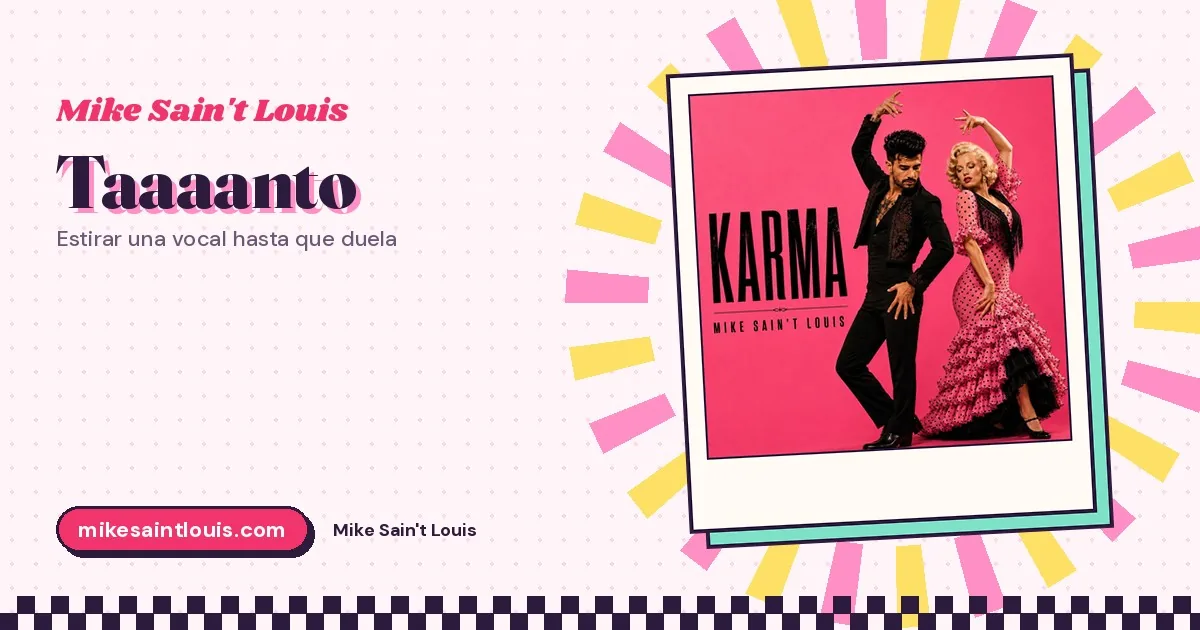
By Mike Sain't Louis ·
Taaaanto: stretching a vowel until it hurts, the secret grammar of «Karma»
Nine a's. I counted them with my finger on the screen, the way you count coins for the parking meter: t, a, a, a, a, a, a, a, a, a, n, t, o. That's how the word «tanto» ("so much") is written in the lyrics of «Karma». It isn't a typo. My finger didn't get stuck on the key while I was watching Pasapalabra, the teatime quiz show. I wrote it that way because that word, in that spot, wouldn't fit in five letters.
Correct my spelling on a CV and I'll thank you. In a song, no.
This piece is about exactly that: long vowels, repeated letters, that 3 a.m. WhatsApp spelling that turns up in so many of my songs and makes more than one person twitchy. And I'm telling it through «Karma», which is probably where I pushed the trick furthest. The «Karma» page already explains what the song is about and why that word has the patience of someone who knows how to wait. I won't repeat the plot here. Here I'm going into the typography, which is a smaller, stranger room, like the toilet of a bar in Malasaña.
«Que todo llega, y se llama» (Because everything comes round, and it's called…)
The chorus is a three-line sentence and a scream. I'm copying it exactly, capitals and a's included, because if I tidy it up it stops being what it is:
«Que todo llega, / y se llama / KAAAAAARMAAAAAA»
(Roughly: "Because everything comes around, / and its name is / KAAAAAARMAAAAAA".)
Look at the architecture. First, «que todo llega», "everything comes around", a grandmother's line at the door of the health centre, a neighbour's line with her shopping trolley, an aunt's line at a wedding when her niece's ex-husband walks past with the new one. It's an age-old phrase, and that's why it works: I didn't invent it, I inherited it. Then «y se llama», "and its name is", which is a pause. A drumroll. What the host of Saber y ganar does before telling you whether the answer is right. And then the name arrives, and the name isn't said: it's let loose. With six a's in the first syllable and six more in the second.
A normal word takes up a second. This one takes as long as a coffee takes to go cold.
The beauty of writing it this way is that the page already comes with instructions. Anyone who reads those lyrics, even if they've never heard the song, knows that word isn't pronounced like in a yoga class at the community centre. It stretches. It drags. It becomes an ambulance siren coming from far away, and you hear it getting closer and can't do a thing. Which, incidentally, is exactly what karma does in the song: it comes from far away, you hear it, you can't do a thing.
Form imitates content. Nobody taught me that at any academy. It's in every school playground.
The spelling of urgency
There are people who type «holaaaaa» on their phone and people who would never in their lives do it. Think of what you feel when someone answers «ok.» with a full stop: dread, suspicion, an urge to call your best friend so she can read the message for you like a tarot card. And think of what you feel when you get «okaaaay». You breathe again. That difference doesn't exist in any dictionary, but in a conversation it's everything.
Radio songs almost never use it in writing. The lyrics printed in album booklets, or the ones on lyrics websites, usually come ironed flat, like a First Communion shirt. You hear someone stretch a vowel across four bars, then you look up the lyrics and it says «amor», with its usual four letters, as if nothing had happened. Information gets lost. Above all, the joke or the wound that lived inside that stretch gets lost.
I decided not to iron. If a word stretches in my head, it stretches on paper. If it's in capitals in my head, it goes in capitals. It's a spelling of urgency, of the things you can't say in a normal tone without lying a little.
And here comes a detail about how I work that's worth spelling out so nobody gets confused. I write the lyrics. Mine, from start to finish, with no artificial intelligence. The music and vocals of my songs are made with AI tools such as Suno. The throat isn't mine: I'm a lyricist, composer and music producer. So for me the written lyric is also a score of emotions. It's the only thing I control with my own hands from beginning to end, and that's why I load it with signals. The extra a's are one of those signals. They tell whoever reads it, and whoever produces it, where the weight is.
I don't know if everyone reads them the same way. I know I write them on purpose.
Six a's and six a's
Back to the word. KAAAAAARMAAAAAA. I said six and six, and it's true: six a's after the K, six a's after the M. I could have made it lopsided, with more in the second syllable so the word dropped like a shop shutter. I didn't. I left it symmetrical, like a swing that rises and falls with the same push.

I can tell you what I was thinking, but I won't fool you by claiming I made a study of it. I didn't measure anything with a ruler. What I do know is that when I look at it on the page, I see an old-fashioned market scale, both pans level. What you give and what comes back to you. Six and six. Maybe it's chance. Maybe my subconscious is a better lyricist than I am. Either works for me.
What I'm absolutely sure of is that I didn't want it in lower case. A word like that in lower case is a wrist tattoo at a hen party in Benidorm. In capitals it's a neon sign. And karma, in this song, has to come in the way the Guardia Civil bursts in on an episode of Caso cerrado: kicking the door down.
«Y duele taaaaaaaaanto» (And it hurts sooooo much)
The other stretched word in the song is the one this piece opened with. I'm copying it with its companions, so you can see exactly where it sits:
«Esto es peor que día tras día / te den un puñetazo, / y duele / taaaaaaaaanto, / taaaaaaaaanto.»
(Roughly: "This is worse than being punched / day after day, / and it hurts / so muuuuuuuuch, / so muuuuuuuuch.")
Here the long vowel isn't a scream. It's a whimper. It's the difference between the person yelling at you in the doorway and the person who stays sitting on the step with the keys in their hand, not opening the door.
What makes me laugh, and breaks me a little at the same time, is that «tanto» is a measuring word. An adverb of quantity. It's for saying "I've eaten so many croquetas I can't move" or "I love you so much I can't explain it". And in the song it's used precisely for what can't be measured: the pain of a punch that lands every single day. So, since the adverb isn't up to the job, I inflate it. I give it nine a's, like someone blowing up a lilo by mouth on Malvarrosa beach until they're dizzy.
Nine a's is an ugly number. Neither round nor symmetrical. I like it that way. Pain isn't symmetrical either.
And it's repeated twice. «Taaaaaaaaanto, / taaaaaaaaanto.» The second time it tells you nothing new. The second time is so you stay right there. So you don't turn the page. It's the gesture of someone who grabs your arm just as you were getting up from the table and says, "No, wait, I haven't finished."
The punch on a timetable
There's something else the song does before it stretches anything, and that's repeat. The first line doesn't appear once: it appears three times in a row at the start.
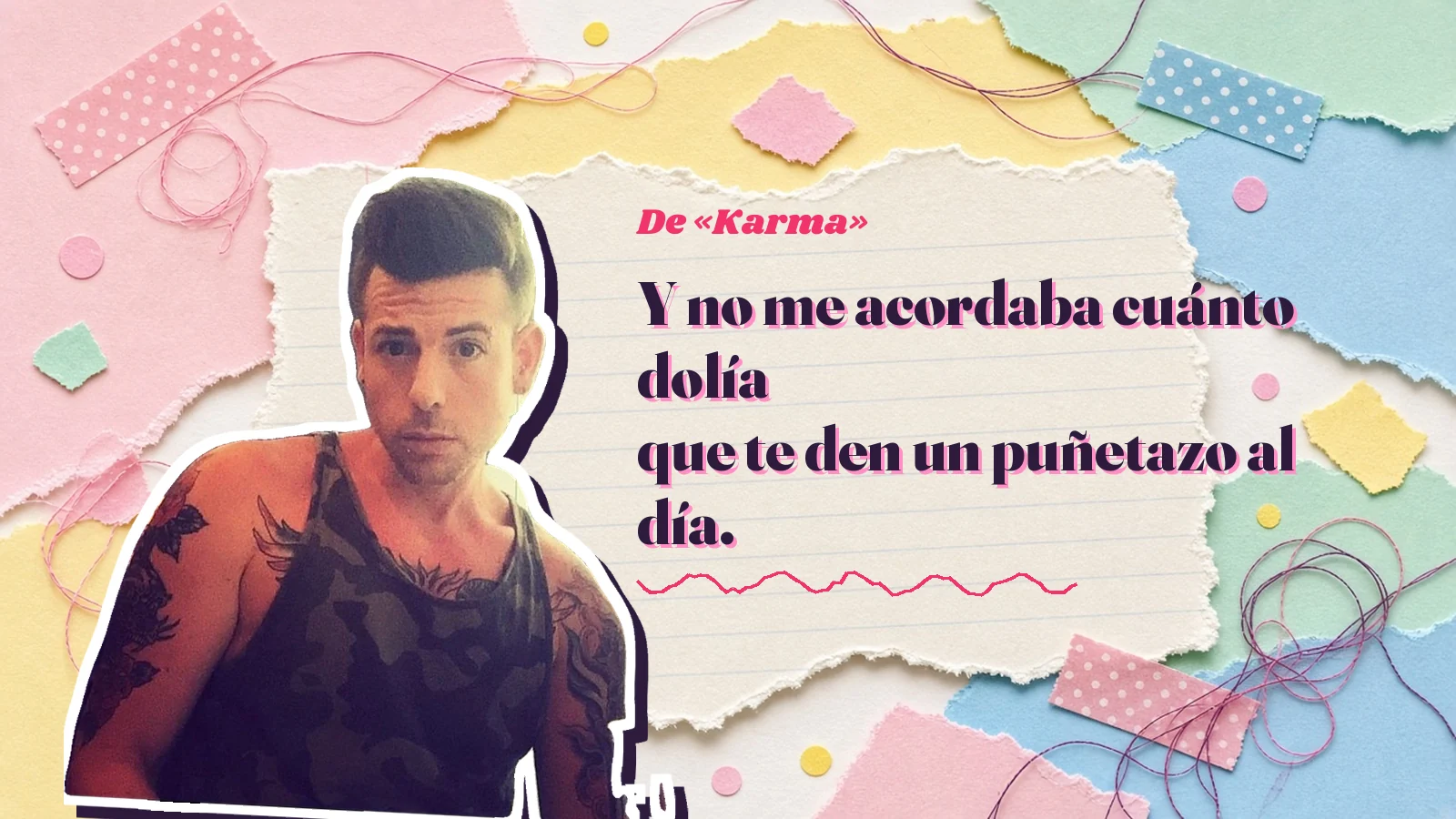
«Y no me acordaba cuánto dolía / que te den un puñetazo al día.»
(Roughly: "And I'd forgotten how much it hurt / to take a punch a day.")
Three times. Like the alarm you set for 7:00, 7:05 and 7:10 because you know yourself. Repetition is the long vowel of a whole sentence. If stretching a letter stretches a word, repeating a line stretches a memory.
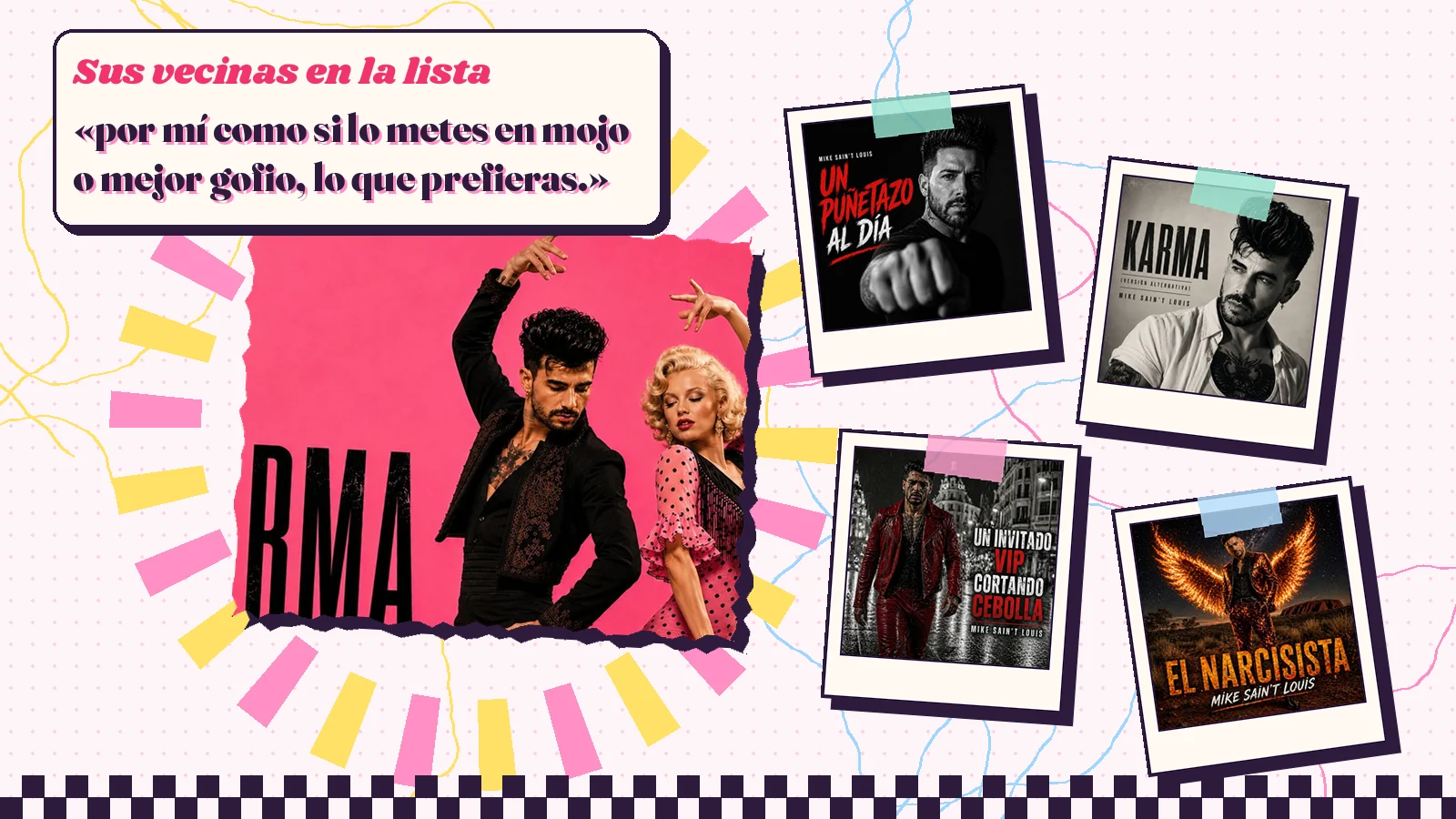
I didn't invent that line for this song. It comes from another one, «Un puñetazo al día», and I explain it on the site: «Karma» picks up the final stretch of that story and turns it into a song of its own. There's also an alternative version of «Karma», so the same unsettled score has several doors. It's like when you tell your mother about something that upset you, then your sister, then the woman at the greengrocer's, and with each version the adjectives change but the punch stays the same.
What interests me here is something else: «no me acordaba», "I'd forgotten". It's a small and very humiliating confession. It means I'd let it slip. That I thought it was over. That I'd gone back to doing the shopping, going to the gym, answering voice notes. And suddenly something reminds you and you realise your body had been keeping count even if you hadn't.
That's no joke. That's the most serious thing in the song.
I thought I was over it
Right after that blow comes a line we've all said at some point without really meaning it: I thought that was part of the past and I was over it. I'm paraphrasing rather than quoting because what matters is the idea, not the rhyme. It's the line of someone who bought a self-help book at the airport and read the whole thing on the flight to Tenerife.
«Superado», "over it", is an exam word. Passed, failed, done. As if heartbreak were the theory part of the driving test and you already had the L-plate stuck on the back window. My lyrics use it so it can come crashing down. Because the next thing that happens isn't a therapy session or a sunrise on the beach: it's a very spiteful little message. And then the chorus comes back with its KAAAAAARMAAAAAA. Over it, he says. Sure.
I laugh at myself before anyone else does. Over it? Everyone says that before the second vermouth.
A family of long vowels
«Karma» isn't alone. If you go to the lyrics and start looking, you'll find a whole family of stretched words, each with its own personality. And since this is about technique, it's time to compare them.
In «Un invitado VIP cortando cebolla» there's a return to hell with so many o's the word looks like a tunnel:
«Hoy es mi vuelta a los infiernoooooooos»
(Roughly: "Today I'm going back to heeeeeeeell".)
There the long vowel is theatrical. It's a diva's entrance in a Gran Vía musical. You come down the staircase, the spotlights come on, you do the fan flourish. The o's are the train of the dress.
In «El narcisista» there's the «frozeeeeeeeeen», which is something else: an English word, from a Disney film, stretched until it turns ridiculous. You've even tried a flamethrower, the lyric says, and the thing is still frozen. The long vowel there is mockery. It's the eye-roll.
And then there's the one in «Karma», the simplest of them all. No tunnel, no Disney. A two-syllable word that becomes a siren. If I line them up, I get a little dictionary of uses:
- the diva's long vowel, sweeping down the staircase to hell;
- the mocking long vowel, rolling its eyes at a frozen heart;
- the whimpering long vowel, the «taaaanto» one, sitting on the step with the keys;
- the verdict's long vowel, the KAAAARMA one, arriving with the siren on;
- and the affectionate long vowel, the «holaaaa» on your phone, which isn't in any of my songs but has rescued more than one Sunday afternoon of mine.
It's no accident that I use the device so much. Nor is it a master plan. It's how I talk, carried over onto paper.
Why I don't spell it properly
I know what some people think when they see those a's: "write properly, you look like a kid." And I get it. For some people a misspelt word gives them the same itch an «ok.» with a full stop gives me. They're entitled to it.
But in a lyric, "properly written" means something else. It means written so that what's really happening comes across. If I write «karma» in lower case, with its five dictionary letters, I'm lying about what happens in that song. I'm pretending the word is said calmly, like asking who's last in the queue at the butcher's. And it isn't said calmly.
There's a piece on this same site about exaggeration in everyday Spanish speech that goes hand in hand with this. Spaniards don't say "I'm tired". We say "I'm dead", "I can't take any more", "I want to die", "I'm throwing myself out of the window". We exaggerate in order to be exact. Long vowels are the spelling version of that exaggeration. They're «me muero», "I'm dying", written in letters.
And if that makes me look like a kid, well, look: a kid with his own label, which is the closest thing to throwing your own birthday party, piñata and all.
Writing a siren
I don't keep a manual for how this is done, and I won't make one up for you. What I can do is take the line apart backwards, the way you dismantle a piece of IKEA furniture to work out why you have screws left over.
Strip everything away and you're left with the flat sentence: «que todo llega y se llama karma». Like that, on one line, with its full stop. Read it aloud in your kitchen while the microwave hums. It sounds like a Mr. Wonderful calendar. It sounds like advice from your brother-in-law after lunch, toothpick in his mouth. It's true, but it has no bite.
Now break it. «Que todo llega, / y se llama / karma.» Now there's a pause. Now there's a drumroll. The sentence stops being advice and becomes a little scene: someone getting ready to say a name.
Now put it in capitals. KARMA. It's no longer a name: it's a sign.
And now stretch it. With too few a's it looks like a typo. With too many it looks like a cat walked across the keyboard. Somewhere in between the siren appears, and the page says exactly what it means to say. In the published lyric it's six and six. Don't ask me to justify the number with a theory. I'd tell you a pretty lie and I'm not in the mood.
It's like salting your mother's lentils: carefully, because there's no going back.
Patience can be written too
There's a paradox in this song that I love. Karma, in the lyrics, is the most patient thing in the world. It doesn't run. It doesn't get angry. It doesn't send messages at four in the morning. It waits. And yet when it arrives, it arrives screaming, with all the a's in the world.
It's like those ladies who say nothing through the whole Christmas lunch, put up with the brother-in-law's comments, put up with the rock-hard turrón, put up with the football argument, and then over coffee drop one sentence that leaves the whole table silent until Epiphany. Patience and the explosion are the same person at two different moments.
That's what long vowels are for. To make the explosion felt. If karma arrived in a whisper, like a cologne advert, nobody would notice. And the song wants the whole building to know.
There's another post on this blog about how to write a chorus that laughs at you and with you, and that's the other side of all this. A chorus like the one in «Karma» is a line that laughs at the other person, yes, but it also laughs a little at me, the one writing it, because it admits I have no weapon except waiting. I'm not going to do anything. I'm not going to send anyone round. I'm going to sit down and let it come. It's the revenge of someone who doesn't know how to take revenge.
And that, if you think about it, is a bit tender.
Reading it on the page
If you've never read one of my lyrics while the song plays, I recommend the experiment. There's a guide on the blog about how to read a lyric while you listen, and «Karma» is a good place to try it. You'll find the lyrics on gayfolkplanet.com, with all their a's, and the song on the platforms via the list of releases.
What you'll notice is that the page stays one step ahead of the sound. You see the a's before you hear them. You see the capitals before the blow. It's like reading the script of a horror film while you watch it: you know the killer is behind the door, and you still jump.
That's what interests me. That reading and listening are two different pleasures, and that they feed each other. On the page, the word looks long. In your ear, it feels long. And somewhere between the two, you remember someone who punched you once a day for far too long.
A schoolyard trick
I'm not going to get academic. Stretching vowels is a schoolyard trick. It's the «maaaaamááá» you hear in any park in Móstoles at seven in the evening. It's the «gooooool» of any radio commentator on a league Sunday. It's the «siiiiií» of an Operación Triunfo contestant when she's picked for the live show. We've heard it all our lives and done it all our lives.
That's why I'm not embarrassed to use it in a lyric. Quite the opposite. To me it's a device from the barrio, from the street, one of those you won't find in writing workshops where they teach you never to repeat a word and to hunt for synonyms in the dictionary. My way of writing comes more from the playground than the workshop.
Some lyricists look for the exact word. I often look for the everyday word and stretch it until it says something new.
What doesn't stretch
Now, one important thing: not everything stretches. If I stretched every word, the lyric would be chewing gum nobody could swallow. In «Karma» there are only two lengthened words: the name and the «tanto». The rest is written bare, short sentence and full stop. «Que todo llega.» «Y duele.» «Y se llama.»
That restraint is what makes the a's stand out. It's like red lipstick: if you paint your eyes, nails, hair, shoes and Primark handbag red too, the lipstick disappears. If everything else is neutral, the mouth can be seen from the other end of the club.
And if in some lyric of mine I overdid the stretching and the word lost its charm, you can each choose which one. I'm not pointing it out.
The view from the trilogy
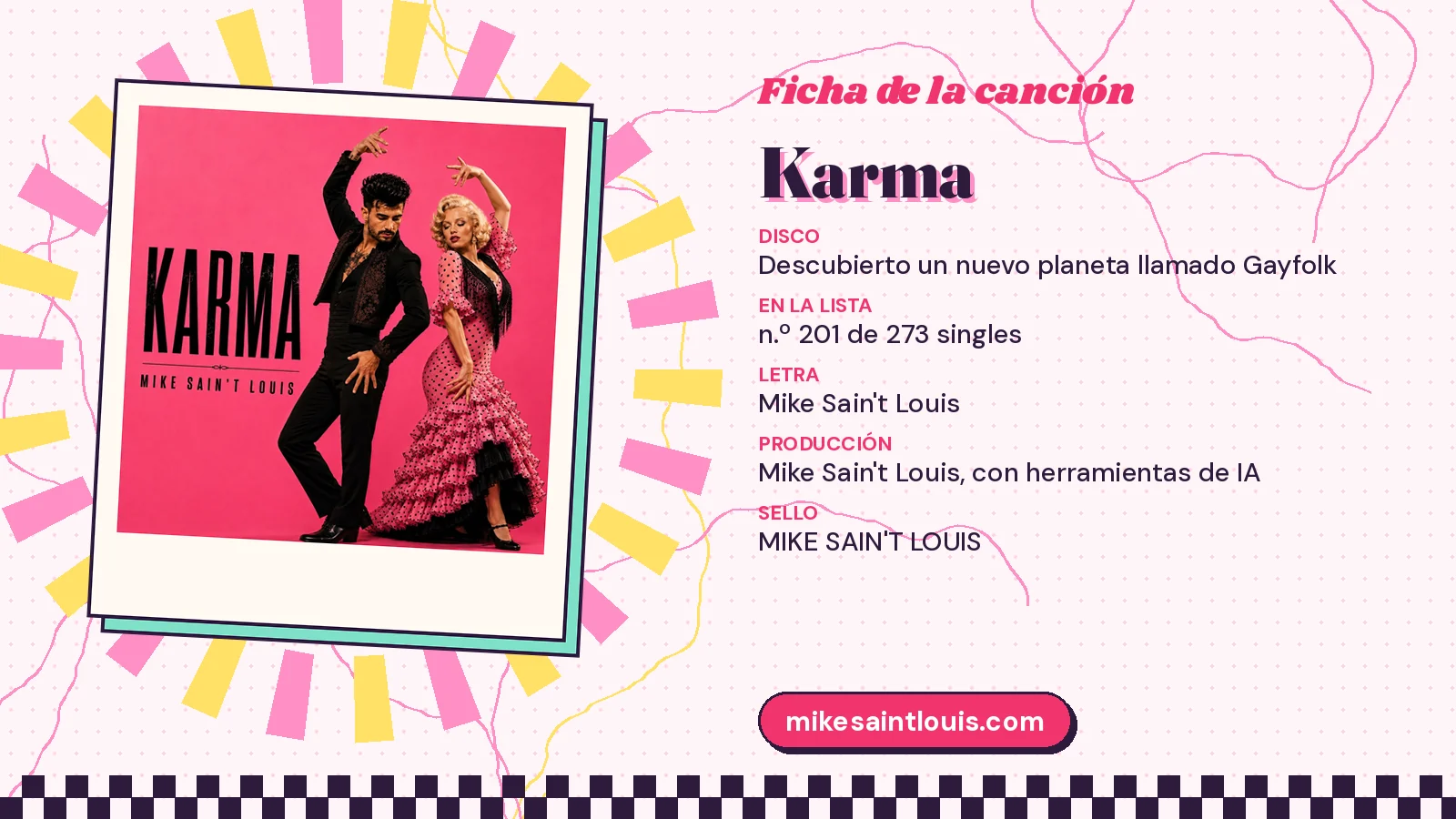
«Karma» is on the first album of the trilogy, *Descubierto un nuevo planeta llamado GAYFOLK*. It's an album full of unsettled scores, lots of exes, plenty of narcissists, lots of WhatsApps left on read and a fair bit of recycled copla. And in that landscape, «Karma» works almost like a mantra. A word repeated and repeated until its meaning changes.
Because at the start of the song, «karma» sounds like a threat. Halfway through, it sounds like comfort. And by the end, from so much repetition, it sounds like something else: weariness, a strange sort of lullaby to put a grudge to sleep. If you go to the Planeta Gayfolk page on this site, you'll see that this album opens the whole universe. And that this word, with its extra a's, is one of its doors.
I won't tell you which is the right one. Everyone goes in through whichever is closest.
Six a's against a punch
To finish without a moral (I've banned myself from morals, and I already spent this piece's one further up), I'll leave you with an image.
A punch a day for a long time is an enormous thing disguised as a small one. Each blow on its own seems like nothing much. The terrible part is the sum. And I, who can't throw a punch, who will never hit anyone and am about as violent as a Smurf, have only one thing to answer that sum with: a very long word.
KAAAAAARMAAAAAA.
Six a's and six a's. My only weapon. My neon sign. My ambulance siren coming from far away. And if it never arrives, at least I'll have got it off my chest by writing it.
Frequently asked questions
Why do the lyrics of «Karma» have so many a's? Because Mike Sain't Louis writes long vowels on purpose. In «Karma» the chorus word appears as «KAAAAAARMAAAAAA» and the «tanto» in the verses has nine a's, to mark on the page where each word stretches and where it weighs.
Who wrote «Karma»? The lyrics are by Mike Sain't Louis, a lyricist, composer and music producer from Madrid, written without artificial intelligence. The music and vocals are made with AI tools such as Suno.
Which album is «Karma» on? Descubierto un nuevo planeta llamado GAYFOLK, the first album of the GAYFOLK trilogy. It has an alternative version and is related to «Un puñetazo al día».
Where can I read the full lyrics? At gayfolkplanet.com/letras/karma, with their original spelling, and the song's page is at mikesaintlouis.com/blog/karma.