
By Mike Sain't Louis ·
Always set apart among so many people: the loneliness you feel most at the party
Any old Saturday in Plaza de Chueca, the heart of gay Madrid. People sitting on the benches with a can in hand, a group of lads in matching stag-do T-shirts, a drag queen hurrying past with her wig stuffed in a Primark bag, someone crying in one doorway and someone laughing in the next. A thousand people in two hundred square metres. And in the middle, one person who isn't really there.
That's what the line that weighs on me most in «Entre cuatro paredes», "Between four walls", is saying. Not the one about the room. The other one.
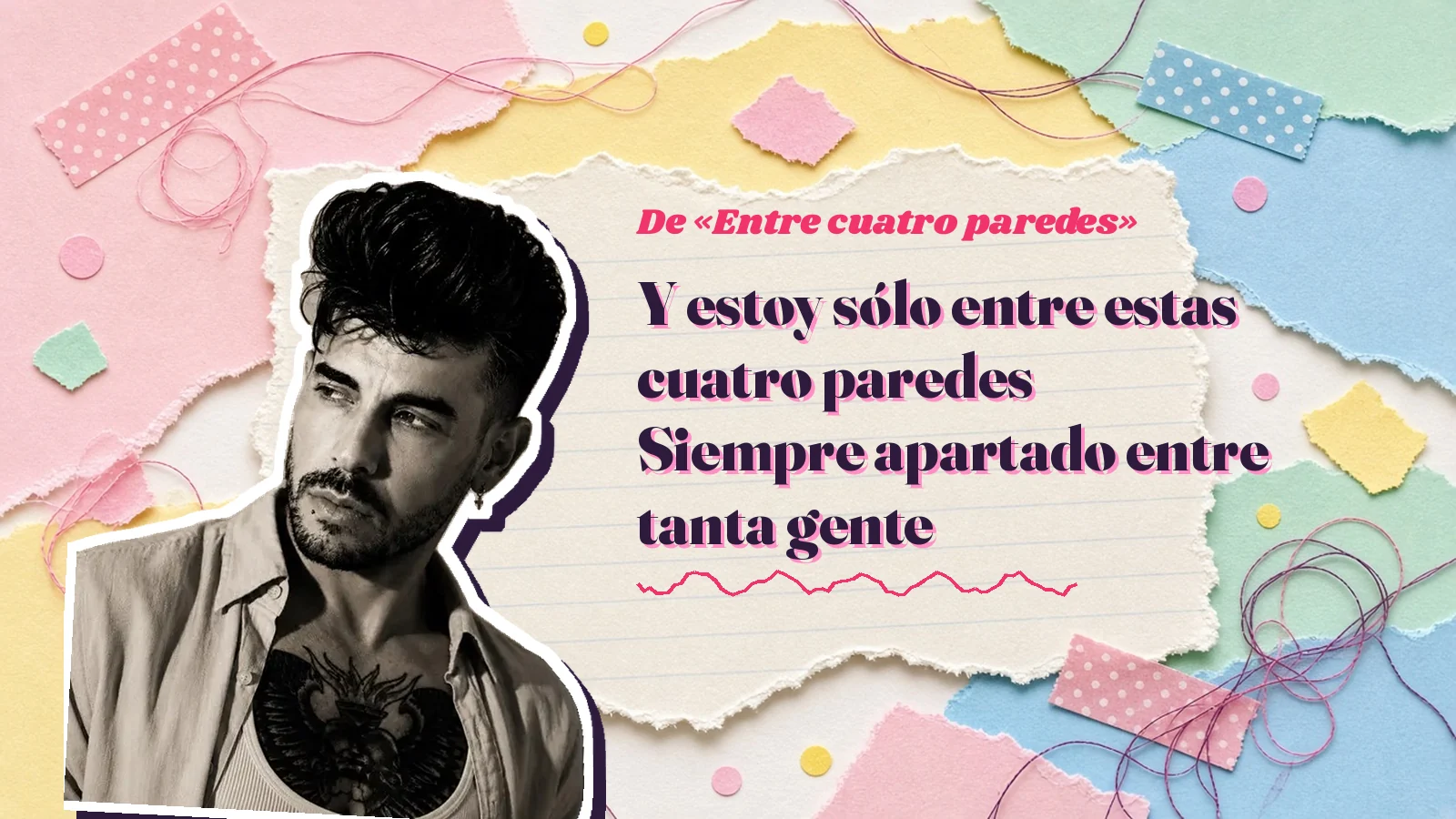
«Y estoy sólo entre estas cuatro paredes / Siempre apartado entre tanta gente» "And I'm alone between these four walls / Always set apart among so many people"
The two lines go together, one after the other, in every chorus. The first is the image everyone gets straight away: the room, the blind down, the unmade bed. The second is the one I'm interested in here, because it turns the first inside out. If you're set apart among so many people, the four walls are no longer brick. You wear them. You take them onto the Metro, into the office, into the supermarket queue and onto the dance floor.
This piece is about that second line. The song page already covers what happens in the lyric, the tunnel, the lack of hope and that "maybe" at the end. Here I want to stay at the party, which is the place where, strange as it sounds, loneliness shows the most.
A warning before I go on: there aren't many jokes here. One or two will slip out, because I am who I am. But this song has none, and I'm not going to sprinkle glitter on something that doesn't wear it.
The paradox of the full bench
There's a kind of loneliness that's easy to tell: the person who lives alone, eats alone, watches telly alone. That one has its time-honoured iconography. Packet soup, the cat, rain on the window. It's insurance-advert loneliness.
And there's another that's much harder, because you can't see it. The loneliness of someone surrounded. Someone with the family WhatsApp group showing forty unread messages, the gym group, the group for their cousin's wedding, and who still feels nobody is talking to them. Someone who goes to a dinner for twelve and comes home without having said a single thing that mattered to them.
"Always set apart among so many people" is a sentence about that second loneliness. And what I find hardest about it is the word "always". It isn't "today I felt left out". It isn't "sometimes". It's always. It's a state, not a bad day.
When I write, I like the small words to carry the heavy load. "Always" is one of them. Six letters and the door shuts on you.
The other small word in the line is «tanta», "so many". It doesn't say "among people". It says "among so many people". That "so many" is a hidden lament, the same one your grandmother uses when she says "with so much food and the boy not eating". There's a lot of something, loads of it, and still the only thing that matters is missing. It's the cruellest arithmetic I know: the bigger the number of people around, the smaller the one set apart becomes. A thousand people in the square don't add up to company. They subtract.
If I go on about words it's because a lyric doesn't have much else. No sets, no actors, no lights. There are words, and each one has to pull its weight.
What it sounds like from inside
I'm going to ask you to try something. Next time you're at a party, on a terrace or in a bar with loud music, close your eyes for three seconds and listen. Not to the music: to the people. You'll hear laughter, glasses, someone shouting a name, someone ordering another round, someone telling a story they've already told four times. It's a warm noise. It's the sound of being in company.

Now imagine that noise reaching you as if from underwater. You hear it, but it doesn't touch you. The laughter next to you isn't with you. The name they're shouting isn't yours. That's the feeling the lyric is trying to put into words. Not silence. Noise that doesn't include you.
That's why this line strikes me as stronger than the one about the room. In the room, at least, the silence is consistent. You're alone and it's quiet. It all adds up. At the party nothing adds up. There's noise, there are bodies, there's music, and you're just as alone. It's loneliness with a soundtrack, and the soundtrack makes it worse.
Five places full of people
So it doesn't stay abstract, here's a list. Five places where you can be always set apart among so many people without anyone noticing. I didn't take them from any study: I took them from looking.
- Your cousin's wedding at a banqueting hall in Alcorcón, out in the Madrid suburbs, at table fourteen, between the boyfriend of a friend from school and a distant uncle who asks you three times what you do for a living.
- A carriage on Metro Line 6 at quarter past eight in the morning, with a hundred bodies pressed against yours and not one that knows your name.
- The WhatsApp group "Mari's Birthday 🎉", where everyone posts cake emojis and your message hangs there without a single thumbs-up.
- The office Christmas dinner, with the Secret Santa and the karaoke, when the only person who speaks to you is the waiter asking whether you'd like the meat or the fish.
- A club dance floor at four in the morning, music at full blast and lights spinning, and you dancing facing a pillar so nobody notices you're not dancing with anyone.
What they have in common is that, seen from outside, they're places of company. Nobody would say you're alone at a wedding. Nobody would say the Metro at rush hour is short of people. And that's the trap: loneliness in company has no photo. It doesn't appear in films with rain on the window. It appears in group photos, in the corner, with a smile that lasts as long as the flash.
That's why the word «apartado», "set apart", seems so exact to me. In all those places you're inside. You were invited, you paid for your ticket, they added you to the group. And still you've been left to one side, or you've stayed to one side, which is sometimes the same thing seen from the other end of the table.
The clock passes two
On the same album there's another song that looks into this mirror from the night: «La noche no es para mí», "The night isn't for me". There the speaker isn't shut in. He's gone out. He's done what you're supposed to do when you're low, what your friends and the magazines tell you: go out, clear your head, get some air. And look what he finds:
«El reloj pasa ya de las 2:00 / Todo a mi alrededor / Se vuelve diferente / Aunque en el fondo sea igual» "The clock's already past 2:00 / Everything around me / Turns different / Though deep down it's the same"
"Though deep down it's the same." That's the key. The night changes the light, the volume, the people. But deep down everything is the same, because loneliness doesn't stay at home waiting for you. It comes along. It orders a drink. It waits at the bar while you go to the loo.
Put the two songs together and I get two sides of the same coin. In «Entre cuatro paredes» you don't feel like leaving the room. In «La noche no es para mí» you do leave, and it's no use. The first is the fear of going out. The second confirms that fear. And between them there's someone who can't find their place, inside or out.
I didn't plan it as a diptych. But when you line your lyrics up on the lyrics page, conversations appear that you didn't know you were having.
Pride, the loudest thing there is
There's one place where this loneliness in company has a particularly cruel edge, and that's Pride. I say it with all the love in the world for the party, which I think is necessary, and with every respect for those who have a whale of a time.
But think about it. A whole week when, in theory, the whole city is yours. Floats, stages in Plaza de Pedro Zerolo, people from every corner of Spain and beyond, flags on the balconies of Calle Hortaleza, in the shop windows, on the city buses. Everyone celebrating that you are who you are. And if that week you feel set apart, the feeling multiplies, because you don't even have the excuse that the world isn't ready for you. The world has thrown a party in your name and you can't get in.
There's a piece on this site about Pride on a Tuesday in November, about the pride that doesn't make the photos, the everyday kind. I thought of it while thinking about this line. Because the loneliness of someone "always set apart among so many people" isn't cured by a date circled on the calendar. If anything, the date puts it more on display.
And here's the blunt sentence, the only one I'll allow myself as a lesson in this whole piece: a crowd is not company.
Antisocial by choice, set apart without choosing
In the trilogy there's another song that seems to be about the same thing and is really about the opposite: «Antisocial». Its protagonist is alone too, but he decided it. He puts it like this:
«Solo me importan aquellos que ya conozco / y siempre van a estar.» "I only care about the ones I already know / and who'll always be there."
Notice the difference. The antisocial one chooses. He has his people, a few, the usual ones, and he doesn't care about the rest. There's something almost proud about that loneliness, like someone leaving the party at eleven because he'd rather have his sofa and his series. It's loneliness with a remote control.
The one in «Entre cuatro paredes» hasn't chosen anything. He's set apart. It's a passive word: someone or something has put him to one side, the way you push away a plate you're not going to eat. There's no pride in it. There's displacement.
I like having both in the same universe, because from outside they sometimes look identical. The lad alone in the corner of the bar might be the happy antisocial waiting for his one friend, or the set-apart one who doesn't know how to approach anybody. From the bar you can't tell them apart. From inside, they're two different planets.
A song without a single joke, on an album full of them
If you know my songs, you know I reach for humour nearly every time. Croquettes on a cruise, coloured contact lenses, Carmina Barrios, the Seville TV matriarch, as mother-in-law. It's my way of telling the truth with a steady hand. I say so on the site, in the house rules on the about page: humour tells the truth too.

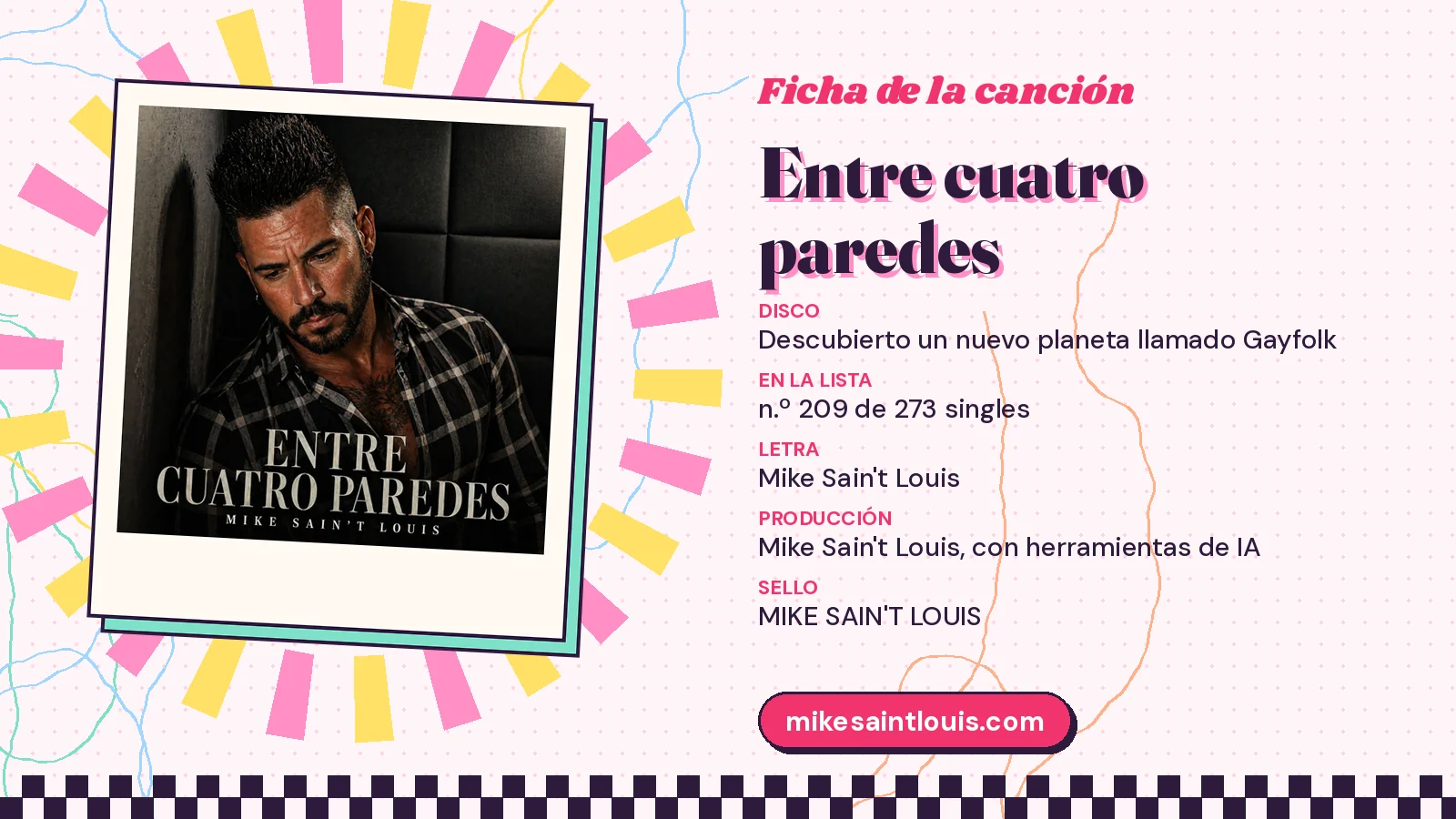
«Entre cuatro paredes» is one of the exceptions. There's not one TV reference. Not one witty insult. Not one supermarket brand. And on an album like the first of the trilogy, *Descubierto un nuevo planeta llamado GAYFOLK*, that really shows. It's as if in the middle of a village fiesta the coloured lights went out and only one bulb was left.
Why no jokes? Because there are places where humour is a way of not looking. And this lyric wants to look. It wants to stay still in front of the thing, the way you stare at a damp patch on the ceiling for half an hour, unable to do anything else.
I've thought about it many times and I believe a joke, in this song, would have been a fake hug. One of those "come on, cheer up"s you say in a hurry at the door. And this lyric doesn't want cheering up. It wants company.
The walls you wear
Back to the opening image. If you're set apart among so many people, the four walls don't belong to a room. They're portable. You put them on in the morning like a coat and take them off, if you're lucky, at night.
This matters to me because it changes how you look at someone who's struggling. Lots of people think loneliness is fixed by getting the person out of the house. "Come on, it'll clear your head." "Let's go to the cinema." "Come to the dinner, everyone will be there." And sometimes it works, of course. But sometimes all you do is move the walls somewhere else, with more people around, where they show even more.
I'm not saying don't invite people. Always invite. I'm saying the invitation isn't enough if, once they arrive, nobody looks them in the eye. If at the dinner for twelve nobody asks them anything. If in the WhatsApp group their messages go unanswered while everyone else's get celebrated.
There's a song of mine, «El segundo exacto», "The exact second", with twenty WhatsApp statuses seen and not a single like. It's a send-up, and I laugh when I read it. But underneath the send-up is this very thing: seeing that they see you and that nobody says a word. That's being set apart among so many people too. Twenty people watching. Zero replying.
I don't feel like going out
The chorus opens with two noes in a row: no hope shows up, no wish to leave the room. Without them the line about the crowd makes no sense.
There's a sister song called exactly that, «No me aparece una ilusión», "No hope shows up for me", with these same opening lines. The same room, another door.
«No me apetece», "I don't feel like it", is a very Spanish expression. It's soft. It isn't "I can't" or "I refuse". It's a lack of appetite, like not feeling like doing the washing-up or not feeling like ringing your aunt. The terrible thing is applying it to leaving the room, which is the most basic thing of all. The song uses the smallest phrase for the biggest thing.
And then, straight after, in the same run of lines, comes "always set apart among so many people". In other words: I don't feel like going out, and besides, I know that if I do it won't make any difference. It's an alley with an exit, but the exit leads into another alley.
When I write, I pay close attention to how sentences link inside a chorus, because the chorus is what repeats, and what repeats is what sticks. In this song the chorus is a perfect chain of reasons not to move. And it repeats so many times that the listener ends up a little trapped in that room too. It's not an effect I'm after to show off. It's what the song asks for.
«Maybe» as the only door
At the end, after all the negations, after the tunnel and the darkness, a sentence appears that starts with "no" and ends by opening a crack:
«No, pero algo en mí pide respirar / Tal vez algún día logre despertar.» "No, but something in me asks to breathe / Maybe one day I'll manage to wake up."
There's no party at the end. No friend knocking at the door, no love turning up at the last minute, no Coca-Cola-advert sunrise on the beach at Benidorm. There's a "maybe". And that "maybe" is the only thing in the whole lyric that isn't set apart from anything. It's the first thing that doesn't say no.
If the person set apart among so many people achieves anything by the end of the song, it isn't joining the party. It's breathing. And then, maybe, waking up. Two verbs of the body, not of society. They're about yourself before anyone else. I find it honest that the song doesn't promise company. It promises, at most, air.
What I'll allow myself to say from here
I'm not a psychologist, and I won't play one. I'm a lyricist. What I know how to do is put into words something another person is feeling but can't name. And I think this song does that with one line: always set apart among so many people. Some people hear it and think, "that's exactly what happens to me and I didn't know how to say it". That's one of the things a lyric is for.
There's a post on the blog about the loneliness of creating alone, which is about a different loneliness, the loneliness of the craft, of spending hours with a notebook and a screen and nobody beside you. It's not the same as this song's, but they share a cousin: the feeling of making something for lots of people with nobody close by.
And if you're reading this from inside your own walls, portable or brick, I'll tell you the only thing I can without making a fool of myself: you're not the only one. Talk to someone. Anyone, even the professional you least feel like seeing. In Spain, 024, the suicide prevention line, answers for free at any hour if things weigh too much. If you're outside Spain, call your local emergency number.
The drag queen with the wig in the bag
Back to the square from the beginning, because I left someone out.
The drag queen hurrying past with her wig stuffed in a Primark bag. She's off to work, most likely. In a little while she'll step onto a stage, make an entire bar laugh, be the most looked-at person of the night. And right now, in the square, nobody looks at her. She walks alone, in a hurry, among a thousand people.
I know nothing about her. I made her up for this piece, the way you invent a figure for a painting. But she helps me close, because both things fit inside her: the spotlight and the corner. The party and the four walls. Sometimes the most surrounded person is the one walking the street most alone, and the other way round.
The song doesn't resolve that. It only says it. And sometimes having someone say it out loud, even through a song made with AI tools and with lyrics written by a bloke from Madrid, is the first crack in the wall.
Maybe one day.
Frequently asked questions
What is «Entre cuatro paredes» about? Someone who can find neither hope nor the strength to leave their room, and who feels «siempre apartado entre tanta gente», "always set apart among so many people". It's one of the songs without humour on the first album of the GAYFOLK trilogy, and it ends with a «tal vez algún día logre despertar», "maybe one day I'll manage to wake up".
Who wrote the lyrics? Mike Sain't Louis, a lyricist, composer and music producer from Madrid, the first AI songwriter. The lyrics are his own and written without artificial intelligence; the music and the performances are made with AI tools such as Suno.
How does it relate to «La noche no es para mí» and «Antisocial»? They're three ways of being alone in the GAYFOLK universe: the shut room, the night that brings no comfort and loneliness by choice. This piece compares them through the line «Siempre apartado entre tanta gente».
Where are the full lyrics? At gayfolkplanet.com/letras/entre-cuatro-paredes. The song page is at mikesaintlouis.com/blog/entre-cuatro-paredes.