
By Mike Sain't Louis ·
Saint by comparison: the halo in «María Teresa de Calcuta»
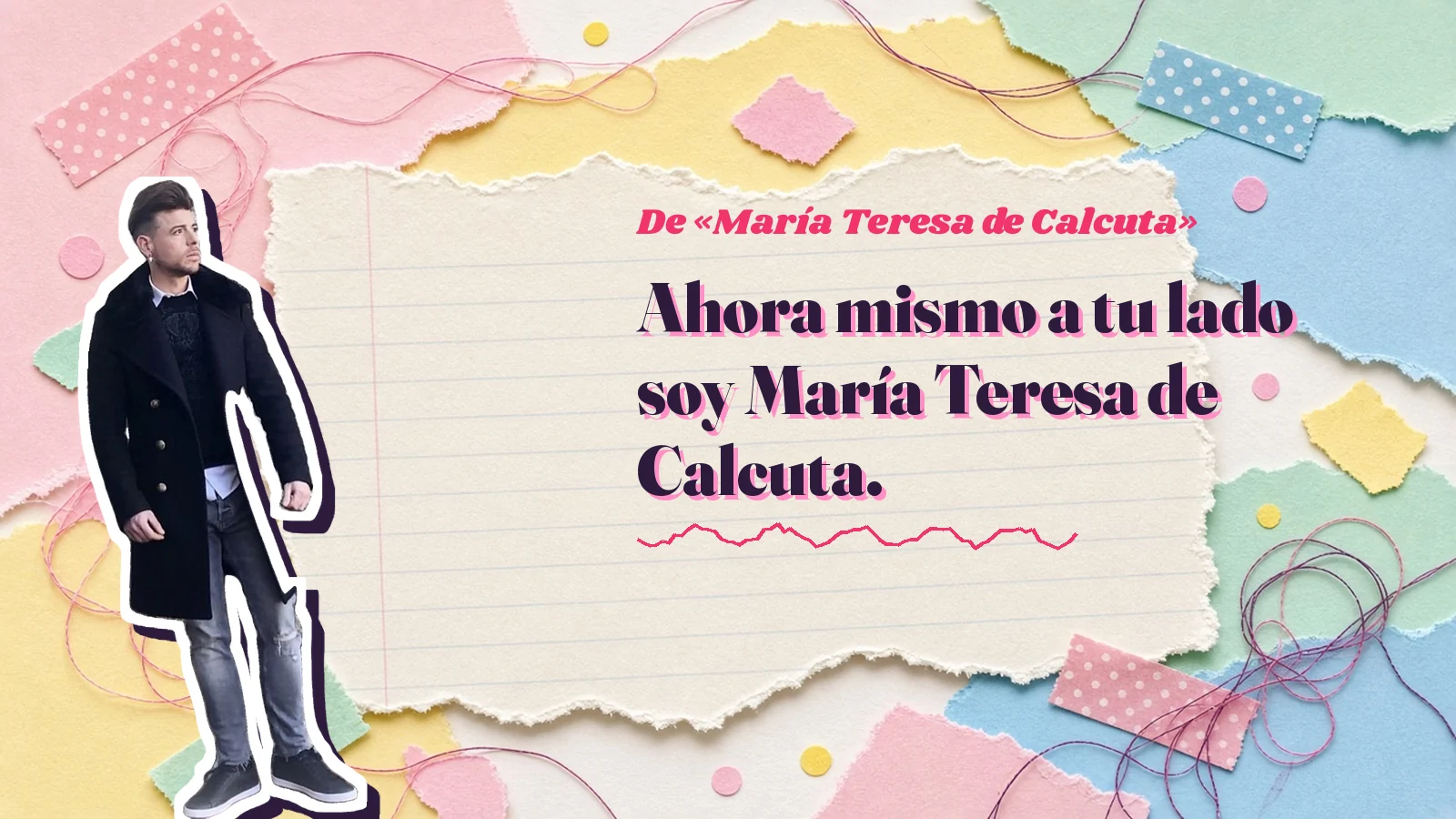
“Right now, next to you, I’m Mother Teresa of Calcutta.”
Nobody has ever mistaken me for a saint, and I doubt anyone ever will. And yet there’s a very easy way to earn a halo: stand next to someone worse than you.
That’s what «María Teresa de Calcuta» is about. Sainthood by comparison. That relative goodness that lands on you without your lifting a finger, simply because the person beside you has set the bar so low that even you, with all your quirks and your bad temper, look like a nun in sandals ladling out soup.
Before going on, the usual note for this kind of song: the ex in the lyric is a character. He has a full name inside the song because radio dedications always do, and because a full name gets a bigger laugh than a generic “you”. But he’s fiction. There’s no real gentleman here waiting his turn at the confessional.
A second-hand halo
There’s something about relationships that go wrong that I find very funny: how quickly the casting changes.
At first you’re both normal. People with flaws, with good days and grumpy days. Then the first big lie surfaces and the map rearranges itself. One of you stays put and the other drops so many steps that the one standing still seems to have risen. Without moving. Without earning it. Pure geometry.
That’s the second-hand halo. Other people give it to you, or you give it to yourself, looking at the person beside you. It isn’t that you’re a good person: it’s that the comparison flatters you.
And it struck me that the most exaggerated, most camp, most bedside-holy-card image for that feeling was the most famous nun of the twentieth century. The lady in the white sari with blue stripes. The one who turns up in every example of goodness in every religious-studies textbook. When you compare yourself with someone awful, you don’t say “I’m a decent person”. You say you’re her. It’s much funnier and wildly out of proportion.
Exaggeration is my way of being precise.
The saint who swears
What really delights me about the song is that the saint in the lyric is no saint at all.
Because straight after declaring himself Mother Teresa, the same narrator comes out with the most profane line imaginable. He goes at the ex with an insult dressed as a rhetorical question, all exclamation marks, in the tone of a playground row you’d never hear in a convent. The halo lasts exactly one line. By the next it’s lying on the floor.
I love that contrast because it’s a lie and the truth at once. It’s a lie that the narrator is a saint. It’s true that, next to the man he’s got, he looks like one. And the joke is that he doesn’t quite believe it himself: he puts on the wimple, looks in the mirror, and out slips a cackle and a curse.
This happens to me a lot when I write. I like characters who proclaim something and contradict it in the same breath. The one who says he’s perfectly calm while slamming the door. The one who says he doesn’t care any more while writing a three-minute song about it. Characters who catch themselves lying and don’t mind. I find them far more human than the ones who have everything figured out.
Something fishy going on
There’s a stretch of the lyric made entirely of a stock Spanish phrase: “suddenly they’ve caught you, there’s a cat locked in.” In Spanish, a locked-in cat is what English calls something fishy.

I love putting old sayings into songs, and this one tickles me because everybody uses it without ever thinking about the cat. What cat? Locked in where? Nobody knows. But when you say it, everyone understands that something smells off.
In the song, the cat is the double life. The moment someone finds what was under the rug. And the next line lists it without frills: bad, unfaithful, hurting you. There the song turns serious for an instant, because what it says is grave even if it says it to the rhythm of a village fiesta.
Then comes the reaction, which is the one that sounds like me: “It makes me really, really sick!” The doubled “really” is the most me thing in the whole song. Ordinary disgust won’t do. It has to be really, really, the way children say it when something seems very big or very bad. It’s a child’s way of talking in the mouth of a very angry adult, and I adore that mix.
Disgust, by the way, is a word that turns up in a lot of my lyrics. It could fill a post of its own.
This one goes out to my ex
The most theatrical moment in the song is the dedication.
Midway through, as if we were in an eighties dance hall and someone grabbed the mic between numbers, the narrator announces that this one goes out to his ex. And he does it with a formula I find hilarious: “who, as you all know”. As though the audience knew the story. As though the ex were famous. As though the whole room knew exactly who was meant and nodded with an “ooh, him” face.
That formula belongs to village fiestas, to late-night radio, to weddings with a live band. “This one’s for Mari Carmen, who turns forty today.” “I’d like to dedicate this to my mother, sitting right here in the front row.” It’s the most endearing part of any small-town show. And I’ve put it at the service of a grudge.
Then comes the character’s full name, both first names and the surname, because a dedication without a name isn’t a dedication. And to finish it off, a “for you, my soul” that sounds straight out of a bolero. Resentment, dedicated with bolero tenderness. That’s how I understand spite: gift-wrapped.
I’m very drawn to the dedication as a form because it turns the song into a public act. It’s no longer something the narrator thinks in his bedroom. It’s something he says in front of everyone, under the spotlight. That has a touch of liberation and a touch of exhibitionism that feels very camp to me. I don’t hide to say it: I say it into a microphone.
Forgetting an “I love you” overnight
Inside the dedication there’s one line with nothing funny about it, and it’s the one that matters most to me in the song.
The narrator tells the ex he has forced him to forget an “I love you” overnight. That’s where the fiesta ends. What’s left is the feeling that something that took so much building had to be thrown out all at once, with no time to say goodbye.
That’s the part of break-ups caused by betrayal that hurts most and is talked about least. The damage, of course. But above all the haste. Having to stop loving someone in a single night, because suddenly you know something you can’t un-know. The body still loves and the head has already shut the door. And between the two, months go by.
I like that the line sits in the middle of all the shouting. As in other songs of mine, the joke surrounds the wound to protect it. If the song were only that line, it would be too sad to bear. With the foul-mouthed saint all around it, you can listen without crying. Or crying a little and laughing at the same time, which is how I like it.
The word on repeat
I have to talk about the word the song repeats most. The one the chorus shouts again and again, until it’s left alone, echoing.
Puta. Whore.
I know it’s an ugly word. I know some people hear it and look away. That’s exactly why I repeat it. Said once, a word is an insult. Said ten, twenty, thirty times in a row, it stops being one. It wears out. It turns into sound. It loses its edge, the way a knife does when you use it for everything.
Our community knows a lot about that. People have thrown words at us all our lives, and one of the things we’ve done is pick them up and repeat them until the poison is gone. Marica, maricón, loca, puta. Said by us, in our mouths, with our intonation, they mean something else. I wrote about that in «Si soy una puta», which is almost this song’s big sister in its sense of reclaiming.
In «María Teresa de Calcuta» the repetition is also funny: the more you hear it, the less it shocks you and the more you laugh that someone decided to yell it so many times. Like a child who has just learned a swear word and says it nonstop for a whole afternoon. In the end the mother laughs. Always.
About the PrEP
There’s one line I find among the most interesting in the lyric, because it brings something very specific to gay men’s lives today into a song of spite.
The narrator suspects the ex’s concern about PrEP is pure fake.
For anyone who doesn’t know: PrEP is pre-exposure prophylaxis, medication taken to prevent HIV infection. In our world it’s an everyday word, from the doctor’s office, from chats with friends, from dating-app profiles. Which is exactly why I felt it mattered to have it in the lyric. Gay break-up songs should talk about the things that make up our real lives too, and sexual health is one of them.
In the song, the PrEP works as evidence. A sudden interest in prevention, in certain contexts, is the clue that something fishy is going on. No need to explain further: anyone who has lived it gets it instantly, and anyone who hasn’t is left wondering, with a search waiting to be typed into their phone.
I like writing that way: no footnotes inside the song. The song says the word and moves on. If someone wants to know more, they can ask. And if someone needs proper information about PrEP, they should ask their doctor or their sexual-health clinic, which is the sensible thing and what I’d tell them at the bar.
Comparing in order to exist
Going through the titles in my catalogue, I realise I compare constantly. It’s practically a habit.

«Mejor que Ben Affleck». «Como Macaulay Culkin en el buen hijo». «Como en la matanza de Texas». «Soy la Shakira marica del Todo a un Euro». And this one, where the narrator is a saint for the length of one line. It seems I can’t explain what I feel without setting it beside a celebrity, a film or a shop.
I think it comes from something I learned by writing: emotions, stated bare, don’t land. “I feel far above you” says nothing. “Next to you I’m Mother Teresa of Calcutta” says everything, and gets a laugh too. Comparison is a shortcut. It hands listeners an image they already carry and saves them the work of imagining.
There’s a catch, of course. Comparison always exaggerates. Nobody is better than Ben Affleck at anything measurable, and nobody truly resembles a nun who won the Nobel Peace Prize. But exaggeration is exactly what interests me. It’s how I say something matters a lot to me without turning solemn.
When I get solemn, I bore myself. When I exaggerate, I understand myself.
Really, really
Let me stay a moment with that doubling from earlier, the disgust that has to be really, really, because it’s one of my favourite verbal tics and I want to defend it.
Doubling a word is what people do when emotion leaves them short of vocabulary. Children do it all the time: it’s really, really big, it’s really, really yummy. Adults do it less, because we’ve been taught to look for a better adjective. But when you’re truly angry, the better adjective doesn’t show up. The same one shows up twice.
In a song, that doubling has a rhythmic advantage too. It gives the line an extra punch, a little stutter that sticks. And it gives the character something I like a lot: it makes him sound sincere. Nobody faking indignation repeats words. Only someone with no time to think does.
So yes: really, really. Unashamed.
What the song leaves out
There’s something I think is worth pointing out, and it’s what this song leaves out.
It doesn’t say how the relationship began. It doesn’t say how long it lasted. It doesn’t say exactly what the ex did, beyond the three heavy words in the lyric. There’s no crime scene, no messages read in secret, no friend who tips you off. The listener supplies all that.
I like it that way because the song isn’t a case file. It’s an outburst. It’s what gets said in the five minutes after finding out, when there’s no tidy story yet, only a brand-new halo, a curse and an enormous disgust. Songs that explain everything tire me a little. I prefer the ones that leave a gap for you to put your own story in.
Relative goodness, relative badness
I’d like to pause on the idea underneath the song, because I think it goes beyond the joke.
Sainthood by comparison is a trap. When you come out of a relationship with someone who hurt you, it’s very tempting to cast yourself as the saint. Everything bad was theirs; everything good, yours. And for a while that story helps, because it puts ground under your feet.
In the long run, though, a borrowed halo gets heavy. It stops you seeing your own mistakes, your own quirks, what you got wrong too. It turns you into a flat character, and nobody is flat.
That’s why I like the saint in the song to swear. It’s my way of saying the narrator isn’t perfect, that he gets angry, that he shouts, that he says ugly things. That he’s right, but he hasn’t got wings. The song gives him the halo and takes it away in the same line, and that contradiction is more honest than any song of pure victimhood.
There are no saints in my songs. There are people comparing themselves.
The bedside holy card
I have a curious relationship with religious imagery, and it shows in this song.

In Spain religious imagery is everywhere, whether or not you go to Mass: holy cards, Virgins in the hallway, rosaries hanging from the rear-view mirror. That iconography is part of almost everyone’s visual vocabulary. And when I write, I use it the way I use TV shows or supermarket brands: as shared material, instantly recognisable.
The nun in the sari is one of those images everybody identifies without explanation. That’s why it works in a chorus. With a lesser-known saint, people would have stopped to think. With her, no. With her the joke lands first time.
And I’m amused by the clash between that figure, who stands for total renunciation, sacrifice and poverty, and a narrator in the middle of a romantic row on a dance floor. It’s the kind of clash I love to provoke: the most sacred beside the most profane, asking neither for permission. I did it too with the rosaries prayed on bended knee in «La música me está salvando», though there the tone was different.
What a saint in a hurry sounds like
One last note on form, because the way I write a lyric has a lot to do with how I then produce it.
This lyric is very repetitive. The chorus keeps coming back with its saint and its swear word. The dedication appears several times, always the same. And in between, short lines you can shout with your arms in the air. It’s a lyric built for the dance floor, so that by the second listen people can already join in.
I write the lyrics without AI. The music and vocals I make with artificial intelligence tools, choosing, discarding and directing until the song sounds the way it does in my head. I explain this in more detail on my About page. For a track like this, I was after runaway fiesta energy: something that sounds like a village band at two in the morning, when the orchestra has lost all shame and so has the crowd.
The song is on «Descubierto un nuevo planeta llamado GAYFOLK», the first album of the trilogy. It’s the album of arrival, of discovery, of the first slammed doors. If you want to see what else is on that planet, the project page tells you, and the full discography has every song in order.
Handing the halo back
If I had to keep one idea from this song, it would be this: the halo has to be handed back.
For a while it serves you. It protects you. It lets you feel good after something that made you feel dreadful. But one day you realise you don’t need it, that you don’t have to be a saint to deserve to be treated well. That you can be an ordinary person, with swear words and quirks, and still deserve loyalty.
That day you take off the wimple, leave it on the bedside table next to the holy card, and walk out with your usual face.
And if someone asks how you’ve been since the break-up, you tell them the truth: awful at first, better now, and you don’t compare yourself with anyone any more. Not with the ex, not with the nun.
Well. With the nun, sometimes. When I’m very good. Which isn’t often.
Frequently asked questions
What is «María Teresa de Calcuta» about?
Sainthood by comparison: the narrator feels like a saint simply because he’s next to an ex who cheated on him. It mixes an over-the-top chorus, a village-fiesta dedication to the ex and a sad line about having to forget an “I love you” overnight. The full lyrics are at gayfolkplanet.com/letras/maria-teresa-de-calcuta.
Is the ex in the song a real person?
No. The ex, full name and all, is a fictional character, like the rest of the story.
Which album is it on?
«Descubierto un nuevo planeta llamado GAYFOLK», the first album of the GAYFOLK trilogy.
Who made the song?
The lyrics are by Mike Sain't Louis, lyricist, composer and music producer from Madrid. The music and vocals are made with artificial intelligence tools.