By Mike Sain't Louis ·
Laughing at the tyrant: «Franco ha muerto» and laughter as a form of memory
There's a question I get asked, or sense, every time someone sees the title «Franco ha muerto» on my singles list. It doesn't always arrive as a question; sometimes it's just a raised eyebrow. But it's there: can you really make pop out of that? Can you put one of the most serious sentences in Spain's recent history on a record full of glitter, feathers and narcissistic exes?
My short answer is yes. The long answer is this post.
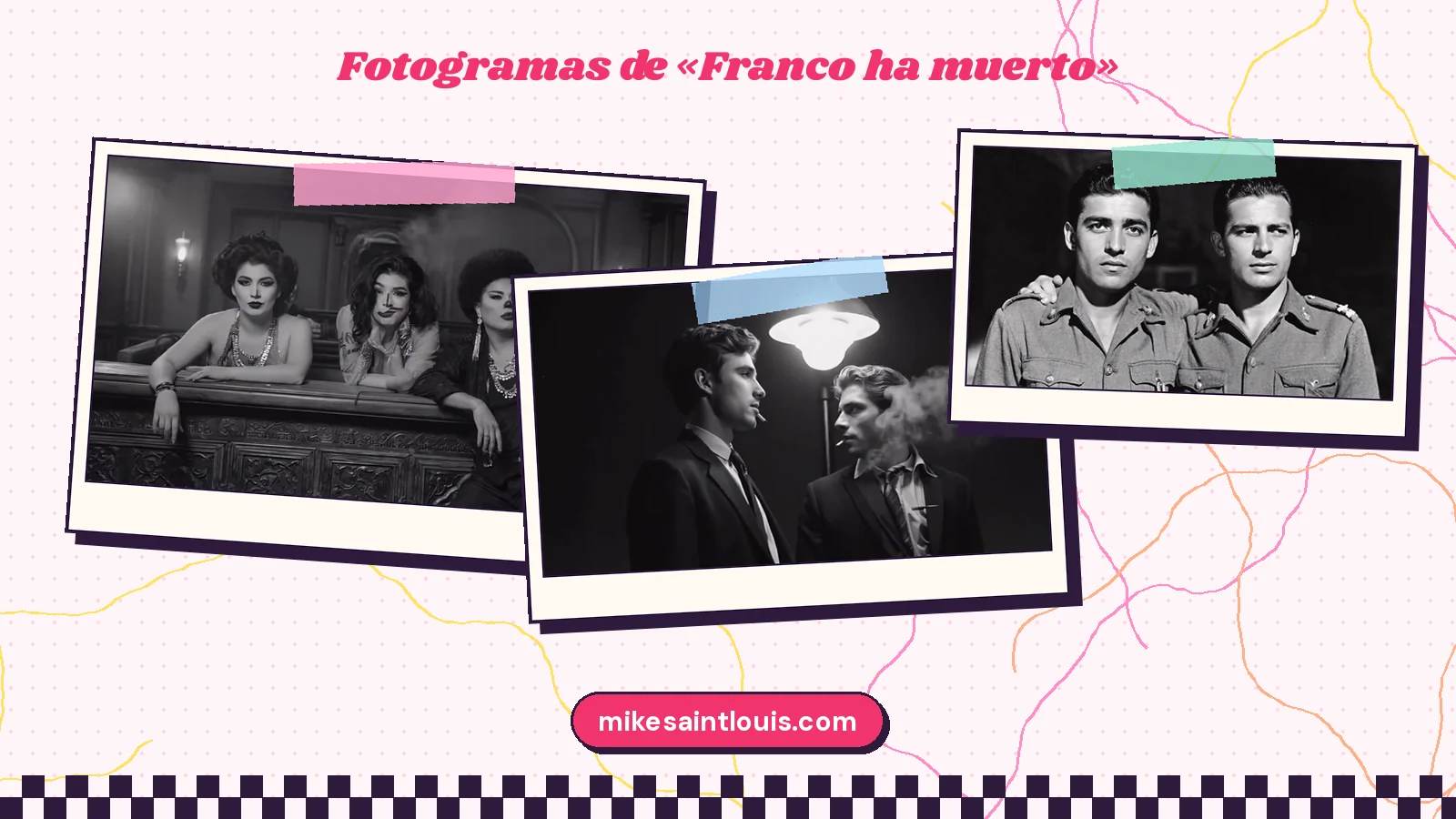
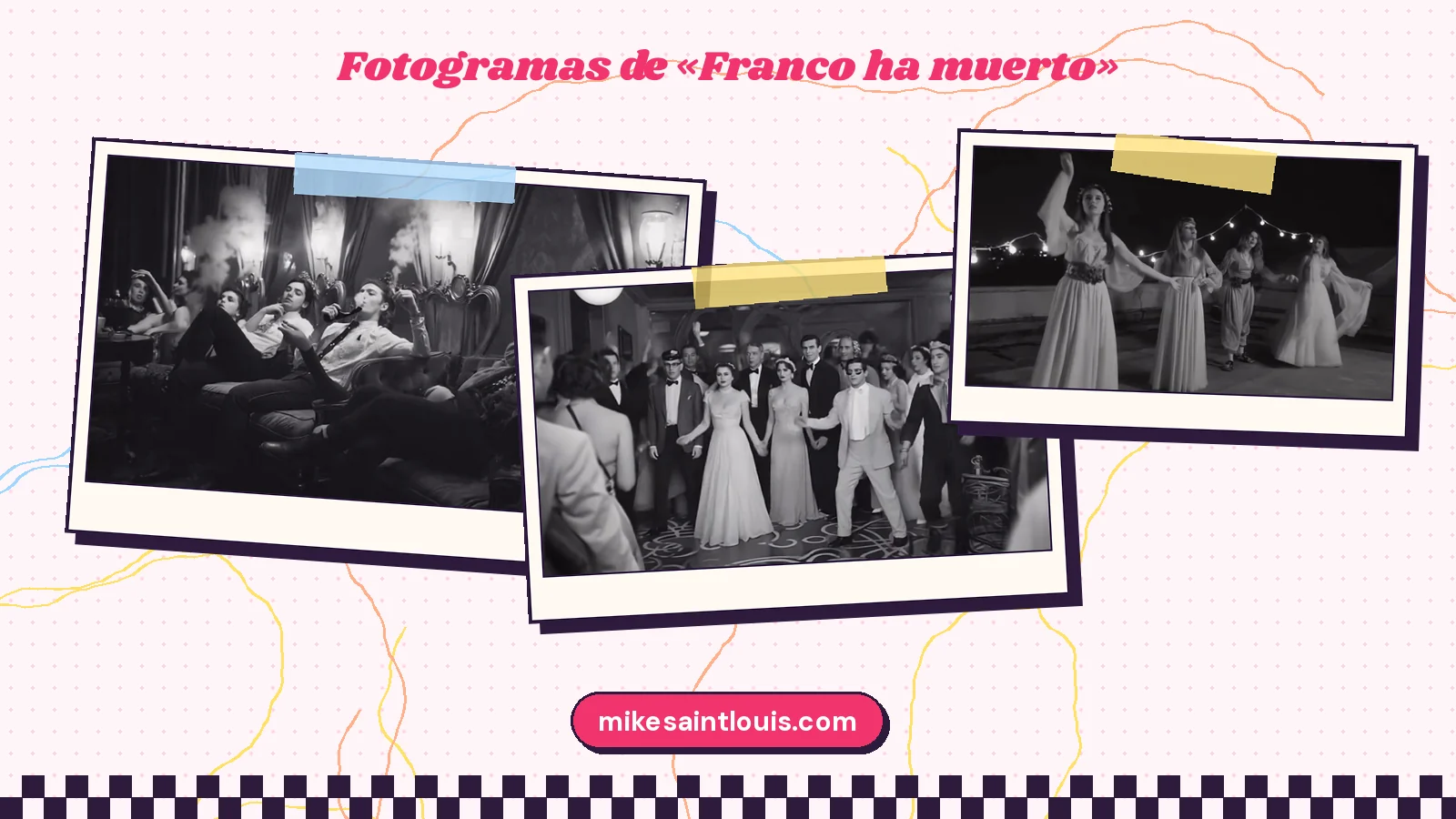
One clarification before I start, because here honesty matters twice over. The lyrics of «Franco ha muerto» haven't been published yet. On gayfolkplanet.com they're listed as "coming soon", and in this text I'm not going to quote or summarise lines nobody can read yet. What does exist and can be looked at is the title, the cover, the official video and the song's place in the catalogue. And above all, there's a very long tradition of people who decided that the best way to remember a tyrant was to laugh at him. That tradition is what this is about.
An announcement on television
On 20 November 1975, the Spanish prime minister, Carlos Arias Navarro, appeared on Televisión Española to announce the dictator's death. His message opened with a formula that has stayed nailed into collective memory. There was a grief-stricken look on his face and something of a church reading in his tone. Millions of people watched it in black and white, in living rooms with crocheted doilies and a brazier table.
What interests me about that moment is less what was said than how it was received. Because the same sentence, at the same instant, provoked completely opposite reactions depending on the living room. In some homes there were tears and mourning. In others, a careful silence, the kind you keep because you never know who's listening. And in others, behind closed doors, there was something close to a party. People say, and it's part of the legend of those days, that bottles of cava sold out in some cities. I have no figures to confirm it and I'm not going to invent any, but the fact that the anecdote has survived half a century says a lot about what many people felt.
That double reading, public mourning and private relief, is the raw material of any song that wants to use that sentence. And it's exactly what the cover shows.
A funeral in sunglasses
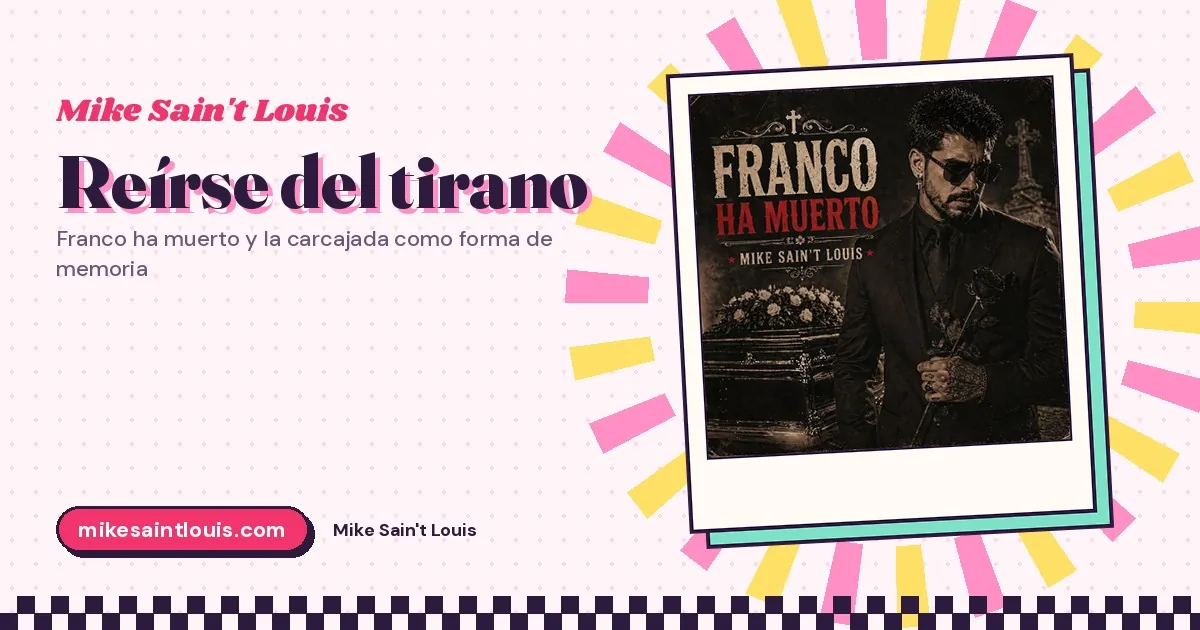
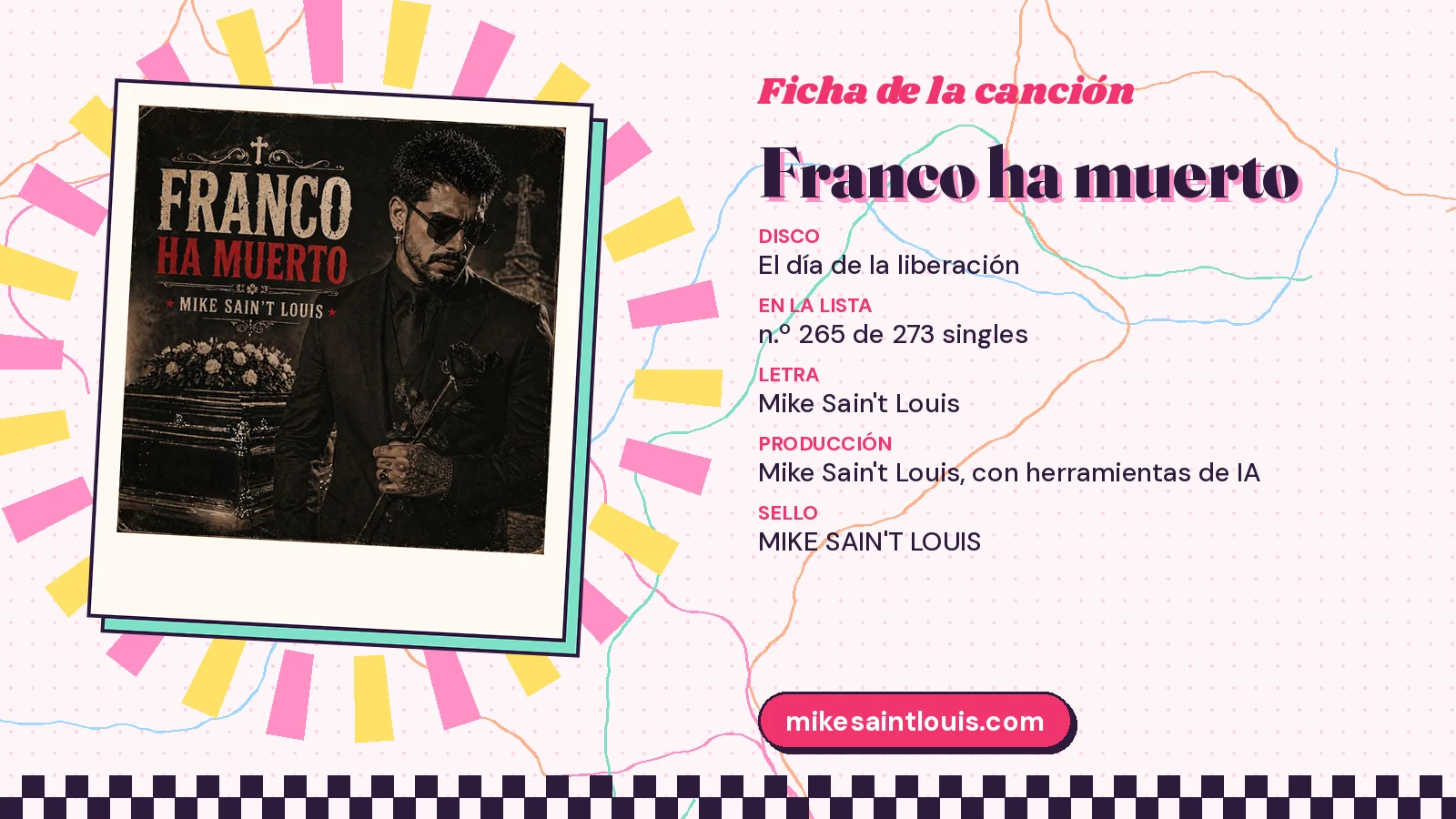
The single's cover is a funeral. A dark coffin covered in white flowers, a stone cross in the background, and me in the foreground, in black from head to toe, wearing sunglasses and holding a black rose in my tattooed hands. The title is set in old-poster lettering, cream and red, like an official notice stuck on a wall.
What the cover does is turn the ambiguity of that 20 November into an image. Everything in it says mourning: the colour, the flowers, the cross. But the pose isn't that of a broken widower. It's that of a star on the red carpet. And sunglasses at a funeral are the most suspicious accessory there is. They can hide eyes swollen from crying or a smile it's better not to show. We don't know. That not knowing is the joke.
On gayfolkplanet.com there's already a long note looking at that cover in detail, and I don't want to repeat it. Here I use it as a starting point for another question: what happens when someone turns a dictator's death into a show, and why doing so isn't frivolity but a very old form of memory.
Ding-dong, the witch is dead
In 1939, «The Wizard of Oz» premiered a song that, without meaning to, would become the unofficial anthem of celebrated deaths: «Ding-Dong! The Witch Is Dead». Music by Harold Arlen, lyrics by Yip Harburg. The Munchkins celebrate with bells and choruses that the Wicked Witch of the East has been flattened under a house. It's a children's song, cheerful, in saturated colours. And for more than eighty years it has served another purpose.
In April 2013, after the death of former British prime minister Margaret Thatcher, a social media campaign took that song to number two on the UK singles chart. The BBC had to decide what to do on its weekly chart show, and ended up broadcasting only a short clip within a news item. There was debate for days: was it disrespect towards someone who had died, or a legitimate form of political expression by people who had suffered from her decisions?
I'm not bringing up the example to compare people or regimes, which have nothing to do with each other. I bring it up because it shows something universal: when someone with a great deal of power dies, the people who lived under that power look for a way to say what they feel, and very often that way is a song. Sometimes festive, sometimes cruel, sometimes simply relieved. Music is where a society says in chorus what it can't always say in the street.
And there's a detail that, for someone like me, isn't minor. «The Wizard of Oz» is one of the films most loved by gay culture. Judy Garland, the rainbow, the phrase "friend of Dorothy" used as a password for decades. That the song of the happy funeral comes from there of all places has an almost poetic logic.
Still dead: Chevy Chase's joke
In the United States, Franco's death left behind one of television's most famous running jokes. In the first season of «Saturday Night Live», in 1975, comedian Chevy Chase began opening the satirical news segment «Weekend Update» with a breaking story he repeated week after week: Generalissimo Francisco Franco was still dead.
The joke was born from something real. During the dictator's long final illness, American news programmes had given almost daily bulletins on his health, to the point where the story had become absurd. Chase turned that saturation into a gag still quoted today. The brilliance of the joke is that it says nothing about Franco: it says something about the media, about obsession with a story, about the need to confirm again and again that something has really ended.
I identify a lot with that need. When something has hurt you for a long time, knowing it's over isn't enough. You need to hear it several times. You need to repeat it. Maybe that's why some titles work like an official bulletin: they don't tell a story, they certify it.
Chaplin, Lubitsch and the right to laugh
The tradition of laughing at dictators is almost as old as dictators. In 1940, Charles Chaplin released «The Great Dictator», in which he played Adenoid Hynkel, an obvious parody of Hitler, who danced with an inflatable globe as if it were a lover. Years later, in his 1964 autobiography, Chaplin wrote that had he known then about the real horrors of the concentration camps, he could not have made that film. That sentence seems fundamental to me: humour against power has limits, and the great comedians know them.
In 1942, Ernst Lubitsch released «To Be or Not to Be», a comedy about a Polish theatre company that tricks the Nazis. It was heavily criticised at the time for drawing laughs from something so grave. Today it's considered a masterpiece, precisely because it understood that ridiculing the oppressor is a way of taking away his power. And in 1967 Mel Brooks shot «The Producers», with its impossible musical number about springtime for Hitler, which turns fascist aesthetics into a Broadway show with chorus girls.
What unites these three examples is a simple idea. The tyrant needs to be taken seriously. His power depends on solemnity, on fear, on an image of greatness. When you laugh at him, you take away what he needs most. That's why dictatorships persecute comedians so fiercely. And that's why, when a regime falls, one of the first things to come back is satire.
Berlanga and «La escopeta nacional»
In Spain we had our own master of that art, and he worked a good part of his career under the dictatorship itself. Luis García Berlanga managed to release «El verdugo» (The Executioner) in 1963, a pitch-black comedy about a man who accepts the job of executioner in order to get a flat. The film got past the censors with cuts and was one of the fiercest criticisms of the death penalty made in those years, disguised as a comedy of manners.
Once democracy had arrived, in 1978, Berlanga released «La escopeta nacional» (The National Shotgun), a satire of the hunting parties where business deals and favours were sealed among the regime's elite. It began a trilogy that portrayed, with cruel, ensemble humour, the decadence of that Spain of offices and shotguns.
Berlanga proved something that helps me a lot as a lyricist: the most effective humour against power isn't the insult but the portrait. You don't need to say something is ridiculous if you show it as it is and let the audience draw their own conclusions. That's the logic of the cover of «Franco ha muerto»: no banner, no slogan, just a funeral in sunglasses. Everyone can read it as they like.
What the joke owes to memory
Some people think laughing at something terrible is a way of forgetting it. I believe the opposite. Sigmund Freud, in his 1905 essay on jokes and their relation to the unconscious, already pointed out that humour lets us say what would otherwise stay repressed. The joke is a side door through which things come out that couldn't get through the main one.
For many people who lived through the dictatorship, humour was a form of survival. Jokes whispered, double meanings in magazines, copla lyrics that said one thing and meant another. And for those of us born afterwards, humour is a way of keeping alive a memory that, if told only in a solemn tone, ends up sounding like an exam lesson.
There's an important difference, though, between laughing at power and laughing at its victims. The first is a noble tradition. The second is cruelty. Any song that plays with this title has to be on the right side of that line, and the cover is clear about it: the joke lies in the fake mourning, in the theatre of official grief, not in anyone's suffering.
A sentence on a liberation album
«Franco ha muerto» is part of «El día de la liberación» (Liberation Day), one of the three albums of the Gayfolk trilogy. The album's name is no small detail when read next to this title. There are personal liberations, like leaving a relationship that was hurting you, and there are collective liberations, like the end of a dictatorship. The two are more alike than they seem: both have a before and an after, and in both the after is hard.
I wrote about that after in «El día de la liberación y el día siguiente», about the hangover that follows any independence party. And Spanish history confirms it. The dictator's death wasn't the end of everything. For LGBTI people, for example, freedom came late and in instalments. The 1977 amnesty did not reach those who had been convicted under the law on social dangerousness. In June of that same year, Barcelona held the first Pride march in Spain, with several thousand people in the street. Madrid had its own the following year.
So when a queer artist puts this sentence on a single, it's celebrating more than a date. It's a reminder that dates don't fix everything. That freedom has to keep being won. And that, meanwhile, there's also a right to laugh.
Half a century later
November 2025 marked fifty years since that announcement. There were events, documentaries, television debates and columns in every newspaper. And there was something that really caught my attention: part of the younger generation knew the sentence more as a meme than as a historical fact. They'd seen it in short videos, in edits, in social media jokes.
That has a worrying reading and a hopeful one. The worrying one is that memory turns into an empty joke, stripped of context. The hopeful one is that the joke is still a door. Someone sees the meme, laughs, asks what it is, and ends up reading about what happened. Many of the things I know about history I learned that way, pulling on a thread that started in a song or a film.
A single with this title works the same way. Someone finds it on a list, the name catches their eye, they see the cover with the coffin and the sunglasses, and they wonder what that's doing on a queer pop record. If that question leads to a search, a conversation with their grandmother or a book, the song has already done its job.
The neighbours on the list
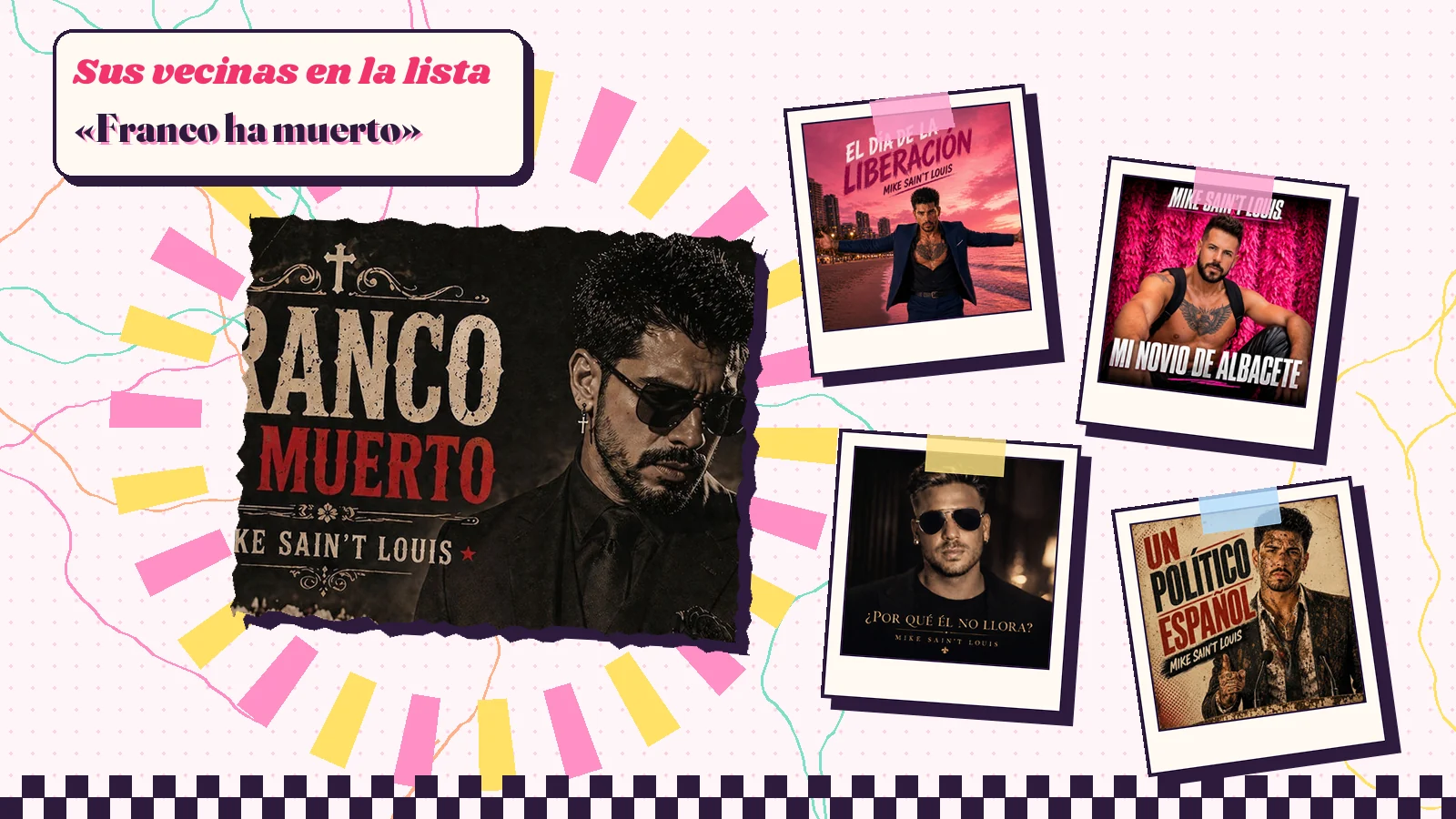
On the singles list, «Franco ha muerto» is track 265 of 273, almost at the end of the road. Just before it comes «Mi novio de Albacete» (My boyfriend from Albacete), and just after it, «¿Por qué él no llora?» (Why doesn't he cry?). The jump amuses me. From a love story with a La Mancha accent to a historic funeral, and from there to a question about a man who doesn't cry.
That last neighbourhood feels almost like a comment. At a funeral, people are expected to cry. The cover of «Franco ha muerto» has someone in sunglasses who won't let you see whether he's crying or not. And the next song asks, precisely, why someone doesn't. It's not a story planned from start to finish, but it's one of those coincidences that make you want to play the singles in order.
The catalogue has other titles that look at politics with the same mix of seriousness and mischief. «Un político español» (A Spanish politician) is a satire with no names or parties. «The Great Depression» plays with economic history to talk about a state of mind. And «Soy marica sideral» is the other side: the proud statement of someone who no longer has to hide.
Camp as a political tool
Some people still think camp is just an aesthetic: sequins, exaggeration, drama. But camp has always had a political dimension. It's the way people who were denied seriousness learned to use exaggeration as a shield and a weapon. If you won't take me seriously, I'll be so theatrical you can't ignore me.
I explained it more calmly in «El camp no es un chiste, aunque te rías» (Camp isn't a joke, even if you laugh). Applied to this title, camp does something very specific: it turns the solemn ritual of state mourning into a catwalk. Mourning becomes costume. The black rose becomes an accessory. The stone cross becomes scenery. And by turning it all into stagecraft, it reveals that it always was. State funerals are also a staging, with their costumes, their music and their actors.
That doesn't take any gravity away from history. Quite the opposite. Showing the theatre of power is the best way to make sure nobody mistakes it for something natural.
The songs of the Transition
If the dictator's death was an announcement on television, what came next had a soundtrack. In 1976 the group Jarcha released «Libertad sin ira» (Freedom without anger), a song born alongside a launch campaign for the newspaper Diario 16 that ended up as one of the anthems of those years. Right from its title it asked for something very concrete: to change eras without revenge, without blood, with the rage put away in a drawer. It became such an emblem that today it's almost impossible to watch a documentary about the Transition without hearing it in the background.
That tone interests me a lot, because it's the opposite of the «Ding-Dong» from Oz. There, death was celebrated with bells. Here, people asked that change shouldn't become a settling of scores. Both reactions are human, and both lived side by side in the same Spain. In some bars people raised a glass. In others they asked for calm. And in many they did both at once, depending on the hour and who was listening.
Then came everything else. The huge concerts, the songwriters who could finally release records without the censor's scissors, the explosion of colour and cheek that in Madrid was called the Movida, with its impossible fashion and its brazen humour. Much of what we now understand as Spanish pop culture, including a good part of gay pop, comes from that decade when people found out, all at once, that almost anything could be said.
My music wouldn't exist without that inheritance. The lyrics I write, with their mix of copla, jokes, heartbreak and pride, are children of that cheek. That's why a title like this one, in my catalogue, also works as a family tree: where the freedom comes from that lets me release songs about exes, Grindr and sequins without anyone knocking on my door.
And there's something more. The songs of those years were written for a country that was learning to talk. Many of mine are written for people who are learning to talk about something else: what happened to them, what they kept quiet, what still hurts. The gesture is similar. First the silence is broken. Then we'll see what music it gets, how it's danced and how it's lived.
Who this song is for
For anyone who grew up hearing after-dinner stories about how everything used to be and never quite knew what to think. For anyone with grandparents who cried that day and grandparents who raised a glass. For anyone who wants to understand why some sentences in this country still burn. And for anyone who knows that laughter, used well, is also a form of justice.
It's also for queer people of all ages. For those who lived in fear before 1975 and for those born long after who sometimes don't know how much what they have cost. Memory doesn't belong only to history books. It's also made with songs, with covers, with jokes that make you ask questions.
While the lyrics remain unpublished, the single can be heard on every platform and downloaded for free from the downloads page, with no sign-up or payment. And when the lyrics arrive, they'll be on the song's page, exactly as written, without a comma changed.
Frequently asked questions
What is «Franco ha muerto» about? The lyrics haven't been published yet, so this post doesn't quote them. The title takes up the sentence with which the dictator's death was announced on television on 20 November 1975, and the cover turns it into a theatrical funeral with sunglasses and a black rose.
Isn't it disrespectful to make pop out of that? Humour against power is an old tradition: Chaplin, Lubitsch, Mel Brooks and Berlanga all laughed at dictators and regimes. The line you don't cross is laughing at the victims. The joke on the cover lies in the theatre of official mourning, not in anyone's suffering.
What is the "still dead" joke? A gag by Chevy Chase on the American show «Saturday Night Live» from 1975: every week he announced, as breaking news, that Franco was still dead, mocking the obsessive coverage of his final illness.
Which album is it on? On «El día de la liberación», one of the three albums of the Gayfolk trilogy. It's track 265 of 273 on the singles list, between «Mi novio de Albacete» and «¿Por qué él no llora?».
How does it relate to LGBTI history in Spain? The dictator's death opened the door, but freedom came in instalments: the 1977 amnesty did not reach those convicted under the law on social dangerousness, and that same year Barcelona held the first Pride march in Spain.
Who makes this song? Mike Sain't Louis, a lyricist, composer and music producer from Madrid, the first AI songwriter. He writes the lyrics and directs the production; the music and performances are generated with artificial intelligence.