
By Mike Sain't Louis ·
«Pero nadie dice nada»: double negation and the noes in my lyrics
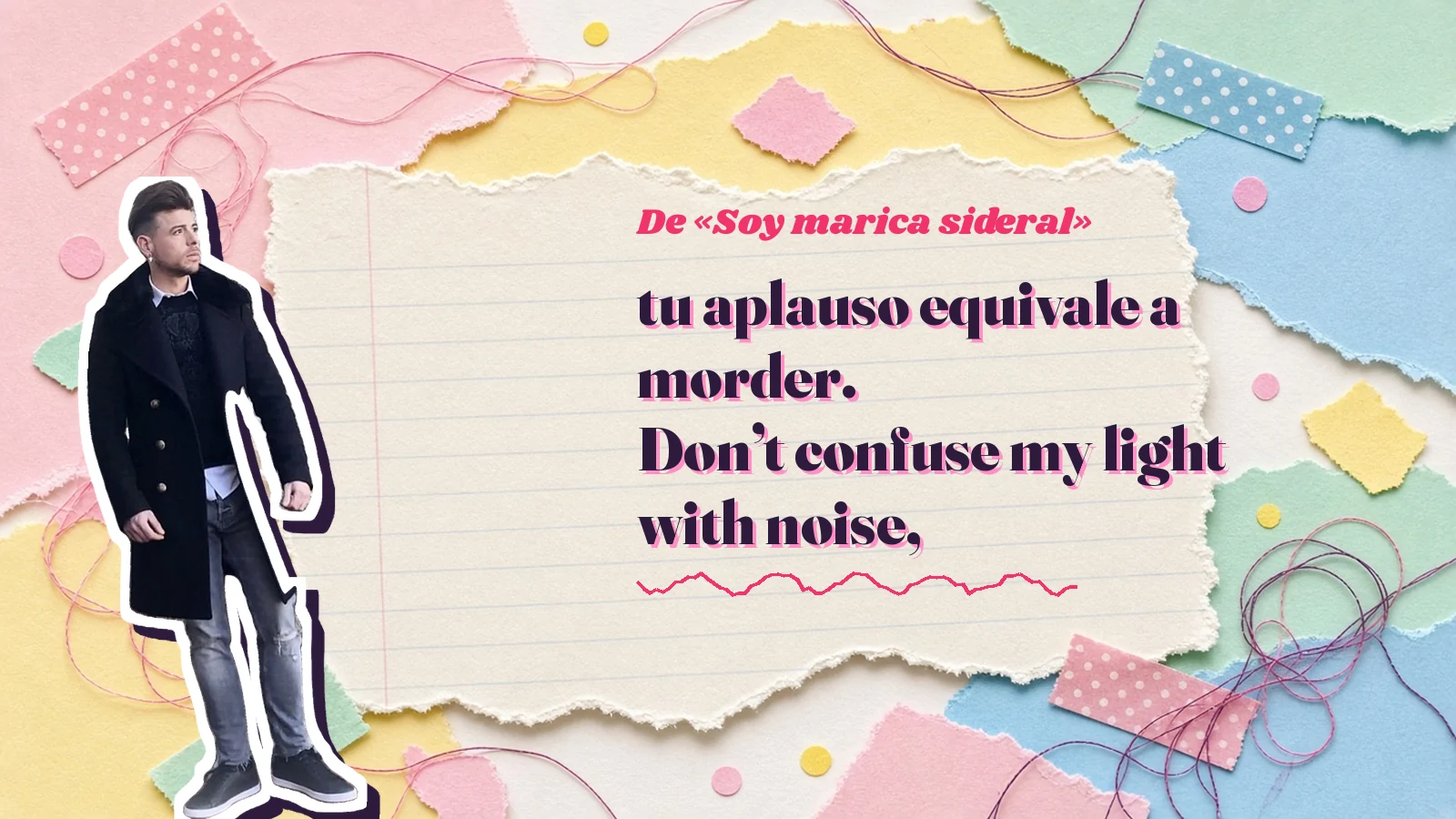
If you count the noes in «Soy marica sideral» you get a lot of them. I didn't come, I don't shout, I don't beg, I don't change, I don't hide, you don't know how to look at me, it isn't my campness. And yet, when I listen to it all the way through, it doesn't feel like a negative song. It feels like one of the most affirmative things I've written. (The full lyric is on gayfolkplanet.com.)
That contradiction has had me hooked for a while. How can a lyric made of negations sound like an affirmation? The answer, I think, lies in who is being told no. When the narrator says «yo no grito pa’ brillar.», I don't shout to shine, he isn't denying himself. He's denying someone else an expectation: that a queen has to make noise to be seen. Every no in the song knocks down a prejudice. And what's left standing when they've all fallen is the person.
I've already written about a song made almost entirely of noes in «Una canción hecha de noes», and about the ni, ni, ni of lists in «Ni psicólogos, ni amigos, ni hermanos». I don't want to repeat either here. I want to look at the grammar of negation from other angles: double negation, the origin of words like nadie and nada, the difference between ya no and todavía no, tampoco, the no that corrects and those noes that deep down mean yes.
Pero nadie dice nada: Spanish double negation
I'll start with the line that gives this piece its title: «Pero nadie dice nada», but nobody says nothing. Anyone who studied English at school was probably told that two negatives cancel each other out and that nobody says nothing is wrong. In Spanish, though, nadie dice nada is perfectly normal. And it doesn't mean everybody says something. It means exactly what it seems: total silence.
Linguists call this negative concord. Negative words don't subtract, they add up. They reinforce each other like someone saying no three times to make it clear. No he visto a nadie nunca en ningún sitio, I haven't seen nobody never nowhere, is a sentence with four negations that any speaker understands effortlessly.
The rule has a small catch that native speakers apply without knowing it. If the negative word comes before the verb, you don't need no: nadie dice nada, nunca he dicho eso. If it comes after, no is compulsory: no dice nadie nada, no he dicho eso nunca. Saying dice nadie without the no in front sounds foreign or broken.
In the song, the line comes after a list of labels people have hung on the narrator. Then comes the but: «Pero nadie dice nada», followed by what nobody points out. That double negation isn't a stylistic slip, it's an accusation. Everyone has something to say about the over-the-top queen, and nobody has anything to say about the one who really did harm. The two negatives together draw a huge silence, the kind that protects someone who shouldn't be protected.
Nadie and nada: two words that meant born
What surprised me most when I started reading about negation is that nadie and nada, nobody and nothing, weren't negative to begin with. They came from Latin natus, born. Nada comes from an expression like res nata, a thing born, and nadie from homines nati, men born, through old forms like nado and nadi.
How does a word meaning born end up meaning no person? Because for centuries it was used in negative sentences: no vino hombre nado, no man born came. By always appearing next to no, the word caught the negation until it kept it. Today nadie on its own is already negative, which is why it can go before the verb without needing no.
I find it a lovely and slightly unsettling story. Nadie is literally someone who has been born, turned into the word for saying there's nobody. Every time I write nadie me apoya, nobody supports me, or nadie dice nada, I'm using a word that carries, hidden inside, the idea of a person who exists.
Something similar happens with nunca and jamás, never and ever. Nunca comes from Latin numquam, which was already negative. But jamás comes from ya más, an expression that originally just meant from now on and became negative by always being used with no. That's why we say nunca jamás, never ever, a redundancy that sounds like a fairy tale and is, grammatically, a double negation with a history.
Jespersen's cycle: when no wears out
The Danish linguist Otto Jespersen described in 1917, in a book on negation in English and other languages, a phenomenon that now bears his name: Jespersen's cycle. The idea is that negations wear out with use. A language starts with a simple negation, reinforces it with another word to make it sound more emphatic and, over time, the reinforcement ends up replacing the original.

The classic example is French. At first ne before the verb was enough. Then pas was added, which meant step, as in I didn't walk a single step. Over time ne... pas became the normal negation. And today, in spoken French, ne has almost disappeared: people say je sais pas instead of je ne sais pas. The reinforcement has taken over the job.
Spanish hasn't gone that far, but the same forces are visible. When a plain no isn't enough, we reinforce it: no, nada; no, en absoluto; no, ni de coña, no way in hell. Those expressions start as intensifiers and, over time, some begin to work on their own. Nobody needs a no in front of ni de broma, not even as a joke, to understand it's a refusal.
It interests me because the same thing happens in lyrics on a small scale. A no repeated many times wears out and stops hitting. That's why in a song you have to keep changing how you negate: a never here, a neither there, a no longer in the chorus. If everything is no, no, no, the listener stops hearing it.
Ya no and todavía no: negation with a clock
There are two negations I find among the richest in Spanish because they carry time inside them: ya no, no longer, and todavía no, not yet. Both say something isn't happening, but one looks back and the other looks forward.
Ya no means something that used to happen has stopped. There's a before and an after. In «El impostor» the lyric says «Ya no tengo ninguna / Duda», I no longer have any doubt, and that ya no tells a whole story: I used to doubt, now I don't. The pieces have fallen into place. In «Forocoches» there's «Ya no hay vuelta atrás por todas las cagadas», there's no going back now because of all the screw-ups, almost a door slammed in time: the way back existed and has closed. And in «Gaslighting» ya no becomes liberation: «Ya no me apagas, no soy tu blame», you don't switch me off any more, I'm not your blame. You used to switch me off. Not any more.
Todavía no, on the other hand, leaves a door open. It means something hasn't happened but could. In «Bareback» the lyric plays with this in a very comic way: «Y todavía no nos hemos emborrachado / Y por las horas ya parece / Que tampoco lo vamos a hacer», and we haven't got drunk yet, and judging by the time it looks like we won't either. First todavía no leaves room for hope. Then tampoco shuts it. It's a date deflating over three lines.
I like to think of ya no and todavía no as two clocks. Ya no marks the end of something, which is why it appears so often in break-up songs: ya no te quiero, ya no me importas, ya no me fío. Todavía no marks a wait, which is why it appears in songs of desire or fear: he hasn't called yet, I haven't got over it yet.
There's a third clock, less frequent: aún no. It means the same as todavía no but sounds drier, more written. In a lyric I choose one or the other by rhythm: todavía has four syllables and aún one or two, depending on how it's pronounced. Sometimes grammar is decided by how many syllables fit in the bar.
Tampoco: the negation that joins in
Tampoco is the negative version of también. If I say yo también, me too, I join something someone has done. If I say yo tampoco, me neither, I join something someone hasn't done. It's a negation of solidarity, a way of standing next to the other person in the no.
In «El impostor» there's a pair of negations I find very expressive: «Nunca ha contestado / A mis preguntas», he has never answered my questions, and later «Tampoco ha insistido / Mucho en verme mejor», nor has he tried very hard to see me better. Nunca and tampoco add up like charges in a file. He hasn't answered. And on top of that, he hasn't insisted either. Each negation adds a fault.
I find it interesting that tampoco has that tone of a list of grievances. When we talk about someone who disappointed us, we tend to list what they didn't do: he didn't call, he didn't come, he didn't ask either. Relationships that end badly are often told in the negative. What weighs isn't what happened, but what didn't.
In «Bareback», by contrast, tampoco sounds almost relieved: «Por eso tampoco estoy tan molesto», that's why I'm not that annoyed either. Here it doesn't add a fault, it lowers the anger. It's the tampoco of a shrug. The same word can accuse or play things down.
No es mi pluma el problema: the no that corrects
I come back to «Soy marica sideral», because it has a very special kind of negation: «Y si no sabes mirarme, / no es mi pluma el problema.», and if you don't know how to look at me, my campness isn't the problem. This no doesn't just negate. It corrects. It says the problem isn't where the other person thinks, and the following lines point to where it is: in the mirror of the one looking.
Linguists call this corrective or metalinguistic negation. It doesn't deny a fact, it denies a way of seeing things. The typical Spanish structure is no... sino, not... but rather: no es mi pluma el problema, sino tu miedo. Sometimes sino doesn't appear and the correction comes in the next sentence, as in the song.
A spelling note that always makes me hesitate: sino, as one word, is the conjunction that corrects (not this, but that). Si no, as two words, is a condition (if you don't come, I'm leaving). In the song's line there's a si no at the start, the conditional, and then the corrective no. Two very different noes in two lines.
This kind of negation interests me a lot when I write about prejudice. The other person has an explanation ready: the problem is your campness, you're too much, you exaggerate. Corrective negation doesn't argue the details. It moves the spotlight. It isn't me, it's you looking at me. It's a way of returning the question without raising the tone, just by changing the subject of the sentence.
No me cambio ni me escondo: the no that affirms
Another line in the song sums up the idea I mentioned at the start: «No me cambio ni me escondo,», I don't change and I don't hide. Grammatically they're two negations joined by ni. But what they communicate is a firm affirmation: I stay as I am, here and in plain sight.
Some noes are really yeses in disguise. No me rindo, I don't give up, means I keep going. No me callo, I won't shut up, means I speak. No me escondo means I show myself. In the context of LGTBI life those noes have a long history. For decades many people like me were asked to change or to hide. Refusing both at once is almost a life plan.
Psychology and psychoanalysis have also noticed the power of no. The psychoanalyst René Spitz wrote a book in 1957 called «No and Yes», about how babies learn to say no, and argued that this gesture, shaking the head, is one of the first steps for a child to feel like a person separate from others. Saying no is a way of saying I.
I don't know whether everything Spitz says still holds today, but the intuition is lovely and I recognise it in my lyrics. When the narrator of «Soy marica sideral» says no, he's separating himself from the mould prepared for him. The no is the border between what others expect and what he decides to be.
Que no eres nada para nadie: the negation that wounds
Not every negation in my lyrics is liberating. Some hurt, and they're written precisely so that the hurt shows. In «El castigo más duro» there's a chain of phrases the narrator has had to hear: «que no vales nada / que ni vales ni un mensaje / que no eres nada para nadie», that you're worth nothing, that you're not even worth a message, that you're nothing to nobody.

Look at how the negations pile up. You're worth nothing. You're not even worth a message. You're nothing to nobody. The last phrase has three negative words, no, nada and nadie, and Spanish negative concord means they don't cancel each other out but multiply. It's grammar in the service of contempt: erasing someone with three noes in one line.
I wrote those phrases exactly as they sound when someone uses them to sink another person. I didn't want to soften them. I think a song can help someone who has heard them recognise them and understand that they don't describe reality, but the intention of whoever says them.
If you've ever been made to feel that you're worth nothing to nobody, or if you tell yourself that, you're not alone and you don't have to carry it in silence. In Spain you can call 024, free, confidential and available 24 hours a day. If there's immediate danger, call 112. If you're outside Spain, look for your country's crisis line or emergency number.
El narcisista nunca: absolute adverbs
There's a family of negations that interests me for its exaggeration: nunca, jamás, nadie, nada. They're absolute words. They don't say rarely, they say never. They don't say hardly anyone, they say nobody. And in real life almost nothing is that absolute.
In «El narcisista» the lyric opens with «El narcisista nunca te vio como un artista,», the narcissist never saw you as an artist. That never isn't a statistic. It's an emotional conclusion, that of someone who looks back and can't find a single moment of recognition. Probably, if you could review every day of that relationship, there would be some instant when the other person did look. But the feeling is one of never, and the lyric writes the feeling.
Psychologists who work with negative thoughts often point to these absolute words as a clue. Nothing ever goes right for me, nobody loves me, I always ruin it. They're phrases said with great conviction which, looked at calmly, are hardly ever literally true. In a song, though, the absolute works: it conveys the intensity of what's felt.
That's why I try to use nevers carefully. In a heartbreak lyric a never can be emotionally accurate. In life, it's worth asking whether it's accurate in fact.
Ni de coña, qué va and other noes without no
Spanish has a huge collection of ways to say no without using the word no. Ni de coña, ni de broma, ni hablar, qué va, para nada, en absoluto, ni en sueños, ni loco. Some are colloquial and some more formal, but they all do the same thing: negate with more force or more wit than a bare no.
In «Bareback» one of the most castizo appears, ni de coña, no way, just when the narrator decides he won't dedicate even a shot to someone who doesn't deserve it. Ni de coña is a cheeky negation, the one friends use when something seems so unlikely it doesn't deserve a polite no. And in «No quiero otro novio cojín» there's another very Madrid one: «¡Qué va, falsedad!», no way, falseness! Qué va has no no in it, and yet it's one of the most emphatic negations in everyday speech.
There's also a very gentle way of negating that I love: litotes. It consists of negating the opposite of what you mean. No está mal, it's not bad, means it's good. No es tonto, he's not stupid, means he's clever. No me desagrada, I don't dislike it, means I like it. The American linguist Laurence Horn, in his 1989 book on the natural history of negation, devoted many pages to these negations that are really softened affirmations.
Litotes is very useful in a lyric when you want to say something without fully committing. It wasn't that bad can be praise, irony or a way of hiding that you liked it too much. It all depends on the tone.
Hasta que no vuelvas: the no that's left over
There's a no in Spanish that's almost a ghost: the expletive no. It appears in sentences like hasta que no vuelvas, no me voy, until you don't come back, I'm not leaving. There the second no really negates, but the first is superfluous: it means the same as until you come back. The academic norm accepts it in constructions with hasta que, although many style guides recommend avoiding it in careful writing.

It fascinates me that a language has noes that negate nothing. It's as if the speaker needed to add a no just in case, to show the wait is loaded with negativity. Hasta que no me pidas perdón no te hablo sounds tenser than hasta que me pidas perdón no te hablo, although both mean the same.
There's also the tag no, the ¿no? we add at the end of an affirmative sentence to ask for confirmation: it's late, isn't it? That no doesn't negate, it asks. It looks for an ally. In Madrid speech we use it constantly, and in a lyric it adds naturalness, so the narrator sounds like someone talking rather than reciting.
Negation in the imperative
One last grammatical curiosity I find very revealing. In Spanish, positive and negative commands aren't built the same way. To order something we use the imperative: grita, vete, cállate, shout, go, shut up. To forbid it we need the subjunctive: no grites, no te vayas, no te calles. You can't say no grita as a command.
That difference makes prohibitions sound different from orders. The subjunctive is the mood of wishing, of what isn't real yet. Forbidding something in Spanish is, grammatically, wishing it won't happen. There's something almost pleading in no te vayas, don't go, that isn't there in vete, go.
In my lyrics, negative commands usually appear at the moments of greatest tension, when someone asks for something he knows he can't control. And then there are the noes that aren't orders but statements, like those in «Soy marica sideral». There the narrator doesn't tell the other person what not to do. He tells him what he himself won't do. And in a song, that shifts the balance of power a great deal.
I wrote about endings and goodbyes in «Hasta nunca, maldita cucaracha», so I won't go back to hasta nunca. And about another kind of small word that decides a lot, possessives, I wrote in «Tu mendigo». Negation and possessives have something in common: they're words you hardly see that change who's in charge of a sentence.
How I negate when I write
Over the years I've learned to check the noes in my lyrics the way I check rhymes. I ask myself three things.
The first is who the no is aimed at. If it denies something about the narrator, the song can sound defeatist. If it denies someone else's expectation, it can sound liberating. The same phrase, no me escondo, changes meaning depending on who expected me to hide.
The second is whether the no is worn out. If I have five noes in a row, I look for another form: a tampoco, a ya no, a ni de coña, a qué va. Variety makes each negation land. I learned Jespersen's cycle without knowing it: when a negation loses force, you have to find it reinforcement.
The third is whether the absolute is honest. A never or a nobody can be accurate as a feeling and false as data. In a song that's fine, as long as the listener understands they're hearing an emotion and not a report.
In the end, negation is one of the most powerful tools a lyric has. Saying what you aren't forces you to think about what you are. And sometimes, as in «Soy marica sideral», a list of noes is the clearest way of saying who you are.
Frequently asked questions
Is it correct to say nadie dice nada in Spanish? Yes. Spanish has negative concord: negative words reinforce each other instead of cancelling out. Nadie dice nada means nobody says anything, not that everybody says something.
Where do the words nadie and nada come from? From Latin natus, born. Nada comes from an expression like res nata, a thing born, and nadie from homines nati, men born. They became negative by always being used in sentences with no.
What is Jespersen's cycle? It's the process, described by the linguist Otto Jespersen in 1917, by which a negation weakens with use, is reinforced by another word and, over time, the reinforcement replaces it. The classic example is French ne... pas, which in speech has become just pas.
What's the difference between sino and si no? Sino, as one word, is a conjunction that corrects: not this, but that. Si no, as two words, introduces a condition: if you don't come, I'm leaving.
What is litotes? A figure of speech that negates the opposite of what you mean, like no está mal, it's not bad, to say it's good. It usually softens or adds irony to what's said.
Where can I get help if I feel worthless? In Spain, call 024, free, confidential and available 24 hours a day. If there's immediate danger, call 112. Outside Spain, contact your country's crisis line or emergency number.
Who writes these songs? Mike Sain't Louis, a lyricist, composer and music producer from Madrid. The music and the vocals of his songs are made with artificial intelligence.