
By Mike Sain't Louis ·
Words with thorns: what I didn't say and what I answered in «El castigo más duro»
My mouth is bleeding. Not for real, relax, no need to call an ambulance. It bleeds in the song, which is where I allow myself these things.
«El castigo más duro» opens with someone who can't get his words out because they have thorns. And from trying so hard to get them out, he bleeds so much that passers-by think he's a vampire weeping under the moon. It's the most Gothic opening I've ever written, and I wrote it fully intending it to look like the cover of a newsstand paperback.
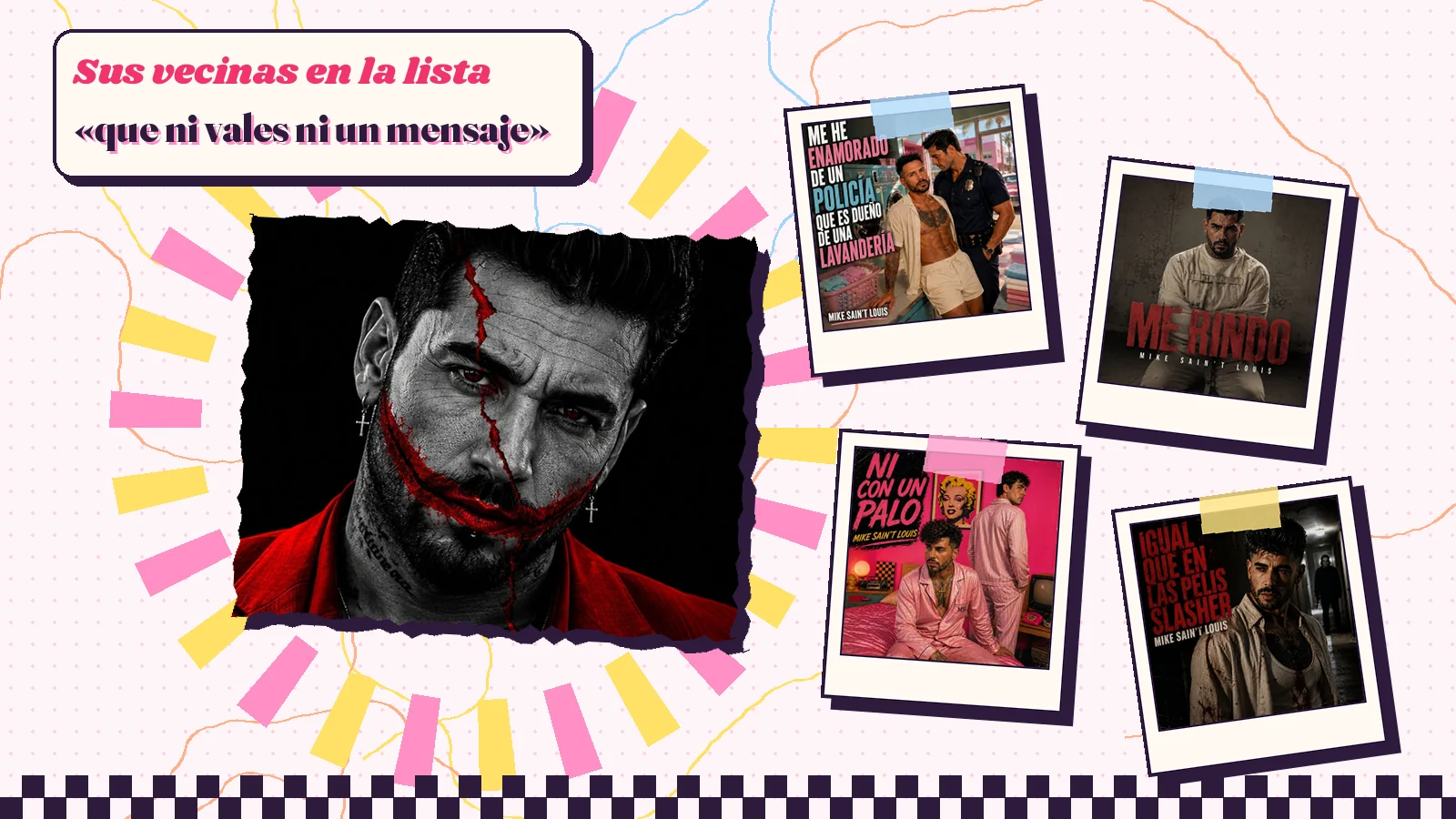
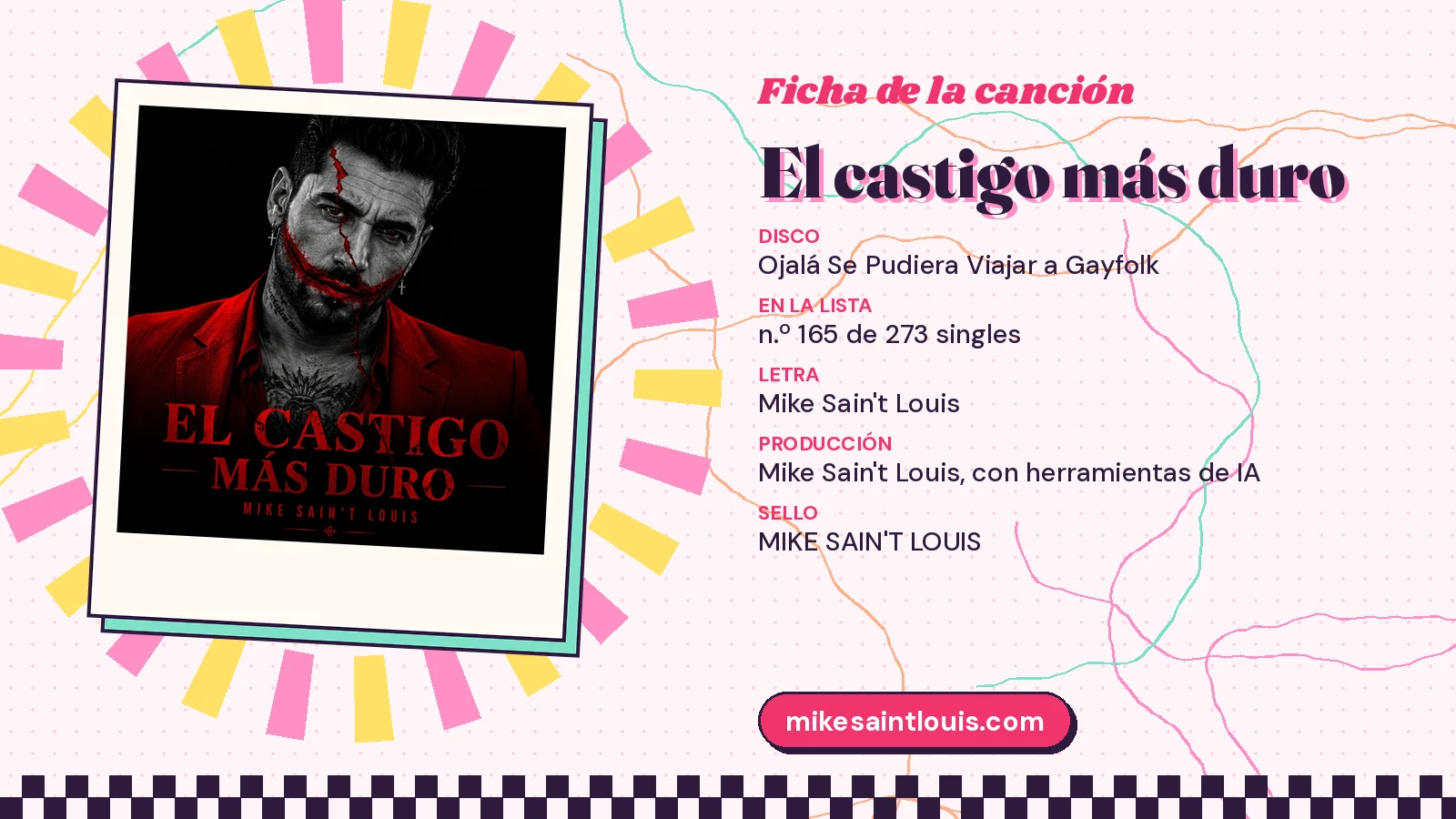
The song is on the second album of the trilogy, «Ojalá se pudiera viajar a GAYFOLK». On the singles list it's track 165 of 273: right after «Me he enamorado de un policía que es dueño de una lavandería» and right before «Me rindo». From falling in love, washing machine included, to punishment, and from punishment to surrender. Anyone who wants to understand how my head works should listen to those three in a row and then have a camomile tea.
On the song's page I already talked about the decision to wipe seven years of clouds and phones. Here I want to talk about something else: words. The ones that won't come out, the ones that mustn't come out, and the ones I prepared very carefully to answer the question that grates the most.
Words with thorns
I'll start with the mouth, which is where it all begins.
«Tienen pinchos y destrozan»
There's a kind of pain that doesn't know how to talk. It isn't that you have nothing to say. It's that what you have to say comes armed. Every sentence is a sea urchin. If you spit it out, it shreds your mouth on the way, and on top of that you don't know what it'll do to whoever catches it.
That's what I wanted to convey with the thorns. Not the silence of someone who feels nothing, but the silence of someone who feels so much they have to keep quiet so as not to cause a bloodbath. They're two very different silences, and the song is precisely about that difference. One of the two characters is silent because it hurts. The other is silent because he's punishing.
I like that the image is physical and a bit ridiculous. Thorns. Like the ones on an Ikea cactus. If I'd written «hurtful words», I'd have stayed on a department-store greeting card. With thorns, the phrase has texture. You feel it on your tongue.
The full-moon vampire
Then comes the vampire, which is what people think I am.
That part really makes me laugh because it switches point of view without warning. Up to then I'm inside my mouth, with my thorns. And suddenly I step out into the street and see myself from outside, through the eyes of a man walking his dog, who sees a guy with a mouthful of blood crying under the moon and thinks: look, a vampire.
It's a joke, but it's also what happens when you're broken in public. People don't see your story. They see a strange scene. They see someone crying at a bus stop on the Castellana and make up a film. You're living a seven-year tragedy and they're watching an episode of «Twilight» on a student-short budget.
I love that mismatch. I use it a lot when I write. The huge and the tiny in the same shot. Enormous pain inside and, outside, a B-movie scene.
The people passing by
I want to linger a bit on those passers-by, because I think they're the most important people in the song and they're hardly ever mentioned.
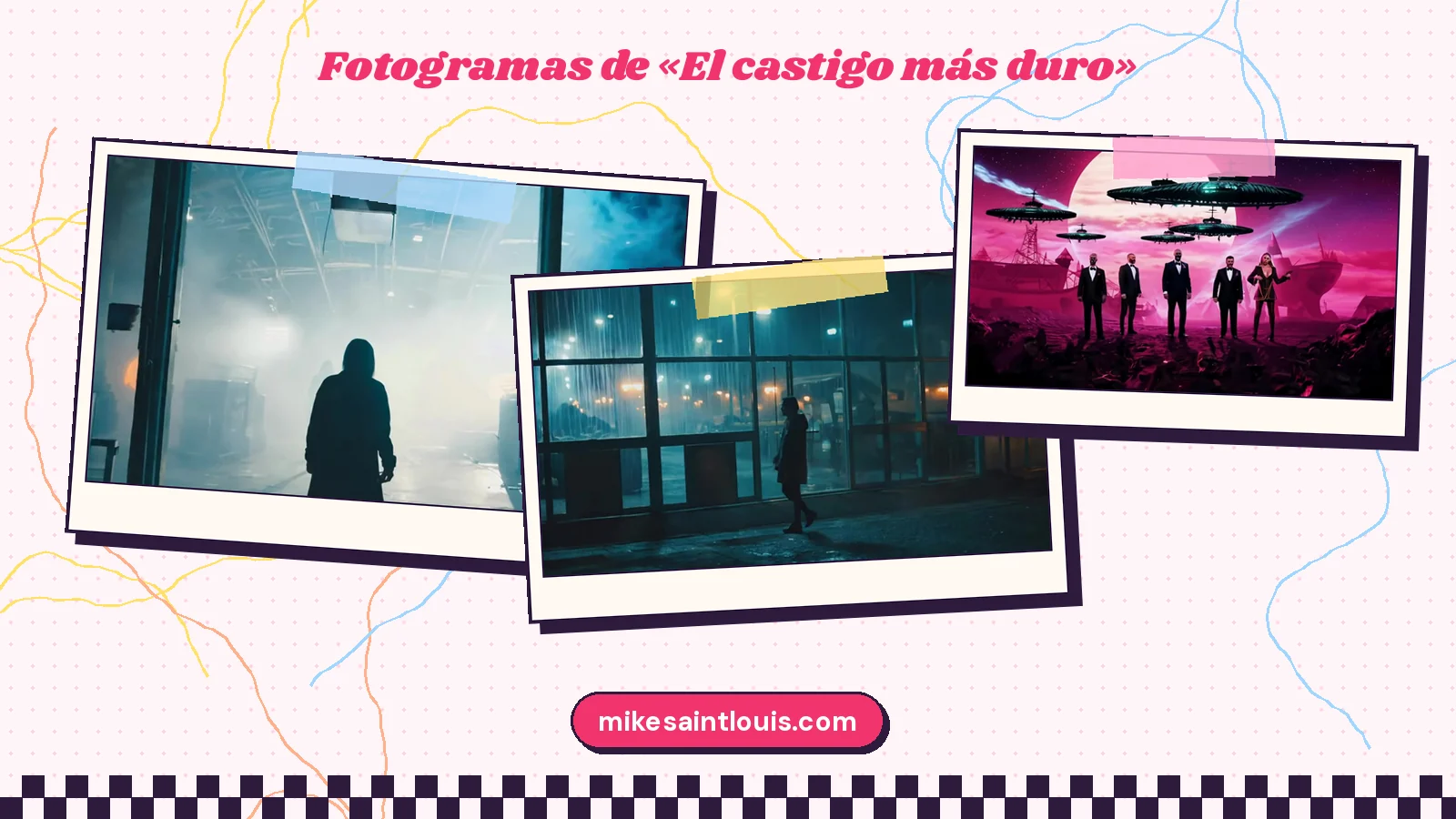
When you write about a breakup, there are usually only two characters: you and him. At most a mother, a mother-in-law, a friend handing out advice. But at the start of these lyrics an audience appears. Anonymous people. Passers-by. Women with shopping trolleys, kids on scooters, a Glovo rider waiting outside a McDonald's. And all of them are watching.
They don't step in. They don't ask. They just draw conclusions. And the conclusion they draw is fantastic and wrong: a vampire.
Those people interest me because they're the ones who turn you into a character. You don't feel like a vampire. You feel like a person with a tight chest who can't speak. But from outside, pain looks strange, exaggerated, theatrical. And when you tell it in a song, you have to choose: either you tell it from inside, which is what almost everyone does, or you also tell it from outside, through the eyes of someone passing who understands nothing.
I chose both. First the mouth. Then the pavement. That double camera is what makes the song, sad as it is, feel like a farce from the very first minute. And farce, in my catalogue, is almost always the way into drama.
Waiting a while
There's a moment in the lyrics hardly anyone mentions that, for me, is among the most honest things I've written. The waiting.
It says I have to wait a while until the pain in my chest lets me breathe properly. Just like that, no metaphor. It's what you do in an anxiety attack. You sit down. You wait. You count the floor tiles. You breathe through your nose like a YouTube video told you. You don't write, you don't call, you don't reply.
I put that wait in the middle of the song because it's true, and because I felt it mattered that listeners knew these lyrics don't come out in the heat of the moment. They come afterwards. First you wait until you can breathe. Then, maybe, you write. I talked about it in writing fast and writing slow too: songs of rage can come out quickly, but songs of pain need the chest to loosen first.
It's the shortest part of the song. And the one that cost me the most.
The Saw mask
Here the humour comes back, and it comes back bloody, which is how I like it.
There are words, the lyrics say, that if they came out all at once would trigger the mask from the film «Saw». The full uncensored version. For anyone who hasn't seen it: there's a contraption in that franchise that goes on your head and, if you don't get it off in time, prises your jaw open like a tin of sardines. It's one of the nastiest things in noughties horror.
I took that contraption and turned it into the consequence of telling the truth. If I let out everything inside me, the trap springs. Not on him: on me. It's a wildly exaggerated way of saying there are things that, once said, can't be taken back. And that sometimes the punishment for speaking is worse than the punishment for keeping quiet.
So, the song says, I've decided not to push any more. That's what was hardest to accept. Keeping quiet wasn't giving up; it was protecting my jaw.
The eternal question
And now we reach the part I really wanted to tell in this article. The question.
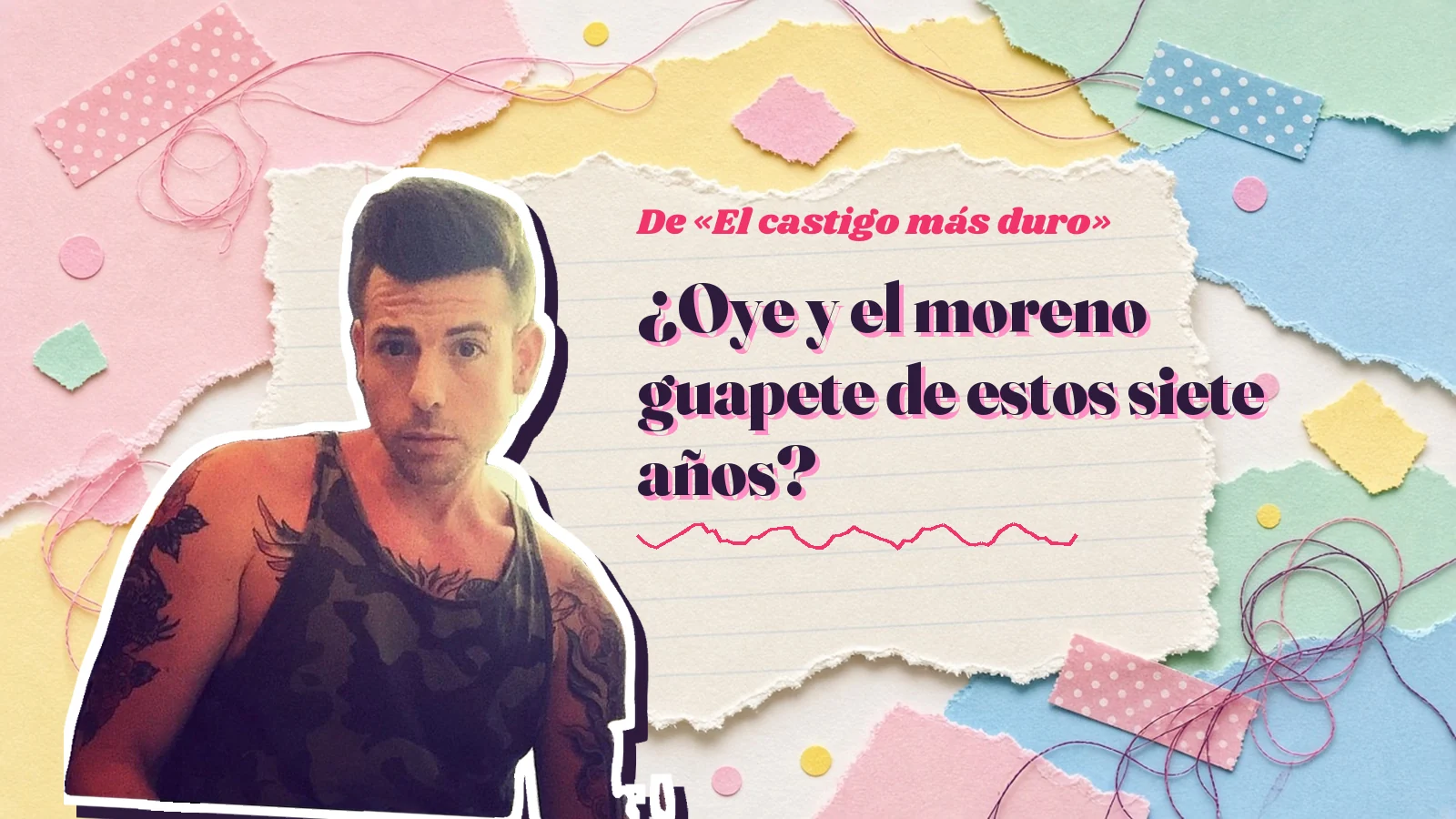
When you come out of a long relationship, there's one question you'll get everywhere: in your home village, at the office, in the bakery queue, in the cousins' WhatsApp group. And him? And your boyfriend? Whatever happened to that lovely lad?
In the song the question arrives like this, with the accent of a neighbour on the landing: «So what about that handsome dark-haired guy from these seven years?». And I, with no desire to tell the truth to every person who asked, prepared an answer. An answer so absurd that nobody could keep asking.
«Era un holograma»
He was a hologram. That's the comic heart of the song, and I say it with pride. I don't give him a name. I don't give him a face. I don't tell the neighbour about the silence or the unanswered messages. I tell her he was a hologram, that I got sacked and couldn't keep up the payments, and that now he's a concrete block.
The hologram
Let me explain why it works, or why I think it works.
A hologram is an image that looks like a person but isn't. You can see it, it glows, it moves, it even seems to look at you. But reach out your hand and it goes straight through. For seven years, according to the song, that was him: a presence that wasn't there. I saw him in my home, in the photos, at Christmas. And when I went to touch him, there was nothing.
The joke is also very office. A hologram your company leases you and, when they fire you, switches off. Like the leased car, like the work phone. I love the idea of the love of your life coming with a maintenance contract. And of losing your job and having him powered down.
There's a painful truth underneath, of course. The feeling that someone was with you while you were useful to them. But put like that, with holograms and leasing, the neighbour laughs, stops asking and you walk off with your baguette without having to cry in front of the greengrocer's.
The concrete block
The hologram isn't the end. The answer has a second part, which is even more savage.
Now he's a concrete block. And if you've got the cash, you can keep him running.
Here the joke twists towards coldness. Concrete doesn't feel, doesn't move, doesn't reply. It's what's left when the hologram switches off. And the lyrics carry on, with a cruelty that still makes me laugh: if you want him, they'll reactivate him in no time, and you should demand sex at least once a week and, while you're at it, double what he used to deliver. I won't explain the «double» joke. It's one of those that die if you explain them.
What I will explain is why it's there. The punishment in the song, the one in its title, also has a side that other lyrics of mine name outright: sex withheld as a form of control. In «Ni con un palo» I wrote it seriously, in bare sentences. Here I slip it into the hologram joke, like hiding a bitter pill inside a slice of ham so the dog will swallow it.
Whatever grates the most
There's a line just before the hologram that sums it all up: the time has come to answer whatever grates on you the most.
Not the truth. Not the fairest thing. Whatever grates the most. That's the logic of the answer. Since you punished me with silence, I'll punish you with a version of yourself you can't stand: a rental hologram, a concrete block. I laugh at you in your absence, which is the only way you've left me.
I don't know if that's right. Probably not. But it saved me a few conversations in the lift. And I told you about it in why I laugh at my exes too: laughter isn't always elegant, but it's mine.
Age, and German
There's a line I find very funny for how little it fits: maybe it's my bloody age, and come what may, and let them talk about you even in German.
Why German? Because it's the language that feels furthest away and most serious to me. People talking about you in the bar downstairs is normal. People talking about you in German is international. It's like saying I don't care if the whole world finds out, including people in a Bavarian village who don't even know where Madrid is.
The age bit, though, I mean seriously. There comes a point when you no longer have the strength to protect anyone's image. Not yours, not his. Let them talk. Let them talk even in German, with capital letters on all their nouns. I've already given the answer I had to give.
Seven years, twice
The number seven turns up twice in the lyrics, and each time it means something different. I discovered that rereading, not writing, which is how you discover the best things about your own song.
The first time it's for deleting: seven years to wipe off the phone and every cloud. An administrative seven, a paperwork seven, a seven for emptying folders.
The second time it's in the neighbour's mouth, in the question about the handsome dark-haired guy. There the seven is different: it's the time other people saw. Seven years of lunches, other people's weddings, group photos. What for me was a folder full of files was, for them, a specific man, with a face and a name, who came to dinners.
Between one seven and the other lies the distance between what you live and what others see. And the hologram answer serves exactly that purpose: to close the second seven without having to open the first.
What was never funny
And after all this, the song takes off its joke wig and stays with what matters. The harshest punishment a narcissist can inflict, the lyrics say, is making you believe four things:
«que ni vales ni un mensaje»
That you're not even worth a message. That's the one of the four that hurts me most, which is why I quote it alone. That you're worth nothing, that you're not even worth a message, that you're nothing to anyone. But the message one is the most concrete. It's the one you can measure. A message takes three seconds. An «I'm fine». A «sorry». An emoji. And you're not worth even that.
It's a line with no joke in it. I didn't find one, and I didn't look. When I write, I try to make sure every song has at least one place where the joking stops, and in this one that place is here, at the end, repeated twice, with a vowel stretched in the middle that sounds like a siren.
I cry because I don't understand anything. He made me stop loving him overnight. Falling out of love from one day to the next isn't a superpower: it's what happens when someone leaves you with no air. In the morning you still love him. By night you don't. And in between, a whole day dying at the sight of nothing touching him at all.
Why not push any more
I come back to the decision at the start, not to push any more, because I think it's the key to the whole song and to many of my lyrics about narcissism.
There comes a moment when you understand that your words, however well chosen, won't get through. That the other person doesn't want them. That his silence isn't a pause but a wall. And then you have two options: bloody your mouth against that wall, or go and write a song.
I chose the second. Not out of courage, I don't have that much. Out of sheer survival. Words with thorns, in a song, don't shred my mouth. I take them out wearing gloves. I place them. I make them rhyme, more or less. And they come out sharp, but they no longer wound me.
That's what I'm trying to say when I say the lyrics are mine. They are: I wrote every word, without AI. The music and vocals are made with artificial intelligence tools, such as Suno, which I direct; I explain it calmly in About Mike. A machine can put a beat to «he was a hologram». What it doesn't know is why that answer saved me from crying at the greengrocer's.
A song with scary cousins
If you like this song's mix of horror and heartbreak, the catalogue has more from the same family. In «Igual que en las pelis slasher» the narrator feels like the lone girl in a horror film, in pyjamas and dressing gown, asking if anyone's there while the ex threatens him with the only thing that really hurts. There the B-movie aesthetic isn't a detail any more: it's the whole set.
And if it's the silence part that interests you, the not-even-worth-a-message part, «Ni con un palo» is the version without jokes. The two songs face each other from opposite ends of the same corridor. One laughs so as not to cry. The other doesn't laugh.
If they ask you
Here's a practical idea, since that's what we're here for. If you're coming out of something similar and they ask you about the handsome dark-haired guy, or the blonde from those five years, or whoever, you don't have to tell the truth. You don't owe your story to the neighbour, or your aunt, or the colleague at the coffee machine.
Invent your own hologram. An absurd answer that ends the conversation with a smile. Let them laugh and move on. Tell the truth to whoever can hold it for you. For everyone else, concrete.
And if one day you feel like telling the truth, that's fine too. There's no rush. Words with thorns wear smooth over time, like the pebbles on an Almería beach that have been rolling at the water's edge for centuries. One day you realise you can say his name without anything bleeding. That day you don't need a hologram. That day you say «I was with someone for seven years and it went wrong», and you drink your coffee, and the neighbour asks after your mother, and life goes on with its noise of shutters and roadworks in the next street.
Until then, concrete. And songs.
The full lyrics are on gayfolkplanet.com and in this site's lyrics archive. Listen with your mouth shut. Just in case.
Frequently asked questions
What is «El castigo más duro» about? It's about silence as punishment in a relationship with a narcissist. It opens with words that can't be said because they hurt, moves through the decision to delete seven years of memories and an absurd answer for anyone asking about the ex, and ends with the punishment in the title: making you believe you're not even worth a message.
Which album is it on? On «Ojalá se pudiera viajar a GAYFOLK», the second album of the GAYFOLK trilogy. On the Planeta Gayfolk singles list it's track 165 of 273.
Who writes the lyrics, and how is the music made? The lyrics are mine, written without AI. The music and vocals are produced with artificial intelligence tools, such as Suno, which I direct. I'm a Madrid-based lyricist, composer and music producer, the first AI songwriter.
Where can I read the lyrics and listen to it? The full lyrics are on the song's page and on gayfolkplanet.com. You can listen on Spotify.