
By Mike Sain't Louis ·
Checking the dates: «De mito a vómito» and the investigation you carry out after being cheated on
A bearded man with short, slicked-back hair and a cross hanging from his ear has his eyes closed and his head slightly bowed, like someone who’s just had some news and hasn’t decided yet what to do with it. The photo is black and white, very grainy. He’s wearing a leather jacket and a pendant round his neck. To his right, in Wild West poster lettering, the title is stacked in three tiers: «De», «Mito», «A vómito». And on the last word, the letters drip.
That’s the cover of «De mito a vómito», «from idol to vomit». I love that detail of the dripping letters, because it’s exactly what the song does with the word in its title: it repeats it so many times that it ends up spilling over.
It’s on «Descubierto un nuevo planeta llamado Gayfolk», the first album of the trilogy, and it’s number 10 in the full list of singles. Its page on the blog already talks about the danger of putting someone on a pedestal. Here I want to talk about something else that happens in the lyrics and that I find very recognisable: the investigation. That moment when you discover you’ve been cheated on and start going back through the calendar, date by date, to see how far the lie goes. And what comes after: cutting every channel, dividing up the pets and leaving with a line that says the slammed door out loud.
The discovery
The song doesn’t say how the person speaking finds out. There’s no message read in secret, no friend tipping him off, no photo turning up. All we know is that, at a certain point, he learns the other person was leading a double life, and from then on nothing is ever the same again.
And I think it’s right not to tell. In these stories, the how is usually the least of it. What matters is the after. When you find out something like that, the world doesn’t change all at once: it changes backwards. Everything that had already happened becomes something else. The goodnight messages, the dinners, the plans. None of it has changed in itself, but it no longer means the same thing.
The lyrics say it with a line that sounds like falling: you think there’ll be no way out. It’s the feeling of being inside something you thought was a house and discovering it was a stage set.
Checking the dates
And then comes the part that interests me most. The lyrics say the person has arrived determined and very well informed at a specific place: a clifftop above a little cove that a year ago seemed so beautiful to them. And then one of the saddest lines on the album: what a shame, because looking at the dates, you were doing it then too.
Looking at the dates. That’s the investigation.
Anyone who’s been cheated on knows what I mean. The moment you discover the lie, your head turns into an obsessive detective. You open the calendar, the chat, the photos on your phone. When did it start? That weekend he said he was with his family? The night he came home late? And that getaway? On the getaway too?
And almost always the answer is the worst one. On the getaway too.
The cruel thing about that exercise is that it doesn’t give you peace. It gives you data. And every bit of data confirms that the memory you had was false. The lovely cove from a year ago is still lovely in the photo, but you can no longer look at it without thinking about what was going on at the same time.
The cove that isn’t beautiful any more
I want to stay a moment longer on that clifftop, because I think it’s the hidden heart of the song.

Every couple has a place like that. A place that becomes «ours». A beach, a bar, a viewpoint, a city you went to for a long weekend. In the lyrics it’s a cove seen from the top of a cliff, and the only thing we’re told about it is that a year ago it seemed so beautiful to them.
That «seemed to us» is what hurts. Plural. A year ago there were two of them looking at the same cove and thinking the same thing. Or so one of them believed.
After checking the dates, that place can’t be got back. It isn’t that the cove has changed. It’s that the memory has been stained. And the unfair part is that the place isn’t to blame for anything. You lose the person, and on top of that you lose the places. Some break-ups leave you without a neighbourhood, without a favourite bar, without a beach. This one leaves you without a cove.
Determined and very well informed
Sad as it is, that expression really makes me laugh: arriving determined and very well informed. It sounds like a reporter. Like a lawyer walking into court with a bulging folder.
That’s what happens after the detective phase. You’re no longer the deceived person who knows nothing. Now you know. You know dates, you know places, you’ve got the evidence. And with all that on you, you turn up wherever you need to. In the lyrics, at the top of a cliff, which as a setting for a showdown is about as dramatic as it gets.
That transformation feels very real to me. Being cheated on takes something from you, but it also gives you a very strange lucidity. For a while you see everything with a frightening clarity. What you used to excuse, you now see for what it is. What used to be «he’s tired» is now «he was with someone else».
The stranger
There’s a line I think is one of the hardest in the whole song, and it’s almost hidden: that stranger had never listened to you, never even bothered to find out where you were.
That stranger is the partner. The person he’d shared a home, pets and trips with. And suddenly, in the lyrics, he’s a stranger.
That change of word really interests me. It isn’t «my ex», or «the bastard», which would be the easy option. It’s «that stranger». As if the person speaking, looking at the dates, had realised not only that he was being lied to, but that he’d never quite known him. And that the other one had never been interested in knowing him either. He didn’t know where he was. He didn’t listen.
That’s almost worse than the cheating. Discovering the other person had a parallel life hurts. Discovering that in the shared life he wasn’t even paying attention hurts in a different, quieter way.
Idol, idol, idol
The word that gives the song its title has two faces. In Spanish, «mito» is a myth, a legend, an idol.
The idol is what the person was before the discovery. The hero, the perfect boyfriend, the one you showed off to your girlfriends with pride. The lyrics repeat it several times in a row, idol, idol, idol, almost like someone who still can’t believe the word doesn’t work any more.
And then the idol turns into vomit. And that second word is repeated far more times. In the published lyrics it appears eight times in a row in a single run, like a retch that won’t stop. That’s what disillusion is like: the idol was built bit by bit, over months or years. The vomit comes all at once and doesn’t stop.
I love that imbalance. The idol comes up three times. The vomit, eight. That’s how fast someone falls off a pedestal, and that’s how long the queasy aftermath lasts.
The first lines, stumbling
The song starts in a very strange way: with loose words, almost one per line. From idol to. Vomit. And you. All alone. How. Lovely.
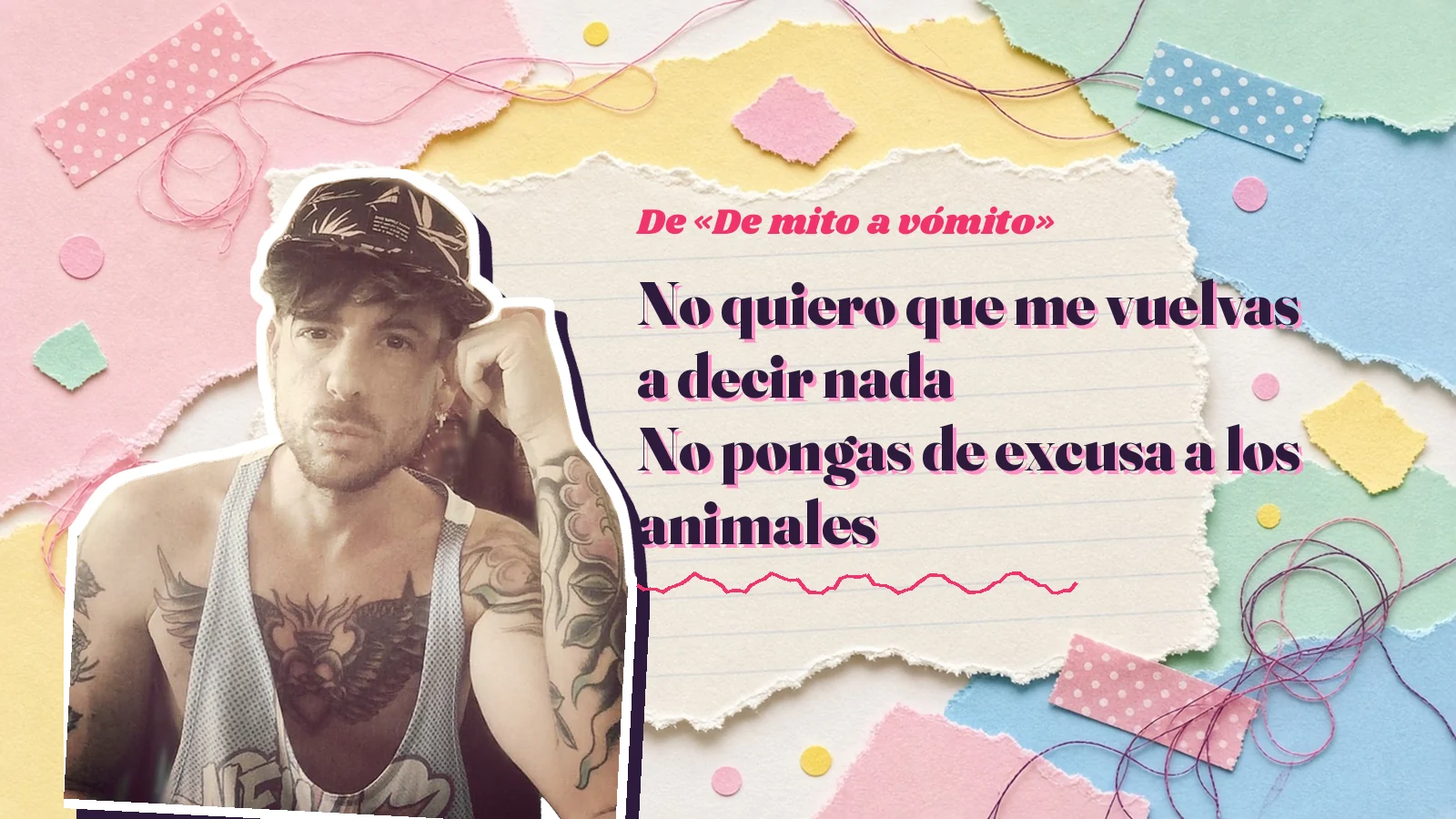
It’s like someone trying to speak who can’t get the whole sentence out. Like when you’ve just found something out and you start talking in pieces, out of breath. That stumbling opening has something of shock about it. There are no verses yet, no long rhymes, no speech. Just loose words falling.
And then, little by little, the lyrics pull themselves together. Whole sentences appear, witty insults, decisions. It’s almost the real order of a break-up: first the blow and the loose words, then the organised fury.
Cutting every channel
Once the investigation is done, the song moves to action. And the action is very specific: not by phone, not by email, not by WhatsApp. I don’t want you to say another word to me.
I love how practical that list is. It isn’t an abstract «I don’t want to know». It’s an inventory of channels, like someone blocking contacts one by one on their phone. The phone, blocked. The email, into the spam folder. The WhatsApp, deleted. It’s the modern version of locking the door and throwing the key in the river.
And there’s some dignity in that gesture. After being cheated on, the most tempting thing is to keep talking. Asking for explanations, listening to excuses, arguing for the hundredth time. The lyrics cut that off at the root. Everything has been said. You’ve checked the dates. No need to tell me your side.
Dividing up the pets
And then there’s one of my favourite lines on the whole album: don’t use the pets as an excuse, we’ve already divided them up, each to his own.
It’s such a domestic detail that it makes you laugh and wince at the same time. When a couple who live together split up, there’s always something that serves as an excuse to stay in touch. The keys, a box of books, the electricity bill. And, above all, the animals. How’s the dog? Can I come round and see the cat? Those questions look innocent, but they’re often the back door the other person tries to come back in through.
The lyrics shut that one too. The pets have been divided up. Each to his own. No shared custody. If you want to know how the dog is, tough luck.
To me it’s one of the truest lines about break-ups you could put in a song. It doesn’t talk about broken hearts or tears: it talks about who ends up with whom. And anyone who’s broken up a shared home knows that’s one of the worst conversations there is.
The Teide will blow first
To make it clear there’s no going back, the lyrics use one of those exaggerations I adore: get back with you? The Teide will blow first.
There are a thousand ways to say «never». Not in a million years, over my dead body, not if you paid me. The lyrics pick a volcano. And not just any volcano: the Teide, the highest peak in Spain, which is just sitting there, still and calm, in the middle of Tenerife. Saying the Teide will blow first sets a geological catastrophe as the condition for getting back together.
That kind of exaggeration is very Spanish, very much the grandmother telling you «I’d sooner throw myself out of the window». And in a song that comes out of being cheated on, it does something important: it turns anger into humour. It’s much easier to leave with your head held high if you leave with a line like that.
Good riddance, and let your mother put up with you
The send-off carries on in the same tone: go on, and let the air flow. Go with God. And let your mother put up with you.

They’re three age-old Spanish sayings, the kind you hear in markets, in rows between neighbours, in family kitchens. None of them is a direct insult, but the three together are devastating. Let the air flow means «go». Go with God means «go, and don’t come back». And let your mother put up with you is the finishing blow: I’m not putting up with you any more, let the woman who gave birth to you do it.
I really love writing in that language. There’s a huge tradition of saying goodbye with wit, of closing an argument with a stock phrase that says it all without a single swear word. And in a gay song it has an extra edge, because those phrases usually come from the women in the family, the aunts and grandmothers, and putting them into a break-up between two men places them somewhere new.
Thank you, Mr Nobody
At the start of the long section there’s another line with plenty of bite: it’s going to be so hard for me to trust anyone again. Thanks to you, Mr Nobody.
Mr Nobody. The idol from before doesn’t even have a name now. He gets a courtesy title, «Don», but for a nobody. It’s pure irony: just enough politeness to make it clear you’re nobody now.
And the line before it is serious. It’s going to be so hard for me to trust anyone again. In the published lyrics, «so hard» stretches out with a long string of vowels, as if the person speaking knew it wasn’t going to be a matter of weeks. Between that serious line and the ironic «Mr Nobody» lies the whole tone of the song: real pain, told with one eyebrow raised.
At least you’ve moved up
One of the sharpest lines in the song is the one aimed at the next guy. First, a warning: try not to leave the next one so fucked up. And then, a poisoned congratulation: at least you’ve moved up, I’m very happy for you.
I love that «I’m very happy for you». Nobody is really very happy when their ex swaps them for someone else. But saying it like that, with icy courtesy, is a way of winning. You don’t give him the satisfaction of seeing you wrecked. You congratulate him. Like congratulating a colleague who’s just pinched your promotion, with a smile that cuts.
And the earlier warning has its generous side. Try not to leave the next one so fucked up. It’s almost advice for the future of someone you no longer care about. Or rather, for the future of the poor soul who comes next, who isn’t to blame for anything.
Thinking with his dick
And in the middle of it all, the simplest explanation. Why did this happen? Because he was thinking with his dick.
No psychological theory. No childhood trauma, no existential crisis. The lyrics sum it up in four bar-room words. And in a song that also has some very sad moments, that works as an anchor. However much it hurts, the cause is ridiculous. The idol hasn’t fallen because of a Greek tragedy. He’s fallen because he got horny.
That reduction to the absurd is very therapeutic, even if it doesn’t mean to be. When someone cheats on you, you tend to think there’s something big behind it, something you failed to see, something you did wrong. The lyrics tell you no. Sometimes it’s just that. Some men think with their dick.
What the song doesn’t do: forgive
There’s one thing I really like about «De mito a vómito», and it’s what isn’t there. At no point is there forgiveness. No reconciliation scene, no «maybe it was both our faults», no final hug.

Lots of break-up songs end on that mature, understanding note of «I wish you all the best». Not this one. This one wishes that your mother puts up with you. And tells the next guy he’s landed himself a promotion, with an icy smile.
I’m not saying forgiving is wrong. There are break-ups where it’s the right thing. But I think we also need songs that don’t forgive, because there are moments when you’re in no state to forgive anyone. Fresh from checking the calendar, with the cove stained and the pets divided up, the last thing you need is a song asking you to be mature. You need the Teide.
Between Pinocchio and Macaulay Culkin
In the list of singles, «De mito a vómito» comes right after «Ese Pinocho nunca me comía el chocho» and right before «Como Macaulay Culkin en El buen hijo». It’s a stretch of the first album packed with fictional characters: a wooden puppet whose nose grows, an idol that turns into vomit and an evil child from a film.
I like that neighbourhood. After «De mito a vómito», which puts all the blame outside with a slammed door, «Como Macaulay Culkin en El buen hijo» turns around and wonders whether the problem might be inside. Played back to back, the two songs are almost the two sides of the same night: the fury at ten o’clock and the doubt at gone one.
The cover: eyes closed
Back to the cover. The man has his eyes closed. He isn’t crying, he isn’t shouting, he isn’t angry. He looks like someone hearing a piece of news who needs a moment.
I think it’s a great choice for a song with so much humour and so much anger. The cover doesn’t show the Teide part or the «let your mother put up with you» part. It shows the moment before. Checking the dates. Realising.
And then there’s the title, in Wild West poster lettering, with that last word dripping. Like a duel in the sun. As if the whole town already knew someone was about to get burned. In westerns, the one with his eyes closed before the duel is usually the one who wins.
For anyone going back through the calendar
«De mito a vómito» is for anyone who’s just discovered a double life and is right now sitting with the calendar open, checking the dates. For anyone who’s looked again at the photos from a lovely getaway and no longer knows what to feel. For anyone blocking contacts one by one.
It’s also for anyone about to reply to «how’s the dog?». Don’t. It’s been divided up.
And it’s for anyone who needs a bit of a laugh in the middle of the wreckage. Because the song doesn’t ask you to stop being sad. It just hands you a few lines to leave with your head held high.
As a lyricist, I love having put the Teide, a mother and a division of pets into the same song about being cheated on. I call myself «the first AI songwriter» because I make the music and the vocals with artificial intelligence, but that way of showing someone the door is mine. If you need it, it’s on the downloads page, for free.
Frequently asked questions
Which album is «De mito a vómito» on? On «Descubierto un nuevo planeta llamado Gayfolk», the first album in Mike Sain't Louis’s GAYFOLK trilogy. It’s number 10 in the full list of singles.
What is «De mito a vómito» about? About discovering the double life of an idealised partner. The person speaking goes back over the dates, realises the cheating went back a long way and cuts off all contact, with a send-off full of very Spanish humour.
What does «the Teide will blow first» mean? It’s an exaggeration for saying he’ll never get back with that person: the highest volcano in Spain would erupt first.
What’s on the cover? A bearded man with his eyes closed, in black and white, next to the title in Wild West poster lettering that drips on the word «vómito».
Who made the song? The lyrics are by Mike Sain't Louis, lyricist, composer and music producer from Madrid. The music and vocals were made with artificial intelligence tools.