
By Mike Sain't Louis ·
«Llorar», in the infinitive: a catalogue of tears and a written permission slip
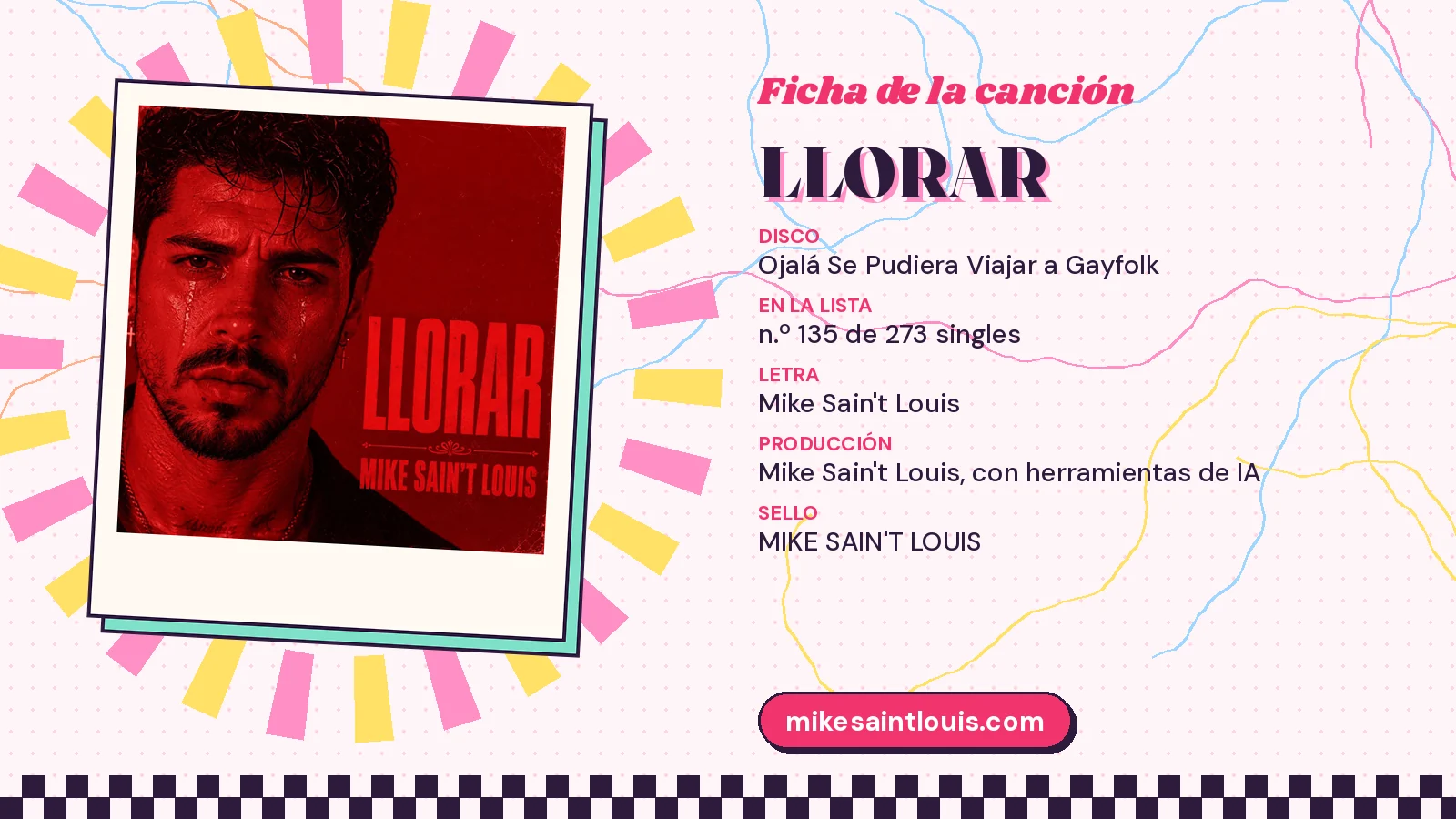
A red face, lit as if by a darkroom bulb. Black hair, thick eyebrows, three-day stubble. Eyes fixed on the camera, not looking away. And two tears running down the cheeks, one on each side, with nobody wiping them. On the right, in tall, narrow letters, a single word: «LLORAR».
It doesn't say "crying". It doesn't say "I cried". It doesn't say "don't cry". It says "llorar", to cry, in the infinitive, like a dictionary entry or a line from an instruction manual.
This is the cover of one of my songs, and I chose it to write about something that, if you count, takes up half my catalogue: tears.
First things first
The lyrics of «Llorar» aren't yet published on the site's lyrics page, so I won't tell you what they say. The song's page talks about the cover and the title, and I'll pull on that thread to talk about my other songs where people cry, which are many and which you can read in full.
Boys don't cry
A lot of boys were taught the same thing, in words or without them: boys don't cry. Dad said it, the school team coach said it, Grandad said it, the cartoons said it. If you fell off your bike, "come on, it was nothing". If you got hit in the playground, "don't be a sissy". If the dog died, you cried in your room with the door shut.
For a boy who was also a bit different, camper than was wise, crying in public was double the danger. It proved right the ones already calling you a poof. Tears were evidence of what everyone suspected. So you learnt to swallow them. To clench your jaw. To wait until you were alone.
The Cure put it into a song at the end of the seventies, "Boys Don't Cry", with irony and sorrow. And years later there was a film with that title, about a trans boy murdered in a small town in Nebraska, which turned the phrase into one of the saddest in nineties cinema.
The cover of «Llorar» is the answer to all that. A man crying head-on, in close-up, not hiding, looking back at whoever's looking. Unashamed. Almost defiant.
An infinitive as permission
The song's page says the title sounds like an instruction or a permission, and that's the best description I know.
The Spanish infinitive has a curious use: impersonal commands. «No fumar», no smoking. «Prohibido aparcar», no parking. «Empujar», push. They're the signs in public places, the instructions on appliances, the road signs. Nobody's talking to you in particular; the rule is talking.
Calling a song «Llorar» is hanging up one of those signs, but the other way round. It doesn't forbid, it authorises. As if the door of a public loo had a plaque saying "Cry" the way it says "Gentlemen". You can here. It's allowed here. Come in and let it out.
I'd love that plaque to exist for real, in every loo in every club in Chueca. Which is where Madrid cries hardest, by the way, though nobody admits it.
Cry, then you'll pee less
Spanish mothers have a saying for everything, and for children's tears they have one that's a masterpiece of loving cruelty: «Llora, que así meas menos». Cry, then you'll pee less.
You'll have heard it, or its cousin. It's said when a child throws a tantrum over something small, a toy they won't buy, a biscuit dropped on the floor. It's a way of belittling tears with a toilet joke, the kind that leaves the child, mid-tantrum, unsure whether to keep crying or burst out laughing.
The phrase fascinates me because it says two things at once. On the one hand, it scorns crying: it's just water leaving by another exit. On the other, it allows it: go on, cry if you want, it's fine. Permission with disdain, authorisation with a raised eyebrow.
The cover of «Llorar» removes the disdain and keeps the permission. Cry. That's all. No joke behind it to cut it down to size.
Although, if you ask me, the mothers have a point. After crying, you feel lighter. Something leaves the body. Through the eyes or wherever.
Crocodile tears
Not all the tears in these stories belong to the narrator. Some belong to the other one, and they're the kind you don't believe.
Narcissists cry too, when it suits them. They cry when you catch them, they cry when you threaten to leave, they cry when they need you back. Crocodile tears, as grandmothers used to say, after the old legend that crocodiles wept while devouring their prey. Tears that express nothing but strategy.
Telling one kind of tear from another is one of the hardest things to learn. At first you believe them all, because you were taught that whoever cries is suffering. After a couple of experiences, you start distrusting even your own. And that distrust is a wound too.
That's why I love the red cover so much. Those tears aren't asking for anything. They're not there to win you back or make you feel guilty. They're there because they come out. They're the opposite of crocodile tears: tears that aren't hunting.
The club loo
And since I mentioned it, the club loo deserves its own section, because it's the great confessional of gay life.
That's where you cry over an ex you've just seen on the dance floor with someone else. Over a message that doesn't come. Over one shot too many. Over a song that catches you off guard. That's where strangers comfort you, hand you loo roll and tell you "babe, he's not worth it". That's where you fix your mascara, breathe deep and walk back out as if nothing happened.
The loo doesn't always appear by name in my songs, but it's behind a lot of tears. It's the natural setting for the mix I most like to describe: party on the outside, crying on the inside. The same man who ten minutes ago was dancing with his arms in the air is now sitting on the toilet lid with his face in his hands. And ten minutes later he'll be dancing again.
That isn't a contradiction. It's a normal night.
I cry because I don't understand a thing
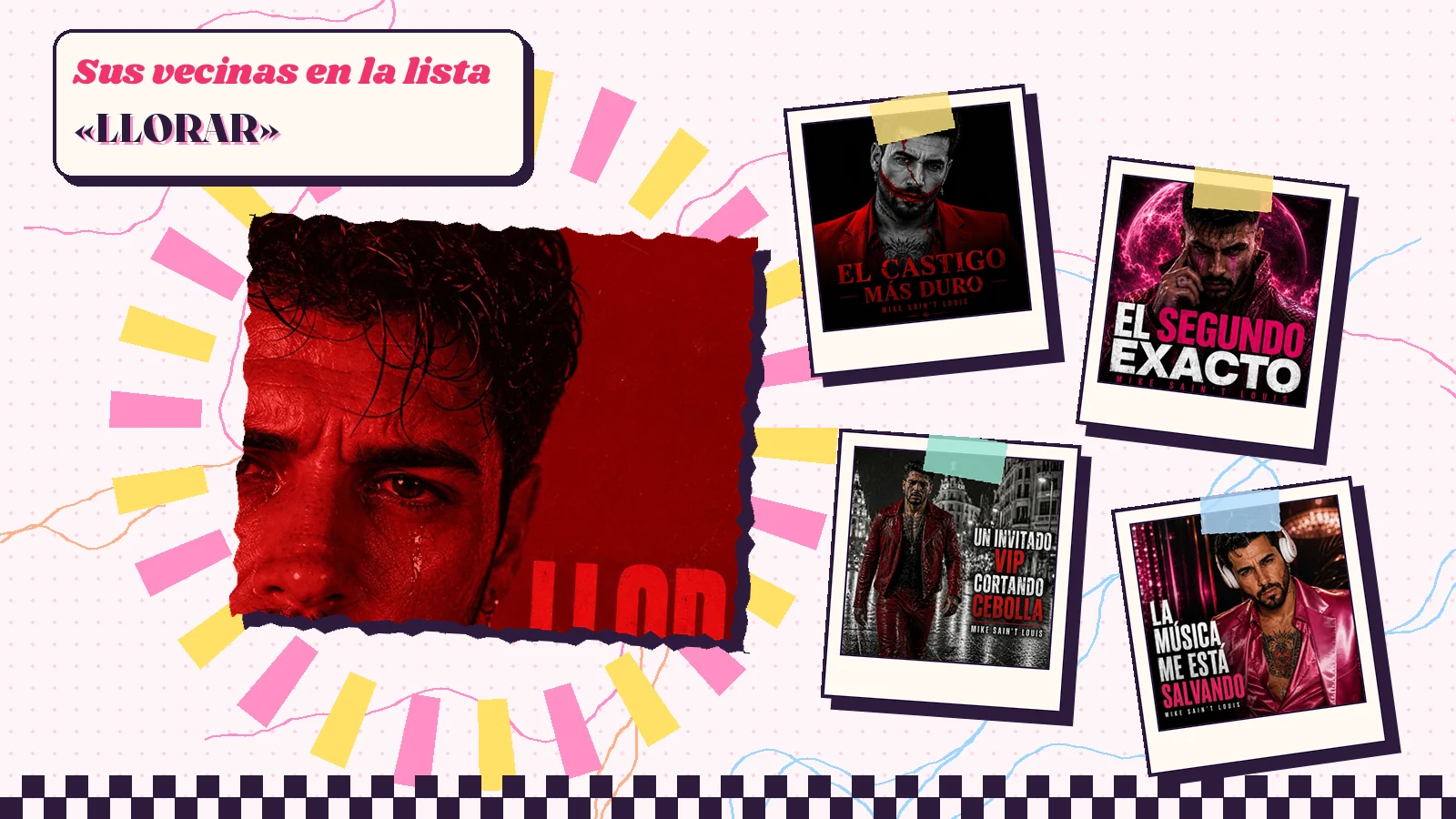
Of all the tears in my catalogue, the ones that weigh on me most are in «El castigo más duro», the harshest punishment. There the narrator says it in a very simple line repeated like a broken chorus: «lloro porque no entiendo nada» («I cry because I don't understand a thing»).
He isn't crying from sorrow, or not only. He's crying from bewilderment. Because someone he loved has made him stop loving them overnight, and he can't work out how. It's the crying of someone looking for a logical explanation for something that has none. The most exhausting kind.
In that song, the last vowel of «nada» stretches out endlessly, as if the crying wouldn't fit in the word. That long word, written with twenty a's in a row, is probably the most honest way I found of drawing a sob on a page.
And what follows in the lyric explains why it hurts so much: the punishment of making you believe you're worth nothing. It's a song for crying to. And it's good that it exists.
The exact second
There's another question in my catalogue to do with tears, and it's become one of my favourite lines. It's in «El segundo exacto», the exact second, in the middle of a song that mocks the haters who look down on music made with AI. Suddenly, without warning, the mockery stops: «¿Será que podrá la inteligencia artificial escoger el segundo exacto donde rompiste a llorar?» («Could artificial intelligence ever choose the exact second when you burst into tears?»).
For me, that question is the centre of everything I do. Machines supply the sound. But the exact second when someone breaks, the precise moment the voice cracks and the tears come, no machine chooses that. It's chosen by whoever has cried. I choose it, when I write where each line goes and which word the blow lands on.
That exact second is the one thing that can't be manufactured. Which is why the crying songs are, paradoxically, the ones I defend most when someone tells me my work has no soul.
Crying, today I don't want to cry
In another song the title verb appears almost as is, but in the negative. In «Un invitado VIP cortando cebolla», a VIP guest chopping onions, there's a line that goes: «Llorar, hoy no quiero llorar» («Crying, today I don't want to cry»). And straight after, the tears come back anyway, «siempre lágrimas», always tears, like a tide that ignores whatever you decide.
That song's title is already a joke about crying. Chopping onions is the universal excuse. "No, I'm not crying, I'm chopping onions." Everyone's said it at some point, red-eyed with a knife in hand, even with not half an onion on the board. A VIP guest in the kitchen, with the onion as alibi, is the perfect picture of someone who doesn't want to be seen crying.
«Llorar», the song with the red cover, would be the answer to that guest: put the knife down. You don't need the onion any more.
Red, not grey
The song's page insists on the colour, and rightly. The whole cover is red. The face, the background, the letters.
If someone asked me to paint sadness, I'd probably paint it grey, or blue. That's what nearly everyone does. Rain on the window, winter light, cold coffee. Crying as something dim, drained of energy.
Red says something else. It says tears can be tears of anger. That you cry with fury when you've been made a fool of, when you've been lied to your face, when you finally understand what they did to you. You cry from love, a love too big for the body. You cry from relief when something you dreaded has finally happened and you've survived. All those tears are red, not grey.
And the gaze confirms it. The boy on the cover isn't crushed. He's looking at the camera with eyes full of water and a firm jaw. It's crying that plants itself in front of you. It doesn't ask for comfort. It asks to be seen.
Looking at the camera
There's a technical detail on the cover that changes everything: the direction of the gaze.

In most photos of people crying, the person looks down, or away, or covers their face with their hands. It's the natural posture of shame: I don't want you to see me like this. Press photographers know it, which is why pictures of funerals and disasters almost always have someone with their head bowed.
The boy in «Llorar» looks at the camera. At you. Directly. Tears falling, eyes open. He doesn't lower his gaze a millimetre.
That gaze turns the scene into something else. You're no longer watching someone crying in secret whom you've caught by chance. You're watching someone who's decided you'll see him cry. There's a huge difference between being caught and showing yourself. The first is shame. The second is a statement.
If I had to sum up in one image what I'd wish for the boys who grew up swallowing their tears, it would be that: crying while looking at the camera.
My fake tears
Now a moment of self-parody, because this is getting very intense.
There's a huge amount of crying in my lyrics, but there's fake crying too. Telenovela crying, with violins and smudged mascara. Crying at full blast, vowels stretched until it sounds like a dog abandoned at a petrol station. «Siempre lágrimaaaaas.» Some of the crying in my catalogue is pure overacting, pure folk-diva drama in the final act.
And I'm happy for them to live side by side. Real tears and stage tears. Sometimes, to reach the real ones, you have to go through the stage ones first. You start crying with exaggeration, clowning in front of the mirror, and suddenly, without quite knowing when, the clown has gone and what's left is crying that wasn't in the script.
Something similar happens with songs. «El segundo exacto» starts by mocking the haters and, halfway through, drops the question about tears that stops you in your tracks. The joke opens the door; what's inside is no joke.
Tears aren't a factory fault
There's an idea doing the rounds that I find dangerous: that crying is a symptom of weakness, a manufacturing defect to be corrected. The modern version no longer says "boys don't cry", but it says similar things in other words: "you have to be strong", "you need to move on", "don't wallow".
I'm not saying you should spend your life crying. I'm saying crying is what the body does when something overflows it, and trying to stop it is like trying to stop a sneeze. You can, but it comes out somewhere else, and nearly always worse. In the clenched jaw, the insomnia, the foul temper with a waiter who's done nothing wrong.
The red cover doesn't make a speech about this. It just shows it: a man crying who hasn't broken. He's still there, whole, with his beard and his gaze. The tears haven't undone him. They've made him visible.
Writing while crying
People say, and I believe it, that sad songs aren't written while crying. In the middle of crying you can't write: you can't see the page, you can't find the words, everything feels too big. Sad songs are written afterwards, when you've cried and you're left with the hangover. In that odd calm, eyes still puffy, you can look at what happened from a certain distance and find the line.
Maybe that's why so many of my saddest songs have a touch of humour. Not because I make light of what hurts, but because they're told from the shore, once you're out of the water. From there you can describe the storm without drowning.
Tears with a soundtrack
Spain is a country that cries a lot to music. Copla is made of tears. So were the rancheras playing in roadside bars. Boleros, eighties ballads, summer heartbreak songs. For decades, music was the only place many men let themselves cry. In the car, radio up, where nobody could see.
Some people cry to Rocío Jurado. Some cry to Camilo Sesto. Some cry to Isabel Pantoja, though they'd never confess it at the office Christmas dinner. Sad songs work as a permission: if the song cries, I can cry with it. It isn't me falling apart, it's the song, and I'm just keeping it company.
That's why I think it matters so much to have songs like that in my catalogue, even if most people know me for the jokes. They're the back door through which someone who won't let himself cry can slip in unnoticed.
Music is saving me
In my catalogue there's a song whose title sums all this up very well: «La música me está salvando», music is saving me. I won't quote it here, but its title is almost a diary. Writing, composing, producing, releasing: all of that serves many purposes, and one of them is having somewhere to put the tears.
A song is a place. When something overflows you, you put the tears into a lyric, add music, make a red cover, and suddenly they're no longer only inside you. They're outside, in a file, on a platform, in the headphones of a stranger who needed them too. It's a way of getting them out of the house.
I'm not saying music heals. I don't like those phrases. I'm saying it helps you put things in order. And sometimes putting things in order is enough to get up the next day.
A man crying on the cover
I want to come back to the image one last time, because I think it's one of my bravest covers, even though there's nothing scandalous about it.
In my catalogue there are covers with feathers, harnesses, accordions, columns of dubious shape, pink bullfighter suits. This one has none of that. It's a face. A man crying. And yet it strikes me as bolder than many of the others, because it shows something still hidden far more than the body: vulnerability.
I put it another way in letter to someone who hasn't told anyone yet. Coming out is, among other things, learning to let yourself be seen. With what you are, what you want, what hurts. Crying in front of someone is a small coming out every time.
For whoever needs it
The song's page suggests listening to it when you need to let it all out. Fair enough. And I'd add: listen to it when you don't need to, as well, to get used to the idea that you can.
And if there's a boy near you, the clenched-jaw, "it was nothing" type, put it on for him without saying why. Maybe he won't cry. Maybe he will. Either way, he'll have seen a cover where another man does it without apologising.
That's enough, for a start.
Frequently asked questions
What is «Llorar» about? The cover shows a boy crying head-on against a red background, and the title is a verb in the infinitive that works as a permission. The lyrics weren't yet published on the site at the time of writing.
Which other songs by Mike Sain't Louis talk about crying? Among others, «El castigo más duro», «El segundo exacto» and «Un invitado VIP cortando cebolla». Their lyrics are at gayfolkplanet.com/letras.
Why is the cover red? Because the song's tears aren't only sorrow: the red also points to anger, love and relief.
Who makes the song? Mike Sain't Louis writes the lyrics, composes and produces. The music and vocals are made with artificial intelligence.