By Mike Sain't Louis ·
The buzzword: when calling someone a narcissist helps and when it's one time too many
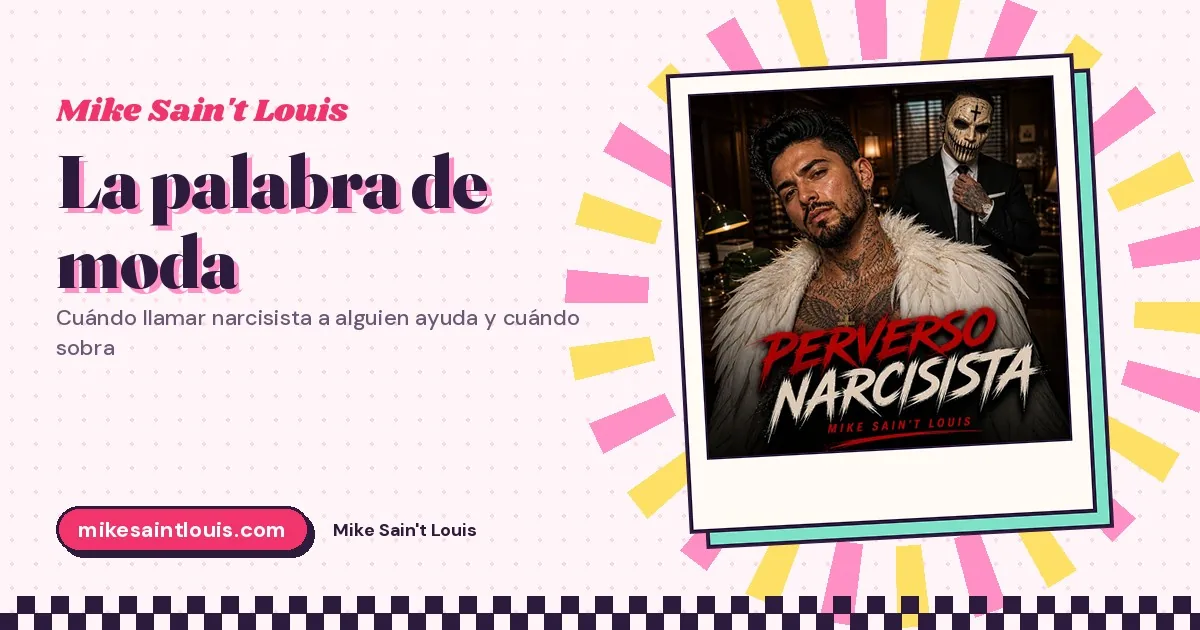
An office with dark wood panelling and green banker's lamps. A man in an immaculate suit, tie knotted tight, hands still. On his face, a skull mask with a cross painted on the forehead. In front of him, in the foreground, a boy tattooed up to the neck, wrapped in a white feather coat, looking at the camera with a weary face. And at the bottom, in red horror-poster letters: «Perverso narcisista». Narcissistic pervert.
If anyone wanted to sum up my catalogue in one cover, they could pick this one. And I'm slightly embarrassed to admit it.
Because I've written so many songs about narcissists that I sometimes wonder whether I've become the trade's official lyricist. The one who, asked one day about his speciality, has to answer: "Well, I do narcissists." Like someone who does croquetas or alterations.
This piece is about that doubt. About the word I've used most, and about when I think it's useful.
A warning before we start
The lyrics of «Perverso narcisista» aren't yet published on the site's lyrics page, so I won't tell you what they say. I'm working from the title and the cover, which the song's page describes, and from my many songs on the same subject whose lyrics are out in the open.
An after-lunch diagnosis
The song's page calls the title "an after-lunch diagnosis". I like the phrase because it describes very well what's happened to the word narcissist in recent years.
It used to be a term for the psychiatrist's office, the textbook, the American hospital drama. Now it's used at Sunday lunch, between the main course and the coffee. "Your brother-in-law's a narcissist." "My boss is a total narcissist." "Mari's ex, textbook narcissist." The word has left the consulting room and moved into the cousins' WhatsApp group.
And the version with a surname, narcissistic pervert, packs even more punch. It's a term from French psychology, popularised by books on emotional abuse, and it describes someone who doesn't just love himself too much but enjoys manipulating and wearing others down. It sounds like a film. It sounds like a villain in a skull mask.
It makes sense as a title. It's a word people say when they finally understand what happened to them.
When the word helps
I'll start with the good side, because it has one.
There's a moment in harmful relationships when you have no words for what's happening to you. You know you're not well, that something doesn't add up, that the other person makes you feel small, but you can't name it. And what isn't named doesn't exist. If it doesn't exist, it must be your fault. That's what the narcissist, in the everyday sense, achieves: making you doubt yourself.
That's when the word is a torch. Someone tells you "what you're describing has a name" and suddenly everything fits. Days of silence as punishment, coldness when you need him most, charm with everyone else and contempt at home. It's no longer that you're exaggerating. There's a pattern, and others have lived it.
I put it very bluntly in «Ni con un palo»: «No es rechazo, es cálculo. / Es saber que el otro sufre y quedarse quieto» («It isn't rejection, it's calculation. / It's knowing the other is suffering and staying still»). That line has no joke in it. It's what someone tells you once they've understood. And understanding, at that point, is the first thing that puts the ground back under your feet.
When the word is too much
Now the bad side, because it has one too, and it's my turn to stand in front of the mirror.

A word that explains everything ends up explaining nothing. If every ex who behaves badly is a narcissist, every demanding boss is a narcissist and every friend who doesn't ring back is a narcissist, the word loses its edge. It becomes a generic insult, like "toxic", which now means little more than "someone I don't like".
And that has a cost for anyone who's truly lived through something serious. If the word wears out, when you use it to describe years of manipulation it sounds the same as when your cousin uses it because her boyfriend didn't like a photo.
I admit it: part of that wear is the fault of people like me, who've used it in a lot of songs. I don't regret it, but it obliges me to be careful. One thing I try to do is not always use it the same way. Sometimes as a diagnosis, sometimes with monsters, sometimes with mockery, sometimes as a nickname with a sting. And sometimes without saying it at all, describing what the other person does so the listener can supply the word if they want.
The mask that doesn't move
Back to the cover, because it solves this dilemma better than I do.
The man behind wears a skull mask. It isn't a face, it's a mask. And the mask has a painted smile that never changes. That's the exact image of what I mean when I use the word seriously: someone whose public face is a fixed piece, a smile that doesn't respond to what's happening around it. He can watch you cry and the smile stays exactly the same.
He's also dressed like a banker. Dark suit, tight tie, wood-panelled office. It's respectable power, the kind that never shouts because it doesn't need to. The narcissist in my songs is almost never a screaming monster. He's the one who looks the most proper person at the meeting. The one who's divine at office dinners. The one everyone envies you for having as a partner.
And the cross on the mask's forehead adds a touch of church, of morality, of the sanctimonious. As if to say: on top of everything, he thinks he's good.
The boy in feathers
The one in front interests me more.
Tattooed to the neck, in an enormous white feather coat, the kind a diva wears to make an entrance at a gala. Dark hair, beard, direct gaze. He doesn't look frightened. He looks fed up. The song's page puts it very well: he seems tired of pretending he can't see who's behind him.
That expression is, for me, the best part of the cover, and the closest to what I want to say in these songs. I'm not interested in the trembling victim, the poor creature who hasn't a clue. I'm interested in the moment you already know. When you look at the camera, in your feather coat and your slightly dishevelled dignity, and think: "I know perfectly well who's behind me. What I don't know yet is how to get out."
That moment, knowing and not yet having left, is the one that's given me most songs. It's an awkward, waiting-room moment, when you can no longer play dumb but don't yet have the strength to get up. Plenty of people stay there for months. Some for years.
He upped his game
There's another line in «Ni con un palo» that seems to me the best answer to the question everyone asks at that stage: has he changed? Was he like this at the start? The line goes: «Pero no cambiaste tú: cambió el nivel de su juego» («But it wasn't you who changed: he upped his game»).

That's the trap of relationships with someone like that. At first everything seems perfect, and when it starts going wrong, your first reaction is to think you've done something wrong. That you've changed. That you're no longer as interesting, as handsome, as fun. The line lifts that guilt off you: you're the same; what's changed is his strategy.
The cover of «Perverso narcisista» could illustrate that line. The boy in front is the same as ever, feathers and tattoos and all. What's changed is what he knows about the man behind.
What a song can't do
Before going on, a serious line, because it's needed.
A song diagnoses nobody. I'm not a psychologist or a psychiatrist, and when I use the word narcissist in a lyric I'm not writing a clinical report. Narcissistic personality disorder exists, it's described in the manuals and it's assessed by professionals, with time and proper tools. What I do is something else: I use the word the way people on the street use it, to name a pattern of behaviour that hurts.
If what you're going through has you sunk, the song can keep you company for a while. What gets you out is talking to someone who knows, and to people who love you.
That said, back to the mask.
The charm at the start
There's a stage in these stories that almost never makes the covers and yet explains everything: the beginning.
Nobody falls in love with a man in a skull mask. You fall for someone charming. Attentive to excess, messaging at all hours, making plans for a year's time when you haven't been together a month. People who know about this call it "love bombing", and I think the phrase is spot on, because it's part war and part gift. They bomb you with affection until you can't think.
In my songs that stage almost always appears in passing, as a bitter memory. The first days, the first weeks, sex three times a day. I don't dwell on it because, by the time I'm writing, I'm already on the far shore. But without that stage, none of the rest makes sense. The boy in feathers wouldn't be in that office if, at the start, the door hadn't been opened to him with champagne.
That's why I'm a little wary of relationships that move too fast. They're not always dangerous. But when someone declares eternal love on the third date, it's worth checking whether he's wearing something on his face.
Banker's lamps
A detail on the cover that goes unnoticed: the green lamps. They're the classic bank-office or old-library kind, green glass shade and brass base. And the dark wood on the walls. Everything smells of old money.
It's no accident the narcissist in the picture has an office. In many relationships of this kind there's an element of financial power: who pays, who decides, who depends on whom. Whoever controls the wallet controls much more than it seems. And in the gay world, where many couples lack the safety net of a supportive family, that dependence can be even stronger.
The cover doesn't say so, but the set suggests it. The man in the mask isn't in a dark alley. He's in his office, surrounded by things money buys. And the boy in feathers, however much of a diva he looks, is on his turf.
The coat as armour
And back to the feathers, because they have one more reading.
An enormous white feather coat is the most eye-catching thing anyone can wear. It's stage wear, gala wear, grand-entrance wear. In gay culture, feathers are much more than decoration. In Spanish, «pluma», feather, is the word for camp: what shows on us, what we were told for years to hide. Putting on a feather coat is saying "here I am, and it all shows".
Wearing it in front of a narcissist in a suit is almost a provocation. The man behind stands for the serious, the correct, what never steps outside the norm. The one in front is the opposite. And he wears it like armour: if you're going to hurt me, do it seeing all of me, with my feathers and tattoos, without disguising myself as what you want me to be.
I like to think that's one way of resisting. Not making yourself small. Not dressing in grey so as not to bother anyone. Keeping the feather coat on even if the man in the mask frowns behind his skull.
Words I avoid
Since I'm talking about words wearing out, I'll confess a few I try not to use, or use very little.
"Toxic" is the first. It's become a wildcard for everything, from a boyfriend who hits you to a friend who's late for coffee. When I read it in someone else's lyric, it sounds like a market-stall T-shirt. I'd rather describe what the other person does: punishes you with silence, makes you doubt what you remember, leaves you on read for three days and then comes back as if nothing happened.
"Psychopath" is another. It has too much of the slasher film and too little of what you live through in a flat in Usera on a Tuesday afternoon. And it's a clinical word even more serious than narcissist, not one to throw around lightly.
And then there's the whole breakfast-mug vocabulary, the motivational slogans in calligraphy font with a little leaf drawn beside them. That I never use. It sounds like an airport gift shop, a cushion with a slogan, a self-help calendar someone gives you at Secret Santa. What I do use is the blunt line, the short diagnosis, the verse that doesn't console but clarifies. Friends are there to console. The song is there to name things.
Making you believe
There's a line in «El castigo más duro» that defines the heart of all this better than any label. It says the harshest punishment a narcissist can inflict is «el hacerte creer / que no vales nada» («making you believe / you're worth nothing»). Not the shouting. Not the slammed door. Making you believe.
That's the difference between a relationship that ends badly and a relationship with someone like that. In the first, you come out hurt but knowing who you are. In the second, you come out without knowing. Your picture of yourself has been changed little by little, like someone rearranging the furniture while you sleep, until one day you wake up and don't recognise your own living room.
The word narcissist, used well, is for that: putting the furniture back where it was. Telling you that what they made you believe wasn't true. There, yes, use it as often as you need.
The sister songs
If the subject interests you, my catalogue has a complete route through it, almost a manual in chapters.
There's «El narcisista», where his heart is so frozen not even a flamethrower would thaw it. There's «Gaslighting», about the manipulation that makes you doubt your own memories. There's «El descarte del narcisista», the narcissist's discard, about the moment you're thrown away as if you'd never existed. There's «Manual de escape de un narci», which is exactly what its title promises: an escape manual. And there's «No contact», the manual's last page: stop answering.
Lined up like that, it looks like one of those part-work series they used to sell at newsstands. "Collect narcissism in twenty instalments, free feather coat with issue one."
I'm laughing, but I mean it. Heard in order, they can work as a map: first the charm, then the doubt, then the discard, then the way out. And if a single person has walked out of the masked man's office thanks to a song of mine, the narcissists' guild can hate me all it likes.
The risk of moving in
There's one more danger in writing so much about the same thing: moving into the wound and staying there.
When a painful experience gives you material, there's a temptation to keep squeezing it long after it's stopped hurting. To turn it into a brand. To let your identity shrink to "the one who was a narcissist's victim". And that, however many songs it gives, is good for nobody, starting with yourself.
What saves me from that, I think, is humour. In I laugh at my exes because it's the most honest way I have of telling it I explain it better: laughing at what happened to you is a way out. Whoever laughs is no longer inside. He's watching the scene from outside, like someone looking at the whole cover and not just the office.
Writing about other things saves me too. About Lola Flores, my niece, fireworks, croquetas on a cruise. Narcissism is one department of the shop, not the whole shop.
Why "pervert"
One last thing about the title. The other word.
«Perverso» is a word from an old morality, from the confessional and the Victorian novel. It sounds like vice, sin, something done in secret in a basement. Putting it with narcissist, the title adds two registers together: the clinical and the moralising. The consulting room and the pulpit.
That mix amuses me because it's exactly the mix on the cover: the banker's office and the cross on the forehead. Respectability and the mask. And because, for someone who comes from where I come from, from a world where for a long time we were the perverts, taking that word to point at someone else has a touch of poetic justice.
The pervert is no longer the one who loves differently. The pervert is the one who hurts you with a smile.
Play it loud, as the song's page says. And if a face comes to mind as you listen, you don't need to say whose. It's enough to recognise it. That recognition, putting a face to the mask, is the first step out of the office. The second is finding the door, which is nearly always closer than it seems, behind those dazzling green lamps.
Frequently asked questions
What is a narcissistic pervert? A term from French psychology popularised by books on emotional abuse. It describes someone who manipulates and wears others down to prop up his own image. In the song it works as a title and as an after-lunch diagnosis.
Where are the lyrics of «Perverso narcisista»? At the time of writing, they aren't yet published on the site. You can read those of other songs on the same subject, such as «Ni con un palo»: gayfolkplanet.com/letras.
Which other songs by Mike Sain't Louis deal with narcissism? Among others, «El narcisista», «Gaslighting», «El descarte del narcisista», «Manual de escape de un narci», «No contact» and «Ni con un palo».
Who makes these songs? Mike Sain't Louis writes the lyrics, composes and produces. The music and vocals are made with artificial intelligence.