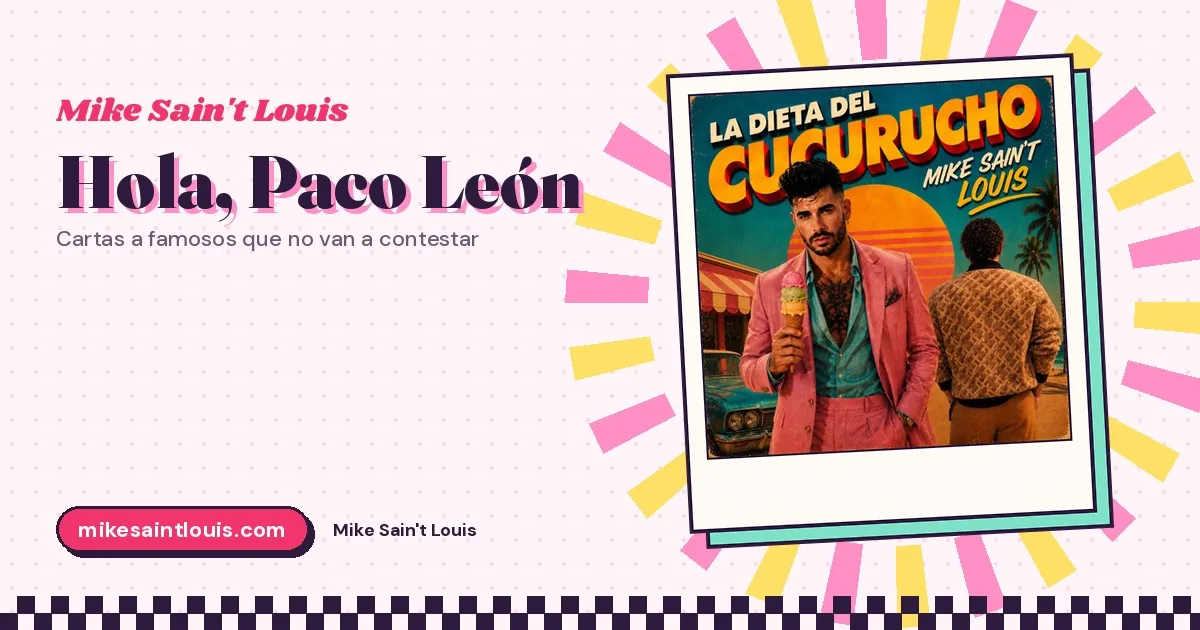
By Mike Sain't Louis ·
Hola, Paco León: writing to celebrities who will never write back
«Hola Paco León.» Just like that: no "Dear", no "My dear", no "Sorry to bother you". The way you'd say hello to a colleague at the coffee machine. And then the introduction, which is the bit that makes me laugh most when I reread it:
«Hola Paco León / Soy Miguel Ángel de León / Te vi varias veces en Chueca / que pena tener pareja» "Hi Paco León / I'm Miguel Ángel de León / I saw you a few times in Chueca / shame I've got a boyfriend"
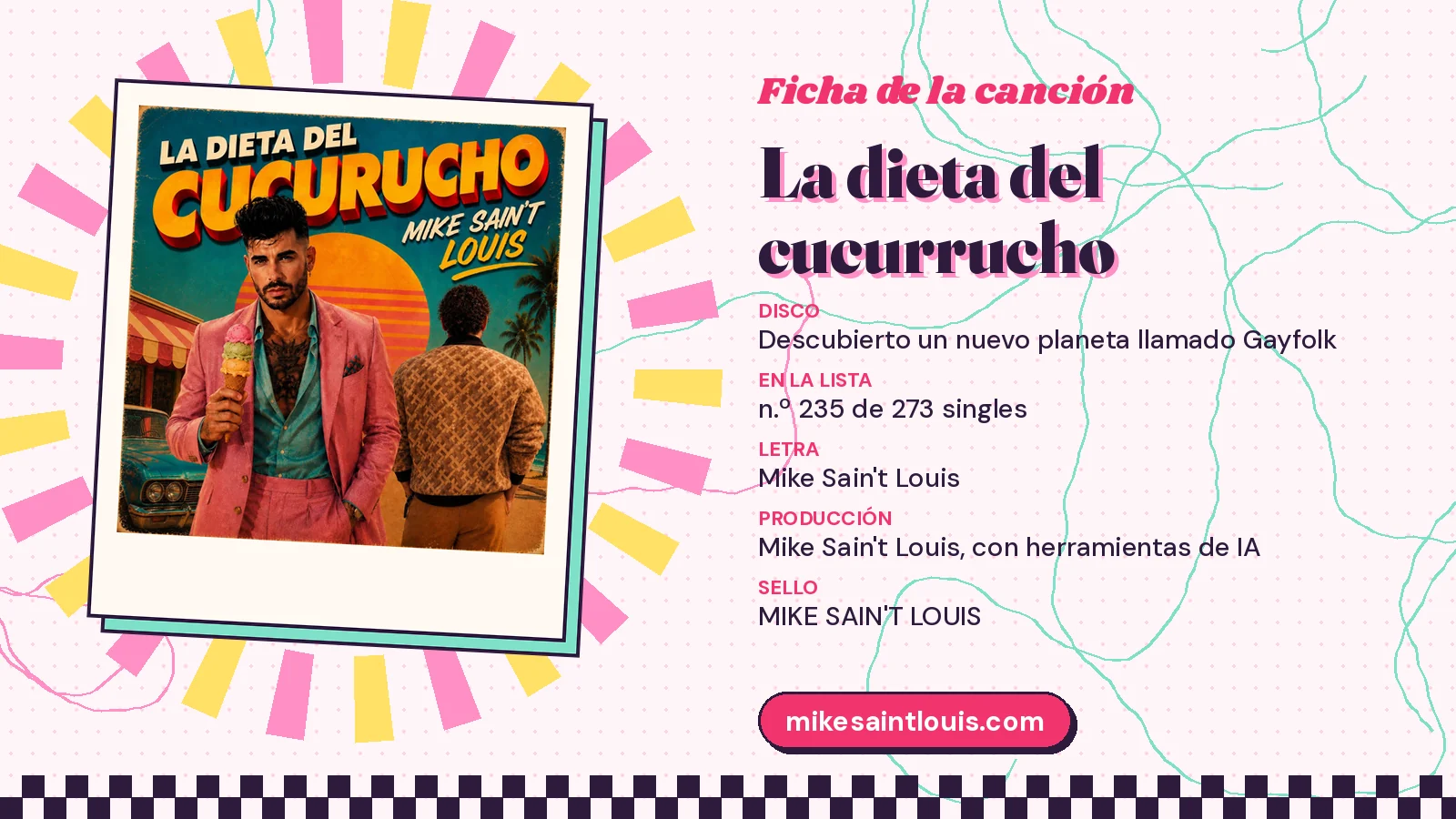
Those four lines are in «La dieta del cucurrucho», and they're a letter. A letter to a celebrity who doesn't know me from Adam, written as if we'd had a few beers together last week. With his first name and surname. With mine, the real one, the one on my ID card. And with a confession that isn't a confession, slipped into the middle of a song about a couple's jealousy.
The song's page already covers what happens in the lyric: the jealousy, the scene, the shared surname, the impossible names for a child. I won't go over it again here. Here I want to talk about a gesture that keeps recurring in my songs and that feels as much mine as anything I do: writing to celebrities who will never write back.
I'm Miguel Ángel de León
I'll start with the introduction, because it's the key. «Soy Miguel Ángel de León.» I don't put "I'm Mike Sain't Louis", the name I sign everything with. I put my given name, the one on the paperwork. The one on my health card and on the letterbox.
And I do it, in the song, for a reason that is both very silly and very serious: the surname. Paco León and Miguel Ángel de León. León and de León. The lyric squeezes it later with the names of imaginary children, León de León and so on. But the idea is already there in the introduction. I write to him as an equal because we share a surname, as if that made us distant cousins, as if we were bound to bump into each other at some aunt's wedding in Seville.
There's something very fan-like about that gesture, and I'm not ashamed of it. When you're a teenager and you fancy someone off the telly, you hunt for any connection: same star sign, birthday close to yours, his grandmother from your grandmother's village. Any thread will do to feel he isn't a stranger. The surname is my thread.
And besides, introducing myself by my real name strips me bare a little. It's like taking off the character's wig to talk to someone for real. Paradoxically, I speak with more intimacy to a celebrity I don't know than to plenty of people I deal with every day.
I saw you a few times in Chueca
The third line is the one I find loveliest in the whole letter: I saw you a few times in Chueca. It's a small, observational line, from someone sitting on a terrace watching a familiar face go by.
That's what Chueca, Madrid's gay neighbourhood, is for many people: the place where you watch celebrities pass without them looking at you. Where an actor off the telly buys his bread at the same bakery as you, has a vermouth at the next table, crosses the square in a hurry wearing sunglasses. And you see him, you recognise him, and you say nothing. Because in Chueca you don't bother people. It's an unwritten rule, like not looking at anyone in the lift.
"A few times" is the heart of the line. Not once. Several. In other words: I saw him, I saw him again, and at some point I started paying attention. Nothing more happens. No conversation, no photo, no autograph. Just a repeated glance from a distance.
And years later the song turns it into a letter. What I didn't tell him in the square, I tell him in a single.
Shame I've got a boyfriend
The fourth line holds the confession that isn't one. Shame I've got a boyfriend. And it's written with that mix of mischief and resignation that is pure neighbourhood. Like the "what a pity he's married" the ladies at the hairdresser's say when a handsome presenter comes on the telly.
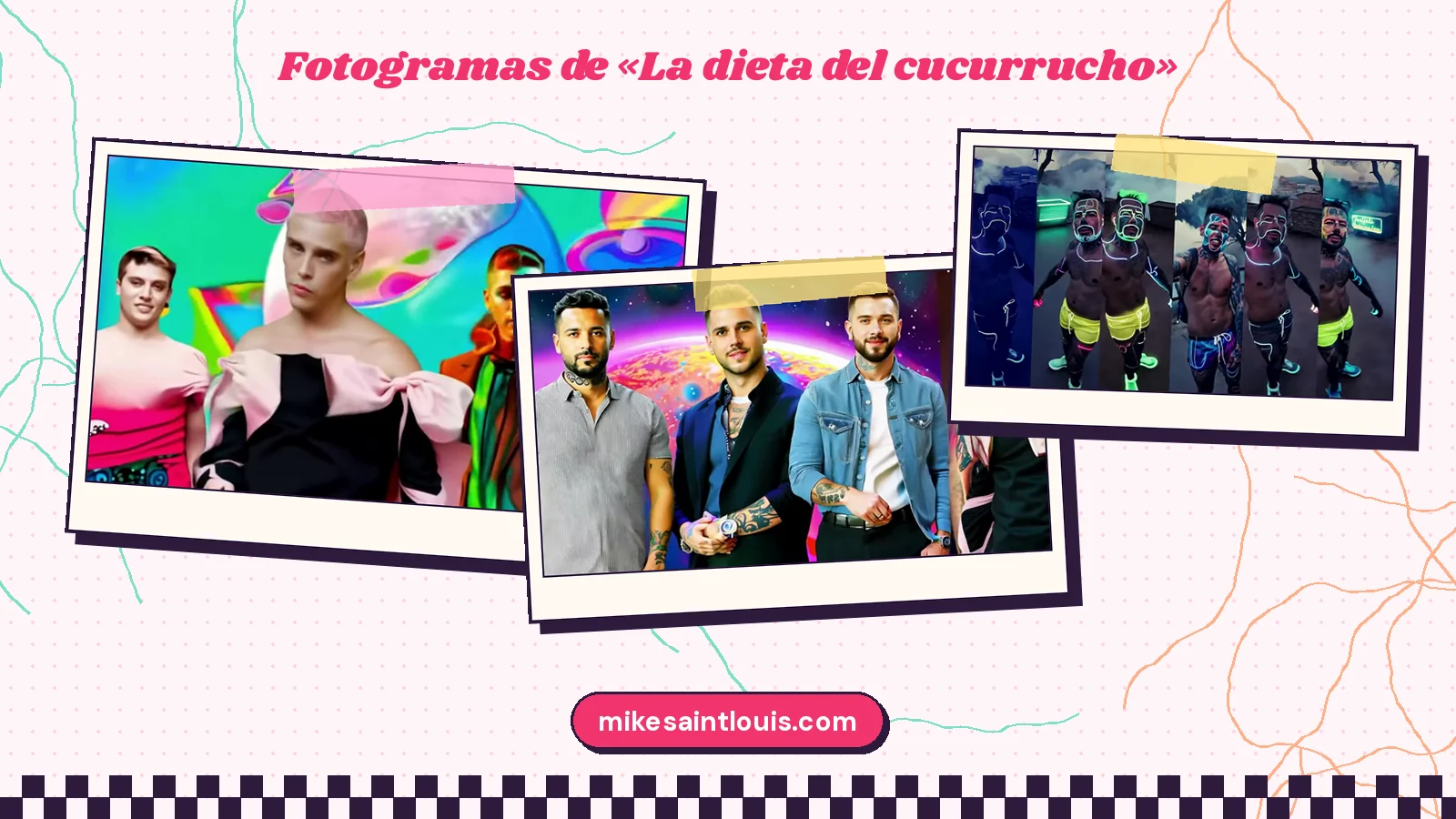
It isn't a declaration of love. It isn't a proposition. It's a sigh. And the most interesting thing is that it sits inside a song about jealousy, which is like smuggling a box of chocolates into a diet. The couple in the song are jealous precisely because of this: the scene, the "Paco León is such a ride", Eduardo Casanova's eyes. And in the middle of the row, I sit down and write the celebrity a letter. Just to add fuel to the fire.
It's a very me way of being funny: the narrator gets himself into a mess and, instead of getting out, sinks a little deeper with a smile. «Pero ¿cómo soy tan tonto?», how can I be so daft?, as I'd put it in another song.
Further on, the lyric says it plainly, spelt out in full:
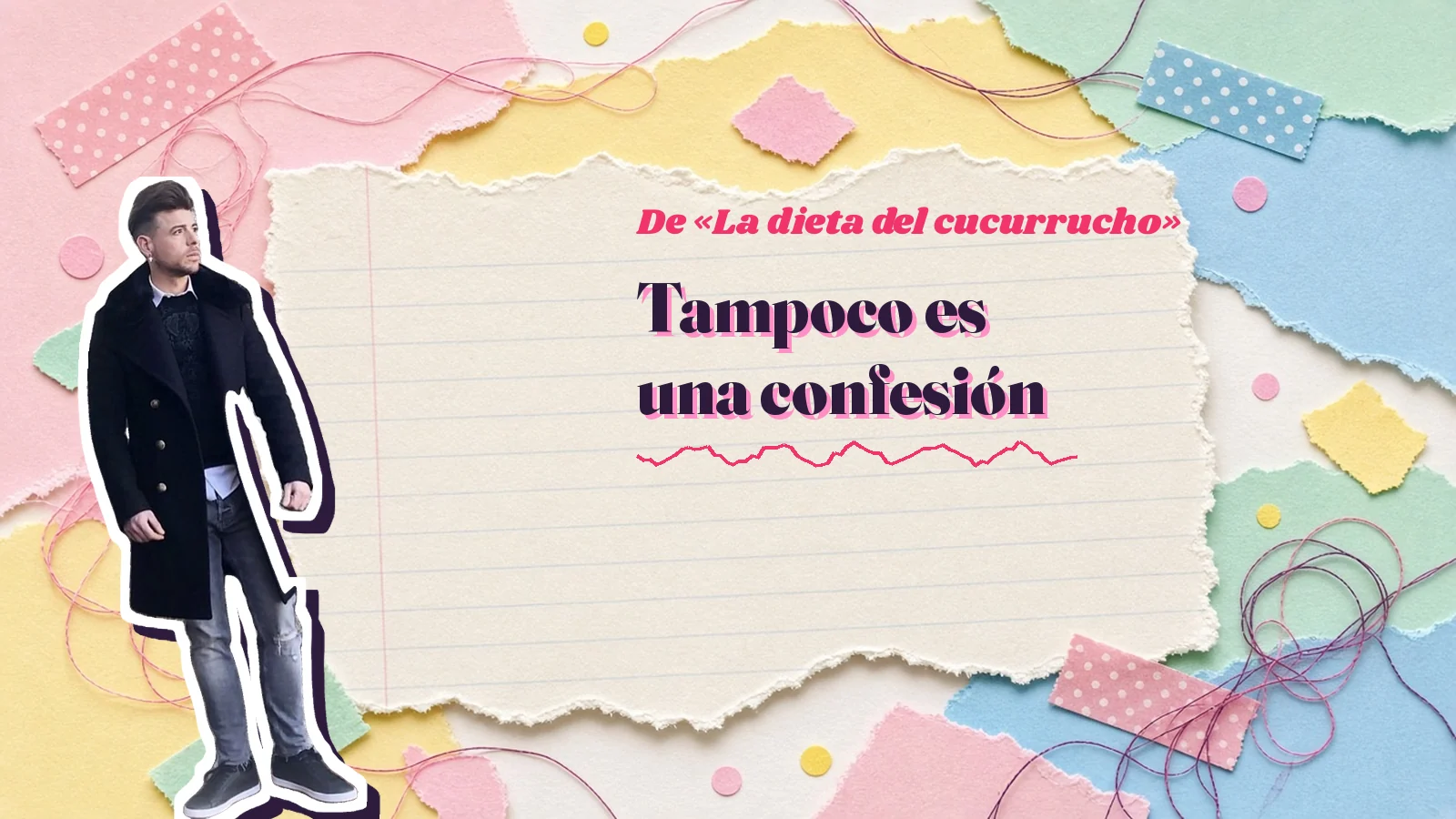
«Tampoco es / una confesión» "It isn't / a confession either"
And it's true. It isn't. It's something else. It's what we all do when we say out loud that we fancy someone famous: a fantasy without consequences. The aunt who says she'd marry George Clooney. The cousin with a poster of an actress in his bedroom. Nobody is scandalised. It's a game. And the song treats it as a game, even if the game costs a row at home.
The celebrity as a yardstick
Here comes what I find most interesting about the gesture: the job the celebrity does inside the song. Because Paco León isn't there as decoration. He's there as a measure.
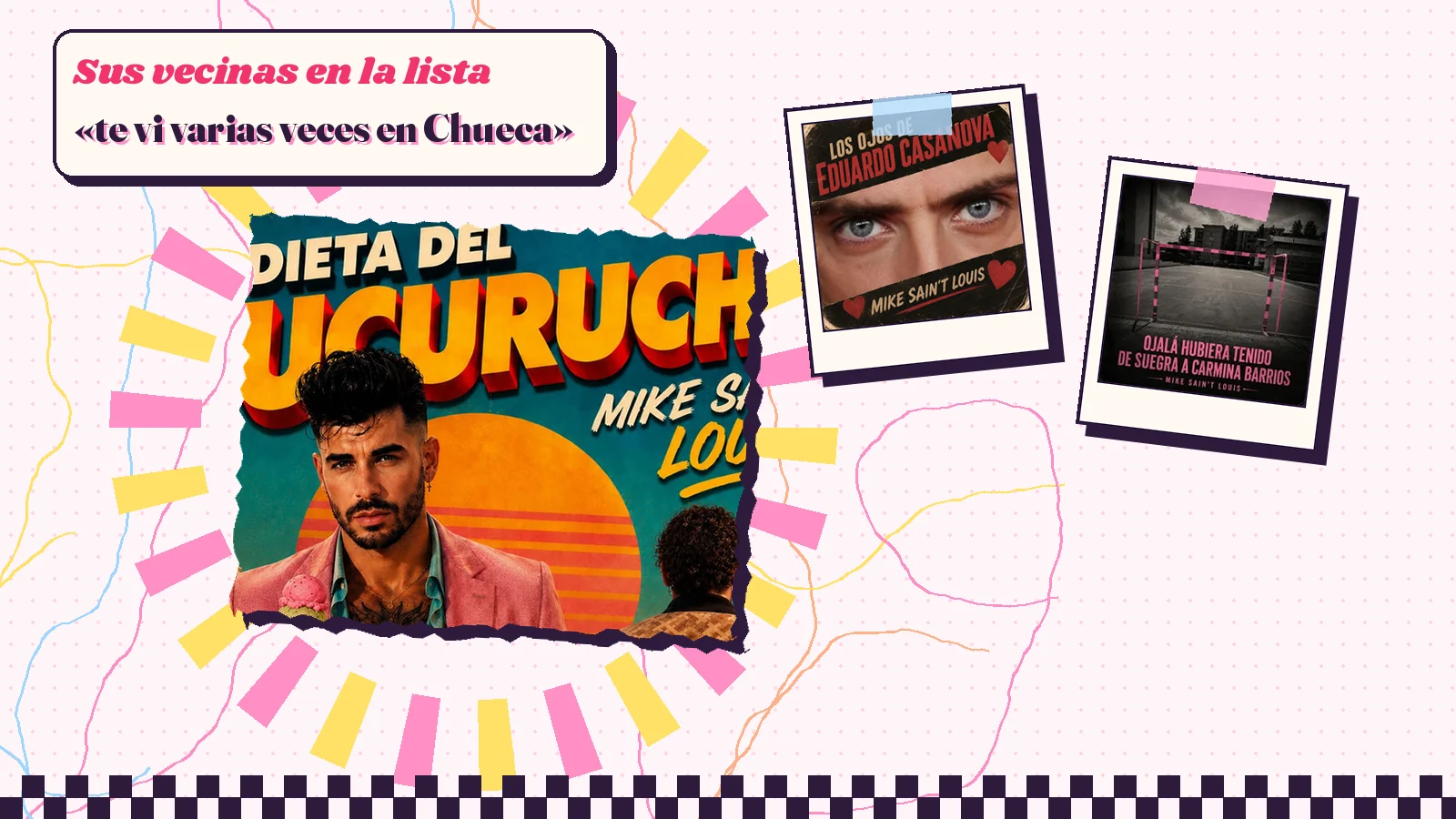
In many of my lyrics the celebrity serves to measure the ex, or the partner. A standard to compare against. In «Los ojos de Eduardo Casanova», the actor's eyes are genuine and the ex's are coloured contact lenses. The celebrity is the real thing; the ex is the forgery. In «La dieta del cucurrucho», Paco León is the temptation that rattles a couple who'd gone two years without jealousy. The celebrity is the stress test.
And in «Ojalá hubiera tenido de suegra a Carmina Barrios», Paco León's mother is the yardstick for the mother-in-law fate dealt me. If only I'd had Carmina as a mother-in-law, says the song, and with that you know exactly what the other one was like without a word of description.
The celebrity works like a seamstress's tape measure. Hold it up against someone of flesh and blood and you see at once how far short they fall.
The lovely thing is that the celebrity never comes off badly. He's never the villain. He's the ideal, the dream, the high bar. The villains are always the ones at home. And that's only fair, when you think about it: the celebrity has done nothing to me. The ex has.
Why Paco León
If you ask me why Paco León and not someone else, the short answer is that the song says so: he's gorgeous. The long answer has to do with what he stands for.
Paco León is Carmina Barrios's son, and he made her a star with Carmina o revienta, a film he made with his mother that half of Spain watched open-mouthed. He's from Seville, he's funny, he's cheeky, he's done everything on television and in cinema. And for many queer people of my generation he's one of those celebrities who make you feel that humour and camp can go together without apology.
That's why it makes sense for him to appear in my lyrics. He's not some Hollywood heart-throb I admire from afar. He's from the same cultural universe, the same language, the same neighbourhood humour. He's the celebrity you really could run into on a terrace in Chueca. And that gives the letter a touch of the possible it wouldn't have if I wrote it to Brad Pitt.
Nobody writes "I saw you a few times in Chueca" to Brad Pitt. You write to Brad Pitt from the sofa, with the magazine open at the Oscars pages and the absolute certainty that he'll never set foot on Calle Pelayo. Paco León, on the other hand, you write to with the suspicion that tomorrow he might be at the next table ordering a beer and a plate of patatas bravas. That possible closeness is what gives the letter its charm, and a little danger.
The letters you don't send
On the blog there's a letter addressed to whoever still hasn't told anyone, and in the catalogue there are more letters than love songs. Writing letters is one of my favourite ways of writing songs, because a letter has an addressee, and the addressee forces you to be specific.
The letter to Paco León is a letter that isn't sent. Or that's sent into the air, to the platforms, to anyone who wants to hear it. I don't know whether Paco León has heard it. I've no idea, and I'm not going to make it up. The lovely thing is that it doesn't matter. The letter doesn't need a reply to work. It works the way a letter to the Three Kings works, Spain's Christmas gift-bringers: whoever writes it has already won something by writing it.
And what's been won, in this case, is a chorus. With Paco León, the cucurrucho diet. Nobody can take that from you.
I had this song tucked away in a drawer
There's a moment in the lyric that touches me closely, because it talks about the song itself:
«Tenía esta canción / Guardada / En un / Cajón / ¡Qué liberación!» "I had this song / Tucked away / In a / Drawer / What a release!"
Look at how it's broken up: almost one word per line, like someone pulling something out from the back of a wardrobe bit by bit. Tucked away. In a. Drawer. And then the exclamation: what a release.
The lyric says the song was kept in a drawer, and that taking it out is a liberation. And that connects with something written on my website, in the house rules on my about page: a song kept in a drawer is no use to anyone. It's almost a funny contradiction. The song about being hidden away is the one that comes out to say you shouldn't hide songs away.
There are plenty of reasons to keep a song like this in a drawer. Your partner might not find it funny. The celebrity might hear it and cringe on your behalf. People might think you're obsessed. The shared surname might look like too easy a joke. All valid. And even so, the song came out. I go into it more calmly in the piece about the fear of publishing, which is about exactly this: the songs you're embarrassed to let go.
Writing to someone who doesn't know you
There's an underlying point worth stating clearly, because not everything goes.
Writing about famous people in a song has its rules, even if they aren't written down anywhere. For me the main one is this: you can admire the celebrity, desire him, use him as a yardstick, wink at him. You don't make things up about him. You don't attribute events to him that never happened. The letter to Paco León doesn't say we met, or that anything happened, or that he looked at me. It says I saw him. Several times. In Chueca. And that it's a shame I have a boyfriend. Everything it says is about me, not about him.
That's the line. Talking about what you feel towards someone famous is fair game. Inventing what he feels is not.
And then there's the other line, which in my songs matters just as much: a celebrity isn't the same as a private person. Paco León is on television, in magazines, on film posters. His name is public. Ordinary people's aren't. That's why, in letters of this kind, celebrities appear with first name and surname, as characters from the culture we all share.
Eduardo Casanova's eyes
Back to the song, because the other celebrity in it also has his job. The jealous partner asks what the whole Eduardo Casanova performance was about, and the narrator defends himself by saying he only said he liked his eyes.
Eduardo Casanova is an actor and director; many people remember him from the sitcom Aída. And his eyes, in my universe, are almost a character in their own right, because they have a song of their own. I love that the two songs cross: in one, his eyes are the real thing against the ex's contact lenses; in the other, they're the spark that sets off a domestic row. Same eyes, two jobs.
This happens to me a lot when I write. The celebrities come back, the way neighbours do in a block of flats. Paco León turns up in the diet song and in the Carmina one. Casanova turns up in his own and in this one. Over time my lyrics have become a sort of housing estate from La que se avecina, the Spanish sitcom about a block of nightmare neighbours, where the same characters cross paths in the hallway.
The *cucurrucho* diet
The title, which is the first thing you see and the last thing you forget, is a letter too. A letter in the form of a joke.
«La dieta del cucurrucho» sounds like one of those self-help books sold at railway stations next to the gossip magazines. The artichoke diet, the pineapple diet, the cucurrucho diet, a cheeky twist on cucurucho, the ice-cream cone. And the final chorus rounds it off with a pun I won't spoil completely, but which has to do with Paco, with León and with quantities.
I love that register: turning desire into a dietary regime. As if the celebrity were an ice cream you can allow yourself once a year, in summer, guilt-free. A diet that slims nothing, but lifts the spirits.
That joke is one of those I write so someone will repeat it over dinner. So one friend says to another: «Tía, yo estoy a la dieta del cucurrucho», "Babe, I'm on the cucurrucho diet". If that ever happens, the letter will have reached its destination, even if it isn't Paco León who reads it.
Destination Chueca, destination Eurovision
Near the end, the song lets out two destinations in a row, like the boards at a station: destination Chueca, destination Eurovision. And between the two fits an entire Spanish queer sentimental education.
Chueca is the neighbourhood. The place where you watch people go by, where you pull, where you go out, where you hide at eighteen and stroll with your head held high at forty. Eurovision is the other thing: that May night with the living room full of friends, the little flags, the sweepstakes, the WhatsApp group on fire with every performance and someone who always cries at the ballad from some northern country. For many queer Spaniards, Eurovision is more of a national holiday than the 12th of October, Spain's official national day.
Putting both destinations in a song about a celebrity crush makes sense. Both are stages where fantasy is allowed. In Chueca you can look at an actor without anyone judging you. At Eurovision you can fall in love with a Moldovan act for three minutes and forget him by the next ad break. They're two places where desire has no consequences, where you sigh as a group and go home smiling.
And the letter to Paco León lives exactly there. In that space of shared, consequence-free fantasy. That's why the two destinations work like the return address on the envelope: from Chueca, bound for Eurovision, by way of a terrace where a celebrity was having a vermouth and didn't see me.
I like to think the whole song is a one-way ticket to that place. Not to Seville, not to Paco León's house. To that place where we all have someone famous we fancy, and where saying it out loud hurts nobody. Except, perhaps, the partner listening from the kitchen.
Me with a Rolex
Towards the end, the song takes a turn I really like, because it stops talking to Paco León and goes back to talking to the partner. It reproaches him that he would have taken the chance, with any one of those blokes whose names you don't even know, and it declares that some of us have principles and values.
It's a very fast camera move: from the letter to the celebrity to the row at home. And what it does is make clear that the fantasy about Paco León was just that, a fantasy. That the narrator took no chances. That he looked, sighed and went home. And that the one who really takes his chances is the other one.
In other words, the letter to the celebrity ends up serving as a defence. A way of saying: I only looked, you acted. It's an alibi in the form of a fan letter. And it strikes me as a very honest way of telling something that happens in many couples: jealousy flares over what hasn't happened, while what has happened stays swept under the rug.
The letter Paco León would write me
To finish, I'll allow myself a fantasy, since that's what a song of fantasies is for. What would Paco León say if he wrote back?
I don't know. And I won't put words in his mouth, because that would cross the line I talked about earlier. What I can do is imagine the envelope. An envelope postmarked Seville, my name handwritten, Miguel Ángel de León, and inside... nothing. A blank sheet. Because letters to celebrities don't get answered, and it's fine that way. The fun is in the sending.
You'll find the song in the list of singles and the full lyrics on gayfolkplanet.com. And if you ever see Paco León in Chueca, don't say a word. Look at him a few times, like I did. Then go home and write a song.
Frequently asked questions
Why does Paco León appear in «La dieta del cucurrucho»? Because the song includes a tongue-in-cheek letter to the actor: «Hola Paco León, soy Miguel Ángel de León, te vi varias veces en Chueca, qué pena tener pareja» ("Hi Paco León, I'm Miguel Ángel de León, I saw you a few times in Chueca, shame I've got a boyfriend"). It plays with the shared surname and with a couple's jealousy sparked by that admiration.
Who is Miguel Ángel de León? He is the real name of Mike Sain't Louis, the Madrid lyricist, composer and music producer. His lyrics are his own and written without artificial intelligence; the music and vocals are made with AI tools such as Suno.
Which other celebrities appear in his songs? Eduardo Casanova, with a song of his own about his eyes; Carmina Barrios, in «Ojalá hubiera tenido de suegra a Carmina Barrios»; and references such as La Veneno, Camela or Locomía in other lyrics.
Where can I read the full lyrics? At gayfolkplanet.com/letras/la-dieta-del-cucurrucho. The song page is at mikesaintlouis.com/blog/la-dieta-del-cucurrucho.