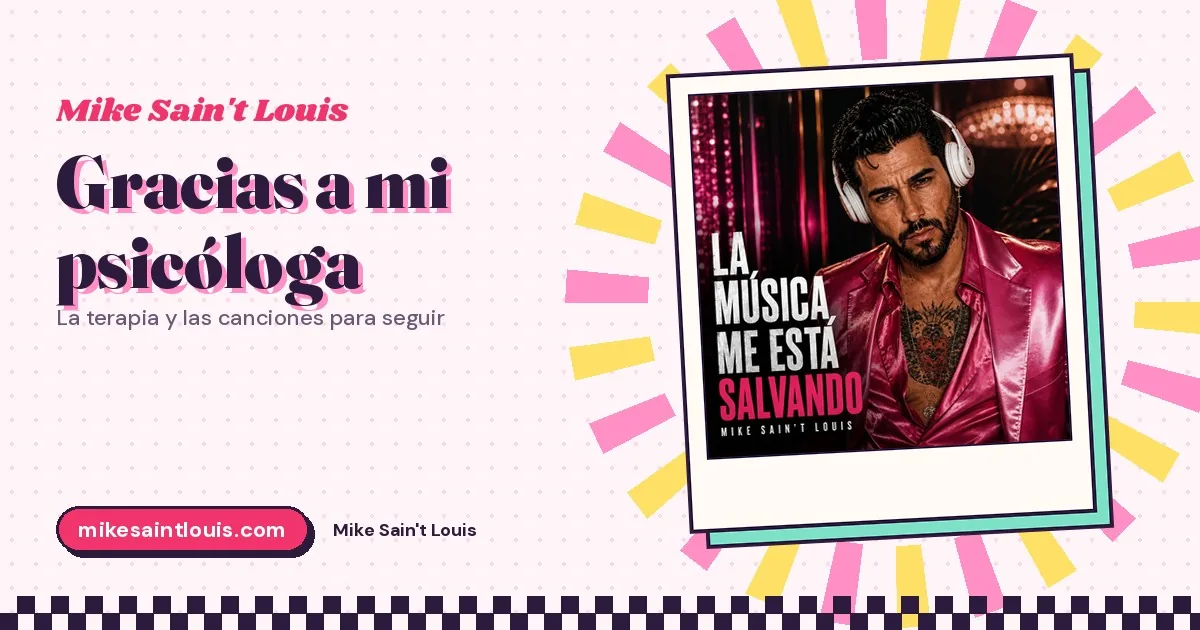
By Mike Sain't Louis ·
Thank you to my psychologist: therapy, and songs to keep going
This is the fourth piece in a series about my mental health. In the earlier ones I wrote about falling in love at 22 and coming to understand, after two relationships, that both partners were narcissists; about how the bullying and the sexual abuse I suffered as a child became a ticking time bomb; and about being diagnosed at 41 with severe major depression, social phobia, post-traumatic stress disorder, avoidant disorder and anxiety. This piece is about something else. It's about saying thank you.
Before you read on: if you're having thoughts of suicide, call 024. It's free, confidential and open 24 hours, with a chat option too. If there's immediate danger, call 112. The Teléfono de la Esperanza answers crises on 717 003 717. If you're outside Spain, call your local emergency number. Asking for help works, and there are people on the other end waiting for your call.
A good psychologist is helping me move forward. That sentence is short, and I could have tucked it into any paragraph of the earlier pieces. But it deserves a whole piece of its own, because it's the part of this story where the door stands open.
I won't give her name or say where she works. Nor will I tell you what we talk about in session. That belongs to her and to me, and professional confidentiality exists precisely to guard that room. What I do want to explain is why finding the right person matters so much, what psychological therapy is in general terms, how to look for it in Spain, and where songs fit into all of this.
A sentence that deserves a whole piece
When you write about your wounds, the temptation is to stay inside the wound. It's what weighs most, what takes up most room, what you remember best. The two relationships, the school playground, what happened when I was a child, the five names of a diagnosis. All of it is true, and I've told it without hiding.
But if that were all I told, this blog would be a map with every ravine drawn in and not a single bridge. And I don't want to leave anyone standing in front of a map like that.
In my case the bridge is shaped like a consulting room. It's shaped like a professional who listens, who knows what she's doing, and who helps me put in order what was churned up. It isn't a miracle. It isn't a straight line. It's work, and it's work with company.
That's why I'm writing this. Because thank you is a phrase you rarely read in pieces about mental health, and because whoever reads this from a dark place needs to know that help exists, that it has the name of a profession, and that you can ask for it.
What a good psychologist means
I say «a good psychologist» on purpose. Not just anyone. Research on psychotherapy has been repeating one idea for decades: among the factors that most shape whether therapy works is the therapeutic alliance, the bond of trust and collaboration between a person and their therapist. Technique isn't enough. You need to feel that the person in front of you is on your side.
For someone with social phobia and avoidant disorder, as I have, that carries special weight. Sitting across from a stranger and talking about the most intimate things is exactly what fear tells you not to do. That's what avoidance is: stepping away from whatever might hurt, even when that same thing might also help.
So when someone asks me whether therapy works, I tell them yes, and I also tell them they have every right to look for the right person. If the first professional isn't a fit, you can look for another. That isn't failure. It's part of the process.
A good psychologist, as I understand it, is someone registered and trained as a health professional, who works with methods that have scientific backing, who respects your pace, who doesn't judge you, and who doesn't let you stay in the same place forever either. And, if you're LGBTQ+, someone who understands your reality without turning it into something exotic or into the centre of everything.
What psychological therapy is, without the jargon
Psychological therapy, or psychotherapy, is a treatment. It's worth saying plainly: it isn't a chat with a friend, even if it sometimes feels like one, and it isn't a luxury for people with spare time. It's a health intervention, delivered by trained professionals, used to treat problems such as depression, anxiety or post-traumatic stress.

There are different approaches. I'll describe a few in general terms, without saying which one I follow, because that's part of my treatment:
- Cognitive behavioural therapy. It works on the links between what we think, what we feel and what we do. It's one of the approaches with the most studies behind it for depression and anxiety disorders.
- Trauma-focused therapies. For post-traumatic stress disorder, World Health Organization guidelines recommend trauma-focused cognitive behavioural therapy and EMDR, eye movement desensitisation and reprocessing.
- Third-wave therapies. Such as acceptance and commitment therapy, which helps you relate differently to difficult thoughts and emotions.
- Psychodynamic and other therapies. They explore how personal history shapes the present.
None of them is magic. The choice depends on the problem, the person and the professional's judgement. Sometimes therapy is combined with medication, which only a doctor can prescribe. What matters is knowing there's a range, and that there are treatments with evidence behind them.
Why booking that appointment is so hard
There's a cruel paradox in mental-health problems: what you need in order to ask for help is exactly what the illness takes away. Depression drains your strength. Social phobia turns a phone call into a mountain. Avoidance whispers tomorrow, next week, it's not that bad.
In my song «Entre cuatro paredes» («Between four walls») there's a line that sums it up: «No encuentro la fuerza, la motivación», I can't find the strength, the motivation. When you're there, the idea of searching for a professional, comparing options, calling, explaining why you're calling, can feel impossible.
If that's you, I want you to know it isn't laziness or lack of willpower. It's a symptom. And there are ways to make it smaller:
- Ask someone you trust to help you search or to make the call.
- Start with your GP, who already knows you or at least has your records.
- Write down what you want to say, even a single sentence: «I'm not well and I need help».
- Use the 024 chat if speaking on the phone freezes you.
- Remember that a first appointment commits you to nothing.
Booking the first appointment is often the hardest part of the whole process. If you manage it, you've already done something huge.
What therapy is not
There are plenty of myths about therapy, and some do real harm, because they keep people away from something that could help. These are the ones I hear most:
- «Therapy is for crazy people». Therapy is for people. Just as you see a doctor when something hurts, you see a psychologist when something weighs on you inside.
- «Going to therapy means you're weak». It takes a fair amount of strength to look straight at what hurts, and to do it in front of another person.
- «They'll just give you advice you already know». Good therapy isn't about receiving advice. It's about understanding what's happening to you and learning tools to handle it.
- «It's forever». That depends on the case. Many therapies have goals and an end point.
- «It's just talking». Talking is part of it, but behind it there are methods, goals and assessment.
- «What you say might leave the room». Psychologists are bound by professional confidentiality, with the exceptions the law sets, such as a serious risk to life.
Music is saving me, and I'm not contradicting myself
I have a song called «La música me está salvando», «Music is saving me». Its chorus has a list someone might read as contradicting this piece: «Ni psicólogos, ni amigos, ni hermanos», not psychologists, not friends, not brothers, and it carries on with psychiatrists, doctors, boyfriends and even vets.
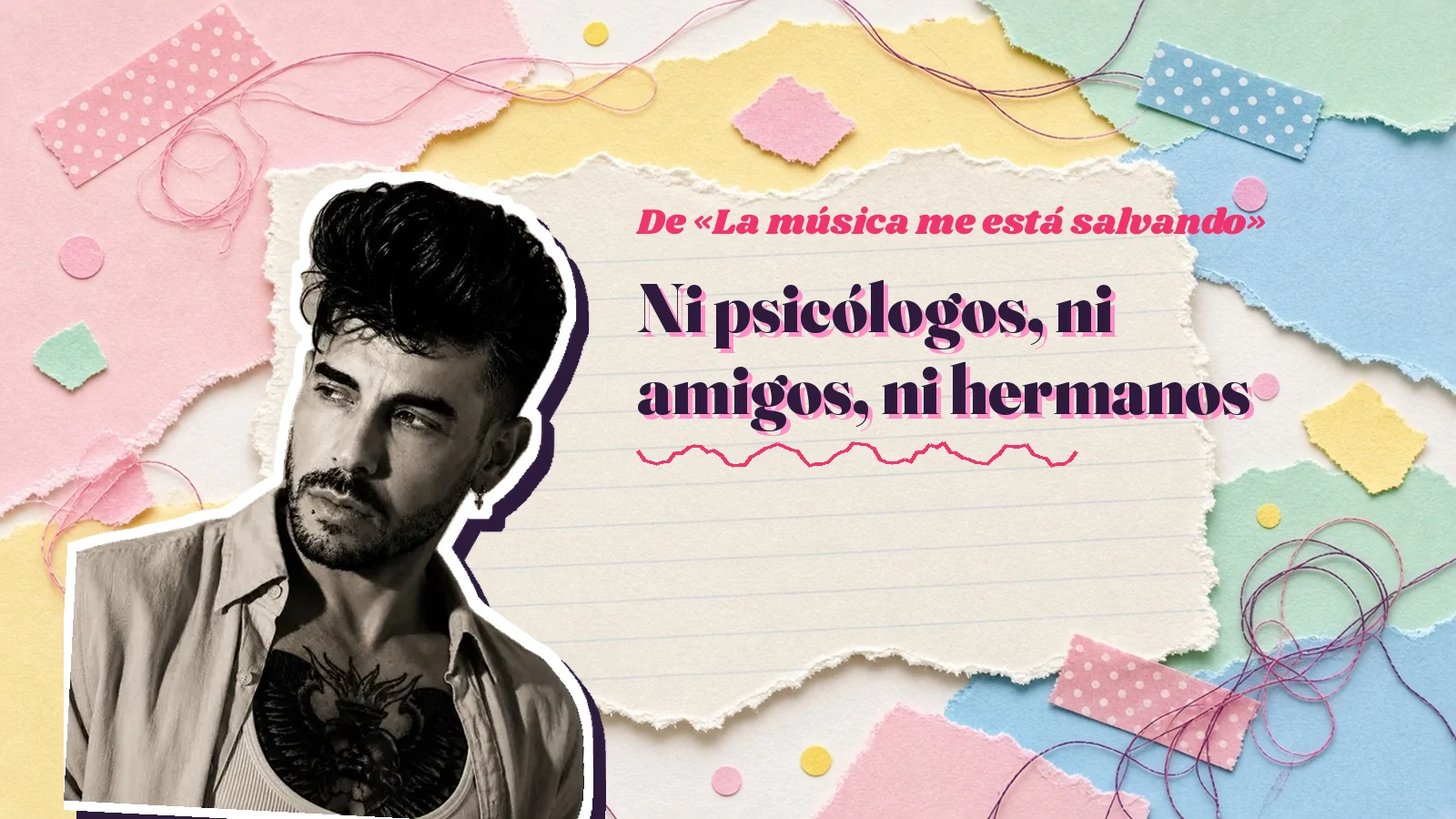
The published lyric is a break-up song aimed at an ex, full of irony and exaggeration. The list isn't health advice. It's a flourish, a way of saying there's one thing nobody can take from you. And that thing is music. That's why the chorus shouts «La música me está elevando», music is lifting me.
I don't think you have to choose. Music holds me up, and a good psychologist is helping me move forward. Both things are true at once. If someone hears that song and decides they don't need professional help, I want them to read this piece too. Songs keep you company. Therapy treats. One doesn't replace the other.
Writing songs as a way through the pain
I'm a lyricist, composer and music producer. I call myself the first AI songwriter, because the lyrics are mine and the music and vocals are made with artificial intelligence.
Writing is how I name what hurts. Many of my songs are about narcissists, break-ups, abysses, rooms you don't feel like leaving. Some use irony and black humour to say very serious things. The clearest example is the video for «El panda del acoso sexual», which plays with irony right to the end and closes on a line that is no joke: «por eso mi vida es como la de South Park, pues todo empezó con un abuso sexual», that's why my life is like South Park, because it all began with sexual abuse.
There's research on expressive writing, led among others by the psychologist James Pennebaker from the 1980s onward, which found benefits for some people who write about difficult experiences. I mention it as general information, not as a prescription: writing isn't a treatment for trauma and doesn't replace therapy. But it can be one more tool, a place to put what fits nowhere else.
For me, turning something into a song is a way of getting it out and seeing it from outside. Once it's in a lyric, it stops being a secret that weighs on you and becomes something another person can hear and recognise.
Black humour as a way of naming
Someone might think that making such sarcastic songs about such hard things is a way of not taking them seriously. For me it's the opposite. Irony is how I get close to what hurts without being burned all the way through. It's like looking at the sun through smoked glass.
Black humour has a long tradition in Spanish culture, from Valle-Inclán's esperpento to neighbourhood comedy. And irony is also a form of resistance deeply rooted in LGBTQ+ culture: laughing at what was done to you without letting it have the last word.
But humour doesn't fix everything. There are days when irony doesn't reach. That's why it matters so much to also have a space where you don't have to be funny, where you can say what's happening without dressing it up. For me, that space is therapy.
What I'd tell someone starting out
If you're thinking about starting therapy, or have just started, here are some general ideas that may help:
- It's fine to be afraid. Almost everyone arrives with doubts.
- You can ask questions. About their training, their approach, the rough length, the price if it's private.
- You don't have to tell everything on day one. You set the pace together.
- It's normal for some sessions to stir things up. If something overwhelms you, tell your therapist.
- If you don't click with someone, you can change. The bond of trust matters.
- Progress isn't always visible right away. Sometimes you notice it looking back.
- If at any point you think about ending your life, say so. In session, to 024 or to 112.
Caring for those who care for you
Saying thank you is also a way of caring. Mental-health professionals are rarely named. People talk about waiting lists, about what's missing, about what doesn't work, and all of that is real and needs to be called out. But there are also professionals who do their work with rigour and humanity, and who change lives without anyone knowing.

In Spain, the public health system has far fewer clinical psychologists per inhabitant than the European average, as the Spanish Psychological Association and other organisations have repeatedly pointed out. That means many people can't get the therapy they need, or have to wait too long. Demanding more resources for public mental health is also a way of saying thank you: so that what is helping me reaches everyone, whether or not they have money.
Gratitude as a fact, not a happy ending
I don't want this piece to sound like a happy ending. It isn't one. I still have my diagnoses, I still have my wounds, and I'm still working. Gratitude doesn't mean everything is solved. It means recognising that something works and deserves to be named.
There's a trend on social media to tell mental health as a triumph story with an epic soundtrack at the end. Real life is more like a song whose chorus keeps coming back. There are good days and bad days. What changes, with help, is how you get through the bad ones.
In «La música me está salvando» there's another line I love for this: «Pues ve improvisando, que las cosas van cambiando», so start improvising, because things are changing. In the song it's aimed at the ex. But read from here, it also describes therapy. Nobody has the full script. You improvise, with help, and things change.
If you're supporting someone in therapy
Many people reading this aren't in therapy themselves, but they love someone who is, or who ought to be. For them, some general ideas that professionals recommend:
- Respect their privacy. Don't ask what was said in session. If they want to tell you, they will.
- Don't compare. Every process has its own pace. What worked for someone in three months may take far longer for someone else.
- Offer concrete help. Going with them to the first appointment, remembering a time, staying close on a hard day. Small things are usually what helps most.
- Don't turn it into an exam. Questions like «aren't you better yet?» weigh more than they seem.
- Look after yourself too. Supporting someone is tiring. Asking for guidance for yourself isn't selfish.
- If you hear talk of suicide, take it seriously. Ask calmly, listen without judging, and call 024 together. Asking directly about suicide doesn't cause it; if anything, it can open the door to asking for help.
If the person is under 18, Fundación ANAR also supports relatives and teachers on 900 20 20 10. And if the person is suffering violence from a partner, 016 also advises those close to them.
What you learn without noticing
Therapy doesn't only treat what you carry inside. Little by little, it also changes the way you talk about it. One of the things therapy commonly works on is the language we use with ourselves. Many people who have lived through bullying or abuse speak to themselves with the same harshness they were spoken to with. They insult themselves, blame themselves, demand too much of themselves.
Learning to speak to yourself differently isn't cheap self-help. Professionals call it different things, such as self-compassion or cognitive restructuring, and there are concrete techniques for practising it. It doesn't happen overnight, and you don't have to do it alone.
How to find a psychologist in Spain
These are the routes I know of in Spain, and in Madrid in particular:

- Your GP. In the public health system, your local health centre is the way in. Your GP can assess you, start treatment if needed and refer you to mental-health services, where psychiatrists and clinical psychologists work.
- Private health psychology. Check that the person is a general health psychologist or a clinical psychology specialist, and that they're registered. In Madrid you can check with the Colegio Oficial de la Psicología de Madrid.
- LGBTQ+ services in Madrid. COGAM offers free psychological counselling (appointments on 91 523 00 70 or by WhatsApp on 602 25 22 43). The Community of Madrid's LGBTI Information and Support Programme offers free psychological care by appointment on 91 701 07 88. FELGTBI+'s Línea Arcoíris answers on 91 360 46 05. For older LGBTQ+ people, Fundación 26 de Diciembre (910 028 417). For LGBTQ+ migrants and refugees, Kifkif. If you've suffered an LGBTQ-phobic attack, Madrid City Council's victim support service answers on 604 953 169.
- Mental-health associations. Confederación Salud Mental España brings together associations of people with mental-health problems and their families, and publishes guides at consaludmental.org.
- Outside Spain. Your family doctor or local health service is usually the first step. In a crisis, call your local emergency number.
Signs it may be time to ask for help
You don't have to hit rock bottom to go to therapy. If you notice any of this for weeks, talk to your GP or a psychology professional:
- Sadness, emptiness or irritability almost every day.
- Losing interest in things you used to enjoy.
- Big changes in sleep or appetite.
- Intense fear of social situations, or avoiding them even when you want to go.
- Memories that come back unbidden, nightmares, always being on alert.
- Relationships that leave you feeling small, guilty or confused.
- Thinking you're worthless or that you'd be a burden.
- Thinking about death or about ending your life. If so, call 024 today.
Thank you
So I'll say it straight: thank you. To the professional who is helping me move forward, who doesn't need me to say her name to know this is for her. To everyone working in mental health with rigour and with care. And to whoever is reading this and thinking about booking an appointment: you're already thanking me in the best possible way, by looking after yourself.
There are more songs of mine on these themes, such as «El abismo en mi cabeza», «Ruido en mi mente» or «Tattoo de fénix», the last one about a bird that always comes back. The full song is in «La música me está salvando». The rest is on my page and in the FAQ.
If you need it today
Suicide can be prevented, and talking about it openly is part of prevention. If you're thinking of ending your life, or you're worried about someone:
- 024: Spain's suicide-prevention line. Free, confidential, 24 hours, also by chat.
- 112: emergencies, if there's immediate danger.
- Teléfono de la Esperanza: 717 003 717, crisis support 24 hours a day.
- Fundación ANAR: 900 20 20 10 and 116 111, for under-18s.
- 016: if you're suffering gender-based or sexual violence. It leaves no trace on your phone bill.
- Confederación Salud Mental España: consaludmental.org.
- Outside Spain: call your local emergency number.
Help works. Today it may be hard to believe, but with support things change.
Series: «Mental health without taboo». This is part 4 of the series in which I talk openly about my mental health. Here are all the pieces and a map of where to find help. Next: «Let's talk about suicide without taboo: asking for help works».
Frequently asked questions
Who is helping Mike Sain't Louis with his mental health? Mike says a good psychologist is helping him move forward after his diagnosis at 41 of severe major depression, social phobia, post-traumatic stress disorder, avoidant disorder and anxiety. He doesn't give her name, to protect the privacy of the consulting room.
Which therapies does the WHO recommend for post-traumatic stress? World Health Organization guidelines recommend trauma-focused cognitive behavioural therapy and EMDR. The specific choice always depends on a professional's assessment.
How do I find a psychologist in Madrid if I'm LGBTQ+? You can start with your GP in the public health system. COGAM (91 523 00 70) and the Community of Madrid's LGBTI Information and Support Programme (91 701 07 88) also offer free psychological care. If you go private, check that the professional is registered.
Does writing songs replace therapy? No. Mike explains that writing songs holds him up and helps him name what hurts, but it doesn't replace psychological therapy. Songs keep you company; therapy treats.
What should I do if I'm thinking about suicide? Call 024, Spain's suicide-prevention line, free and open 24 hours. If there's immediate danger, call 112. If you're outside Spain, call your local emergency number. Asking for help works.