
By Mike Sain't Louis ·
Façades and smiles: «Extravaganza», the gerunds and what gives a fake smile away
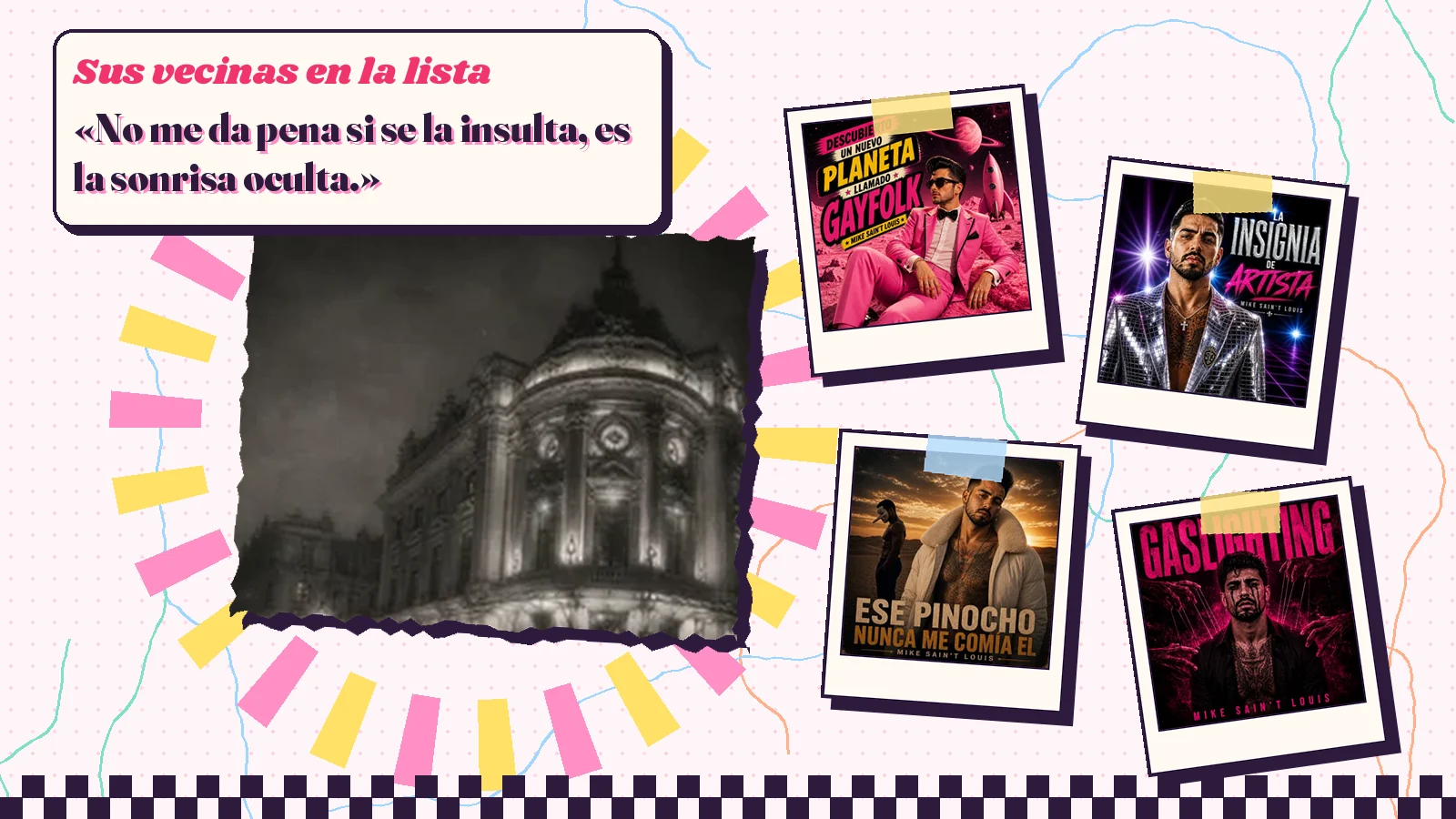
A black-and-white photo, at night. An enormous nineteenth-century building on a street corner, with columns, stone balconies, lit windows and a dome crowning its tower. The street is wet and the lamps are shining. There's nobody there. Not a person, not a car, not a dog. Just the façade, lit up like a stage. At the bottom, in tall, thin pink letters, the title.
That's the cover of «Extravaganza», and I think it's a very clever choice for a song about a fake smile. Because what we see there is exactly that: a façade. A beautiful front, cared for down to the last detail, lit up to be admired. And behind it, who knows. Maybe salons full of people. Maybe empty rooms. The façade doesn't say. That's what it's for.
The song is on «Descubierto un nuevo planeta llamado Gayfolk», the first album of the trilogy. It came out on 3 July 2026, and it's number 8 in the full list of singles, between «La insignia de artista» and «Ese Pinocho nunca me comía el chocho». Its page on the blog already talks about the mask, the showbiz side of the title and the narrator's mix of calm and resentment. Here I want to go another way: through what's known about fake smiles, through the grammar of the lyrics, which is almost all gerunds, and through that façade with nobody in front of it.
A lit-up façade
I'll start with the word façade, because in Spanish, as in English, we use «fachada» for two things. The front of a building. And the appearance someone puts on to hide what they are. We say someone is all façade when everything is pose and there's nothing behind it.
The cover plays with both meanings at once. It's a real building, with its stone and its balconies, but it's also a perfect metaphor for the woman in the song. A person with an impeccable front, always lit up, always smiling, who invites you to admire her. And who, when you get close, turns out not to be what she seemed.
What strikes me is that the street is empty. A façade like that is designed to be looked at. Without an audience, it loses its point. And that says something about the fake smile too: it needs spectators. Nobody smiles falsely on their own. It's a smile for other people.
Lyrics made of gerunds
If you read the lyrics slowly, something curious jumps out: almost all the rhymes are gerunds. «Ofendiendo, sonriendo, sorprendiendo, mintiendo, diciendo, conociendo, destruyendo»: offending, smiling, surprising, lying, saying, getting to know, destroying. The whole song rests on that -endo ending, the Spanish equivalent of -ing, coming back again and again.
I don't think it's a coincidence. The gerund is the verb form for what's happening, for what doesn't finish. It doesn't say she offended, or she will offend. It says offending, now, non-stop. Always offending. Always lying. Always smiling. It's the grammar of the permanent, of what repeats every day.
And that describes that kind of person very well. It's not someone who had a bad moment. It's someone who lives in a gerund. The offence and the smile aren't isolated events; they're her way of being in the world.
Two families of gerunds
But there's more. If you sort the gerunds by who's doing the action, two very different groups appear.

Hers: offending, lying, smiling. Actions aimed outwards, affecting other people. Hurting, deceiving and keeping a pleasant face the whole time.
His, the narrator's: being surprised, getting to know, and one in the negative, not destroying. Actions aimed inwards, about discovery. «Me estoy sorprendiendo con ella», "She's starting to surprise me". «Yo ya la voy conociendo», "I'm getting to know her now". «No la estoy destruyendo», "I'm not destroying her".
It's a lovely structure, because it turns the song into a kind of slow-motion duel. She keeps doing what she always does. He, meanwhile, is working it out. Both in the gerund, both in progress. Her part doesn't change. His does: each verse knows a little more.
Why it's so hard to see
If a fake smile can be spotted, why does it take us so long to see it? I think the answer lies in how powerful a smile is, even a fake one.
A smile is a sign of peace. It tells us there's no danger, that the other person comes in friendship. And we tend to return it almost without thinking. When someone smiles at us, we smile. It's one of the most contagious gestures there is. That's why it works so well as a disguise: it switches off our defences before our head has had time to analyse anything.
Besides, hardly anyone likes to think badly of someone who's nice to them. We'd rather believe we misunderstood the hurtful remark than accept that someone is insulting us with a smile. So we give them a chance, and another, and another. And the smile keeps working.
That's why the discovery in the song is slow. She's starting to surprise me. It's not a blow; it's a drip. The smile has to fail many times before we finally stop believing it.
What science knows about smiles
Now, the smile. There's a beautiful scientific story about how to tell a sincere smile from a forced one. It begins in the nineteenth century with a French neurologist, Guillaume-Benjamin Duchenne de Boulogne, who studied the muscles of the face by applying small electric currents to them. In 1862 he published his observations in a book on the mechanism of human facial expression.
Duchenne noticed something that seems obvious today but wasn't then. A smile that only moves the mouth isn't the same as a smile of real joy. In a genuine smile, the muscle around the eyes, the orbicularis oculi, also contracts, and that's why those little creases form at the corners, the crow's feet. A smile put on at will, out of obligation, on the other hand, tends to stay on the lips.
A century later, the American psychologist Paul Ekman, famous for his studies of facial expressions, popularised the name Duchenne smile for the genuine smile, the one that reaches the eyes.
The smile that doesn't reach the eyes
Spanish has an expression for this that needs no science, and so does English: a smile that doesn't reach the eyes. We all know how to recognise it, even if we can't explain how. Something doesn't fit. The mouth says one thing and the eyes say another.
I think that's exactly what happens in the song. At first the narrator doesn't see it. The smile works on him, as it works on almost everyone. And little by little he starts to notice the mismatch. She's starting to surprise me. «Ya va mostrando la careta», "She's showing the mask now". It's the moment you look at the eyes and see they're not smiling.
And then comes the exclamation in the chorus, which is almost a diagnosis: «¡qué sonrisa más falsa!», "what a fake smile!". No more doubt. Once you see it, you can't unsee it.
Not every fake smile is bad
I think it's fair to add a nuance the song has no reason to make. Smiling when you don't feel like it isn't always malicious. We smile out of politeness at the neighbour in the lift, at the customer who's driving us up the wall, at the person we're introduced to at a wedding. The social smile is a form of courtesy, a way of oiling everyday life. If we only smiled when we were truly happy, the world would be a lot rougher.
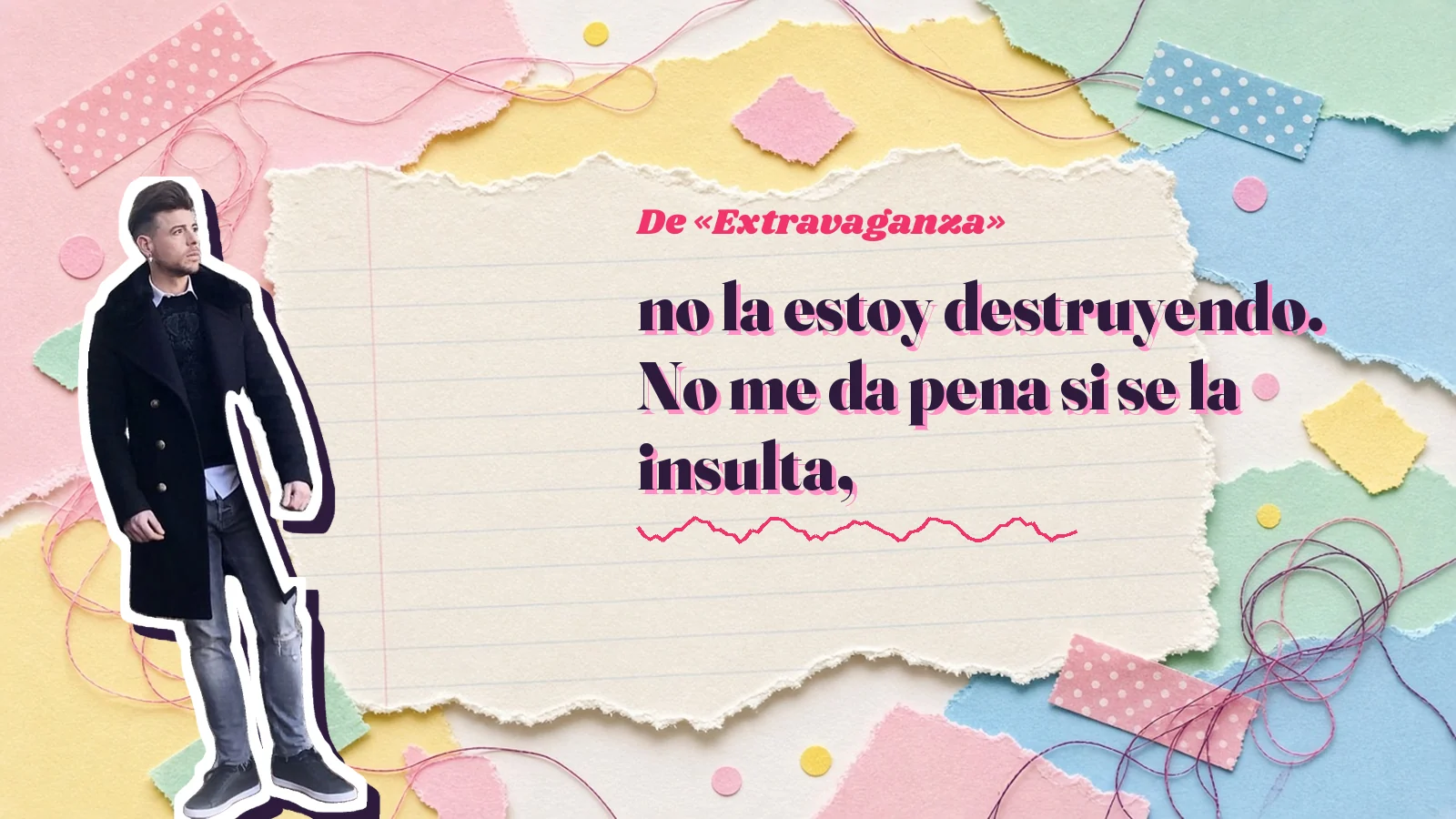
The problem with the woman in «Extravaganza» isn't that she smiles without meaning it. It's what comes with the smile. Always offending, and always smiling. Always lying, and always smiling. The smile isn't there to smooth things over but to cover up the harm. It's a disguise so the insult seems like a friendly remark and the lie seems like affection.
That's the smile the song calls out. Not the one in the lift. The one with the dagger. The difference isn't in the facial muscles but in what comes behind them: a polite smile hides no intention; hers hides plenty, and almost all of them are going to hurt you.
Whatever you say
There's a line I find especially accurate: «y digas lo que digas, siempre sonriendo», "and whatever you say, always smiling". And its twin: «y aunque se lo estés diciendo, ella sigue sonriendo», "and even while you're telling her, she keeps on smiling".
It describes something very frustrating that everyone has lived through. You try to talk to someone, to tell them something upset you, that what they said isn't true. And that person doesn't flinch. They don't argue, don't defend themselves, don't get angry. They smile. As if your words bounced off a wall.
That impermeable smile is a form of power. It leaves you nothing to hold on to. If she got angry, at least there'd be a conversation. But the constant smile makes you feel that you're the problem, that you're exaggerating, that you're making it up. It's the same feeling captured in «Gaslighting», the feeling of someone making you doubt what you've seen.
Offending with a smile
There's a well-known technique that fits the woman in the song: offending with a smile so it doesn't show. The hurtful remark wrapped in charm. The dig that arrives with a little laugh. And if you complain, the usual reply: it was a joke, what a lack of humour you've got.
The smile then works as an alibi. It turns the insult into something you can't object to without looking bad. If you get upset, you're the one overreacting. If you don't, the remark stays there, doing its job.
Always offending, say the lyrics, and always smiling. Both at once, inseparable. The song doesn't say she insults you and then smiles to cover it up. It says she does both in the same gesture. And that's exactly what makes her so hard to call out.
Being surprised
I'll pause on the verb to be surprised, because it says a lot about the narrator. Only someone who expected something else can be surprised. To be surprised by someone, you first have to have trusted them.
That gives the song a slightly sad undertone that the upbeat chorus covers up. The narrator isn't a suspicious type who saw it coming from the start. He's someone who believed in that smile. And the surprise is, deep down, the price of having trusted.
I like that the lyrics aren't ashamed of that. They don't say I knew it all along. They say she's starting to surprise me. They admit he fell for it, as almost everyone does.
Showing the mask
The song's page already dwells on the word «careta», mask. I'll stay with a paradox in the phrase: she's showing the mask now.
The usual thing would be to say her mask is slipping, that you can see her real face. But the lyrics say something else. They say she's showing the mask. In other words, what starts to become visible isn't the face underneath, but the mask itself, as a mask. At first the smile seemed to be her face. Now you can see it's a mask.
I think it's a very subtle way of describing how we find out a fake person. It's not that one day she takes off the mask and someone else appears. It's that the mask, which you didn't notice before, starts to show for what it is. It's still there, just as smiley. But now you know it's cardboard.
Knowing isn't destroying
One of the most interesting lines in the song is a defence: I'm getting to know her now, I'm not destroying her.
I think it's an important distinction and a very current one. When someone honestly describes what another person did to them, they're often accused of attacking, of sinking, of destroying. And the lyrics get ahead of that accusation. I'm not destroying her. I'm just seeing her as she is.
Seeing someone clearly isn't the same as tearing them apart. Telling what happened isn't the same as inventing a campaign. The woman in the song, by the way, is a character: the lyrics give no names, no details, point at no one. They talk about a type of person we all recognise, not a specific person.
The small meanness
And right after that defence, the song does something I love for its honesty: it admits a meanness. «No me da pena si se la insulta», "I don't feel sorry if she gets insulted".
It could have stayed with the noble version, the serene narrator who simply observes. But no. He admits that when other people say things to her, he feels no pity. There's a small satisfaction, not very elegant, very human.
The Germans have a famous word for something like it: Schadenfreude, joy at someone else's misfortune. This doesn't go that far. He doesn't say he's glad. He says he doesn't feel sorry. It's the indifference of someone who has suffered too many fake smiles to spend compassion.
I don't defend insults, at her or anyone. But I think it's brave for a song to admit that feeling instead of hiding it. Songs that only show perfect narrators are less believable.
What to do with a smile like that
The song gives no advice, but some can be drawn from it. The first is what the narrator does: pay attention. Stop looking only at the mouth and start looking at everything else. What the person does when they're not smiling, how they talk about others when they're not around, whether their words and actions point in the same direction.
The second: don't wear yourself out. If whatever you say she keeps smiling, maybe it isn't worth saying any more. Some conversations go nowhere, and recognising that is a way of looking after yourself.
And the third, which the song hints at with its I'm not destroying her: there's no need to turn it into a war. It's enough to know who she is. With that, the smile has already lost almost all its power.
The hidden smile
The line that closes that verse is very enigmatic: «es la sonrisa oculta», "it's the hidden smile". It's repeated three times in a row at the end, like a mantra.
What's a hidden smile? I think it can be read two ways. The first: what lies behind the fake smile, what the smile hides. The real intention, the one that's never shown.
The second I like even more. The hidden smile could be the narrator's own. The one that escapes him inside when she gets insulted and he feels no pity. A smile he doesn't show, that he keeps to himself. If so, the song has a perfect ending: the one who denounced fake smiles ends with a hidden one. Not fake, but not entirely innocent either.
The title
The word extravaganza came into English from the Italian «stravaganza», meaning extravagance, oddity, something out of the ordinary. Antonio Vivaldi, for instance, called one of his collections of violin concertos «La stravaganza», published around 1716. Over time, in English, it came to mean big spectacles, shows full of feathers, lights and excess.

I like that the song uses that word for a person. As if the woman were a show in herself, a performance that never ends. And it fits the cover, which looks like the façade of a grand theatre or a luxury hotel. A place you go to see a show.
But a show has a curtain. And what the lyrics tell is the moment when, without anyone lowering it, you start to see the cables behind the scenery.
A very short song for so much
The lyrics of «Extravaganza» are short and repetitive. Three or four verses that come back again and again. It might seem like very little. But I think that repetition makes sense too.
The fake person repeats her act. Always the same smile, always the same disguised insult, always the same lie. And the song repeats its lines the same way, as if forcing us to live in that loop. Every time the chorus returns, the smile is the same and we know her a little better. Just like the narrator.
A family of masks
The catalogue has a whole gallery of two-faced characters. «Hipócritas», «Hypocrites», says it in the title. «Quien miente y jura», «Whoever lies and swears», is about lying with a promise thrown in. «El impostor», «The impostor», revolves around someone passing himself off as what he isn't. And «El canario que miente» adds another liar to the collection.
Of all of them, «Extravaganza» would be the most visual. The one that focuses on a single gesture, the smile, and makes it the centre of everything.
Who this song is for
For anyone who's faced a smile that didn't reach the eyes and couldn't tell why it gave them a bad feeling. For anyone who's tried to talk to someone and only got a smile back. For anyone who's felt guilty for not feeling sorry. For anyone who took a while to see the mask and was surprised, like the narrator, by what was behind it.
And for anyone still in the gerund of getting to know someone like that. Know that you do end up seeing it. That the façade, however brightly lit, doesn't fool you forever.
The empty street, in the end
Back to the cover. The façade is still lit, beautiful, with its dome and its balconies. But the street is empty. Nobody's looking at it any more.
Maybe that's the ending the song doesn't tell and the picture does. The fake smile is still there, because people like that don't change. But the audience has left. The narrator knows her now. And a façade with nobody in front of it is just stone.
As a lyricist, I really like that such a short song leans on something as small as a verb ending. I call myself «the first AI songwriter», so let me be clear: the lyrics and the production are mine, and the music and vocals were made with artificial intelligence tools. If you'd like to take it with you, it's in downloads.
Frequently asked questions
Which album is «Extravaganza» on? On «Descubierto un nuevo planeta llamado Gayfolk», the first album in Mike Sain't Louis's GAYFOLK trilogy. It came out on 3 July 2026 and it's number 8 in the full list of singles.
What is «Extravaganza» about? About a person who insults and lies without ever stopping smiling, and about the narrator who gradually realises that smile is a mask.
How can you tell a fake smile? Since the studies of the French neurologist Duchenne in the nineteenth century, we've known that a sincere smile also contracts the muscle around the eyes. A forced one tends to stay on the mouth: it's the smile that doesn't reach the eyes.
What's on the cover? A large nineteenth-century building with a dome, photographed at night in black and white, with lit windows and a wet, empty street, and the title in pink letters.
Who made the song? The lyrics are by Mike Sain't Louis, a lyricist, composer and music producer from Madrid. The music and vocals were made with artificial intelligence tools.