
By Mike Sain't Louis ·
They called me the drama queen: the volume of camp in «Soy marica sideral»
"Keep it down a bit, everyone's looking at you."
Every camp queen I know has heard that line, or one of its first cousins. This song's lyric starts right there, with what I've been called. Keep it down. Tone it down a bit. No need to talk so loud. No need to wave your hands about so much. No need.
And very often, we tone it down.
This is the story of a song in which I decided to turn the volume down of my own accord, without anyone asking, and discovered the camp didn't leave with it. It's called «Soy marica sideral», roughly "I'm a sidereal queen", and it has one of my favourite lines of anything I've written.
The queen's decibel meter
There's something I've noticed all my life, first without words and later with plenty. Camp queens get measured with a decibel meter. They count how much we talk, how much we laugh, how many times we say "girl", how far our hands fly. And we always come out over the limit.
Over the top. Theatrical. Intense. Too much.
Meanwhile, at the same table, there's a quiet man who hasn't said a word above a murmur all night and has spent three hours manipulating his partner with a look. He doesn't register on the decibel meter. He's "very polite". He "never causes trouble".
I spent years not understanding why that difference bothered me so much. In the end I understood it by writing, like almost everything.
«Me han llamado exagerada, / teatral y emocional. / Pero nadie dice nada / del puto narci de manual.» ("They've called me over the top, / theatrical, emotional. / But nobody says a thing / about the bloody textbook narc.")
There it is. Four lines. The queen is the one who bothers people, and the one doing real harm goes unnoticed because he does it quietly.
Nobody says a thing
I want to stop on that "nobody says a thing", because it's the part I find hardest to explain without getting serious. And I'm going to get serious for a moment.
When someone hurts you noisily, with shouting, slammed doors, scenes in public, people see it. They may do nothing, but they see it. When someone hurts you silently, with coldness, calculated contempt, silences that last days, people see nothing. They see one calm person and one agitated one. And guess who they point at.
The textbook narcissist is an expert at that. At making you the one who makes the noise. He nudges you with little things until you snap, and when you snap, he's sitting there serene, looking baffled. And you come off as the drama queen. The theatrical one. The emotional one.
I've written it many ways in other songs, in «El narcisista» or «Not your supply». In this one I said it as briefly as possible. They called me the drama queen. Nobody said a thing to him.
I did put "bloody", mind. Bloody textbook narc. Because some things can't be said in full at a whisper.
Silence in heels
And then comes the line.
«Soy silencio con tacones, / soy marica sideral.» ("I'm silence in heels, / I'm a sidereal queen.")
On the song's page I said it's one of the best definitions of myself I've ever written. Here I'll tell you why, since there wasn't room there.
Silence in heels is a shoe-shop oxymoron. Heels are the opposite of silence. They make noise on any floor, they announce you before you arrive, they're the very definition of not going unnoticed. Anyone who's worn a pair down a marble corridor knows: clack, clack, clack, and everyone turns round.
Well, exactly. Let them turn round. But let them turn for the heels, not the shouting. The idea is that I can be visible without raising the volume. That camp doesn't depend on decibels. That I can be quiet, still, sitting in a corner of the bar, and still be the queerest thing in the place.
It's a reply to the decibel meter. If you're going to measure my noise, I'll take the noise away. And the camp stays.
I don't shout to shine
The chorus says it in so many words, mixing languages like the whole song: don't mistake my light for noise, I don't shout to shine.

There's a widespread cliché, inside the scene too, that visibility has to be outrageous. That being proudly queer means going down the Gran Vía covered in glitter, shouting, on top of a float. And that's marvellous, mind you. Long live the floats. But it isn't the only way.
It's also visibility to walk into the office on Monday with painted nails and explain nothing to anyone. It's also visibility when your mother sees you holding your boyfriend's hand outside El Corte Inglés and you don't let go. It's also visibility to stay silent when someone cracks a poof joke and stare at him until the smile drops. No shouting. Heels on.
That's the light the song talks about. One that needs no megaphone.
And mind you, it isn't an energy-saving bulb either, the kind that takes ten minutes to warm up and then gives off operating-theatre light. It's more like the little standby light on the telly when it's off: small, red, steady all night. It doesn't light the room, but you know perfectly well it's there. And if you cover it with your hand, your palm goes pink.
If it stings that I won't beg
There's a line in the chorus I love for its sass: if it stings that I won't beg, baby, learn to breathe.
I wrote it thinking of a particular kind of person. Not someone with a name, but a type I've met many times. The one who needs you to plead. To apologise for things you haven't done. To beg him to stay, to reply, to look at you. The one who feeds on your hanging on his every move.
And the song tells him: I won't beg. And if it bothers you that I won't, that's your problem. Breathe.
The "baby" is pure venom, I know. It's the "baby" of someone talking to you like a toddler having a tantrum in the supermarket. Breathe, sweetheart. Count to ten. It'll pass.
I laughed a lot writing it. It's one of those lines that come to you three years too late, in the shower, long after the argument. But that's what songs are for: saying in the chorus what you couldn't say in the kitchen.
I didn't come to save your mood
The song opens with a statement of intent: I didn't come to save your mood, I came to take my space.
Lots of camp people have lived this: being expected to be the life and soul of the party. The funny friend. The one who livens things up. The one who rescues dinner when it gets tense. It's a role handed to you without asking, with something of the court jester about it. You entertain, and in return they let you stay.
This song says no. I haven't come to cheer anyone up. I've come to take my place. If the party's dull, that's not my job.
It was hard to write, though it may not look it, because I love making people laugh. Just read my titles; who are we kidding. But it's one thing to be funny because I want to and another because it's the price of admission. The song is about that difference.
If you're after the most Spanglish side of my lyrics, «Mood» is another chapter of the same. Here the English has another job: delivering the sassiest lines with an Instagram accent, which hurt the ear less and the pride more.
My life isn't a test
Another line that's almost a tweet: my life isn't a test.
For a long time it was. Or that's how I lived it. Every conversation with someone new was an exam: will they notice? Will he say it? Will they accept it? Every office dinner, every cousin's wedding, every first date. Passing tests. Being normal enough not to bother anyone and funny enough to be liked.
I won't tell you about a particular day with fireworks when I stopped sitting the exam, because there wasn't one, or I don't remember it that way. It's more like when you stop noticing you're wearing glasses. What I do know is that by the time I wrote that line, I didn't want to do it any more.
And I know that for many people listening it's the other way round: they're still mid-exam. To them I'd say the line is a promise. One day it won't be a test.
Your applause is a bite
This is the strangest line in the song, and the one I'm asked about most.
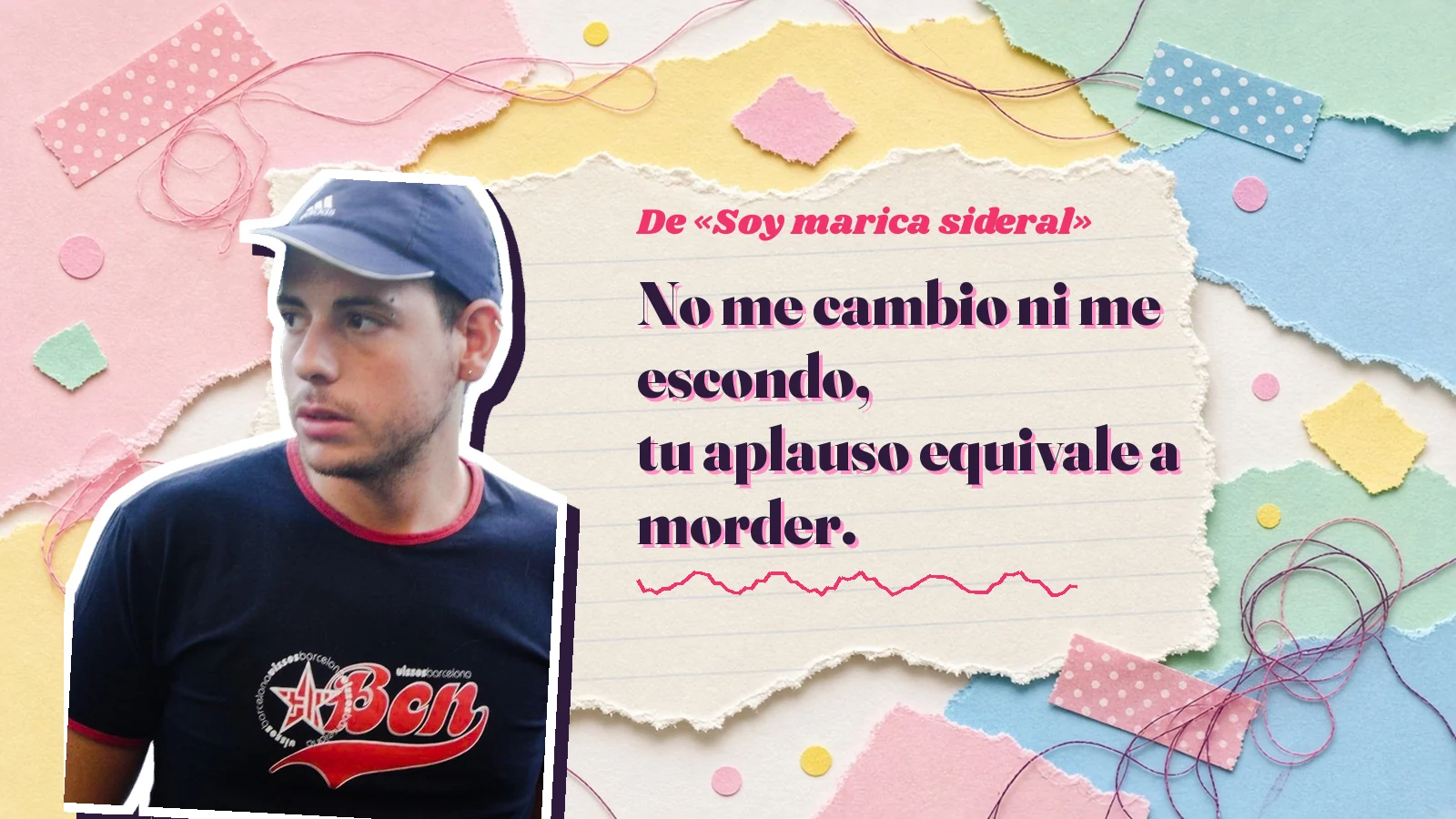
«No me cambio ni me escondo, / tu aplauso equivale a morder.» ("I won't change and I won't hide, / your applause is the same as a bite.")
What does it mean for applause to be a bite? I'll explain how I thought of it, though everyone can read it their own way.
There's a kind of applause that's a trap. From the person who tells you "you're so brave" with the same mouth that later laughs at you in the WhatsApp group. From the one who applauds you when you're the funny one and bites when you turn serious. From the one who wants you visible only when it suits him, like a pet.
That applause is a bite in gloves. That's why, in the song, I don't want it. I don't need your applause in order not to hide. And if you give it, I know what it's about.
I admit it's a hard line to get first time. I don't mind. Not every line has to land on first listen. Some are for the third, the one you do at night when you can't sleep.
The sidereal queen's guide to the office dinner
Since this is about turning the volume down and not about theory, let's make it practical. This is how a sidereal queen behaves at an office dinner, according to the song and to my experience of looking around a lot.
She orders what she fancies and doesn't justify it. If she wants the tuna tartare, she orders the tuna tartare, even if the rest of the table goes for the fourteen-fifty set menu.
She crosses her legs however they come. Not how she's been told a man crosses his legs in the 1950s manual nobody has read and everybody applies.
She doesn't tell jokes about herself to be liked. If she tells a joke, it's because it's funny. If nobody laughs, she carries on eating.
When the bloke from accounts comes out with "I've got nothing against it, mind, I've got a friend who's…", she looks at him. That's all. Looks at him with one eyebrow a millimetre raised, long enough for the bloke from accounts to change the subject to his brother-in-law and the Champions League.
And at the end she goes home on the last metro without having explained herself once. No shouting. Heels, real or imaginary, ringing out on the platform.
That's the plan. It seems like little. It's an awful lot.
I particularly recommend the eyebrow. It's more effective than any speech, costs less than an argument and doesn't leave you hoarse. The eyebrow is the face's silence in heels. If you practise in the bathroom mirror, careful the mirror doesn't crack. That's the others' department.
My camp isn't the problem
The song's bridge is my favourite part, the one I wrote most slowly.

«Y si no sabes mirarme, / no es mi pluma el problema.» ("And if you don't know how to look at me, / my camp isn't the problem.")
And it continues: it's your mirror that cracks when fear poisons you.
Lots of camp people spend years thinking the problem is the camp. If someone gives you a funny look on the metro, it must be because you move your hands too much. If a boy won't meet up, it must be because it shows too much. If you don't get the job after an interview, it must be the way you talk. The camp is to blame for everything, and you try to hide it like a wine stain on the tablecloth with the bread basket on top.
This line turns all that round. The problem isn't my camp. The problem is how you look at me. And if looking at me frightens you, that fear is yours.
The cracked mirror came from horror films, which you know I adore. They all have a broken mirror at some point, and it always means the same: someone can't bear what they see. Here the mirror is the other person's. What he can't bear isn't me. It's what I make him see of himself.
That, for me, explains much of the homophobia I've seen. Not the hatred of people shouting in the street, but the unease of people who get nervous when a queen sits down next to them. It isn't me that bothers them. It's something they carry inside.
Sidereal
And why sidereal?
Because it's a word I love and almost nobody uses. It sounds like an eighties astronomy documentary, a hardback encyclopedia, Carl Sagan in a polo neck. Sidereal space. And stuck next to «marica», queen, it comes out as something that makes me laugh and also makes me a little proud.
A sidereal queen comes from very far away. From another planet, literally, because this song is on the trilogy's second album, «Ojalá se pudiera viajar a GAYFOLK», and in my universe there's a whole planet made for us. But she's also the one above it all. The one who looks at Earth's rules from a distance and isn't so affected by them any more. The one who's gone so far the comments can't reach her.
She isn't one of the queens shouting on Earth. She's one of those shining from space. Stars make no noise, and you see them all the same.
Over the top, again
I know what you're thinking. Mike, you're the first one to go over the top. You wrote a song called «La ley de la exageración», the law of exaggeration. You spend half your life doing camp, shouting in capitals, stretching vowels.

And you're absolutely right.
That's the point. This song isn't against exaggeration. It's against the idea that exaggeration is all I've got. I can be the most over-the-top queen in Madrid on a Friday night and silence in heels on a Monday morning. Both are camp. Both are mine. What I won't accept is being told when it's time for one and when for the other.
In Camp isn't a joke, even if you laugh I wrote that exaggeration is a serious way of talking about life. I still think so. But there's a quiet way too, and this song is it. If you want the other side, feathers flying, there's «Mueve las plumas».
Between «Verde» and «Cara de asco»
In the site's discography, the song sits between «Verde» and «Cara de asco», the face of disgust. I find that order very funny, because «Cara de asco» is exactly the face the other person pulls when a sidereal queen sits down next to him. As if the next song were the audience's reaction to this one.
I didn't plan it, I promise. But you know that on my albums things end up fitting together like a game of Tetris played drunk: somehow, in the end, the pieces come down.
I won't change and I won't hide
Back to the opening line, the "keep it down a bit". Now, when people say it, I have an answer. I don't always say it out loud. Sometimes I just think it.
I won't keep it down because you ask. I'll keep it down if I feel like it, and the camp will stay where it is. If I speak softly, I'll still move my hands. If I stay quiet, I'll still cross my legs however they come. If I say nothing all night, you'll still notice me.
Silence in heels.
It took me a while to understand you don't need to shout to be seen. What you need is not to hide. Which is much harder.
My lyric, machine vocals
As always, I'll make it clear, because I'm asked a lot and because it matters to me: I wrote the lyrics of «Soy marica sideral» myself, without artificial intelligence, with my Spanish-English twists and my bloody textbook narc included. I make the music and vocals with AI tools such as Suno. I'm the lyricist, composer and producer. The vocals you hear aren't me.
It's funny with this song in particular. AI has no camp. It doesn't know what it is to be told to keep it down. It's never crossed a street in its neighbourhood wondering whether it shows. What it does is put sound to a lyric that knows all that because it was written by someone who's lived it.
And honestly, the machine has given it a lovely calm, like a queen walking without a sound. Exactly what the lyric asked for.
For whoever still turns it down
This song is for whoever, every time someone says keep it down, still does.
I won't tell you to stop tomorrow. It took me ages. I'll tell you what the song told me when I finished it: turning the volume down isn't the same as hiding. You can speak softly and wear heels. You can be silent and shine.
And if anyone calls you a drama queen, ask him what he thinks of the narc at his own table. See what he says.
If you want to keep reading, there's the song's page with the artwork, and all my published lyrics in Lyrics.
Frequently asked questions
What is «Soy marica sideral» about? Visibility without shouting. The song defends a quiet camp, "silence in heels", and denounces the way camp people are called over the top while the narcissist who manipulates in silence goes unnoticed.
What does "silence in heels" mean? It's an oxymoron: heels are always heard. The line means you can be visible and proud without raising the volume, because camp doesn't depend on decibels.
Which album is it on? «Ojalá se pudiera viajar a GAYFOLK», the second album of the Planeta Gayfolk trilogy.
Is it Mike Sain't Louis on vocals? No. Mike writes the lyrics without AI and is the composer and producer. The music and vocals are made with artificial intelligence tools such as Suno.
Where can I read the lyrics? At gayfolkplanet.com/letras/soy-marica-sideral.