
By Mike Sain't Louis ·
The ventriloquist and the detective: «El señor Garrison» and why being right is no comfort
A photo in pink and sepia tones, with the scratches of an old print, as if it had been taken out of a 1950s album. A man in a dark suit, open shirt, white pocket square and aviator sunglasses looks straight at the camera, very serious. In one arm he holds a ventriloquist's dummy. The dummy wears a felt hat, sunglasses, a pinstripe suit and a tie. They're dressed almost identically. At the top, in pink neon lettering with little sparkles, the title.
That's the cover of «El señor Garrison», «Mr. Garrison», and I love how much it says without saying anything. It looks like a man with a dummy, nothing more, but really it's a man and his double. Two guys in dark glasses, the same film-gangster air, the same pose. One of flesh and blood, the other of cloth and cardboard.
The song is on «Descubierto un nuevo planeta llamado Gayfolk», the first album of the trilogy. It came out on 5 June 2026, and it's number 182 in the full list of singles, between «Una obra de teatro» and «Un puñetazo al día». Its page on the blog already explains the South Park references and how funny the fear of ending up married to a puppet is. Here I want to pull on two other threads: the ventriloquist, which is what the cover suggests, and the detective, which is what the lyrics suggest. And to arrive at a question the song leaves hanging: what good is it to be right?
A photo from another era
It's worth looking at the style of the image too. It isn't a modern photo, clean and brightly coloured. It's toned pink and sepia, with lines and specks like an old print, and the title is in a cursive neon script that recalls the signs of old nightclubs. All together it evokes the world of variety shows, when ventriloquists filled theatres and turned up on black-and-white television.
And the outfits reinforce that feeling. Felt hat, pinstripes, dark glasses: it's the uniform of the classic movie gangster. A man and his henchman. Or a boss and his shadow.
I like the contrast between the look and the content. The image promises a mobster story, shady deals under the lights of a nightclub. And the song tells something far more domestic: a guy in his room, with the computer on, trying to find out who his boyfriend is meeting. But deep down the two things are alike. There are secrets, there's surveillance, there's someone who trusts nobody.
Who Mr. Garrison is
For anyone who doesn't know him, a bit of context. South Park is the adult animated series created by Trey Parker and Matt Stone, which premiered in 1997 on the American channel Comedy Central. It's set in a mountain town in Colorado, and its leads are four foul-mouthed boys: Stan, Kyle, Cartman and Kenny.
Mr. Garrison is their teacher. And in the early seasons he's almost never alone: on his hand he wears Mr. Hat, a puppet in a little hat that he talks to, argues with, and uses to say things he wouldn't dare say himself. He's one of the most recognisable characters in the series, and one of the strangest. An adult with a more intense relationship with a puppet than with any person around him.
That's why the line in the chorus works so well. «Voy a acabar como el señor Garrison», "I'm going to end up like Mr. Garrison". Anyone who's seen the series knows instantly what fear we're talking about.
The ventriloquist
The cover takes the idea a step further. The dummy isn't just any puppet: it's dressed exactly like the man. It's his miniature copy.

I think that's a lovely clue. In ventriloquism, the dummy talks through the artist's still lips. It seems to have a life of its own, but everything it says comes from the same place. The dummy is usually the cheeky one, the one who blurts out what the ventriloquist wouldn't say with his own face. It lets the human be polite and the dummy be insolent.
Carry that over to the song and there's something very human in it. When you suspect your partner, part of you wants to shout it all out and another part wants to keep your composure. The lyrics let both of them speak. On one side there's the one who asks, almost embarrassed, who on earth told him to open the computer. On the other, the one who says, with all the irony in the world, that his boyfriend and the other guy weren't getting together to play Parcheesi.
The one with the polite question is the ventriloquist. The one with the irony is the dummy.
A puppet won't cheat on you
There's a reading of the chorus that isn't as funny as it seems. Why would anyone rather marry a puppet?
Because a puppet won't cheat on you. It has no phone. It doesn't arrange secret meet-ups. It doesn't lie to you about where it's been. It stays where you leave it and says what you make it say. It's the perfect partner for someone who's tired of being hurt.
The catch is that this perfection is a trick: a puppet doesn't cheat on you because it has no life. It can't surprise you, for better or for worse. It won't make you laugh with something you didn't think of yourself. It won't hug you. The price of never suffering is never having anyone real.
That's why the joke in the chorus is, underneath, a very serious fear. The fear of being so burnt that the only possible relationship is with something that can't let you down. And the song turns it into a cartoon image so it can be said without going under.
The cushion boyfriend, the puppet boyfriend
There's another song in the catalogue that plays with a similar idea: «No quiero otro novio cojín», «I don't want another cushion boyfriend». There, the problem is a partner who's like a cushion, comfy, soft, with nothing inside. Here, the fear is ending up with a puppet.
I like thinking of them together because they sketch the two extremes of the same worry. On one hand, you don't want someone with no life of their own. On the other, when the person with a life of their own uses it to lie to you, you start wanting something inert. Between the cushion and the puppet lies what people are really looking for: someone alive who doesn't cheat. It sounds like so little and it's so much.
Dying more times than Kenny
The other South Park reference is Kenny. In the early seasons, Kenny dies in almost every episode, in the most absurd ways, and in the next one he's back as if nothing had happened. The other boys shout their famous line, "Oh my God, they killed Kenny!", and life goes on.
«He muerto más veces que Kenny», "I've died more times than Kenny", say the lyrics. In other words: my heart has been broken so many times I've lost count. But it also means, and this is what I like, that he's come back every time. Kenny always returns. In his orange parka, in the next episode, ready for something else to happen to him.
It's a very good image of a certain kind of resilience. Not the heroic kind, someone rising with a sword. The comic kind, someone getting up because there's no other option, dusting himself off and heading out again with his hood up. Sometimes surviving is just that: showing up in the next episode.
The home-grown detective
And now, the detective. The part of the lyrics I enjoy most is the one about how the narrator tests his boyfriend. He doesn't use a magnifying glass or hire anyone. He uses BlueStacks, a program for running Android phone apps on a computer. And he boasts, half proud and half sorry, about knowing his way around routing.
I love that the song is so specific. It doesn't say he's suspicious. It says which program he uses. That gives it a very present-day truth. Jealousy used to mean sniffing a shirt or checking the phone bill. Now it comes with emulators, connections and networks.
And yet the scene is ancient. A man in his room at night, in front of a screen, trying to work out whether his partner is cheating on him. The tool changes; the anguish doesn't.
Who told me to
The best thing about that verse is the questions. Who the hell told me to open the computer. Is it my fault I'm a good programmer. Who told me to know about routing. Why am I testing you instead of watching a gory film in my room.
They're the questions of someone who knows what he's doing won't do him any good. There's no spy's pride. There's irritation. Almost as if knowing how to do things were a curse: if he didn't know how, he couldn't look, and if he couldn't look, he'd be calmly watching his film.
That idea strikes me as very honest. Some kinds of knowledge, at certain moments, are a temptation. And the song doesn't brag about giving in. It laments it.
A note on privacy
While we're here, I think it's fair to make something clear outside the song. Getting into someone else's phone or accounts without their permission isn't a game. In Spain, accessing someone's private messages or data without consent can be a crime, the offence of discovery and disclosure of secrets set out in the Criminal Code. And, crimes aside, spying on your partner is usually a sign the relationship is already broken inside.
The song doesn't sell it as a good idea. It tells it as what it is: a bad moment for someone desperate. The questions in the lyrics, that "who told me to", are precisely the awareness that he shouldn't be doing it. It's a confession, not a tutorial.
Knowing too much
There's an expression people use a lot that this song illustrates very well: knowing too much. It's usually said of characters in spy films, the ones who've seen what they shouldn't and are in danger because of it. Here the danger is more intimate.
The narrator knows too much about computers, and that lets him look. He knows too much about how these stories end, and that pushes him to check. And in the end he knows too much about his boyfriend, which is exactly what he didn't want to know. Each piece of knowledge leads to the next, like a staircase that only goes down.
The lovely thing, if you can call it that, is that the song doesn't punish him for it. It doesn't make him the villain. It lets him be what he is: someone who couldn't stop, who hurt himself by searching and who tells it with the serious face of the man on the cover and the cheeky mouth of his dummy.
Being right
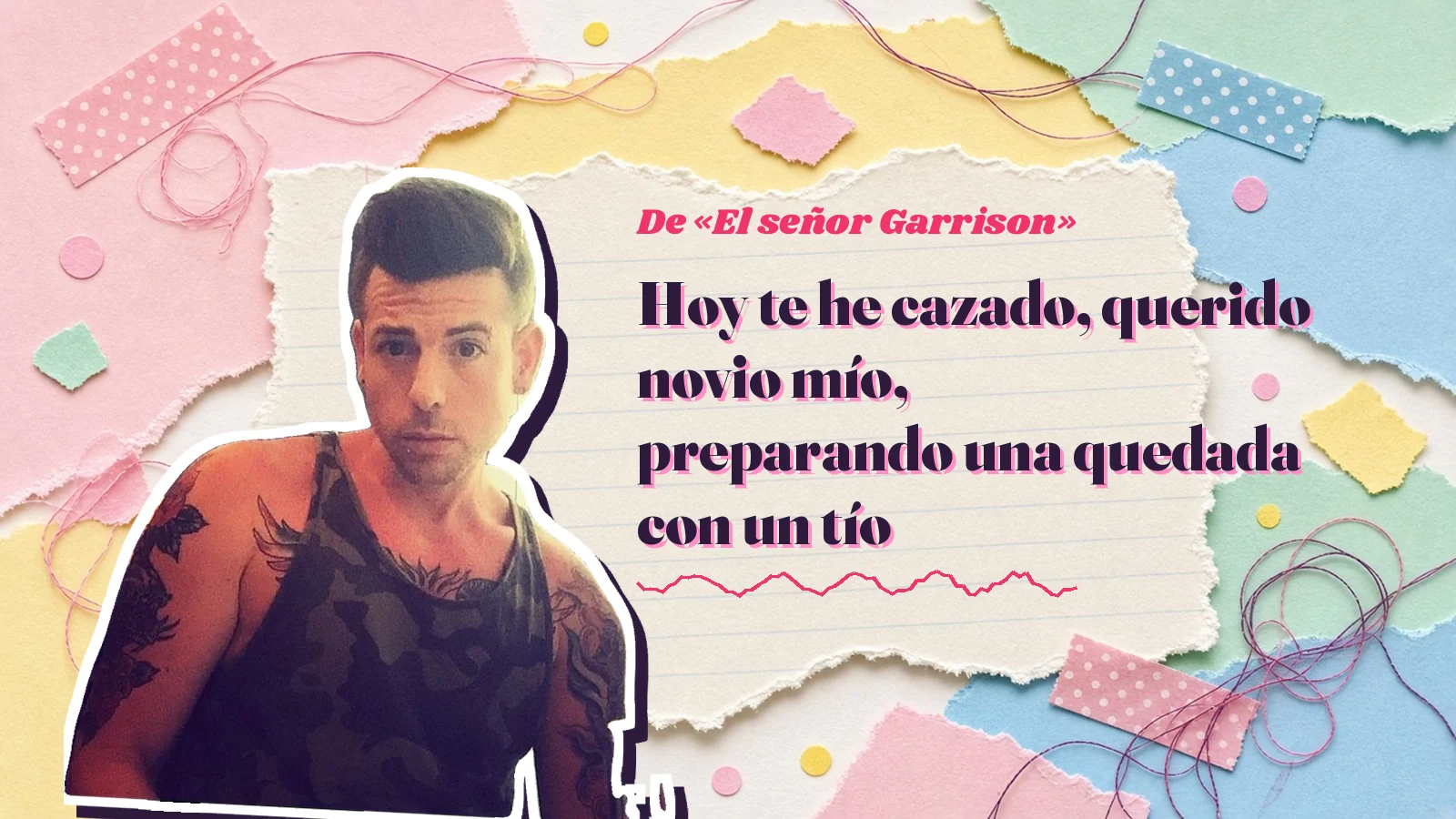
And then comes the twist. «Hoy te he cazado, querido novio mío», "Today I caught you, my dear boyfriend", setting up a meet-up with a guy.

The detective is right. The suspicions were true. And what I find most interesting about the song is what happens next: nothing. No celebration. No revenge. No victory. The chorus comes back, the same as before. I'm going to end up like Mr. Garrison. Married to a puppet.
That, I think, is the sharpest idea in the whole lyric. Being right is no comfort. When you investigate and find what you feared, you win nothing. You've confirmed you were being lied to and, on top of that, you've had to go through the ordeal of looking for it. The reward for being right is exactly the pain you wanted to avoid.
Some people think knowing the truth will bring them peace. Sometimes it does, in the long run. But at the exact moment you find out, what it brings is a huge emptiness. And the song shows that beautifully with a chorus that doesn't change, as if the discovery hadn't moved anything.
The other guy
There's a character the lyrics barely mention: the guy the boyfriend is arranging to meet. He has no name, no face, not a single line. He exists only as the evidence.
I think that's a good decision. Plenty of songs about cheating spend their time attacking the third party, describing him, comparing themselves to him. This one doesn't. The problem isn't the other guy, who might not even know there's a boyfriend. The problem is the lie of «querido novio mío», "my dear boyfriend", with that affectionate possessive that sounds so bitter at that moment.
What it portrays, above all, is the narrator himself. The song is far more interested in what's going on inside the one investigating than in the details of the date. It's a self-portrait, not an accusation.
What the lyrics don't tell
Another thing I like is what's left unsaid. After catching the boyfriend, the song doesn't say whether he leaves him, makes a scene, forgives him or pretends he hasn't seen anything. The chorus just comes back.
That silence makes room for the listener. Everyone can imagine the ending they know. And I think it's truer to life than any neat ending. At the exact moment you discover something like that, you don't yet know what you're going to do. You only know that it hurts and that, once again, you've died like Kenny.
Masochist or pessimist
Before the discovery, the lyrics ask a question: maybe I'm a masochist, or maybe I just like being a pessimist. The song's page already plays with this. I'd only add one thing, from the detective's side.
Testing someone is a form of active pessimism. You don't just think they'll let you down: you set up the situation to check. And that has something masochistic about it, of course, because if it goes badly you went looking for the blow, and if it goes well you don't believe it and test again.
It's a loop with no way out. And that's why the chorus repeats so many times at the end, five in all. There's pop structure, sure, but above all there's the shape of obsession: going back to the same thought again and again, in case something changes this time.
The gory film as a refuge
There's a detail that makes me laugh: the alternative to spying is watching a gory film. Not a romcom, not a nature documentary. One full of blood and guts.

In the Planeta Gayfolk universe, horror films turn up a lot, in songs like «Igual que en las pelis slasher», «Just like in slasher films». And here it works almost as a self-care plan. Watching someone get cut to pieces on a screen is presented as healthier than tearing yourself apart investigating your boyfriend.
It makes sense. Fictional horror has a beginning and an end, switches off with a button and isn't about you. The horror of discovering a lie doesn't.
Cartoons as a language
I find it very telling that a song about jealousy and deceit uses a cartoon series as its language. It could have quoted a tragedy or a novel. Instead it uses a teacher with a puppet and a boy who dies every week.
I think it has to do with a very recognisable way of facing pain: with absurd humour. Whole generations grew up with adult animation and have, in those characters, a repertoire of images to explain almost anything. Saying I've died more times than Kenny is quicker, funnier and, curiously, more accurate than saying I've suffered a lot.
Humour doesn't take away the seriousness. It puts it somewhere you can look at it without turning away. And it also connects people: anyone who's seen the series gets the reference instantly, with no need to explain anything else. It's a shared language, and in a song about feeling alone that's no small thing.
A family of suspicions
«El señor Garrison» has close relatives in the catalogue. «El anillo de casado», «The wedding ring», tells a secret love affair from inside the secret. «De mito a vómito», «From idol to vomit», is about what happens after you discover you've been deceived, when you go back over the dates and everything fits together in the worst possible way.
Read together, those songs tell the story of deceit from different sides: the one hiding it, the one suspecting it and the one who already knows. «El señor Garrison» belongs to the one who suspects, with a mix of shame and humour that makes it very recognisable.
Who this song is for
For anyone who has ever looked where they shouldn't and regretted it before they'd finished. For anyone who has been right about a suspicion and found that being right doesn't help. For anyone afraid of getting so burnt that they can only love something made of rags.
And for anyone who needs to laugh at all of it to keep going. Like Kenny, who comes back every week with his hood up.
The dummy, in the end
Back to the cover to finish. The man and the dummy look at the camera with the same serious face and the same dark glasses. Neither of them smiles.
I like to think the dummy isn't the future husband from the chorus but the narrator's other self. The one who says things through the ventriloquist's still lips, the one who comes out with the Parcheesi irony, the one who laughs so as not to cry. It isn't a partner. It's a way of surviving.
As a lyricist, I enjoy having squeezed a cartoon teacher, an Android emulator and a game of Parcheesi into the same song. I call myself «the first AI songwriter», so it's worth making clear: the lyrics and the production are mine, and the music and vocals were made with artificial intelligence tools. If you'd like to take it with you, it's in downloads.
Frequently asked questions
Which album is «El señor Garrison» on? On «Descubierto un nuevo planeta llamado Gayfolk», the first album in Mike Sain't Louis's GAYFOLK trilogy. It came out on 5 June 2026 and it's number 182 in the full list of singles.
Who is Mr. Garrison? He's the teacher in the animated series South Park, created by Trey Parker and Matt Stone. In the early seasons he always has Mr. Hat on his hand, a puppet he talks to.
What is BlueStacks, which appears in the lyrics? It's a program that lets you run Android phone apps on a computer. In the song, the narrator uses it to test his boyfriend, and he himself asks who on earth told him to.
What's on the cover? A man in a dark suit and aviator sunglasses holds a ventriloquist's dummy dressed almost exactly like him, with a hat, sunglasses and a pinstripe suit, in a pink-toned photo.
Who made the song? The lyrics are by Mike Sain't Louis, a lyricist, composer and music producer from Madrid. The music and vocals were made with artificial intelligence tools.