
By Mike Sain't Louis ·
The planet was born from a block: «Buscando el polvo perfecto» and camp on the apps
«Masc4masc. No fems. No fats. No effeminates. Discretion. Old guys need not apply.»
If you’ve ever had Grindr open for more than ten minutes, you’ve read that profile. You’ve read it a hundred times. You’ve read it on a twenty-two-year-old with an abs selfie in the gym toilets and on a sixty-year-old with a photo of a sunset in Torrevieja. You’ve read it in Madrid, in Seville and in a village in Soria where the next user online was forty-three kilometres away. It’s the same list. Always the same.
«Buscando el polvo perfecto» («Looking for the perfect shag») takes that list and puts it in the mouth of a character who thinks he’s God. The song’s page on the blog already covers the satire: the man doing the blocking, the chorus that shouts the app’s name, the fuck buddy from Toledo with his depressing advice, and the planet at the end. Here I want to go to two specific places. One is pluma, camp, flamboyance, because of everything the character despises, that’s the one that hurts me most. The other is the ending, because in that last verse, spelled out in full, comes the name of the first album of the trilogy. Planet GAYFOLK is born in a song about being blocked.
And to me, that explains almost everything.
You’re camp and effeminate
Among all the song’s reasons for blocking, fat, bald, old, under-endowed, there’s one that isn’t about the body but about the way you exist in the world:
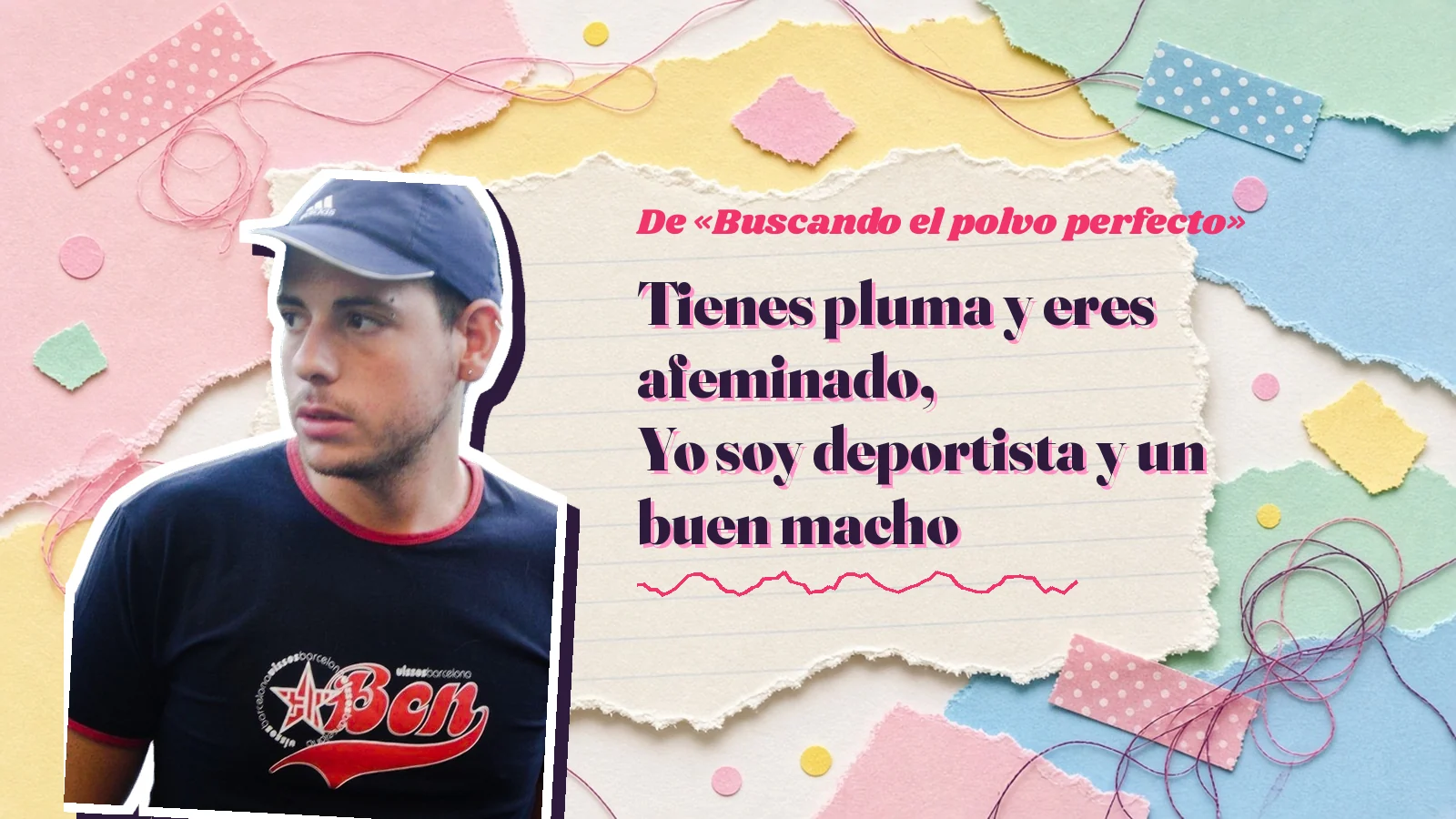
«Tienes pluma y eres afeminado, / Yo soy deportista y un buen macho» («You’re camp and you’re effeminate, / I’m sporty and a proper macho»)
Pluma. Literally «feather»: the Spanish word for being visibly, flamboyantly queer. The hand that moves too much when you talk. The voice that rises at the end of a sentence. The way you cross your legs, the way you laugh, the way you call your best friend «girl». The T-shirt a touch too tight, the earring, the way you look at a Loewe window on Calle Serrano. Everything that earned you clips round the ear, nicknames and lunches alone in the playground.
And the incredible thing is that, after surviving primary school, secondary school and your cousins in the village, you reach the place that’s supposed to be for your own people, you open your own people’s app, and you find the same line the class bully used to say: «no fems». Written this time by another queer.
That’s the saddest part of the whole satire, and that’s why the song treats it with such venom. The character says he’s sporty and a proper macho, then finishes with a playground couplet: get yourself to the gym, Romeo. As if camp came off on the cross-trainer. As if it were fat.
You can’t burn off camp at the gym. Thank God.
Femmephobia with wifi
There’s a word for this in Spanish, plumofobia, femmephobia, and I find it useful because it names something many people would rather not see. It isn’t that someone fancies one type of boy and not another; that’s desire, and everyone has their own. It’s that contempt for the feminine has become a way of showing off.
And the apps have industrialised it. Before, the man who despised camp did it at a bar, with a name and a face, and risked someone answering back. Now he puts it in his bio, under a headless photo, and thousands of people read it every day. No need to show your face. No need to explain. Block and done.
The chorus says it with a word stretched to the point of ridicule: Grindeeer. Just like that, the e’s dragged out like a market trader’s cry. Then, at all hours. Then, ¡hoy lloras!, today you cry! I love that «today you cry» because nobody knows who it’s aimed at. The blocked one, left staring at his phone. Or the blocker, who’s been on the app for three hours and is still alone.
Everybody cries on that wheel. It’s just that some admit it and others write «masc4masc».
Block, ugly, stroll, Romeo
You have to look at the rhymes, because they do half the work. In Spanish, bloqueo (I block you) rhymes with feo (ugly). With paseo (as in «take a hike»). With Romeo. And finally with «yo creo», «I reckon», the vaguest rhyme in the language, the kind you’d use in a birthday card stuck on the fridge door.

They’re playground rhymes, the ones used to mock the chubby kid in class. And that’s exactly what makes them devastating. The app god thinks he’s terribly sophisticated with his advert body and his list of requirements, but when he opens his mouth he comes out with a ten-year-old’s couplets. Contempt has no vocabulary. It has four words that end the same way.
Every verse repeats the same structure, like a form: a flaw in the other man, a virtue of his own, the block, the jibe. Flaw, virtue, block, jibe. Four times over. Hundreds of times a day on any phone in Chueca. Repetition turns cruelty into routine, which is exactly what happens on the apps: nobody blocks in a rage, you block with your thumb, without looking, while waiting for the bus.
And routine, once you put it in a song, stops looking normal.
A discreet boyfriend
There’s a line in the chorus that always stops me:
Looking for the perfect shag. Looking for a discreet boyfriend.
Notice the contradiction. A perfect shag and a discreet boyfriend. The first is for right now, in the next twenty minutes, your place or mine. The second is for life, but without anyone noticing. Nobody finds out. We don’t walk hand in hand down Fuencarral. If my mum texts, you’re a colleague from work.
«Discreet» is the trick word of the apps. Sometimes it’s a married man with two kids and a people carrier. Sometimes it’s a village lad who can’t come out because his family wouldn’t accept it, and that deserves all the respect in the world; everyone comes out when they can. And sometimes it’s simply someone who has decided that being queer, being visible, being noticeable, is something for other people. For the camp ones. For the effeminate ones. For those he doesn’t want to be mistaken for.
That’s why the discreet boyfriend and the «no fems» go together in the same song. They’re two sides of the same thing: loving a man, but without looking like you love a man.
I’ve written about the married man who won’t come out in «El anillo de casado», which takes another road with another kind of humour. Here, the discreet boyfriend is a catalogue wish, one more item on the app god’s shopping list.
If you’re looking to get married
The narrative part of the song, the bit with the fuck buddy from Toledo, has a line that’s almost a proverb:
«Si buscas casarte esta no es la aplicación» («If you’re looking to get married, this isn’t the app»)
And it’s followed by a worse one: if you don’t look after yourself, you’ll have to lower the bar. There’s no other way.
The song’s page already describes that conversation, the resignation of the man giving the advice and how depressing the man receiving it finds it. I’m more interested in what that line reveals about the market. Because that’s what a hook-up app is: a market. There’s supply and demand. There are first-class goods and seconds. There are sales. And if you’re not «looked after», if you’ve got a belly or grey hair or camp or are in your forties, the advice is to lower the bar, the way you’d drop the price of a flat on Idealista because nobody’s calling.
The character answers that he finds it depressing. And the other man tells him it’s not him saying it, it’s obvious. That reply strikes me as one of the most real things in the song. It’s not me saying it: the line of someone who has accepted the rules of the game so completely he no longer sees them.
And then he tops it with one that is pure nineties Madrid: you always come to Grindr llorado. «Already cried.» Cried out at home before you arrive. Tears done in advance.
That verb strikes me as one of the lyric’s great finds.
The worn-out god
I want to go back to the character doing the blocking, because the song paints him with a line that keeps coming back: I’m God and you’re worn out.
God. No less. He’s the one with the mirror selfie, abs on show, bathroom lighting on his side and the towel arranged like a Canova statue. The one who spends the afternoon flicking through profiles like flicking through the IKEA catalogue, quick thumb and bored face.
The beauty of satire is that it doesn’t need to say that this god will wear out too. We all know it. Abs have a sell-by date, like yoghurts. The man blocking the grandad today will be a grandad in a few years, and he’ll open the app and find his own list written by a twenty-year-old. Go and cry to your plastic surgeon, they’ll tell him. And maybe he will.
The song doesn’t say so. But the chorus’s ¡hoy lloras! leaves it hanging like a threat.
There’s one clean line, no joke, that comes to me every time I think about that character: whoever treats others like objects ends up feeling like one.
Face pic on request
There’s something about the apps the song doesn’t name, but that sits under every line: the way they turn people into pieces.
You open the grid and what you see isn’t faces. It’s torsos. Backs. Bulges in Calvin Klein trunks. Hairy legs on a beach towel in Maspalomas. Sunsets, dogs, cars, a bottle of beer on a terrace. And in the bio, if there is one: «face pic on request». As if the face were an extra, something you unlock once you’ve passed the first filter.
There’s a logic to it, I won’t deny it. Many people can’t show their face because they’re not out, because they work with the public, because they live in a village where everyone knows everyone or in a country where being queer is a crime. And that has to be respected. But the effect, multiplied across millions of users, is a supermarket of bodies with no owners. The abs aisle. The bum aisle. The bear aisle. The twink aisle. And the till, which is the block button, always open.
The character in the song moves around that supermarket like a fish in water. He chooses, discards, blocks. Fat, out. Bald, out. Old, out. Camp, out. It’s exactly what anyone would do with a trolley in front of the fruit section: this peach is bruised, this one’s too ripe, this one doesn’t do it for me.
Except peaches don’t go home and cry.
What the profile doesn’t say
There’s an hour on the apps nobody mentions in their bio. Three in the morning on a Tuesday.

At that hour the grid is full of people who can’t sleep. The one who’s just broken up with his boyfriend and doesn’t know what to do with such a big bed. The one who arrived in Madrid two weeks ago and doesn’t know a soul. The one who’s sixty and has spent his whole life hiding. The village lad who’s opened the app for the first time with his heart in his mouth. The married man who went down to take the bins out and has been standing in the doorway staring at his phone for forty minutes. And also, of course, the god of the abs, who hasn’t gone to bed because he’s waiting for someone worthy of him to message.
They’re all looking for the same thing, and it isn’t exactly a shag. It’s for someone to look at them.
That’s why the Toledo fuck buddy’s line, the one about always arriving on the app already cried out, strikes me as so spot-on. Nobody opens Grindr at three in the morning because they’re on top of the world. You go in with something inside you: loneliness, boredom, lust, sadness, a mix of everything. And the app, instead of receiving that with care, puts it in a grid and tells it to compete.
I don’t want to preach against the apps. There are couples who met there and have been together fifteen years. There are whole friendships that began with «hi, how’s it going?». There are village kids for whom that grid was the first proof that they weren’t alone in the world. All of that is true.
But it’s also true that the list from the beginning, «no fems, no fats, no old guys», gets written on that grid. And that it’s read, at three in the morning, by someone who already arrived cried out.
The cover: a god on another planet
The single’s cover is pure eighties science fiction. A man with his hair gelled upwards, a trimmed beard and a serious stare, in a dark leather jacket with pink neon lines and a star on the shoulder. His chest is bare and tattooed. Behind him, an enormous pink planet, a small moon, mountains and pointed crystal towers like an alien city. And the title at the bottom in chunky pink letters, like a B-movie poster.
It’s the app god. But they’ve taken him out of his flattering bathroom light and planted him on another planet. And there, surrounded by pink crystals and strange moons, he doesn’t look so godlike any more. He looks like a lost tourist. An astronaut who has landed somewhere his rules don’t apply.
I like to read it that way: as the worn-out god’s arrival on the planet where nobody will rate him.
A new planet called GayFolk discovered
And we come to the ending, where the song changes its skin:

«No hay grinder ni aplicaciones, tampoco hay complejos, / No hay de qué preocuparse a los que van de discretos, / Y las personas allí no son simples objetos.» («There’s no Grindr and no apps, no hang-ups either, / Nothing to worry about for those who keep it discreet, / And people there aren’t mere objects.»)
There it is, in the lyric: the phrase that gives the first album of the trilogy its name, «Descubierto un nuevo planeta llamado GAYFOLK», «A new planet called GAYFOLK discovered». In the catalogue, in fact, the song bearing that title shares this very lyric. The planet doesn’t appear in a song full of rockets and stars. It appears at the end of a satire about Grindr.
To me that’s perfect. Because GAYFOLK isn’t born as a sci-fi fantasy for escaping the world. It’s born as an answer to something very specific, very tacky and very everyday: the block. The list. The «no fems». The feeling of being a product on a shelf.
And against all that, the planet proposes the simplest thing: a place with no apps and no hang-ups, where the discreet have nothing to worry about and where people aren’t objects. It doesn’t say everyone there is good-looking. It doesn’t say everyone there is camp. It says nobody there gives you a score.
If you want to see how that planet was built up across the three albums, the Planeta GAYFOLK page tells the whole story.
No more worries
The song’s last line is almost a slogan: no more worries.
It’s very naive, and it knows it. No planet takes your worries away. Not Mars, not the Moon, not Mykonos in August. But some naivety is necessary, especially after three verses of cruelty. After listening to the app god reel off his reasons for blocking, the ear needs something kind, however exaggerated, however fairy-tale.
The whole trilogy leans on that naivety, and I’m not the least bit ashamed of it. There are plenty of songs out there explaining how bad everything is. Few let you imagine, even for three minutes, a place where it wasn’t so bad.
Camp as a flag
I’d like to finish by going back to camp, because I think the song, underneath the mockery, defends it.
Pluma isn’t a flaw to be hidden. It’s a way of being in the world with a very long history. The folklóricas, Spain’s great copla divas, had it. The drag queens of the eighties in the bars of Chueca had it. The village locas who threw a shawl over their shoulders at the fiesta and danced in front of everyone had it, and many of them paid a price for it we can’t even imagine. Camp was courage long before anyone talked about visibility.
That’s why «no fems» written by a queer makes my blood boil. Because it disowns the people who opened the door for you.
There are songs in the catalogue that celebrate that camp without apologising. «Marica chill» is one, with its glitter on the face in the morning and its heels for going down to the beach. «Mueve las plumas», «shake your feathers», says it in the title. And about the body, the one the app despises and the one we actually have, I wrote in «Escribir sobre el cuerpo sin pedir perdón».
«Buscando el polvo perfecto» comes at it from the other side: it puts the contempt in its owner’s mouth so it sounds like what it is. Ridiculous.
For next time
The song’s page ends with advice I love: listen to it next time someone blocks you for no reason, or better still, next time you’re about to block someone.
I’ll add another. Next time you’re writing your profile bio, before you type «no fems», think about the child you were in the playground. The one who moved his hands when he talked. The one who’d rather skip rope with the girls. The one who got his first «maricón» at eight without yet knowing what it meant.
That child wasn’t to blame for anything.
And neither is the camp boy who messaged you «hi» at eleven at night.
You don’t have to answer him. But don’t give him a score.
Frequently asked questions
Which album is «Buscando el polvo perfecto» on?
It’s part of «Descubierto un nuevo planeta llamado GAYFOLK», the first album of Mike Sain't Louis’s GAYFOLK trilogy.
What is «Buscando el polvo perfecto» about?
It’s a satire of gay hook-up apps told from the blocker’s side: a character who thinks he’s God and rejects others for being fat, bald, old or camp.
How is it connected to planet GAYFOLK?
The last verse mentions, for the first time, a new planet called GayFolk, with no apps and no hang-ups, where people aren’t mere objects. That phrase gives the first album of the trilogy its name.
What’s on the cover?
A man in a leather jacket with pink neon lines in front of a pink planet, a moon and a city of crystal towers, with the title in pink letters.
Who made the song?
The lyrics are by Mike Sain't Louis, lyricist, composer and music producer from Madrid. The music and vocals were made with artificial intelligence tools.