
By Mike Sain't Louis ·
The insult no one hears: «El abismo en mi cabeza» and the sadness you can’t see from outside
A young man, bare-chested, with a winged tattoo across his chest, covers half his face with his hand. His eyes are closed and two black streaks run down from them, as if he were crying ink. Huge wings of dark feathers open behind his back. But what really catches your eye is above him: his hair dissolves into splashes of ink, and inside that cloud float hunched figures, bodies hugging themselves, a face, a clock. All of it black on a white background, almost like paper. At the top, in block capitals, the title.
That’s the cover of «El abismo en mi cabeza», «The abyss in my head», and I like it because it does exactly what the song does: it opens up the head and shows you what’s inside. From the outside, the guy in the photo could just be tired. A hand on the face is something we all do a hundred times a day. What changes the picture is that we can see the storm hanging over him. In real life, you can’t see that storm.
The song is part of «El día de la liberación», the third album of the trilogy, which is explained on the Planeta Gayfolk page. It’s number 233 in the full list of singles. Its page on the blog already goes through the lyrics verse by verse. Here I want to do something else: talk about the distance between what someone feels on the inside and what other people see on the outside. Because this whole song takes place somewhere no one else can get into.
Before going on, something important. These lyrics are dark, and at one point they mention a noose. If you recognise yourself too much as you read this, if you’re having thoughts of hurting yourself, don’t carry it alone. In Spain you can call 024, the suicide prevention line, free and available at any hour. If there’s immediate danger, call 112. If you’re outside Spain, call your local emergency number.
An insult without sound
The song begins at night, with something shouting a name. And it immediately makes clear what kind of shout it is: «un insulto sordo que nadie responde», «a muffled insult that no one answers». That combination seems to me the key to everything. An insult that makes no sound. A shout that makes no noise. Something violent happening in complete silence.
That’s often how deep sadness works. There’s no one outside insulting you. There’s no argument the neighbours can hear through the wall. The attack comes from within, and it has the advantage of knowing you better than anyone: it knows exactly what to say to you, when to say it and in what tone. And since it makes no noise, no one comes.
The part about no one answering can be read two ways, and both interest me. The first is that no one replies to the insult, that there’s no one to argue back. The second is that no one even knows it exists. If no one hears it, no one can answer. Not to defend you, and not to ask you what’s wrong.
That’s why I started with the cover. The drawing makes the invisible visible. If everyone on the street carried a cloud like that over their heads, we’d see far more storms than we imagine. And we’d probably treat people with a bit more care.
The shadows that dance
There’s a detail in the first verse that strikes me as very cruel and very accurate: the shadows dance. They don’t lurk, they don’t chase. They dance. To the sound of a cold silence, but they dance.
I like that cruelty because there’s a lot of dancing on my albums. There’s the dance floor, the village fiesta, the glitter, songs made for moving your hips without asking permission. And suddenly, in this one, the ones dancing are the shadows. The party goes on, but it isn’t yours. You walk among them like someone crossing a club with no wish to be there, watching everyone else move to a beat you can’t hear.
It’s a very familiar feeling for anyone who has been sad in a crowded place. Everyone seems to be functioning normally. They laugh, they talk, they make plans. And there you are, in the middle of it, not quite sure how to do what everyone else does without effort.
The abyss has a sense of humour
The chorus brings in the image that gives the song its title, and it brings it in with a very strong personality. This abyss isn’t a still hole. It’s someone. And it mocks you, too: «se ríe de mi torpeza», «it laughs at my clumsiness».
To me it’s one of the hardest ideas in the lyrics. Feeling sunk is bad enough. But on top of that, whatever is inside laughs at you for not knowing how to get out. It watches you stumble and enjoys it. Every failed attempt to get up, to do the shopping, to answer a message, to take a shower, becomes material for mockery.
Many people who have been through depression describe something similar: not just the sadness, but the constant judgement of their own sadness. Not just I can’t, but how useless I am for not being able to. It’s a double sentence. And the word clumsiness sums it up very well, because it’s a small word, almost domestic. It doesn’t talk about great failures. It talks about not getting things right, about tripping over the simple stuff.
A maze with no doors
Then comes the image I love most in the whole song: the abyss is a maze with no doors. Think about it for a moment. An ordinary maze is hard, but it has a way out. It may be difficult to find, you may spend hours going round in circles, but it exists. A maze with no doors is something else. It’s a place that, in theory, you can’t leave.
That’s what it feels like, even though it isn’t what it is. And that difference seems fundamental to me. Deep sadness has the power to convince you there’s no way out. It tells you so with such certainty that you believe it. But what the abyss tells you isn’t a fact. It’s a symptom.
The song doesn’t make that clarification, and it’s right not to. The lyrics describe things from the inside, and from the inside there are no doors. If the song suddenly stepped out to say that yes, there is a way out, it would be a lie within its own logic. That clarification is mine to make here, outside the song, in a text you read with the lights on: the maze seems to have no doors, but it does. Sometimes you need help to find them.
The sun that forgets
The chorus ends with a line I find very beautiful and very sad at the same time: the sun never remembers that place. It doesn’t say the sun doesn’t reach it, or that it’s covered. It says it forgets.
Forgetting is a very specific kind of abandonment. It isn’t active rejection. No one throws you out. They simply stop thinking about you. And that image of the sun forgetting a corner connects with the feeling that the world keeps running without counting on you. The days go by, people get on with their lives, the sun comes up every morning everywhere except there.
I also like it because it turns something enormous, the sun, into something absent-minded. Like a friend who forgets to call you. Not out of malice, but because they’ve got a lot on their mind. And that, curiously, leaves a crack open: what has been forgotten can be remembered.
Walls that talk without saying anything
In the second verse, the walls whisper hollow secrets. It’s another of the paradoxes that fill these lyrics: secrets with nothing inside. Whispers with no message.
It strikes me as a very precise description of what the mind does when it spins around itself. Thoughts that seem important, that present themselves as revelations, as hidden truths you finally understand. And when you look at them calmly, they’re empty. They go round and round and lead nowhere. They’re noise dressed up as meaning.
The walls, what’s more, belong to the maze. The same ones that have no doors. So they don’t just shut you in: they talk to you as well. They keep you entertained with secrets that are nothing while you stay inside.
Days like old mirrors
In the same verse, the days break like old mirrors. It’s an image with a long tradition: a broken mirror brings bad luck, an old mirror has stains and gives back a blurry reflection. Here both things come together.
A day that breaks like a mirror is a day that shatters and in which you no longer recognise yourself. You look and what you see is fragmented, stained, distorted. And what breaks isn’t one particular day, but days in the plural, one after another, like a habit.
I’m interested in that idea of a broken routine. When people talk about deep sadness, they often imagine big dramatic moments. But very often what there is is this: days that don’t hold together. Days that start and slowly crack at the corners until, by night, not one of them is left standing.
Losing before you play
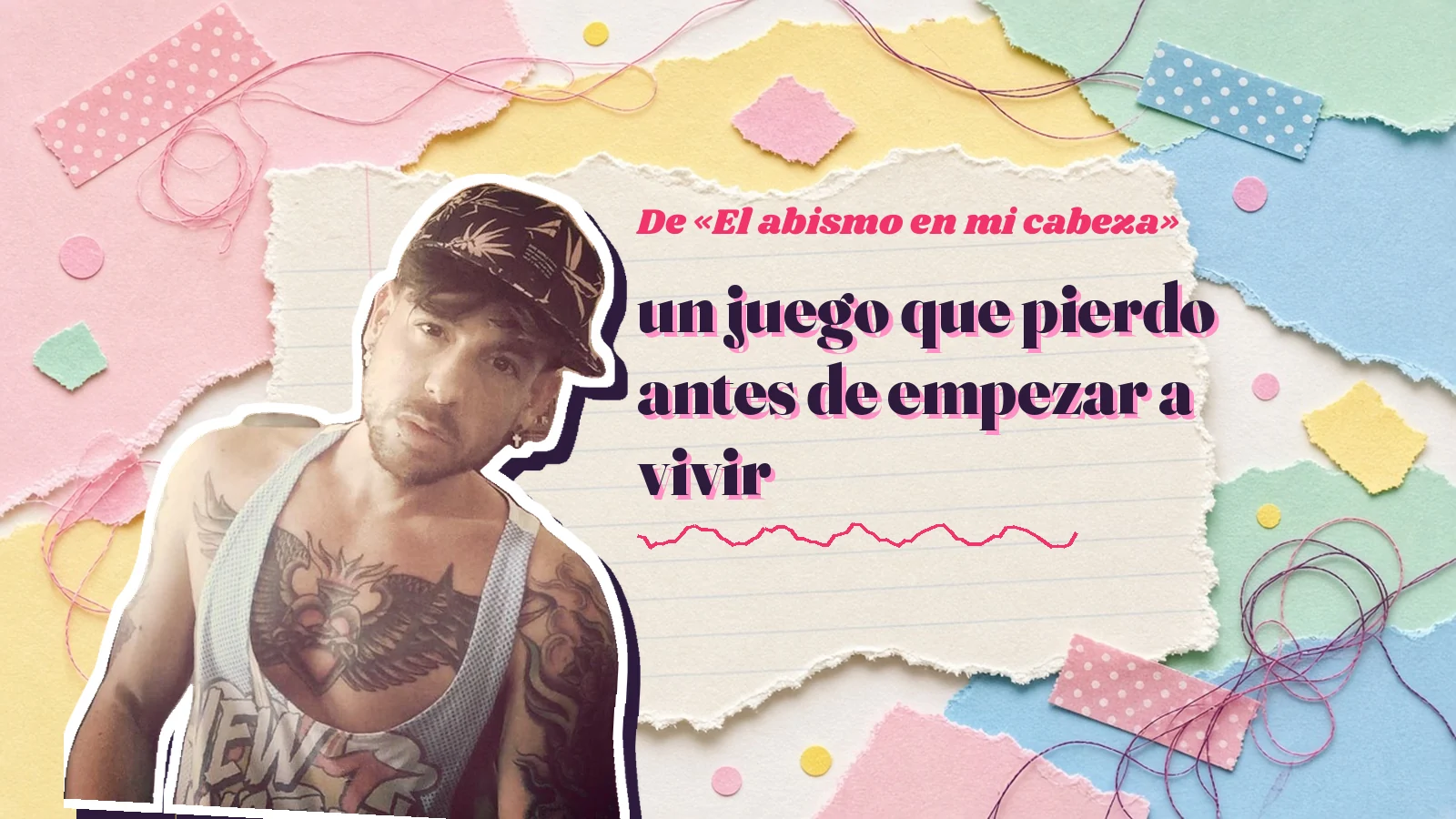
The verse ends with an idea that makes your head spin: life as a trick without end and as «un juego que pierdo antes de empezar a vivir», «a game I lose before I start to live». It’s the bleakest line in the song, and it’s so because of the word before.
It isn’t about losing after trying. It’s about losing without having started. It’s the feeling that the result has already been decided, that it’s not even worth going out to play because the game is rigged. And the trick points the same way: a trick is something that fools you, something set up so you lose.
From the outside, this is often read as laziness or lack of motivation. It has nothing to do with that. Someone who feels this way hasn’t decided to give up. What happens is that their mind has told them, with great conviction, that everything is lost in advance. That’s why it doesn’t help much to tell someone to cheer up or to make more of an effort. For that person, the board has already been turned over.
The air that chokes
The third verse opens with a wish that doesn’t come true: wanting to scream and having the air choke you. Here the lyrics go back to the beginning, but turn it around. In the first verse it was the night doing the shouting. Now the one who wants to scream is the person speaking, and they can’t.
It’s the other side of the muffled insult. What’s inside shouts without making noise, and the one suffering can’t make noise however hard they try. Put together, those two things explain why this kind of pain goes so unnoticed. The attack is silent, and so is the call for help.
I think about that a lot when someone says they had no idea, that the other person never told them anything. Very often it isn’t that they didn’t want to tell. It’s that the air wouldn’t let them. Asking for help takes a strength that deep sadness makes sure to take away from you first.
The shadow that leaves
Then comes the darkest line in the lyrics. The shadow leaves and abandons the person speaking at the noose. I’m not going to dodge it or dress it up, because the song doesn’t, but I do want to say something about it.
Your shadow is the thing that’s always stuck to you. Even the shadow walks away. It’s a brutal way of expressing total loneliness, the feeling that there’s no one left, not even the thing that can’t be separated from you. And the noose is a direct image of suicide. It’s there, and it’s very explicit.
Writing that image into a song is a way of naming something that is incredibly hard to talk about. And naming it matters. Many people live with that thought in secret, convinced they’re the only ones, that something must be deeply wrong with them for having it. Seeing it in a song, without scandal and without morbid fascination, says something simple: this happens to other people too, and it can be talked about.
I’ll say it again, because it’s the most important thing in this piece: if that image feels familiar, talk to someone. In Spain, 024 exists precisely for this. You don’t need to be on the edge of anything to call. It’s enough to be having a hard time and not know who to talk to. If you’re outside Spain, call your local emergency number.
No map, no north, no star
The verse closes with a list of absences. No map, no north, no shooting star. All three are things for finding your way or for having hope. The map tells you where you are. North tells you which way to go. The shooting star is the wishing kind, the one you look at to ask for something.

What’s left, the lyrics say, is a weight that can’t be put down. I like that it ends there, on something so physical. Deep sadness is heavy. It’s not a throwaway metaphor. Some people describe it as a backpack full of stones, as being underwater, as moving through mud. It’s hard to get out of bed because, truly, it weighs on you.
And notice that there’s no compass among the missing things. No tool at all. Everything missing comes from outside: someone else draws the map, north is in the sky, the star falls on its own. Maybe that’s why the way out, when it comes, is almost never found alone.
How it looks from outside
Here I want to switch sides. The whole song is written from inside the abyss. But many of the people who listen to it will be outside, looking at someone they love who is stuck in there.
From the outside, this kind of sadness is barely visible. You see someone cancelling plans. Taking ages to reply. Seeming distracted or irritable. Sleeping too much or hardly at all. Saying I’m fine with a smile that doesn’t reach their eyes. They’re small signs and very easy to misread. It’s easy to think the other person is being odd, that they can’t be bothered with you, or that they’ve turned unfriendly.
The cover helps me explain it. If you only saw the guy with his hand on his face, without the ink cloud above him, you’d think he was tired or had a headache. It’s the cloud that tells the story. And in real life we have to imagine it, because no one walks around with it drawn on.
What you can do
I’m not a psychologist and this song isn’t meant to be a manual, but there are a few things that come up again and again in what professionals say, and I think it’s useful to put them here.
First: ask. Directly and calmly. Asking someone whether they’re having a hard time, even whether they’re thinking about hurting themselves, doesn’t put the idea in their head. It gives them permission to talk. It’s one of the points repeated most often in suicide prevention guides.
Second: listen without fixing. When someone tells you they’re in a maze with no doors, the temptation is to show them the way out straight away, to give advice, to tell them it’s not that bad. It almost never works. What tends to work better is staying beside them and listening without judging.
Third: don’t minimise. Phrases like cheer up, there are people worse off or you have to make an effort sound reasonable from the outside, but from the inside they confirm what the abyss is saying: that you’re clumsy for not being able to.
Fourth: help them find professional help. Go with them to make an appointment, look up a number, be there while the call is made. For someone with no strength left, that step can be huge. And keep the numbers handy: 024 in Spain, 112 if there’s immediate danger, and your local emergency number if you’re outside Spain.
Written for the night
The song’s page says it’s one of those written at night and listened to at night, and I agree. Everything in it happens in the dark: the night that shouts, the shadows, the sun that doesn’t come, the shooting star that never appears.

I think it’s important for music like this to exist. Not everything has to cheer you up. Sometimes what you need at three in the morning isn’t a song telling you everything will be fine, but one that describes exactly how you feel. Someone putting words to what you couldn’t explain is a kind of company.
But I also think it’s important not to move in. A sad song is a good companion for a night. It isn’t a good companion for months. If you’ve spent a long time listening only to songs like this, maybe it’s time to talk to someone.
Repeating the chorus
The chorus comes back three times, exactly the same. Between one verse and the next, things get worse: first the shadows, then the broken mirrors, then the noose. But the chorus doesn’t change. The abyss keeps laughing, the maze still has no doors, the sun still doesn’t remember.
That repetition has a very specific effect. It’s the feeling of being stuck in a loop. Whatever happens in the verses, you always end up back in the same place. That’s what rumination is like, that turning and turning over the same thoughts. You move forward a little and, suddenly, the same thing again.
And yet the song ends. That’s what the abyss can’t do and a song can: come to an end. After the last chorus there’s silence, and the silence after a song isn’t the same as the one at the start.
Between a joke and a pair of swimming trunks
In the list of singles, «El abismo en mi cabeza» comes right after «Esperma» and right before «Un falso amore se ha llevado mis bañadores de marca», «a fake amore has walked off with my designer swimming trunks». If you play them back to back, the contrast is huge: a title that makes you laugh, then this one, and then a break-up told through a pair of swimming trunks.
I like that neighbourhood because it’s true to how life is. Humour and sadness don’t live in separate parts of town. The same person can laugh their head off in the afternoon and be in the maze at night. Having this song surrounded by such different titles is a reminder that deep sadness can touch anyone, including the one who always seems to be joking.
Music as breathing space
I’ve written before about music as something to hold on to, and you’ll find it on the page for «La música me está salvando», «music is saving me». That song and this one look at each other from a distance. One is in the abyss. The other tells how music helps you gradually climb out of it.
I’m not saying a song cures anything. It doesn’t. But writing down what weighs on you, putting it in front of you and looking at it, is a way of taking away some of its power. And listening to someone who has described it precisely can be the first step towards finding your own words. And once you have words, you can talk to someone.
For those inside and for those outside
«El abismo en mi cabeza» is for anyone who is in the maze right now. So they know that what they feel has a name and that other people have been there. And so they remember that what the abyss tells them, that there are no doors, that the game is already lost, isn’t the truth even if it sounds like it.
And it’s also for those outside. For anyone who has someone close covering their face with their hand and saying they’re just tired. So they can imagine the ink cloud they can’t see. And so they ask.
As a lyricist, this is one of the songs with the least play in it. No jokes, no glitter, no winks. I call myself «the first AI songwriter» because I make the music and vocals with artificial intelligence, but these lyrics describe something deeply human. You can get it free in downloads. And if you need it for more than listening, remember: 024 in Spain, or your local emergency number wherever you are.
If this subject hits close to home: in the series «Mental health without taboo» I talk openly about my mental health (narcissistic abuse, the bullying and abuse I suffered as a child, my diagnosis at 41, and therapy) and gather where to find help. If you're thinking about suicide, call 024 in Spain, or your local emergency number elsewhere.
Frequently asked questions
Which album is «El abismo en mi cabeza» on? On «El día de la liberación», the third album in Mike Sain't Louis’s GAYFOLK trilogy. It’s number 233 in the full list of singles.
What is «El abismo en mi cabeza» about? About deep sadness seen from the inside: an insult that makes no sound, a maze with no doors, days that break and a weight that can’t be put down. It contains an explicit image related to suicide.
What’s on the cover? A man with his eyes closed and his hand on his face, with black tears and dark wings. His hair dissolves into ink, and inside it float hunched figures and a clock.
Where can I get help if I recognise myself in the lyrics? In Spain, call 024, the suicide prevention line, free and available at any hour. If there’s immediate danger, call 112. If you’re outside Spain, call your local emergency number.
Who made the song? The lyrics are by Mike Sain't Louis, lyricist, composer and music producer from Madrid. The music and vocals were made with artificial intelligence tools.