By Mike Sain't Louis ·
The «no vacancies» sign: «El anillo de casado» and the secret map of a hidden love
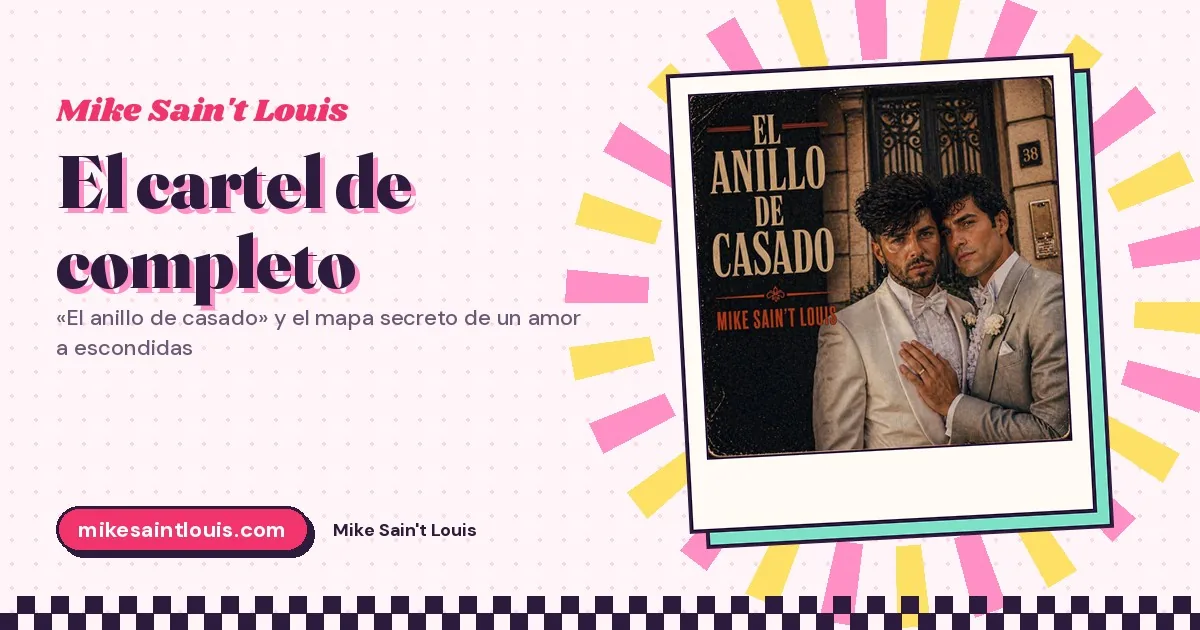
Two men pose very close together in front of an old doorway. They’re wearing cream tuxedos, white bow ties, ruffled shirts and a white flower in the lapel. One rests his hand on the other’s chest, and on that hand a wedding band catches the light. Behind them, a wrought-iron door, a plaque with the number 38 and, on the wall to the right, a brass intercom. On the left, against a black background, the title in tall sand-coloured letters with a little ornament in the middle, like an old-fashioned wedding invitation.
That’s the cover of «El anillo de casado», «The wedding ring», and I think it’s one of the trickiest in the whole catalogue. Because it shows a wedding between two men, elegant, arm in arm, looking into the camera without a trace of fear. And the song tells exactly the opposite story: a church wedding with a woman, and two men who love each other in corners. The cover is the ending the lyrics won’t allow themselves.
The song is on «Descubierto un nuevo planeta llamado Gayfolk», the first album of the trilogy, and it’s number 159 in the full list of singles. Its page on the blog already talks about the copla, the humour and the tipsy glow after five pints. Here I want to focus on something else: the places. The map of Madrid drawn by a relationship that can’t walk hand in hand down the street. Because this song, if you look closely, is full of places.
A beer hall as the first stop
The story begins in a well-known chain of beer bars, with five pints on the table. I love that the first setting is somewhere so ordinary. It isn’t a gay bar or some hidden venue. It’s the kind of place you meet colleagues on a Thursday, where nobody pays attention to anybody.
And that’s exactly why it works. Two men having beers in a chain bar don’t draw attention. They could be friends, colleagues, brothers-in-law. The camouflage is perfect. The only thing that gives away what’s really going on is the laughter and the glances, and the lyrics put it with a lovely diminutive: bien escondiditos, nicely tucked away.
That diminutive says a lot. Hiding is serious; it can be sad, it can be dangerous. Hiding with a diminutive is something else: it’s almost a game, a bit of mischief. It’s the lyrics’ way of taking the drama out of something that, told differently, would weigh a ton.
The ring as an object
The song’s title isn’t a person’s name or an emotion. It’s an object. A ring. And that object takes up everything.
In the first verse, what the narrator wants is for the other man to take it off. Not to leave his wife, not to come out, not to change his life. Something much smaller and much more immediate: take off the ring so they can go to bed together. As if, by taking it off, the commitment stopped existing for a few hours.
That fantasy interests me a lot, because it’s so human. Thinking that removing an object is enough to leave everything it stands for outside the door. But the ring, even if it stays on the bedside table, is still there. And the song knows it, because the chorus never stops naming it. It repeats it again and again, almost obsessively: the ring, the wedding ring, wedding, the ring.
It’s on the cover too. It’s the only thing that shines on the hand resting on the other man’s chest. The band right where you’d see it in any wedding photo. Except that here the wedding is a different one.
A chorus that sounds like congratulations
The chorus has something of a wedding song about it. It talks about a man forever in love, who went to church, who shows off his ring, who is more in love every day since he started wearing it. If you heard it without the rest of the lyrics, it could be played at the reception.

But context changes everything. The one saying these things is the lover. And so every line turns ironic without a single word changing. More in love every day, yes, but with whom? The lyrics leave the question hanging, and I’m not going to answer it here. I like it left that way.
And then comes the punchline, the line that sums it all up with an almost cheeky lightness: «si pasa por mi cama y lo disfruto para mí es pasado», «if he passes through my bed and I enjoy it, to me it’s in the past». It’s a way of saying it’s no big deal, that what happens in bed stays there and there’s no point overthinking it. A defence. Because if everything is in the past, nothing hurts.
The doubt that changes everything
That defence holds until the bridge. There the song changes tone and a question appears, repeated three times: and what am I going to do? The answer, also repeated, is I don’t know.
It’s the moment the game ends. The narrator admits he feels so good with him and that he’s starting to fall in love. It’s no longer a five-pint fling. It’s something else. And what traps him a little more each day, the lyrics say, is «su supuesta heterosexualidad», «his supposed heterosexuality».
A single word: supposed
If I had to keep just one word from the whole song, it would be that one: supuesta, supposed. It’s the shortest word in the line and the one carrying the most weight.
Supposed means everyone takes it for granted, but it isn’t quite true. That there’s an official version and a real one. The official one is the wedding, the wife, the guests. The real one is the beer bar, the glances, the guesthouse. And the narrator is the only person who knows both.
The curious thing is that the lyrics say that heterosexuality is exactly what traps him. Not in spite of it, but because of it. There’s something very recognisable in that contradiction. The man who isn’t available, who can never be entirely yours, who has a life you don’t belong to. That impossibility sometimes makes desire grow instead of fading.
I don’t want to draw any moral from this. The song doesn’t judge either of them. It just puts the word in front of you and lets everyone think what they like.
Four hundred guests
The last verse has the sharpest contrast in the whole song. On one side, a church wedding, with the bride in pure white and four hundred guests. On the other, two men making their way around Madrid de discretos, keeping a low profile.
Four hundred guests is a huge number. It’s the kind of wedding people remember, with everyone watching, photos, family on both sides, toasts and speeches. It’s the most public version of a relationship possible. The one that’s announced, celebrated and put on record.
And against that, the other relationship doesn’t have a single witness. No guests, no photos, nobody who knows anything. It’s the imbalance that hurts: four hundred people for one story and zero for the other.
The map of the discreet
This is where the song turns into a map. The two men have no home to meet in. He lives with his wife, and presumably the narrator can’t take him back to his place, or doesn’t want to, or doesn’t dare. So the whole city becomes their home in stolen hours.

They walk around Madrid looking for somewhere. And the lyrics give a lovely detail: they’re «buscando hostales que no tengan colgado en el telefonillo», «looking for guesthouses that don’t have hanging by the intercom» the sign that says full. It’s such a concrete image you can see it. Two men standing in front of a doorway, looking at the little sign next to the buzzers, moving on to the next one if there’s no room.
And here the cover plays its trick again. Because behind the two grooms there’s a numbered doorway and, to the right, an intercom. The same intercom as in the lyrics. What in the song is the place where you look for a room by the hour is, on the cover, the doorway of a wedding. The same object with two stories.
The places of a secret
I like thinking of this song as a tour of the places used by anyone living a hidden love. First, the public place where nobody looks: the beer bar. Then the rented private place: the guesthouse. In between, the street, crossed de discretos, without holding hands.
They’re places you pass through. None of them is yours. None of them is a home. And that says a lot about the relationship. It’s a story with no postal address, one that exists in other people’s spaces and by the hour.
There’s something very Madrid about that, too. The city has lots of small guesthouses in old apartment buildings, with their plaque by the street door and their sign next to the buzzers. Anyone who has walked around the centre has seen them. The lyrics turn them into the setting for a love story that has no other.
What the cover dares to imagine
I keep coming back to the cover because I think it’s half the song. The lyrics tell you what happens. The cover tells you what could have happened.
Two men dressed as grooms, in front of a doorway, looking into the camera. They aren’t hiding. They aren’t in a guesthouse looking for a room. They’re right there at the door, in plain sight, like any couple who have just got married and are posing for the photo. It’s the wedding the lyrics don’t have.
In Spain, two men have been able to marry since 2005. So the cover isn’t imagining anything impossible. It imagines something legal, normal, everyday. What makes it so powerful is that, in the story the song tells, that perfectly possible thing doesn’t happen. Not because of the law, but because of fear, habit or whatever it is that leads a man to marry a woman in white before four hundred people while he falls for another man.
The copla tone
The song’s page already points out that it has a lot of classic copla in it, and I agree. Copla, the great Spanish song tradition, is full of loves that can’t be spoken of: the mistress, the married man, the love that can’t be named in public. It’s a genre largely built on secrets.
What this song does is take that mould and swap the characters. Here there’s no woman waiting for the married man. There’s another man. And the setting isn’t a country estate or a roadside inn, but a chain beer bar and a guesthouse in the centre. Everything else is the same old pain: loving someone who has another life.
I really like that continuity. Telling a queer story with the tools of such a popular, age-old genre puts it inside the tradition instead of leaving it outside.
Humour as a raincoat
One thing about this song is that it doesn’t turn tragic. It could. It has all the ingredients for a drama: the lover, the secret, the wedding, the falling in love with no future. But the lyrics prefer the tipsy glow, the diminutives, the merry mood, the five pints.

That humour works like a raincoat. It doesn’t stop the rain, but you get less wet. The narrator laughs at the situation because, if he didn’t, he’d have to look it in the face. And looking it in the face would mean admitting what he says in the bridge: that he doesn’t know what he’s going to do.
I think it’s a very honest way of telling something like this. Many people who have been someone’s secret don’t experience it as a non-stop tragedy. Sometimes it’s great, sometimes it’s awful, and almost always there’s a bit of joking around to make it bearable.
Being someone’s secret
Deep down, «El anillo de casado» is about a very specific position: being someone’s secret. Not the cheater, not the one being cheated on, but the one outside the official photo.
That position has its own rules. You can’t call whenever you want. You can’t appear in photos. You can’t tell anyone who knows him. You meet in places where nobody knows either of you. You fit around his schedule, his excuses, his special dates, which are never with you.
And yet sometimes it feels really good. The song doesn’t deny it. With him I’m so fine, it says. That’s the trap. It isn’t a story where everything is bad and the way out is obvious. It’s a story with genuinely good things in it, and that’s exactly why it’s so hard to leave.
What the lyrics don’t say
The song ends without resolving anything. We don’t know whether the narrator leaves or stays, whether the other man leaves his wife or everything carries on as before. The last chorus goes back to the same place: the ring, the man in love, the past.
I like that open ending because it’s true to how these stories tend to go. They don’t end with a big scene. They drag on. They repeat. One more beer bar, one more guesthouse, the sign again. And the question from the bridge is left hanging.
What the lyrics do make clear is who knows the truth. Four hundred guests went home believing one thing. The narrator knows another. And that, like it or not, is his.
De discretos
The lyrics say they walk around Madrid de discretos, and I love that expression. Going about de discreto isn’t the same as being discreet. It’s a disguise. It’s putting on an attitude the way you’d put on a trench coat so no one recognises you.
Walking down the street de discretos means keeping a hand’s breadth apart, not touching, talking about neutral things if someone walks past, looking around before stepping into a doorway. It’s a constant effort. A kind of performance that lasts the whole way from the beer bar to the guesthouse.
For a very long time, for many gay men, going about de discretos wasn’t a choice but an obligation. The song doesn’t talk about that directly, but the expression carries all that history with it. Today two men can walk hand in hand down almost any street in Madrid. And yet, in this story, they can’t. Not because the city stops them, but because one of them is wearing a ring.
The third person in the story
There’s someone in this song who barely appears and yet is at the centre of everything: the woman in pure white. She turns up in a single line, as part of the wedding. She has no name, she doesn’t speak, she knows nothing.

I think it’s important not to forget her. The song is told from the lover’s point of view and, naturally, it focuses on what he feels. But the wedding with four hundred guests is her wedding too. The ring is hers too. And the story being lived out in Madrid’s guesthouses affects her as well, even if she doesn’t know it.
The lyrics don’t judge her or cast her as victim or villain. They simply leave her there, in white, as a reminder that in a secret like this there are almost never just two people.
He’s hiding too
And then there’s him, the one with the ring. The song doesn’t let us into his head. We don’t know why he got married, what he feels for his wife, what he feels for the narrator. We only know what can be seen from outside: that he went to church, that he shows off his ring and that, even so, he passes through another bed.
That silence interests me. Because he’s living in hiding too, just differently. His hiding place isn’t a guesthouse: it’s his own wedding. That whole public life, with its four hundred guests, is also a way of not showing something. And that, even if the lyrics don’t say so, must weigh on him.
I don’t want to justify him or condemn him. The song doesn’t either. But I think it’s honest to recognise that in this story no one is entirely free.
No rooms available
The «no vacancies» sign is also a very simple metaphor. It’s what the narrator runs into every time he tries to make room for this relationship: there’s no space.
There’s no space in the other man’s official life, which is already full with his wedding and his guests. There’s no space in the photos, at family dinners or in plans for the future. All that’s left are rooms by the hour, and sometimes not even that. Some nights every guesthouse is full and you just have to keep walking.
Between a stick and the summer
In the list of singles, «El anillo de casado» comes right after «Ni con un palo», «not even with a stick», the Spanish way of saying not in a million years, and right before «Me gusta el verano», «I like summer». I find the neighbourhood funny: a song whose title sounds like a flat refusal, then this one, which is about not being able to say no, and then one that sounds like holidays.
Lined up, they almost look like a sequence. First the firm no. Then the yes that shouldn’t be. And then summer, which is when so many of these stories start or end. I didn’t plan it that way, but I like how they sit together.
For anyone who’s looked for a free room
«El anillo de casado» is for anyone who has ever been someone’s secret. For anyone who has sat in a beer bar unable to take the other man’s hand. For anyone who has looked at the sign by the intercom hoping it would say there was room.
And it’s also for anyone who has been on the other side, with the ring on and another life in their head. The song doesn’t point a finger at him. It just holds up a mirror and a question: and what are you going to do?
As a lyricist, I love having fitted a chain of beer bars, a wedding with four hundred guests and a «no vacancies» sign into the same song. I call myself «the first AI songwriter» because I make the music and vocals with artificial intelligence, but that map of Madrid I drew with words. The lyrics are in lyrics and the song is free in downloads.
Frequently asked questions
Which album is «El anillo de casado» on? On «Descubierto un nuevo planeta llamado Gayfolk», the first album in Mike Sain't Louis’s GAYFOLK trilogy. It’s number 159 in the full list of singles.
What is «El anillo de casado» about? About a man who falls for another man who has just had a church wedding with a woman. It tells the story of their hidden relationship through Madrid’s beer bars and guesthouses, with copla-style humour and a doubt that never gets resolved.
What’s on the cover? Two men dressed as grooms, in cream tuxedos with a flower in the lapel, in front of a doorway with the number 38 and an intercom. One wears a wedding band on the hand resting on the other’s chest.
Are the characters real? No. The characters in the song are invented.
Who made the song? The lyrics are by Mike Sain't Louis, lyricist, composer and music producer from Madrid. The music and vocals were made with artificial intelligence tools.