
By Mike Sain't Louis ·
From chulapo to chulito: old Madrid and my lyrics
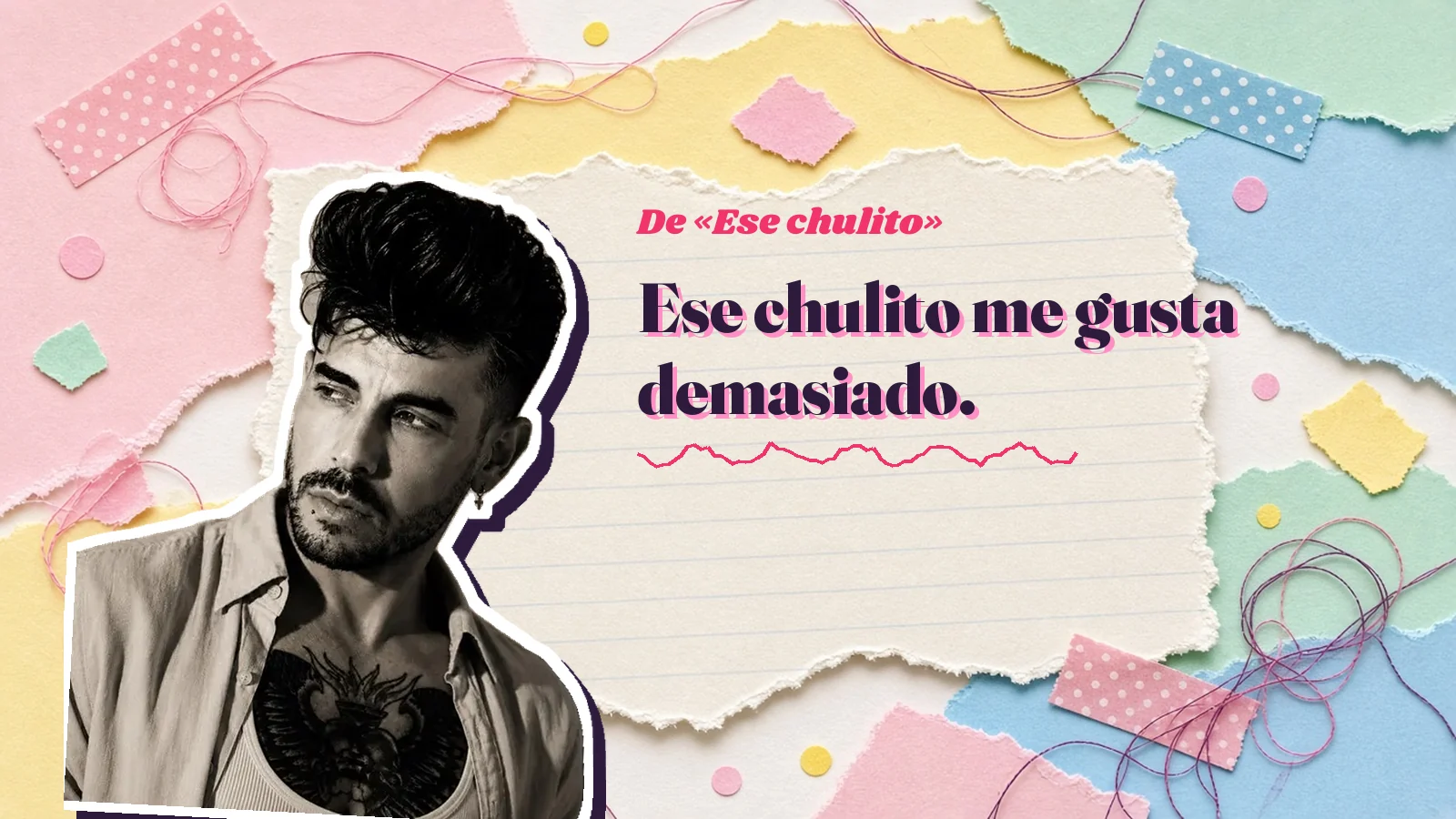
«Ese chulito me gusta demasiado» («I like that cocky lad far too much»).
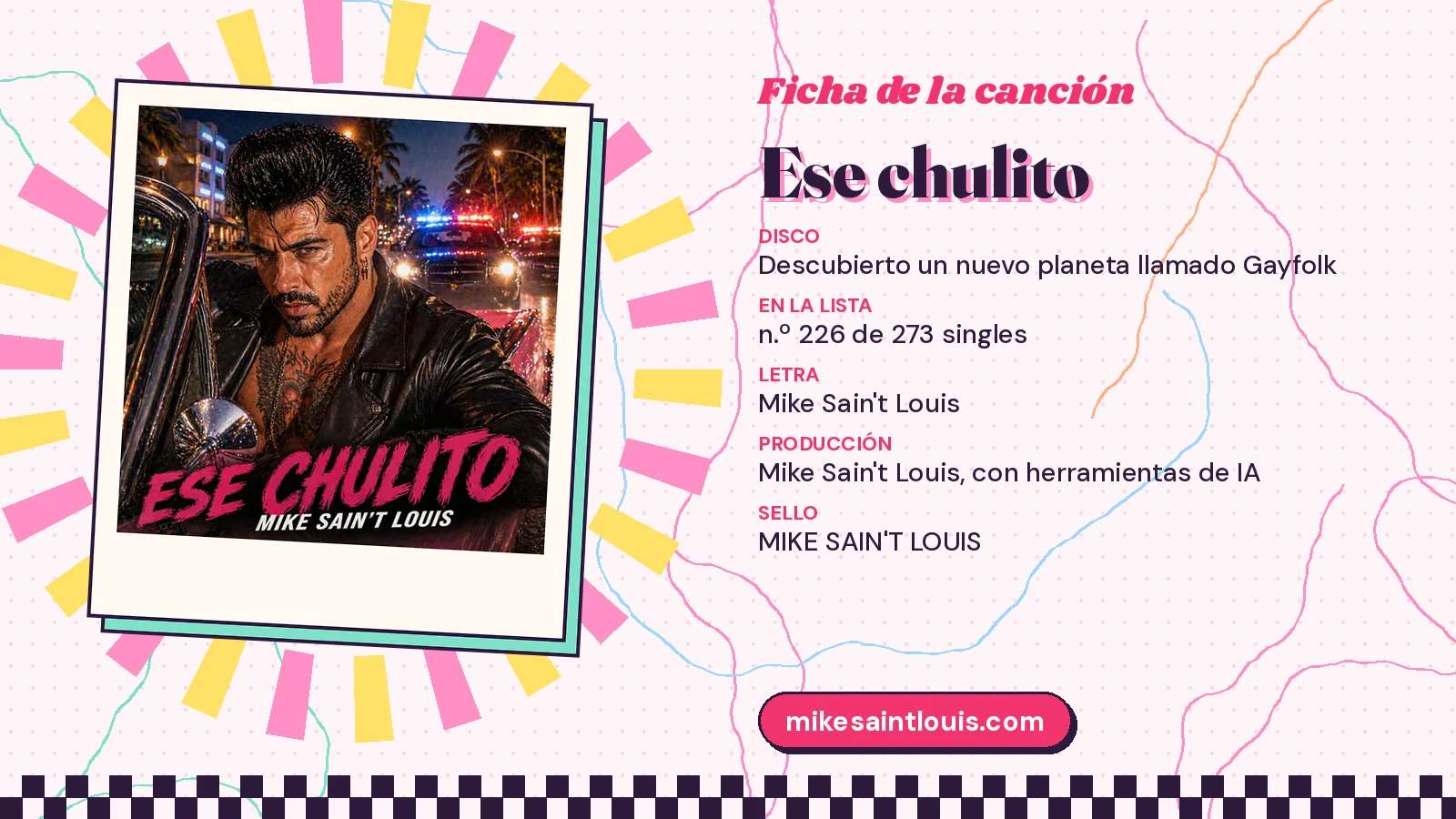
That's how «Ese chulito» begins, a song from the first album of the GAYFOLK trilogy about butterflies in the stomach. It's a reggaeton track with twerking, a driving test and a Guardia Civil checkpoint. There's nothing zarzuela about it (the full lyric is on gayfolkplanet.com). And yet its first important word, «chulito», carries two hundred years of Madrid.
Because the chulito is the grandson of the chulapo. The man who puts on the checked cap and the carnation every 15 May. The one who dances the chotis without stepping off a single brick. The one who strolled onstage in nineteenth-century farces with his thumbs hooked in his waistcoat and a cutting line ready.
This piece isn't about my Madrid, my streets or the bars where things happen in my lyrics. I've written about that already. It's about something else: castizo Madrid, the Madrid of street fairs, zarzuela and the chotis, and the way it sneaks into songs that seem to have nothing to do with it. It's about words, characters and a tradition that, seen up close, was always heavy on pose, costume and exaggeration. Heavy, in other words, on what we'd now call camp.
The chulapo, the chulapa and the chulito
I'll start with the outfit, because castizo Madrid enters through the eyes.
The Madrid chulapo wears a flat checked cap, the parpusa, a tight waistcoat, narrow trousers, a white kerchief at the throat and a carnation. The chulapa wears a fitted dress, a white scarf over her hair, a red carnation tucked into it and, if the occasion deserves it, a Manila shawl. It's the uniform of San Isidro and the August fairs, and it's a costume nobody puts on to go unnoticed.
The word comes from «chulo». And in Madrid «chulo» has two faces that I find irresistible. On one side it's the show-off, the one who thinks he's better than everyone, the one who answers you back with swagger. On the other, «¡qué chulo!» is what you say about something lovely: a shirt, a flat, a plan. The same word works as a flaw and as a compliment.
In «Ese chulito» both faces sit together. The chulito is someone you fancy far too much, who keeps you up at night, whose smile makes your head spin. That's a compliment. But the diminutive and the tone also hint that he's a bit of an old-school chulo: someone who knows he's handsome, flaunts it and asks nobody's permission. Castizo was never humble.
It tickles me that a reggaeton song, with its «que empiece el bailoteo», let the dancing begin, names the boy it fancies with the same root as the character who once danced the chotis in the meadow. The music changes. The way of planting your feet doesn't.
Majos, majas and «qué majo parece»
Before the chulapo came the majos and majas.
In eighteenth-century Madrid, majos were the young men of the working-class districts who dressed flamboyantly, made a show of being true Madrileños and looked down their noses at the Frenchified courtiers. Goya painted them again and again in his tapestry cartoons. And two of his most famous canvases, which now hang in the Prado, are called precisely «The Naked Maja» and «The Clothed Maja».
Over the centuries «majo» has softened. Today a majo boy is a nice boy, pleasant, decent. No longer the neighbourhood swaggerer, but the neighbour who carries your shopping upstairs.
And that softened word turns up in the introduction to «El canario que miente», dedicated to those who hide behind a smile and a «qué majo parece», he seems so nice. There, nice has a false bottom again. The one who seems nicest may be the biggest liar. It's as if the word remembered where it came from: the eighteenth-century majo was, above all, a well-dressed façade.
Castizo Madrid has always played with appearances. Majo, chulapo, maja and chulapa were all defined by how they presented themselves to others. And for someone who writes about impostors in masks, that's prime material.
San Isidro in the meadow
15 May is San Isidro, Madrid's patron saint. And on that day, for centuries, the city has spilled out onto the meadow beside the saint's hermitage, across the Manzanares river.

Goya painted that too. «The Meadow of San Isidro», from 1788, is a small canvas swarming with people: clusters of majos and majas sprawled on the grass, parasols, carriages, and Madrid in the distance with its domes and its palace. It's almost a snapshot of a city-wide picnic.
Today's fiesta isn't so different. There are chulapos and chulapas dancing the chotis to the barrel organ, and stalls selling lemonade and rosquillas, the saint's ring-shaped pastries. Those pastries have names that sound like affectionate insults: the «tontas», the silly ones, which come plain, and the «listas», the clever ones, which wear a coat of icing. It strikes me as one of the most Madrid things there is: giving a pastry a personality. Silly or clever depending on what you've got on top.
There's no meadow in my lyrics, but there is a very San Isidro habit: celebrating as a group what ought, in theory, to hurt. In «Un puñetazo al día», someone throws a funeral in Madrid with their best friend, in a dive where time seems to have stood still, with a wreath in the boot of the car. What's being buried is an ex-husband and the years he stole. And one of the friends, as it happens, is called Isidro, like the saint. A fictional character with a patron saint's name, at a party that turns grief into a pilgrimage feast.
The August street fairs
When Madrid empties out in August, the old central districts fill up. It's the month of the castizo verbenas: San Cayetano, San Lorenzo and the Virgin of La Paloma, in the streets of Lavapiés, the Rastro and La Latina.
They're fiestas of narrow streets, of paper lanterns strung from balcony to balcony, of barrel organs and the chotis, of fried tripe and lemonade. And of tremendous heat. An August verbena in Madrid is a party thrown in spite of the weather, almost in defiance of it.
I love the idea of the verbena as the party for those who stay. Whoever has money and a flat by the sea leaves. Whoever doesn't dances in the street of their own barrio. There's a lot of that in my lyrics: parties that aren't the ones you dreamed of, plans that fall short, beaches never reached. The verbena is the possible party, the one within reach. And sometimes it's the best one.
It's also the party of the morning after. Every verbena has its hangover, and the barrios wake up to plastic cups on the cobbles. In my songs, the mornings after turn up more often than the nights before. That's very verbena too: a party is always better told once it's over.
Where are you off to in that Manila shawl?
The most famous verbena of all isn't in the street but on a stage. «La verbena de la Paloma», an 1894 zarzuela with music by Tomás Bretón and a libretto by Ricardo de la Vega, is probably the most castizo work in the entire repertoire.
Its plot is small, as befits the «género chico», the one-act comic operettas Madrid adored. Julián, a typesetter, is jealous because his girlfriend Susana is going to the fair with an old apothecary, Don Hilarión. There are rows, there's an aunt stirring up trouble, there are policemen, and there's a happy ending. And there's the line half of Madrid knows by heart: where are you off to in that Manila shawl, where are you off to in that silk chiné dress?
What interests me about that zarzuela is that its engine is jealousy. All the castizo colour of the verbena, all the chotis, is there to serve a neighbourhood jealousy scene. And jealousy runs through my lyrics as well.
In «La dieta del cucurrucho», a couple has gone two years without a jealous fit and suddenly it all blows up over a remark about one actor's eyes and another's sex appeal. It's exactly the mechanism of «La verbena de la Paloma»: a settled couple, a third figure who appears, and a scene that erupts in an instant. The setting shifts: instead of a street in La Latina, a bedroom. The object of jealousy shifts: instead of a moneyed apothecary, two stars of film and television. But the drama is the same. And in both stories the drama is mostly comedy.
The chotis on a single brick
The chotis is Madrid's dance, though it wasn't born here. It descends from a Central European dance, the schottische, which became fashionable in the ballrooms of nineteenth-century Europe and reached Madrid in that era. Here it turned into something else: a slow, close-held dance for couples, danced almost without leaving the spot.
The most famous thing about the chotis is that the man, by tradition, dances on a single brick. He turns on the spot, barely shifting, while the woman circles around him. It's a dance in which one stays still and the other moves.
That choreography has often been read as a portrait of the traditional couple: him planted in the centre, her in orbit. And when I think about it from Planet Gayfolk, I can't help wondering what happens when the two people dancing are two men. Who stays on the brick? Who circles? Does anyone have to stand still?
My songs don't answer with a chotis, but with other dances. In «Ese chulito» what begins is the bailoteo and the perreo, the jiggling and the twerking. In «La vecina cotilla», someone puts the track on and imagines dancing slowly with the neighbour across the way. These are dances where nobody's stuck on a brick. But I like to think they share something with the chotis: they're close dances, for two, where the spot matters less than who you're holding.
The corrala and the nosy neighbour
If there's one quintessentially castizo building, it's the corrala: tiny flats opening onto an inner courtyard through long galleries with railings. Lavapiés still has a few. It's a house where everyone sees what everyone else is doing.
Zarzuela turned the corrala into a stage set. «La Revoltosa», from 1897, with music by Ruperto Chapí and a libretto by José López Silva and Carlos Fernández Shaw, takes place in a Madrid courtyard of neighbours. Mari Pepa, the troublemaker of the title, drives every man in the building to distraction, while the women watch, gossip and plot. Felipe, the chulapo in love, pretends not to care. The whole piece is a game of glances between windows and galleries.
My «La vecina cotilla», the nosy neighbour, is a corrala without the corrala. Someone spies on the neighbour opposite: watches him work out in tiny shorts, lean out of the window, change into his pyjamas. And ends up embracing the role: I've turned into the nosy neighbour. It's the woman watching from the gallery in «La Revoltosa», but with desire moved to a different seat. The one spying here isn't policing the barrio's morals. She's keeping an eye on the handsome boy. And she owns up to it with real charm.
The corrala was a place where privacy was impossible. For many LGBTQ people, for decades, the barrio was exactly that: somewhere everyone was watching. I like that my nosy neighbour turns that gaze inside out. It's no longer the gaze that judges, but the one that wants.
The yokel who comes to Madrid
One of the stock characters of castizo theatre is the paleto: the country bumpkin who arrives in Madrid and understands nothing. He gets lost, gets swindled, is scandalised by the capital's ways and ends up the butt of the chulapos' jokes. Cinema gave him his most popular outing in «La ciudad no es para mí», the city's not for me, the 1966 film starring Paco Martínez Soria.

My lyrics have a paleto too, but he isn't the one arriving from outside. He's the one who's bothered.
In «Tan paleto», and in its twin version «Tan cateto», someone runs into a person who's bothered by two men holding hands, bothered that the boyfriend is African, bothered that their children might see a kiss. And the song's answer is the question in its title: how can you be such a hick, how can you be so small-town?
There's a twist on the tradition here that I adore. In the old farces, the paleto was the outsider who didn't know the city. In my song, the paleto is the one who doesn't know the world. He could have been born in the very centre of Madrid and still be a paleto. Being a hick is no longer about where you're from, but about how small your head is. And that, funnily enough, is deeply castizo: the Madrid chulapo's mockery of whoever doesn't get it, only now aimed at whoever won't tolerate.
Arniches and the slang invented on stage
There's an oft-repeated idea about castizo Madrid speech that I find lovely: that much of it was fixed on the stage and from there passed into the street.
Carlos Arniches, the great author of Madrid farces at the turn of the twentieth century, filled his plays with chulapos and chulapas who talked with exaggerated cheek, all turns of phrase, diminutives and stock sayings. It's often said that audiences ended up copying his characters, and that plenty of Madrileños started talking the way Arniches's Madrileños talked. The theatre didn't just copy the city's speech: it pushed it along.
I love that idea because it says castizo is, in part, a performance. That the chulapo is a role people chose to play. And that brings it very close to queer culture, where performing, exaggerating and dressing for a part are ways of saying who you are.
There's a lot of that exaggerated barrio talk in my lyrics. «Hoy estoy contentillo, estoy con el puntillo», I'm a bit merry today, a bit tipsy, in «El anillo de casado», with its two diminutives chained together. «Ni de coña», no bloody way, in «Bareback», followed by a «mi niño», my boy, that's pure affection with a sting. The «pringado», the loser, of «Buscando el polvo perfecto». The «¡Patán!», oaf!, that caps the first verse of «La música me está salvando». Arniches wouldn't have written those words, but they come from the same school: the insult with wit and the quick comeback.
Mola and flipar: castizo now
Castizo isn't a museum piece. It keeps changing, and today it has words the chulapo of 1900 wouldn't have understood.
«Mola», for one, Madrid's way of saying something is cool, that you're into it. In «Me mola Zeus» the word becomes a shouted chorus in capital letters. In «Que te mola el cruising» it sits in the title, glued to an English word. And the same song has something even more contemporary Madrid: «Yo estoy fliping». The castizo verb «flipar», to freak out, with an English ending, as if someone from Lavapiés had spent a summer in London and come home talking like that.
That's castizo too. Castizo has always absorbed whatever arrived from outside and made it its own. The chotis came from Central Europe and became the most Madrid of dances. The Manila shawl, as its name says, arrived by the Philippines route, though many were made in China. The «fliping» in my song is the same thing on a small scale: a foreign word that moves in and settles down in a Madrileño's sentence.
And then there are the old words still hanging about. The «pavo», the bloke, who turns up in your bed on a hangover morning. The «tío», mate, used for any man at all. The «tía», girl, with which a friend tells you you look awful. Words you never learn from a book, only from the street.
Chueca was a composer
There's one fact that has always struck me as a little joke played by history.
Madrid's gay district is called Chueca after the Plaza de Chueca. And the square is named after Federico Chueca, a nineteenth-century Madrid composer and one of the giants of the género chico. His most famous work is «La Gran Vía», an 1886 revue written with Joaquín Valverde, in which the streets of Madrid become characters who talk and dance.
In other words: the neighbourhood that became the heart of LGBTQ life in Madrid bears the name of a zarzuela composer. Castizo and queer share a postcode. Every time someone says «see you in Chueca», they're unknowingly naming a writer of chotis and street marches.
In my lyrics, Madrid often appears as the place where certain things are hidden. In «El anillo de casado», a couple hunts the city for discreet guesthouses. I like to think that couple, slipping out of a guesthouse in the area, would cross the square named after a composer who filled Madrid with streets that talked.
Castizo belongs to us too
I reach the end with an idea I've been turning over since the beginning.
Castizo Madrid is usually presented as something traditional, even conservative. The costume, the chotis, zarzuela, the street fair, the Virgin of La Paloma. It looks like our grandparents' world. But look closely and castizo is made of things queer culture knows intimately.
It's made of costume: nobody dresses as a chulapo for comfort. It's made of pose: the chulo, the majo and the chulapa are defined by how they stand. It's made of exaggeration: the quick line, the snub, the compliment that's almost an insult and the insult that's almost a compliment. It's made of performance: a slang that walked off the stage and that people chose to imitate. And it's made of partying in the street, in the barrio, among neighbours who look at each other far too much.
That's why it doesn't seem strange to me that a chulito should turn up in a twerking song, that the corrala neighbour should turn up in a song about desire, or that the yokel of the old farces should turn up in a song against homophobia. Castizo doesn't stay in the meadow. It slips in anywhere someone dresses up, plants their feet and answers back.
And if some 15 May you spot a chulapo with his cap tilted a little more than usual and his carnation a little redder, don't be surprised. He may just be being very castizo.
Frequently asked questions
Which Mike Sain't Louis songs connect with castizo Madrid? Among others, «Ese chulito», «La vecina cotilla», «Tan paleto», «Tan cateto», «La dieta del cucurrucho», «Un puñetazo al día», «El anillo de casado», «Me mola Zeus» and «Que te mola el cruising». None of them is a chotis, but all of them borrow castizo words, characters or situations.
How are «chulito» and «chulapo» related? Both come from «chulo», which in Madrid means both a show-off and something lovely. The chulapo is the traditional character of the street fairs, and the chulito of the song is his present-day version.
Why is the Chueca neighbourhood called that? After the Plaza de Chueca, named for the Madrid composer Federico Chueca, author of género chico zarzuelas such as «La Gran Vía», written with Joaquín Valverde in 1886.
Who writes these songs? Mike Sain't Louis, lyricist, composer and music producer from Madrid, who presents himself as the first AI songwriter. The music and vocals of his songs are made with artificial intelligence.