
By Mike Sain't Louis ·
As Antonio Recio would say: television as a dictionary of heartbreak in «Esperma»
Almost seven years. Not one goodbye kiss. Not one last hug. And then, just as the song is about to turn serious, in through the front door of the Montepinar block walks a moustachioed wholesale fishmonger.
«Como diría Antonio Recio, / Tras tras / Por detrás» "As Antonio Recio would say, / Tap tap / From behind"
Just like that, with no warning. In «Esperma», the quotation that holds up the most venomous moment of the lyric doesn't come from a Golden Age poet or a Rocío Jurado song. It comes from La que se avecina, Spain's long-running sitcom about a block of nightmare neighbours, from a Telecinco comedy character half of Spain knows better than their own neighbour on the fourth floor.
This piece is about that. About why, in my lyrics, I quote television the way others quote Lorca. The page for «Esperma» already tells the song's story, the designer swimming trunks and that final fall from legend to vomit. Here I'll stay with the quotation. With that «como diría», "as … would say", which is, if you think about it, one of the oldest formulas in the language.
«As … would say» is a door
«Como diría mi abuela», "as my gran would say". «Como diría el otro», "as the fellow says". «Como dice el refrán», "as the saying goes". We Spaniards have been talking in quotations for centuries. We don't trust what we say on our own, so we summon someone with more authority. Gran, who has seen it all. The proverb, which has said it all. "The fellow", whom nobody can identify but who is always right.
In my lyrics, that someone with authority often steps out of the screen. And I don't think it's frivolous. I think it's honest. Because for me, and for many of my generation, the phrases to name what was happening to us weren't handed over at school. They came from the telly in the living room, on while the table was being laid, turned up loud so you could hear it from the kitchen.
When I write como diría Antonio Recio, I'm doing what your gran does when she says "as my mother used to say". I'm calling a witness. It's just that my witness wears a fishmonger's overall.
What Recio says without saying it
The interesting thing about the quotation in «Esperma» is what it does inside the song. The lyric comes from a hard place: almost seven years with someone who has been so cruel he deserves silence and punishment. I'll copy it, because that's the tone just before the leap:
«Ese chico con el que he dormido casi siete años / Ha sido tan malo conmigo / Que se merece el silencio y el castigo» "That boy I've slept beside for almost seven years / Has been so cruel to me / That he deserves silence and punishment"
After that, if you carry on down the same road, you end up with an afternoon soap. And I didn't want an afternoon soap. I wanted to say that things happened behind everyone's back, that there was a "from behind" in the story, without listing details like a police report.
And then Recio appears. «Tras tras, por detrás.» What serious prose would take two verses to explain, Recio makes clear in three words. Because the character arrives with his whole world already on: his cheek, his double standards, his way of being a respectable gentleman who isn't respectable even in dim light. The quotation doesn't inform. It insinuates. And insinuation, in a break-up song, is worth more than accusation.
Then comes a «trakatrá», a machine-gun rattle from the shared courtyard, and the song moves on. That's it. The door has opened and closed.
Television as a dictionary
Some people think putting television characters into a lyric is an easy joke. Like sticking a souvenir sticker on a song. I see it the other way round: television is a shared dictionary. If I write "Antonio Recio", millions of people see a face, a moustache, a tone and a way of being in the world. I don't have to describe anything. The dictionary is already in the listener's head.

And for someone who writes songs, that's gold. A song has very little room. There's no space to introduce characters, describe rooms, explain context. Every word has to carry a lot. A proper name from the telly is a word with a whole world packed inside it.
I tell it in another song of the trilogy too, «Me rindo», where the question of whether it was all outtakes from La que se avecina or Caso cerrado, a Judge Judy-style courtroom show, does the work of a treatise on lying. Two television programmes, and you already know the relationship was a cross between a neighbours' sitcom and a studio trial with Dr Polo raising an eyebrow.
A pantheon of the screen
If I take stock, my lyrics have a small television and pop pantheon, each figure with its job. It isn't a plan. It's what has come out.
- Antonio Recio, for what happens behind people's backs.
- La Veneno, for when you have to stand up to someone and ask who they think they are.
- Carmina Barrios, for the mother-in-law you'd have wanted, in «Ojalá hubiera tenido de suegra a Carmina Barrios».
- Caso cerrado, for the couple's trials held in the living room, remote in hand.
- And the nine o'clock news, which doesn't appear by name in any lyric of mine but is in all of them, because it's the background noise of dinners where someone isn't speaking to you.
La Veneno, by the way, enters «Kaaa-miga» with a quotation that's practically a battle cry:
«Porque, como diría ella: “¡Yo soy La Veneno, y tú quién eres, maricón!”» "Because, as she would say: 'I'm La Veneno, and who are you, maricón!'"
"As … would say" again. The door again. And again the quotation does work that would cost me far more on my own: the line from Cristina Ortiz, the trans icon known as La Veneno, brings her story, her courage and her cheek, and lends them to the song for the price of one line.
Quoting isn't copying
There's something I want to make clear here, because with AI the suspicion always crops up. Quoting isn't copying. When I say "as Antonio Recio would say", I'm not plagiarising a script. I'm summoning a character and saying, in my own words, something that fits him. The song's «tras tras, por detrás» is mine, written for that moment in that lyric, even if it sounds like Recio. What I borrow is the character, not the text.
It's what the old folclóricas, Spain's grand dames of copla, do when they say in an interview "as Lola used to say". They put Lola Flores in the witness box to say something of their own.
And to make it clear once more, because it never hurts: the lyrics are mine, written without artificial intelligence. The music and vocals of my songs are made with AI tools such as Suno. I'm a lyricist, composer and producer; the throat isn't mine. The Recio quotation wasn't chosen by a machine. It was chosen by a man from Madrid with the TV remote within reach.
Seven years in one line
Before Recio comes in, the song does something I think is among the hardest things in a lyric: fitting seven years into one line. «Casi siete años», it says. Not even seven: almost. That "almost" is painfully precise. It's the difference between rounding up and counting the days. Whoever says "almost seven years" knows exactly how many months were left until the anniversary.
Seven years is a long time. Long enough for two house moves, three jobs, a death in the family, four summers on the same beach in Cádiz and a dog that's no longer a puppy. And the song tells none of that. Only the number. The listener supplies the rest, with their own seven years or their cousin's.
Then comes the sentence: he deserves silence and punishment. I worked on this from the other side in «El castigo más duro», where silence is the other person's weapon. Here silence changes hands. I'm the one using it. Not a kiss, not a last hug. The silent treatment returned to sender, recorded delivery.
And right there, when the song is at its coldest, Recio walks in. It's no accident. After silence, you need noise. After punishment, a moustache.
If Recio read the lyric
I've sometimes wondered what the character would think if he read the song. Not the actor, who has enough on his plate, but Antonio Recio himself, the one from Montepinar, with his overall, his seafood business and his opinion on everything.
He'd probably be scandalised. He'd say that isn't music, that in his day songs were about love and not stained swimming trunks, that this is a disgrace and where will it all end. And then, behind everyone's back, he'd play it in the car. Tap, tap.
That's the character's charm and the reason he's so useful to me: he's the man who condemns in public what he enjoys in private. The double mask. Exactly what the song reproaches the ex for. So the quotation does more than the joke: it works as a mirror. I put Recio in the lyric because the ex and Recio are from the same family, the ones who play the decent man and have a drawer full of things they'd never show at Sunday lunch.
When you think about it, I've put a fictional character in the song to talk about a flesh-and-blood person without having to describe him. With Recio, the portrait is already painted. It only needs signing.
The caption and the chorus
There's a relationship I love between television and the chorus, and in «Esperma» it's very clear.
A TV caption has to be understood in two seconds, because people are peeling potatoes. A chorus has to be understood first time, because people are dancing, driving or washing up. Both are lines written for someone not giving their full attention. And both rely on the same thing: a word that hits and sticks.
This song's chorus has that word, the one that gives it its title, shouted with exclamation marks and followed by synonyms from every register, like an emergency dictionary. I won't repeat it here more than necessary; it's already in the title. But it works like a breaking-news caption: red, in capitals, with a siren in the background.
Television taught me that a line on screen has to earn its place. So do songs.
The quotation as anaesthetic
There's another function of the quotation that I think matters most, and that's anaesthetic.

«Esperma» is a very brutal song. It talks about almost seven years, an ending with no hug, stained designer trunks, something that happened behind everyone's back. Tell it all neat and it hurts too much, or it's too disgusting, or both. The Recio quotation slips a laugh in just before the hardest part. Like the shot of orujo, Galician firewater, they give you before pulling a tooth in a village in Galicia.
It isn't that laughter takes the pain away. It lets it through. With the laugh going first, the listener lowers their guard and the next line gets in before they can cover their ears.
There's a piece on the blog about cringe as a writing tool that's about something similar. What's embarrassing, what's disgusting, what isn't said at the table, can be said if someone has laughed first. Laughter is the permission.
From legend to vomit
The song ends with a farewell that's also a quotation, though this time it's me quoting myself in the form of a placard:
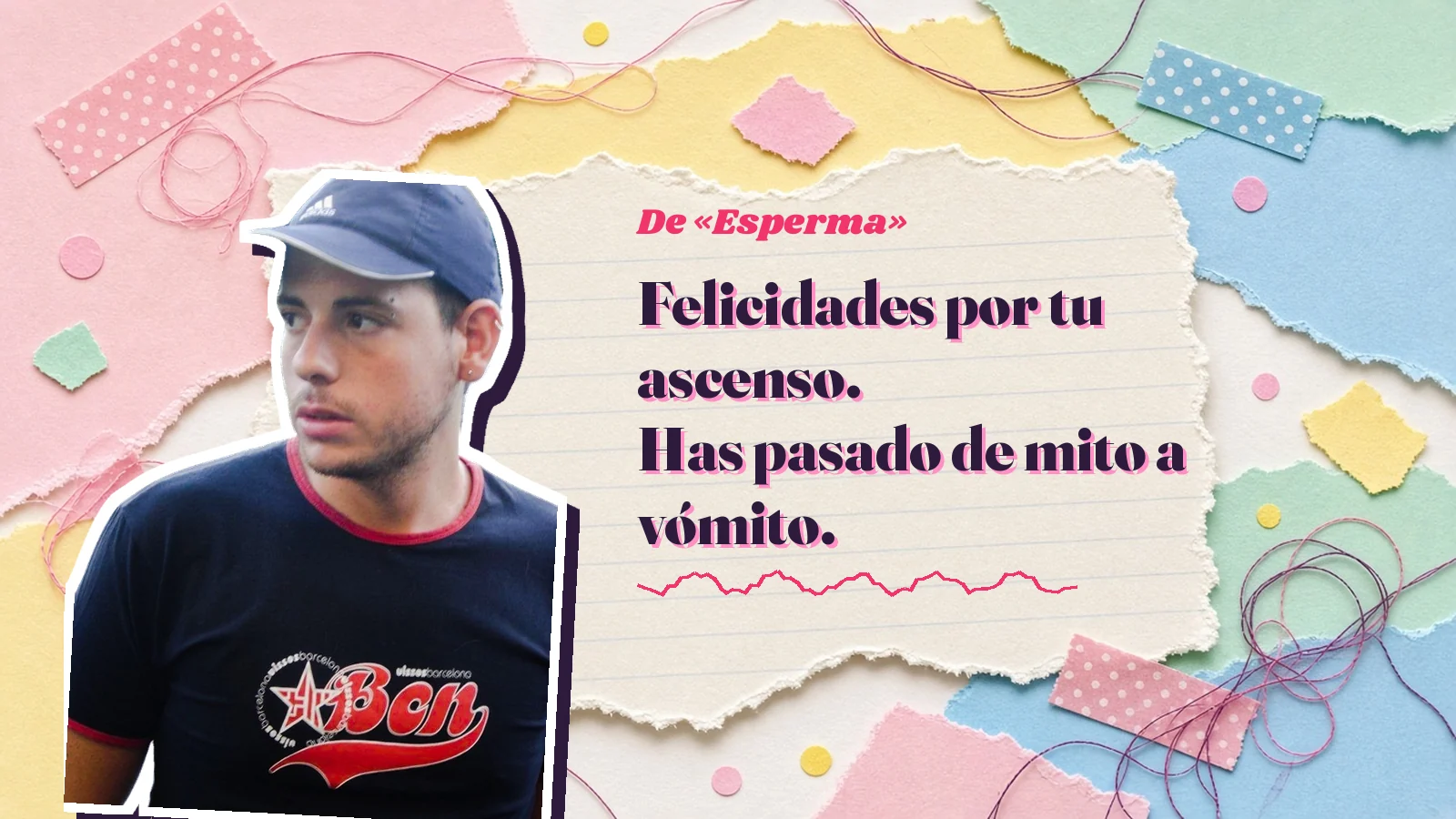
«Felicidades por tu ascenso. / Has pasado de mito a vómito.» "Congratulations on your promotion. / You've gone from legend to vomit."
I love that line because it's pure television. It's a celebrity-gossip headline. It's what a panellist on an afternoon chat show would say with her glasses on the tip of her nose, looking straight at camera: "Congratulations on your promotion". And the wordplay, mito and vómito, has that internal rhyme the caption writers on Sálvame, the notorious gossip show, love so much: short, easy to remember, cruel.
If television gave me the dictionary, it also gave me the grammar. The grammar of captions, headlines, lines that fit on one row at the bottom of the screen. Much of what I write is designed that way: to fit in a caption. So that someone can repeat it at the office the next day without any context.
«Has pasado de mito a vómito.» Caption. Screen. Next story.
Television is no minor reference
There's a widespread contempt, especially in certain cultural circles, for mainstream Spanish television. Telecinco is "trash TV", reality shows are "for chonis", the Spanish answer to chavs, chat shows are "for pensioners". And I, being queer and from Madrid and raised on all of it, think there's a lot of classism in that contempt and a bit of homophobia in disguise.
Because for years mainstream television was the only place where many working-class kids saw someone like themselves. La Veneno on a late-night set. A drag queen on a talent show. A gay character in a series, even if he was the punchline. For many people those were the first mirrors: warped and tacky, but mirrors.
I explain it better in a blog piece on laughing at and laughing with in queer humour: for a long time, television laughed at us, and now we take that same television and use it to laugh our own way. Quoting Recio in a song by a queer madrileño is just that. Taking a character who wasn't made for us and putting him to work on our side.
And I don't think it's a minor reference. I think it's the most mine of all.
What the quotation can't do
So as not to oversell it, a word of warning from the workshop: quotation has limits.

It doesn't work for everything. In a song like «Entre cuatro paredes», a Recio quotation would be disrespectful. In «Ni con un palo», a dry text about the narcissist's sexual punishment, a cameo from Montepinar would shatter the line like a plate on the floor. Some lyrics have to go without guests.
Nor does it work if the listener doesn't know who's being quoted. If someone in Mexico or Argentina hears "as Antonio Recio would say", they may be left baffled. That's the price of writing with a local dictionary. I accept it. My songs are written in the Spanish of Spain, with Mercadona and Telecinco, and that's part of their charm. If someone from elsewhere gets lost with Recio, let them ask; that's the fun of it.
But when the quotation works, nothing works better. Three words and a moustache.
The remote control
There's an image that helps me explain how I use these quotations: the remote control.
When you write a lyric, you're constantly changing channels. You're on the drama channel, with the seven years and the silence. Suddenly you switch to the comedy channel, and Recio appears. Then back to the gossip channel, with the piece of bread. And you finish on the news channel, with the legend-to-vomit caption. A song of mine is often a rainy Sunday afternoon of channel-hopping, blanket over your knees and a chorizo sandwich in the other hand.
Channel-hopping has a bad name, as if it were a lack of attention. I think it's a way of telling a story. Jumping from one channel to another lets you put together things that shouldn't be together: a seven-year heartbreak and a moustachioed fishmonger. And from that collision comes something neither channel would have on its own.
What I never do is hand the remote to someone else. I change the channel. I decide when the laughter comes in and when it leaves. And in a song as brutal as this one, that's everything.
The piece of bread
There's one line left to look at, because it comes right after Recio and is almost another quotation, this time from the stock of proverbs: el trozo de pan, the piece of bread. To be a piece of bread is to be a good soul, kindly, incapable of harm. And the song uses it with a sneer, like saying "look at the little saint" while pointing at what he's done.
The lovely thing is that, between Recio and the piece of bread, the song brings together two traditions: television and the age-old proverb. The fishmonger's overall and the baguette. Montepinar and the bakery on the corner. And both say the same thing: that the one who seemed good wasn't.
That's my dictionary. Half Telecinco, half grandmother. And when a song like «Un falso amore se ha llevado mis bañadores de marca» or «Esperma» needs a word I can't find on my own, I open one of those two pages.
As I would say
To finish, I'll quote myself, since I'm entitled too. On the website, on my about page, there are some house rules, and one of them says you can tell the truth with humour too. I wrote it with songs like this in mind. In «Esperma», the truth is ugly: almost seven years, an ending with no hug, stained trunks. The humour is Antonio Recio walking through the door with his moustache.
And between the two, a song you can listen to without covering your ears. It's on the first album of the trilogy, *Descubierto un nuevo planeta llamado GAYFOLK*, and in the list of singles on this website.
As Recio would say: tap, tap. From behind. And you, all on your own. How lovely!
Frequently asked questions
Why does Antonio Recio appear in «Esperma»? Because Mike Sain't Louis uses characters from Spanish television as quotations within his lyrics. In «Esperma», the character from La que se avecina hints at what happened behind everyone's back without having to explain it.
Who wrote «Esperma»? Mike Sain't Louis, the Madrid lyricist, composer and music producer. The lyrics are his own and written without artificial intelligence; the music and vocals are made with AI tools such as Suno.
What other television references are there in his lyrics? La Veneno in «Kaaa-miga», Carmina Barrios in «Ojalá hubiera tenido de suegra a Carmina Barrios», and La que se avecina and Caso cerrado in «Me rindo», among others.
Where are the full lyrics? At gayfolkplanet.com/letras/esperma. The song page is at mikesaintlouis.com/blog/esperma.