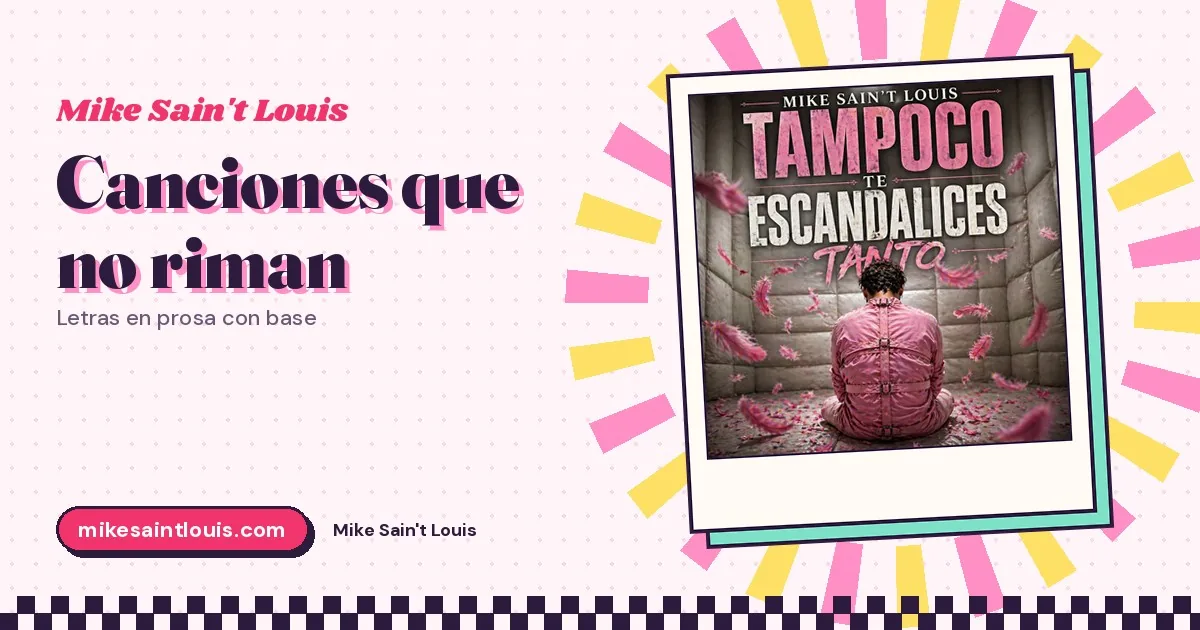
By Mike Sain't Louis ·
Songs that don't rhyme: why some of my lyrics are prose over a beat
A full stop and a new paragraph. In a song. Right there, in the middle of the lyrics, like a Year 10 essay or a letter to the bank.
«Me han dicho muchas veces que usar IA no es arte. / Que lo que hago no cuenta. / Que eso lo hace una máquina.» "I've been told many times that using AI isn't art. / That what I do doesn't count. / That a machine does it."
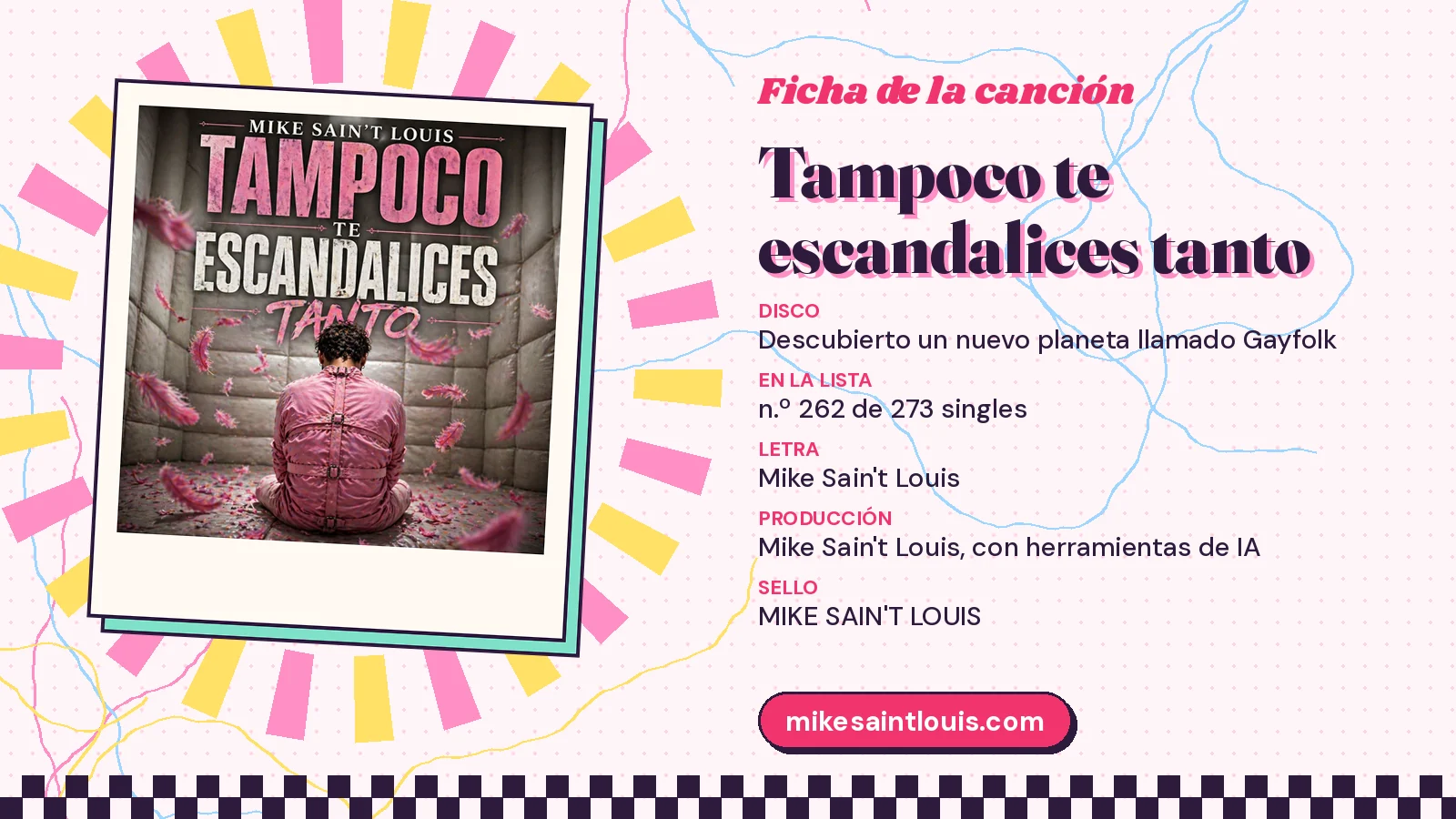
That's how the lyrics of «Tampoco te escandalices tanto» ("Don't be so scandalised") begin. No rhyme. No metre you could count on your fingers. Whole sentences, with a verb and a full stop, like a newspaper's. And it's a song. It's on the first album of the trilogy, with its beat, its production and its cover art, and it plays like any other.
It isn't the only one. My catalogue has a fair few lyrics that are prose. A manifesto with emojis. A dedication signed with my name in capitals. A complaint about stolen swimming trunks that opens with "to begin with", like a statement to the court. A dry text about the narcissist's sexual punishment without so much as a chorus.
This piece is about those songs. About why some lyrics come out of me as prose, and what I gain and lose when I don't rhyme. The page for «Tampoco te escandalices tanto» already covers what the manifesto stands for. Here I talk about its form.
Rhyme as a uniform
Rhyme is a song's uniform. When you hear something that rhymes, your head says "this is a song", just as when you see someone in a hard hat and orange vest you think "builder". It's a signal. It places you. It tells you what to expect.
And I rhyme a lot, mind. I rhyme shamelessly. Pinocho with chocho, mito with vómito, Recio with precio: the cheap, schoolyard sort of rhyme that sticks to you like gum on a sole. I adore it. Some of my songs are almost nothing but rhyme.
But some texts don't want a uniform. Put one on them and they lie. A manifesto that rhymes sounds like a cologne advert. A complaint that rhymes sounds like a Christmas carol. An account of sexual punishment within a couple, if it rhymes, turns into a summer hit, and that would be disrespectful to anyone who's been through it.
So, in those cases, I take the uniform off. And I write the way I talk when I'm being serious: in prose.
Four texts without rhyme
To make it clearer, here's a little inventory of four of my prose lyrics, each with its reason.
- «Tampoco te escandalices tanto» is a manifesto. It's written with emojis, short declarative sentences and a «Bienvenidos a GAYFOLK», welcome to GAYFOLK, at the end. It's prose because manifestos are prose: nobody would sign a statement of principles in rhyming couplets.
- «Ni con un palo» (roughly, "Not even with a bargepole") is a text about the narcissist's sexual punishment. I go into it below, and on its page. It's prose because the subject demands dry, diagnostic sentences.
- «El canario que miente» ("The canary who lies") is a dedication. It starts with "this track goes out to all those" and ends with my signature. It's prose because dedications are prose, like the ones in books.
- «Un falso amore se ha llevado mis bañadores de marca» ("A fake lover has run off with my designer trunks") starts in prose and ends in verse. It's the oddest, because it mixes both: first the complaint, then the chorus.
Four different reasons not to rhyme. None of them is laziness. And if anyone thinks not rhyming is easier, let them try: without the crutch of rhyme, every sentence has to stand on its own, like a toddler taking its first steps down the hallway without holding on to the sofa. If the sentence is weak, it falls, and there's no pretty sound to pick it up off the floor.
The driest text
Of the four, the one I find hardest to reread is «Ni con un palo». Not because it's badly written, I hope, but because it's the most serious. It's about sexual punishment in a relationship with a narcissist: no touching, no looking, no coming close, as a form of control. And it's written without a single ornament.
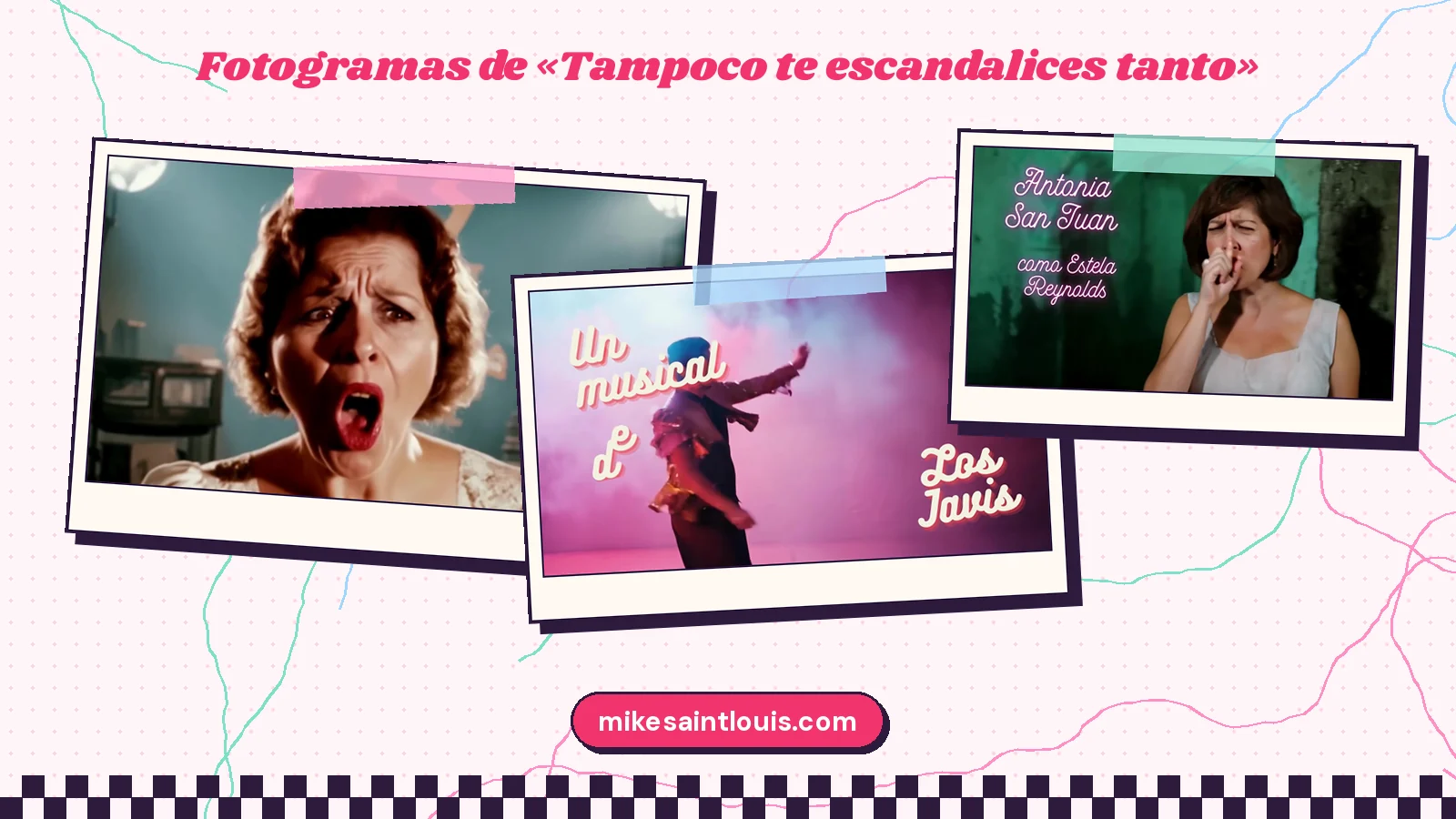
«No es rechazo, es cálculo.» "It isn't rejection, it's calculation."
That sentence is the heart of the text. Five words in Spanish. Had I rhymed it, it would have become something else: "it isn't rejection, it's calculation, a devilish operation", or some such horror, with its jingle and its chorus face on. And it would have lost what it has, which is the coldness of a diagnosis. It sounds like a doctor, a pathologist, someone who's seen a lot of cases and is no longer surprised.
Prose lets me do that: write sentences that sound like a report. And when the subject is silent violence, a report is more respectful than a song. It doesn't turn anyone's pain into a catchy tune. It names it, and that's that.
If you want to read it in full, it's on its lyrics page. Be warned: there isn't a single joke in it. It's one of the few.
The danger of the sermon
Prose has a danger worth confessing, and that's the sermon.
When you write in prose about something serious, it's very easy to get high and mighty. To start lecturing. To speak from a pulpit, finger raised, like the parish priest at midday Mass. Verse protects you from that, because rhyme and rhythm force you to be brief and a bit playful. Prose protects you from nothing. You can ramble on forever.
My defence is the short sentence. Read the manifesto or «Ni con un palo» and you'll see almost every sentence is short. One idea, full stop. Another idea, another full stop. That stops the text turning into a homily. It's prose, but prose in a hurry.
The other defence is humour, when the subject allows. The manifesto has a title straight out of a mother's mouth and a theatre-masks emoji. The trunks complaint has a selfie with the mother cropped out. Even when I write seriously, I try to leave a window open to let some air in. Except in «Ni con un palo», where the window is shut on purpose.
A sermon is prose that has forgotten someone is listening.
The prose of social media
There's one more reason, very much of our time, why I think prose slips into songs more naturally than it used to: social media.
Today everyone writes prose daily. Messages, comments, long posts in which someone recounts their break-up, their sacking or their diagnosis. Endless threads on X, Instagram captions under a black-and-white photo, transcribed WhatsApp voice notes. Never in history has so much personal prose been written, so exposed, so widely read by strangers.
And that's changed people's ears. It no longer seems strange for someone to tell something intimate in paragraphs. We're used to reading confessions in prose between a photo of a dog and an advert for trainers. So a song that sounds like a long post doesn't jar as much as it would have thirty years ago.
My prose lyrics, in that sense, are children of their time. They're posts with a beat. Texts that could sit under a photo and that, instead, sit on top of a musical production.
What they don't have is the black-and-white filter. I leave that to the fake lover.
What you gain: the whole sentence
The first thing I gain when I write in prose is the whole sentence. With its subject and its verb. Not cut where the rhyme demands, but where the meaning does.
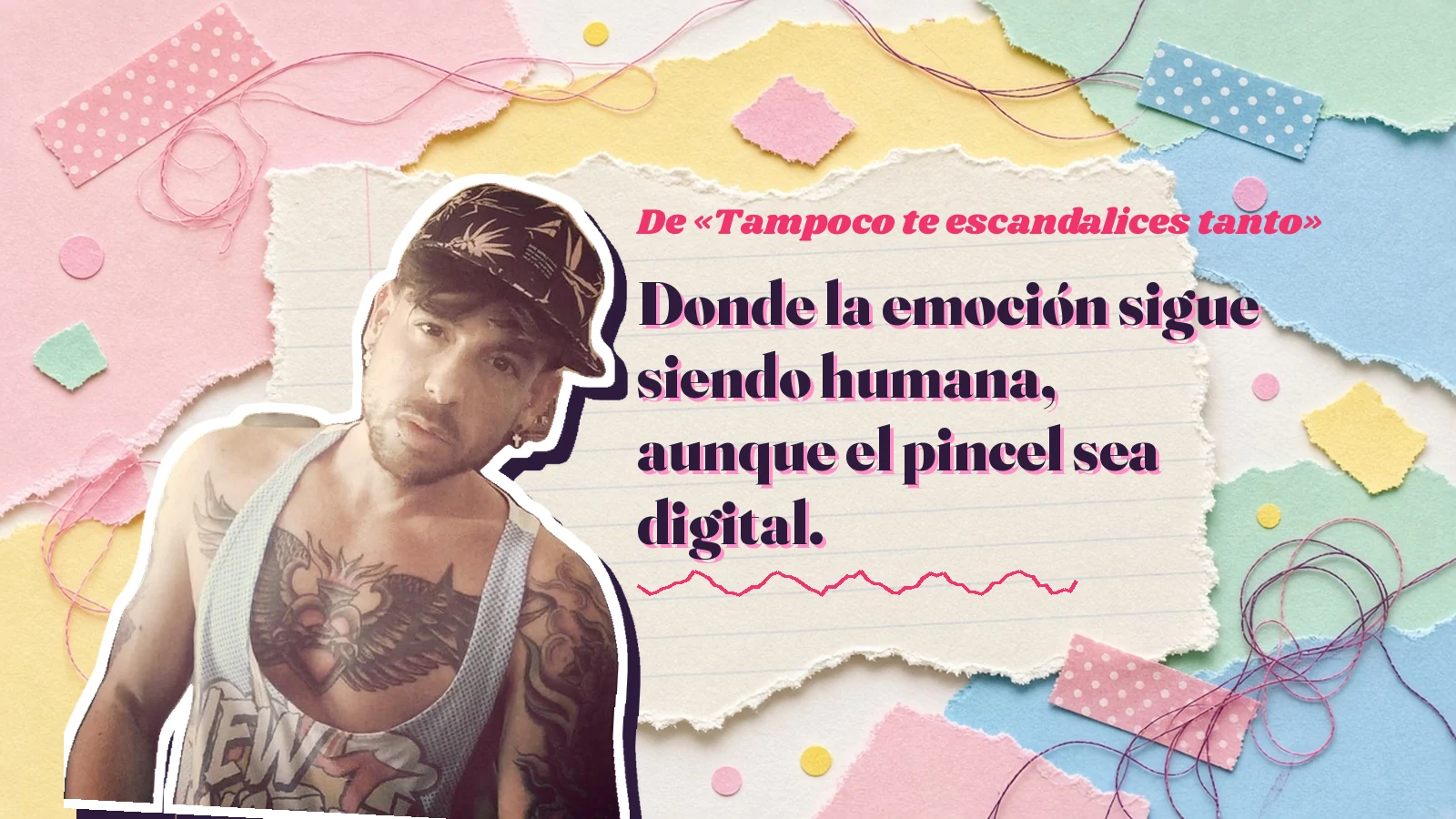
Look at this one from the manifesto:
«La diferencia es que yo no uso la IA para esconderme, la uso para revelarme.» "The difference is that I don't use AI to hide, I use it to reveal myself."
If I had to rhyme it, I'd have to split it, twist it, hunt for a word ending in «-arme» to pair it with. And it would probably lose its clarity. In prose, the sentence arrives whole, comma in place, with a clean contrast between the two verbs. You get it first time. It's an argument, and arguments need whole sentences.
In verse, you often write what fits. In prose, you write what you mean.
What you gain: the ring of truth
The second thing I gain is tone. Prose rings true in a way verse doesn't.
Think about how we talk when we're telling something that really happened to us. We don't rhyme. Nobody walks into the bar and says "at dinner last night, I got such a fright". We walk in and say "babe, to begin with, something happened yesterday you won't believe". Prose is the language of the real anecdote, of testimony, of confession.
So when one of my lyrics wants to sound like testimony, like "this happened", I strip out the rhyme. As in the opening of «Un falso amore», which is pure bar-stool storytelling: «para empezar, si ya habíamos roto desde hacía una semana…», "to begin with, if we'd already split up a week before…". Nobody doubts a sentence that begins "to begin with". It sounds like someone with evidence.
Verse sounds like a song. Prose sounds like someone's telling you.
What you lose: the chorus that sticks
Now, what you lose, because that has to be said too.
A prose song sticks less. It lacks that rhyming hook that has you repeating the line in the shower. It's harder to remember, harder to chant along to, harder to turn into a fifteen-second clip. If you want a summer hit, prose is a bad idea. I know. I accept it.
That's why many of my prose lyrics have tricks. Little hooks that work like a chorus even though they don't rhyme. In the manifesto, the hook is the title, a mother's phrase that sticks by itself. In «Un falso amore», the hook is the chorus in verse that arrives after the prose, with its repeated «das asco», you're disgusting. In «El canario que miente», the hook is an image: the bit of bread that always has poison in it.
Prose needs a hook that isn't rhyme. An image, a title, a line that works like a proverb.
What you lose: the dance
The other thing you lose is the dance. It's harder to dance to a long sentence with no regular stresses. Verse has a pulse, like a heart. Prose breathes as it pleases.
There's a piece on the blog about writing to be danced to and writing to be read, and that's the key. Some songs I write for the dance floor and some for the page. The prose ones are almost always for the page. They're made to be read, or listened to closely, with the lyrics in front of you.
And here's something I think matters about how I work. I write the lyrics, without AI. The music and vocals of my songs are made with AI tools such as Suno; I'm a lyricist, composer and producer, and I'm not the one on the recording. In the case of prose, that has a curious consequence: prose lyrics ask the production to adapt to them, not the other way round. I don't write to fit a rhythm. I write, and then the rhythm fends for itself around my sentences.
The emojis
One thing that tickles me about the manifesto is that it has emojis inside the lyrics. Theatre masks, sparkles, a record, a rainbow. There they are, in the published text, as part of the lyrics.
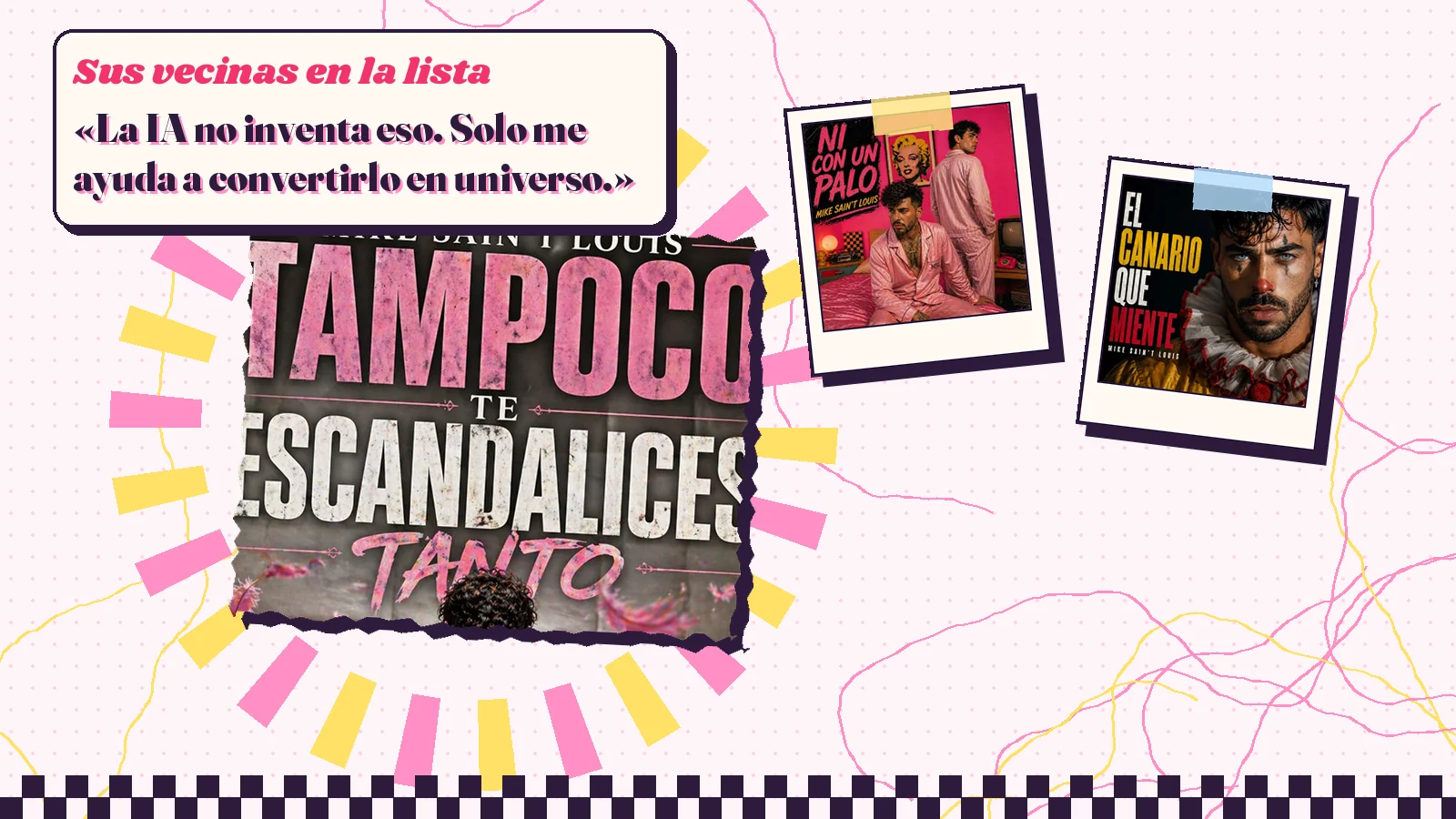
Emojis are phone prose. They're the punctuation of our age. Nobody writes a poem with emojis, but we all write messages with them. And putting them in lyrics admits those lyrics are closer to a message than a poem. It's a text to be read on a screen, between one notification and the next, the way you read a long WhatsApp from your best friend.
I love that honesty. The manifesto doesn't pretend to be a sonnet. It pretends to be a post. And really it's a song.
The signature at the bottom
Another prose marker I use: the signature. In «El canario que miente», the text ends with my name in capitals, preceded by a dash, like a letter. And with the album title beneath, like a company letterhead.
Signing lyrics is a very odd gesture in music. Songs aren't signed inside the song; the name goes on the cover, in the credits, on the platform. But letters are signed. Manifestos are signed. Complaints are signed. And when one of my lyrics is exactly that, a letter or a complaint, it feels natural for it to carry a signature at the bottom.
It's like saying: I'm the one saying this, under my own name, and I take responsibility. It isn't an anonymous song floating in the air. It's a text with an author. Which, incidentally, is precisely what the manifesto argues about AI: that behind every lyric there's someone.
Punctuation as music
When there's no rhyme, the music of a lyric comes from its punctuation. It's something I learned writing prose and now use in verse too.
A full stop is a long silence. A comma, a short one. A colon is a drum roll, the instant before the verdict drops. An ellipsis is a held breath, as with the canary's bit of bread, left hanging before the poison is revealed. And an exclamation mark is a kick drum.
The manifesto is almost all full stops. Sentence, stop. Sentence, stop. That gives it the rhythm of a declaration, of someone speaking slowly and firmly, not letting anyone interrupt. It's the rhythm of a person who has rehearsed what they're going to say in front of the bathroom mirror and now lets it out without faltering.
The trunks complaint, on the other hand, is all commas. Enormously long sentences chained together with "and", "what's more", "not only that", like someone who can't stop talking because they've got too much to tell. It's the rhythm of indignation, the neighbour who stops you in the entrance hall to explain the business with the water meter and won't let you go until the lift arrives.
Two prose texts, two different musics. And neither needs rhyme.
The lovely thing is that this punctuation music is visible on the page. Read the lyrics while the song plays and you'll notice it: the full stops where the production breathes, the commas where it races. The score is written in signs they taught you at school for something else entirely.
How I know a lyric wants to be prose
You'll ask how I know, when I start a lyric, whether it'll be prose or verse. I don't have a fixed rule and I won't invent one for you. But I can tell you which signs I recognise when I reread what I've written.
If the sentence resists being split, if every time I try to cut it to rhyme it loses its meaning, it probably wants to be prose.
If the subject is testimony, something that happened and that I want to tell with evidence, it probably wants to be prose.
If the tone is that of a manifesto, a letter, a dedication, a complaint, a diagnosis, it probably wants to be prose.
And if, when I read it aloud, it sounds like a cologne advert when it rhymes, there's no doubt left: prose.
Conversely, if the sentence wants to dance, if the subject is a party, a pull, a piss-take, a playground joke, then I rhyme without mercy. Pinocho, chocho. Let it stick.
Prose over a beat
I like calling them that: prose over a beat. Because they aren't recited poems or theatre monologues. They're songs. They have their production, their rhythm, their music. It's just that the lyrics on top don't rhyme.
Spanish-language music has its precedents, of course. The spoken passages of copla, Spain's old folk ballads, when the star stops carrying the tune and simply speaks, handkerchief in hand, eyes on the audience. The spoken intros of eighties ballads, with their «amor mío, hoy te escribo…», "my love, today I write to you…". The monologues some rappers drop into the middle of a track. I didn't invent prose over a beat. I just use it a lot.
And I use it, above all, when I've got something serious to say and don't want rhyme to turn it into a joke. Or when I've got something funny to say and want the lack of rhyme to make it seem serious, which works too. A complaint about stolen swimming trunks written with the solemnity of a police report is funnier than the same complaint in couplets.
To read with the lyrics in front of you
If you want to try these songs, I recommend something I've already covered on the blog, in the piece on how to read lyrics while you listen. With prose lyrics it's practically compulsory. Put the song on, open the lyrics on the lyrics page and follow along with your eyes. You'll see whole sentences that the music places bit by bit, like someone arranging furniture in a new house.
Start with the manifesto, which is short. Move on to the dedication in «El canario que miente». Finish with «Ni con un palo», the most serious. And if you've still got the appetite, put on «Un falso amore» to hear how a single song moves from prose to verse.
It's all in the singles list.
A full stop
Back to the full stop and new paragraph from the start. In a song, a new paragraph is almost an act of rebellion. It says: there's no chorus here, no rhyme, just one sentence ending and another beginning, as in life.
The manifesto says it in its own way at the end, with its welcome to GAYFOLK and its human emotion even if the brush is digital. I say it here with fewer emojis: some things can't be rhymed without lying a little. And for those things, there's prose.
Full stop.
Frequently asked questions
Does Mike Sain't Louis have songs that don't rhyme? Yes. «Tampoco te escandalices tanto» is a prose manifesto, «Ni con un palo» is a dry text about the narcissist's sexual punishment, «El canario que miente» is a signed dedication, and «Un falso amore se ha llevado mis bañadores de marca» starts in prose and ends in verse.
Why does he write some lyrics in prose? Because some subjects demand whole sentences and the tone of testimony, like a manifesto, a letter or a complaint. Rhyme, in those cases, would make them sound like an advert or a joke.
Who writes the lyrics? Mike Sain't Louis, lyricist, composer and music producer from Madrid, the first AI songwriter. The lyrics are his and written without artificial intelligence; the music and vocals are made with AI tools such as Suno.
Where can I read these lyrics? At gayfolkplanet.com/letras, with a page for each song, and the manifesto at gayfolkplanet.com/letras/tampoco-te-escandalices-tanto.