
By Mike Sain't Louis ·
Blocking isn't cowardly: no contact in the age of stories
There's a line in «No Contact» that could open a novel:
Tu llamada ya no suena («Your call doesn't ring any more»)
A handful of words. Not one more. And inside them, all the work it takes to make them true.
Because a call doesn't just stop ringing on its own. Someone has had to make a decision, has had to dig through the phone's settings, has had to press a button and confirm that yes, they really do want to block this contact. And then do the same in another app. And another. And another.
On the song's own page I've already talked about how this lyric takes the no-contact rule, the textbook advice for getting out of a relationship with a narcissist, and turns it into a party. The full lyrics are published. Here I want to get down to the practical detail, the part the song sums up in one short line and that in real life takes weeks: how you cut contact with someone at a time when everyone is connected to everyone else through twenty different channels at once.
The twenty doors of a phone
A few decades ago, cutting someone off was fairly simple. You didn't pick up the landline when it rang at certain times. You asked your mum to say you were out. You sent letters back unopened, if there were letters. You avoided certain bars. That was about it. The person dropped out of your life almost by default, because there weren't many ways for them to slip back in.
Today, that same person can be present in your daily life through an absurd number of cracks. Let's make the list, because it's a long one:
WhatsApp, obviously. But also the friends' WhatsApp group, where you can't block them without everyone noticing. Instagram, with its stories, its DMs and its list of who's seen what. TikTok, which can put them in front of you without you even following them. Facebook, if you're of that generation. The dating app where you met, which helpfully tells you they're two hundred metres away. The shared Spotify playlist you made together that keeps popping up on your home screen. The location sharing you forgot to switch off. The payment app that suddenly flashes their name when you go to split dinner with someone else. Email, LinkedIn, Telegram, his mother's phone number you've still got saved just in case.
Each of those doors is a way back in. And each demands a small decision, which added to all the others becomes an enormous one.
That's why I find it so lovely that the song settles it in a single line. Not because it's easy, but because when it's finally done, that's exactly how it feels: a silence. The phone that doesn't ring. The peace of having no door left open.
The first morning
The song begins in the morning, and that says a lot. Before the club, before the lights and the drop, the first verse starts with someone waking up feeling free.
Anyone who's been through this kind of break-up knows the mornings are the worst. At night, with people around, it's easy to be distracted. But on waking, in that minute when you're not quite conscious yet, your head goes straight to the usual place. You grab your phone before your eyes are fully open. You check for something. And the absence of messages hurts, even though you're the one who shut all the doors.
So that first morning when you wake up and the first thing you feel isn't the hole but relief is an event. It doesn't come on day one, or day two. It comes when it comes, sometimes without warning, on some ordinary Tuesday. And when it does, you realise you've crossed a border.
The lyric doesn't say how long that morning took to arrive. It just says it's come, that the other person is no longer part of the narrator, and that from there on everything else is celebration. I like to think the whole song, with its night at the club, is the party that morning deserves.
The guilt of blocking
There's something almost nobody mentions about no contact, and that's the guilt.

Blocking someone still has a bad reputation. It's seen as childish, over the top, inelegant. «Come on, there's no need to block him», people say. «You can be adults about it.» «Blocking is so teenage.» Lots of people believe the mature way to end a relationship is to stay friends, or at least keep the other person in your contacts, as proof there are no hard feelings.
With a normal person, maybe. With someone who manipulates, who gaslights, who has made you doubt your own memory, that «you can be adults about it» is a trap. Because every open door is an invitation to start all over again. An innocent «how are you?» at three in the morning. A «this made me think of you» over some song. A «I just wanted to say sorry». And behind it, the same old cycle.
The writing on narcissism has an English word for this, «hoovering», after the vacuum cleaner: the attempt to suck you back in once you've already left. And the only defence that really works against a hoover is not being in the same room.
The song says it without a trace of guilt:
Aunque supliques, not at all («Even if you beg, not at all»)
I love that «not at all» because it doesn't explain itself. It doesn't say «I'm sorry, but». It doesn't say «I need time». It says no. Full stop. Blocking, in this lyric, isn't cowardice or immaturity. It's the lock you fit on your own front door.
Mutual friends
There's one difficulty with no contact that multiplies in the gay world, and that's how small the gay world is.
In any city, the scene has a limited number of bars, clubs, saunas and friendship groups. The dating apps show you the same faces over and over. Your friend's ex is your ex's friend. The guy you pulled last night turns out to have dated the one who broke your heart two years ago. And the person you've blocked everywhere is still, inevitably, at somebody's birthday party.
That makes no contact more complicated than pressing buttons. You have to decide what to do about mutual friends. Whether to ask them not to tell you anything. Whether to stop going to certain places. Whether to tough out the night you both end up in the same bar, one at each end.
And this is where the song takes your side with a very concrete idea: the dance floor. Instead of hiding, you go out. Instead of avoiding the bar, you fill it. «On the dancefloor, I don’t look back», goes the chorus. If you cross paths, let him see you shine. Not looking back doesn't mean not going places. It means going and not searching for him with your eyes.
The ghost watching your stories
There's a gorgeous irony in the last part of the lyric. The final stretch ends by telling the other person that he is the ghost.
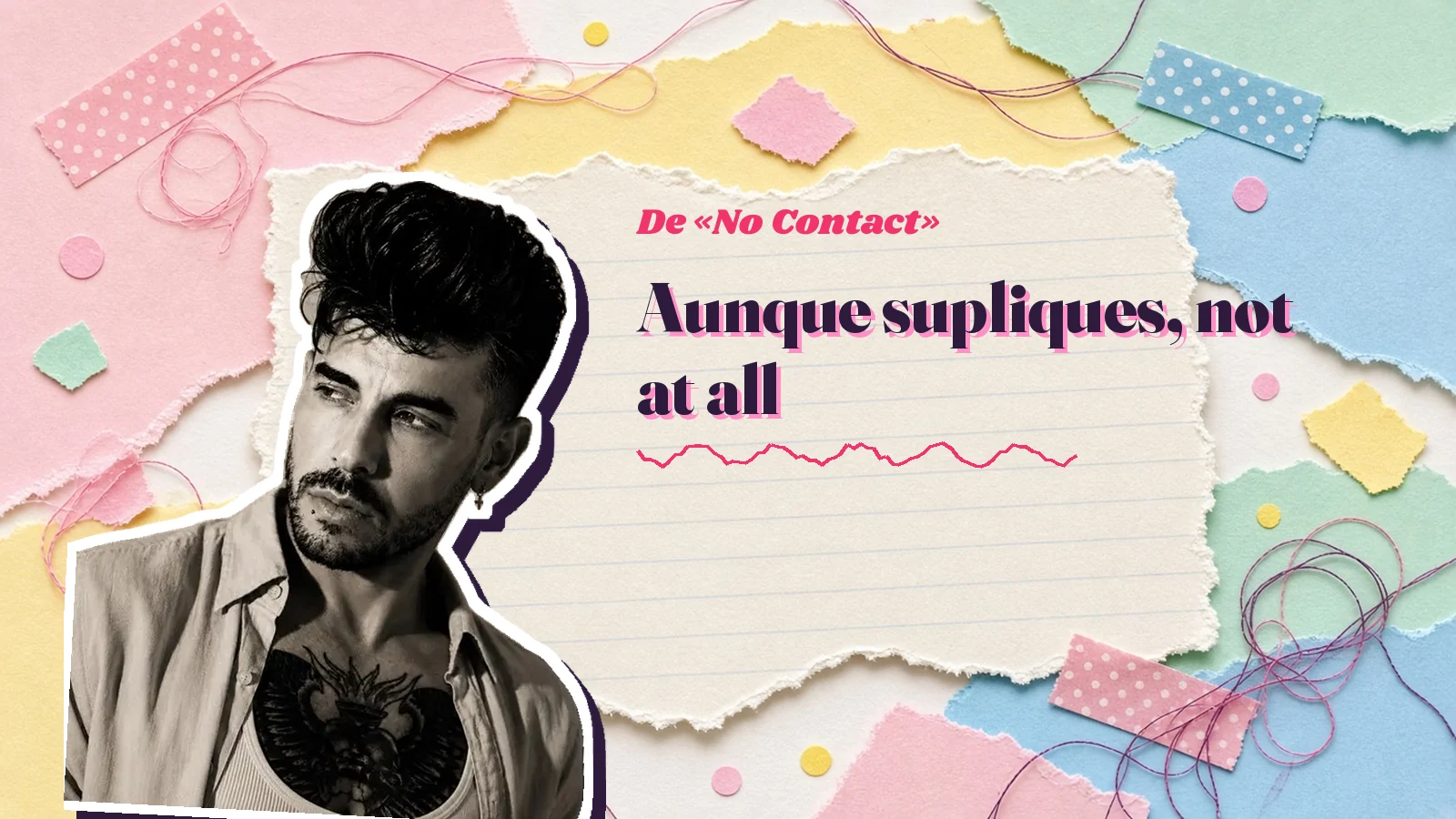
For years, the trendy word for disappearing acts in love has been «ghosting»: someone stops replying from one day to the next, no explanation, and turns into a ghost. The person who's been ghosted is left staring at their phone, waiting for a message that never comes. In that story, the ghost is the one with the power.
In «No Contact» it's the other way round. The one who disappears isn't the manipulator but the one breaking free. And the one left haunting the place is the ex. The one who, blocked on WhatsApp, might still be watching your stories from a burner account. The one asking mutual friends about you. The one who shows up at the club on exactly the night you're there.
Calling him a ghost turns the tables. A ghost is present, yes, but can't touch you any more. It can watch, it can hover, it can rattle about in the corridor at night. But it has no body. It can't get back into your life unless you let it.
And if he keeps watching your stories, let him. Let him see someone who's doing fine.
The cap he doesn't deserve
My favourite line in the song is a really silly one, the kind that makes you laugh the first time and then you can't get it out of your head:
Don’t deserve ni mi snapback
Not even my cap. You don't even deserve that. A snapback is one of those flat-peaked caps with the adjustable fastening at the back, and dropping it into a chorus about narcissism has a kind of daft genius to it. But in English «snap back» also means to bounce back suddenly to an earlier state, to recover. And the song keeps both readings at once: you don't deserve my cap, and you don't deserve me coming back.
That kind of humour is very me, and it does a very specific job in songs like this. When you're talking about something that did a lot of damage, laughter stops the damage from having the last word. I've talked about it in Me río de mis ex porque es la forma más honesta que tengo de contarlo. Laughing at the narcissist isn't downplaying what he did. It's downplaying him.
And on a dance floor the joke also works as a battle cry. Nothing throws someone who thinks he's the centre of your life like watching you laugh at his cap.
Shaking without falling
Beneath all the partying, the lyric has a moment of honesty I don't want to skip. It's in the pre-chorus, when it admits to shaking. Even if it shakes, it won't fall.
That admission matters. Dance-floor self-help songs tend to sell you a version of the break-up where you walk out triumphant from minute one. You look in the mirror, put on some lipstick and that's that. Real life doesn't work like that. No contact, especially in the first days, is hard. There are nights when your finger is hovering over the unblock button. There are mornings when you wake up with the urge to message him just to see if he answers.
The song doesn't hide that. It puts it in the lyric, right before the most festive chorus, as if to say: yes, I'm shaking, but watch me dance.
The narrator also mentions that therapy has helped, and that strikes me as a very honest detail for a club track. Getting out of a relationship like that is almost never done alone. You need someone to help you see what was done to you, to name things, to stop believing the version of you the other person told. Having that turn up among the beats and the lights has something normalising about it.
Trading tears for the beat
There's an idea in the second verse that sums up the whole song: every tear gets traded for the beat.
It isn't about not crying. The tears are there, acknowledged, counted. But they turn into something else. They become rhythm, movement, a way of using your body that isn't lying in bed staring at the ceiling.
There's something very queer about processing pain that way. For a long time, the dance floor was where people like us went to survive what was happening outside. Where you danced after funerals, after insults, after break-ups. The club as an emotional A&E, with a mirror ball instead of strip lights.
«No Contact» signs up to that tradition. It doesn't suggest you get over the narcissist by meditating, journalling or going on a spiritual retreat. It suggests you go out, turn the volume up and shout that you're free. Maybe it isn't the therapy a manual would prescribe. But it's one a lot of us have practised at some point.
A family of songs
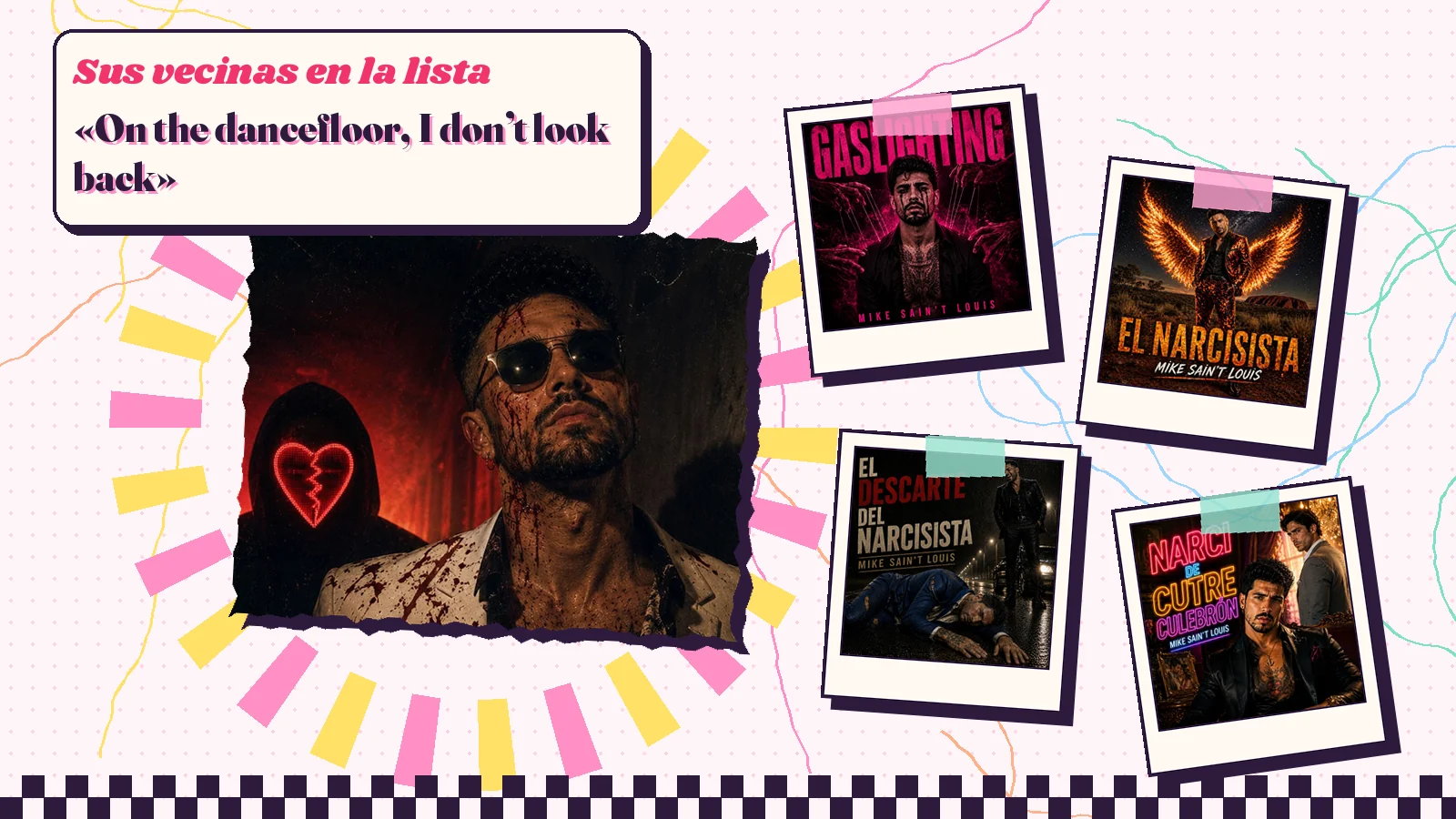
«No Contact» is part of «Ojalá se pudiera viajar a Gayfolk», but it isn't alone in my catalogue. It has first cousins all over the place, because narcissism and manipulation are themes I keep coming back to.
There's «Gaslighting», which takes manipulation apart from the inside, while you're still in the relationship and can't believe what you're seeing. There's «El narcisista», which is more of a portrait of the character. And there's «El descarte del narcisista», about the moment he throws you away like a used object.
Put them in order and they read almost like chapters of a story. First the manipulation, then the portrait, then the discard. And finally «No Contact», the only one where the decision is made by the person who suffered everything before. It's the chapter where the door is shut from the inside.
If you fancy listening in that order, start with «Gaslighting» and finish with this one. The ending is a lot better than the beginning.
The flying monkeys
There's another term from the writing on narcissism that I adore, because it comes straight from one of the queerest icons in film history. People talk about «flying monkeys» to mean the ones the narcissist sends to do the dirty work once you've stopped answering.
The flying monkeys are the ones from «The Wizard of Oz», the ones the Wicked Witch of the West sends after Dorothy. And Dorothy, with her ruby slippers and her rainbow, is one of the most beloved figures for gay audiences of any era. For decades in the United States, calling someone a «friend of Dorothy» was a discreet way of saying he was gay. So the image has its charm: the flying monkeys chasing Dorothy are, in a way, chasing one of our own.
In real life, the flying monkeys are those mutual friends who suddenly message to tell you he's «in a terrible state», that you «should talk to him», that he's «not as bad as you think», that «there's no need to be like that». Sometimes they do it in good faith, with no idea what's behind it. Sometimes not. Either way, they're another open door.
No contact, done properly, ends up including some of those monkeys too. Not all of them, and not forever. But for as long as it takes for nobody to bring you messages you didn't ask for.
There are no flying monkeys in the song, but there is the attitude you need with them. «No excuses para ti», says the second verse. No excuses for you. Not for him, and not for anyone who comes on his behalf.
What doesn't need explaining
There's one last thing I really love about «No Contact», and it's to do with what the song doesn't do. It doesn't explain.
It doesn't tell you in detail what happened in the relationship. It doesn't list the lies, reconstruct the fights or try to convince anyone the ex was bad. It takes it as read. There's a mention of gaslighting, another of excuses, another of tears, and that's it. The rest of the lyric is about what comes after.
In a subject like this, that's an important choice. People leaving a relationship with a manipulator often feel a huge need to explain themselves. For others to understand what happened. For someone to tell them they're not going mad. And sometimes that need becomes another way of staying tied: you keep talking about him, keep telling his story, keep giving him the starring role.
The song skips that stage. Not because it doesn't matter, but because it isn't the dance floor's business any more. Explanations are for therapy and for real friends. For the club, all you need to know is that it's over.
In other songs of mine the ex does get the starring role, and in a very comic way, as in «Narci de cutre culebrón» or the whole gallery I went through in Pequeña tipología cómica de exnovios. But in «No Contact» the ex barely has a face. He's a call that doesn't ring, a ghost and a «bye bye». Which is exactly the space he deserves.
Bye bye
The chorus ends with a farewell that couldn't be more direct: «Bye bye narci, don't look back».
It's funny that the lyric tells the other person not to look back, when the no-contact rule usually asks that of you. But I think that line holds a bit of both. It's an order to yourself, not to turn round looking for him. And it's an order to him, not to turn round looking for you again.
Deep down, that's what no contact is: an agreement not to look at each other, signed by only one of the two parties. The other one can keep looking, keep hovering, keep being a ghost. But you've already decided you're not turning round.
If you're on day one of no contact, or day forty, or the day you almost broke it, put the song on. It doesn't fix anything by itself. But for three minutes it reminds you there's a place where his call doesn't ring any more and where, in spite of everything, you can dance.
All the lyrics, with their invented narcissists and their dance floors, are in Letras.
Frequently asked questions
What is «No Contact» about? It's about no contact, the rule of cutting off all communication with a narcissistic or manipulative ex. The song turns that decision into a night at the club: the narrator feels free, blocks, leaves the drama behind and dances while the ex is left behind as a ghost.
What does «no contact» mean? It's a practice often recommended for getting out of relationships with manipulative people: not answering calls or messages, blocking on social media and closing off any route by which the other person could get back into your life.
Which album is «No Contact» on? It's part of «Ojalá se pudiera viajar a Gayfolk», one of the albums in Mike Sain't Louis's Gayfolk trilogy, and it's on Spotify and all the other platforms.
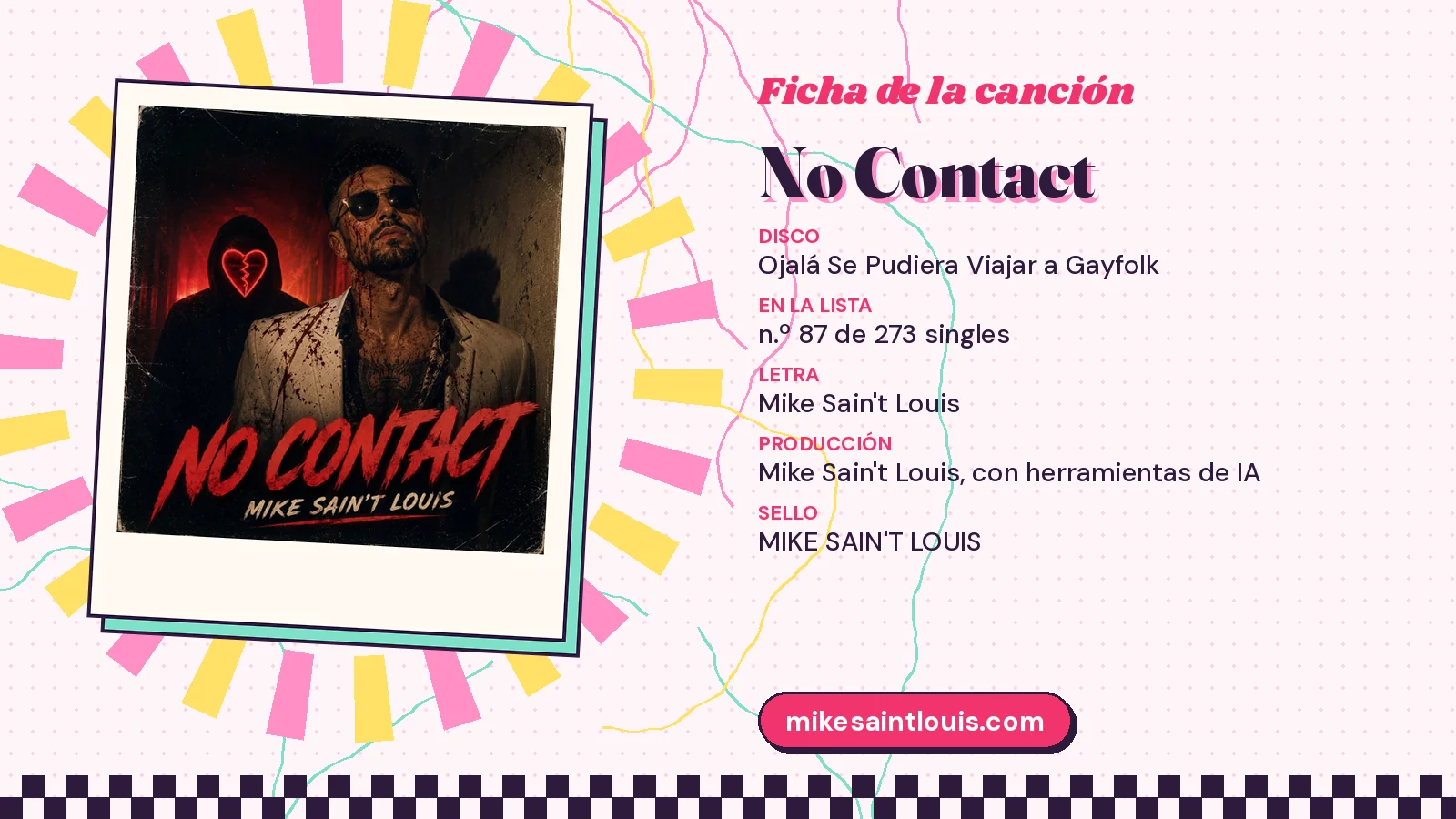
Who makes «No Contact»? Mike Sain't Louis, a lyricist, composer and music producer who calls himself the first AI songwriter: he writes the lyrics and directs the production, and the music and vocal performances are generated with artificial intelligence.