
By Mike Sain't Louis ·
«Even if to you I'm just an algorithm»: copying a diva as self-defence in «Malena»
A club, a door swinging open, a woman walking in and the whole room changing temperature. That's how «Malena» begins, with its dance-floor English and its bar-stool Spanish poured together like two drinks nobody ordered in the same glass. For three long minutes the song is exactly that: glitter, dancing, a queen who never asks permission. And then, almost at the end, when you've already let your hair down and thrown your arms in the air, a line appears that doesn't match the mirror ball:
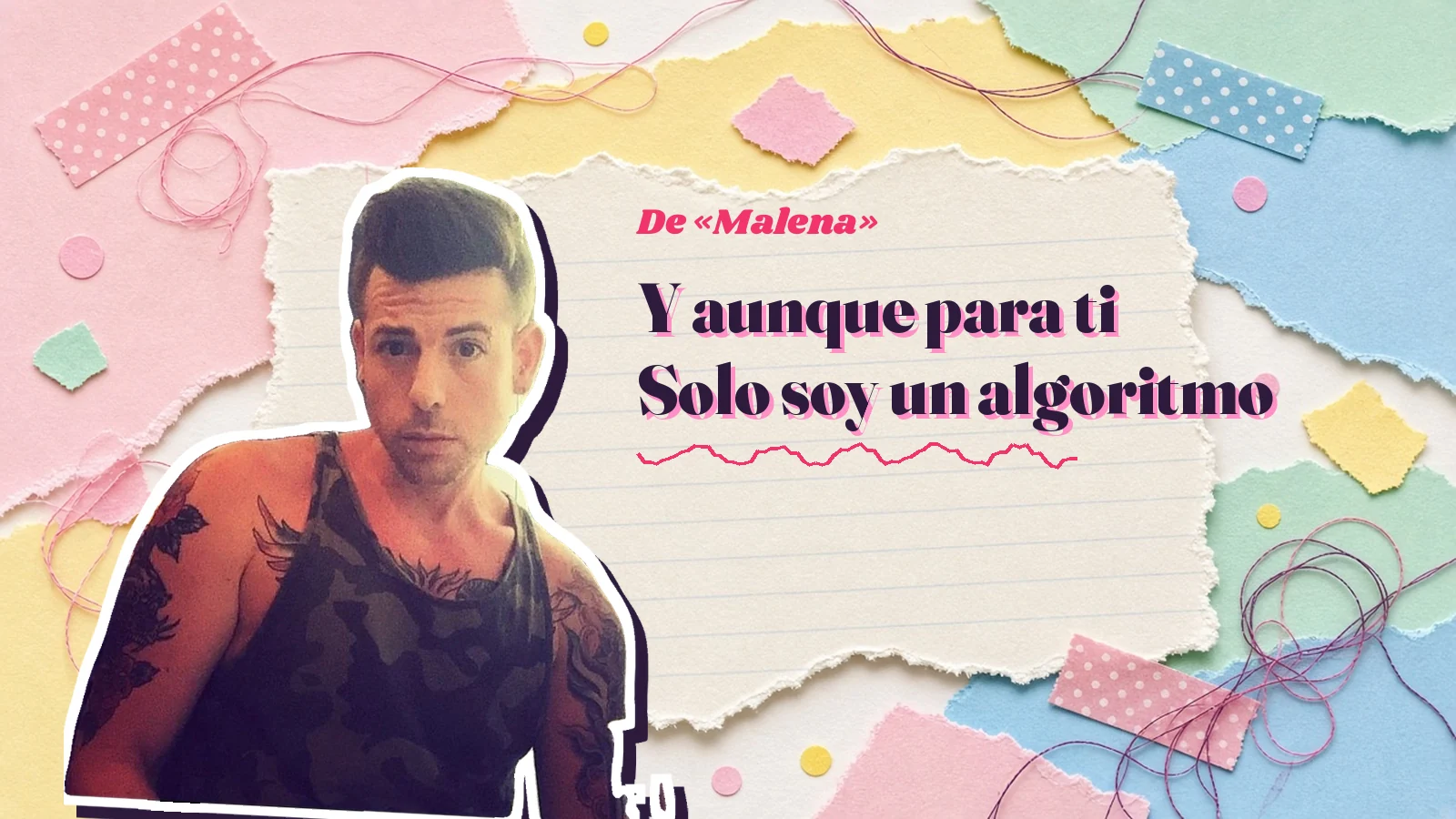
Y aunque para ti / Solo soy un algoritmo («And even if to you / I'm just an algorithm»)
That line is the reason for this post.
Because «Malena» looks like a song of pure admiration and nothing more. A tribute to Malena Gracia, the woman everyone in Spain remembers on a TV set wearing more sequins than the scenery. And it is that. But when I reread the published lyrics I realise the tribute has a second addressee, someone who isn't on the dance floor, someone watching from the edge with folded arms, saying a machine made all this. The song answers that someone. And it answers in the queerest way imaginable: not with arguments, but with a diva.
On the song's own page I've already talked about letting your hair down and the stubbornness of dancing differently. Here I want to go somewhere else. I want to talk about why, when someone reduces you to an algorithm, the answer that comes out isn't an essay on authorship but an «I want to be like her». And why that answer, which looks like a piece of disco silliness, is the most serious one I have.
What you say in front of the mirror
There's a tradition we all know and few of us confess to. Standing in front of the bathroom mirror, hairbrush for a microphone, and being someone else for four minutes. Being Rocío Jurado at the Florida Park. Being Raffaella Carrà tossing her hair on prime-time Spanish television. Being Malena Gracia walking onto a TV set as if the set belonged to her and the presenter were the guest.
The chorus of «Malena» is exactly that mirror moment:
Yo quiero ser, ser como Malena Gracia («I want to be, to be like Malena Gracia»)
Notice what it doesn't say. It doesn't say «I want to be with her». It doesn't say «I want her for myself». It says be. Be like her. And that difference holds half the history of gay culture in this country: growing up without role models who looked like you, and finding them wherever the light was. In the folclóricas, the great ladies of Spanish song; in the showgirls; in the Saturday-night presenters; in the women television treated as over the top and whom we watched as if they were instruction manuals.
Many of us never had a footballer poster. We had the remote control.
And the remote taught us that there were women who walked into a room and the room adjusted to them, not the other way round. For a kid with a bit of a flounce, in a neighbourhood where the flounce got paid for at break time, that was survival information. It wasn't frivolity. It was a map.
So when the lyric says «I want to be like», I don't read it as a fan's whim. I read it as what we all did: copy the attitude of someone stronger until the attitude became ours.
Wanting to be, not wanting to have
Club tracks usually talk about desire. I see you, I want you, come here, kiss me till dawn. «Malena» has some of that, of course, because it's a club song and the club runs on desire the way a car runs on petrol. There are kisses requested, there are stars, there's «dance with me». But its centre of gravity isn't there. The centre is identification.

And that's something that interests me a great deal when I think about my own lyrics: the difference between desiring someone and wanting to be someone. Straight club culture is built on the first. Queer club culture, the real thing, Chueca at four in the morning, is very often built on the second. You don't go onto the floor to pull the diva. You go to become her for the length of one song.
When «Kaaa-miga» ends by quoting La Veneno, the trans icon of Spanish late-night television, with her «I'm La Veneno, and who the hell are you, maricón!», something similar happens. The diva's line becomes your line. You use it as a shield. You put it on the way you'd put on a jacket with shoulder pads for a job interview you already know will go badly.
In «Malena» the shield is the full name. Malena Gracia, Malena Gracia, repeated like a prayer. And the repetition isn't a lazy chorus: it's an incantation. The more times you say the name, the closer you are to being her. Anyone who spent an entire adolescence muttering the names of famous women under their breath to work up the nerve to cross a school corridor knows this.
Some people laugh at it. Let them. Camp has always started like that, with someone laughing at what you take seriously, and you taking it seriously precisely because they laugh. I went into it more calmly in Camp isn't a joke, even if you laugh, and «Malena» is almost a practical demonstration of that idea.
An algorithm with painted nails
Back to the line. The one that matters to me.
To understand it you have to know what people say to me. They say it a lot, in comments, in messages, to my face. That what I do isn't music. That a machine made it. That I press a button and that's that. In «El segundo exacto» I turned that very sentence into a lyric, and in «Discutiendo con la IA» the lyric hits back at whoever's complaining: if using AI is just pressing a button, go on then, you do it, darling.
What happens in «Malena» is subtler. There's no fight here. There's a dance floor, a diva, a bilingual chorus asking you to dance till tomorrow. And in the middle of all that, a single admission: to you, to that unnamed you, I'm just an algorithm.
It doesn't argue. It concedes. And then it says what really matters:
Yo soy como Malena / y nunca me rindo («I'm like Malena / and I never give up»)
That's what I love about the turn. The song doesn't defend itself by proving it isn't an algorithm. It doesn't flash a lyricist's ID card. It doesn't explain that a person writes the lyrics while the music and the vocals are made with artificial-intelligence tools like Suno, which I explain everywhere and which is written on my About page. The song couldn't care less about any of that. It answers with an attitude borrowed from a TV diva. Call me an algorithm if you like. I'm like Malena.
To me it's the most honest answer there is. Because contempt for music made with AI is almost never a technical debate. It's contempt about class, about taste, about who has the right to make songs and who doesn't. And against that contempt, queer tradition has a very old weapon: exaggeration. Pile on more glitter. Walk into the club as if you owned it.
An algorithm with nails painted red. That's what I am to some people. I think it's a fabulous look.
Disco bilingual
The lyrics of «Malena» are written in a language that exists in no dictionary and in every nightclub on the Spanish coast. Half English, half Spanish, with lines that switch language mid-verse because the rhyme wants it, or because it sounds better, or because that's how people talk at three in the morning on a terrace in Benidorm with friends from Manchester, Albacete and Rotterdam.
A room that lights up with no regrets, a charm you sip like a fine wine, a fire nobody escapes: every image comes half in English and half in Spanish, and the chorus signs off with a «can't escape your fuego» that would fail any official exam. If a language-school teacher read it, they'd throw themselves off the balcony.
I'm fascinated by this mixed language because it's the real language of the party. Nobody on a dance floor speaks correctly. You talk with your hands, with stray words, with the name of the song. And the Spanglish of «Malena» works the way Raffaella's Italian worked for a small-town kid in the eighties: you don't need to understand everything to understand what matters. She reigns. You want to be her. The end.
I thought about it more slowly in One song, twenty accents, where I talk about writing pop in a Spanish that travels badly and arrives well. With «Malena» the mixing goes one step further, because the English isn't there to sound international: it's there to sound like the dance floor, the place where the sentence matters less than the beat.
And yet the final turn is in Spanish. Look. The whole song dances in two languages, but when the serious line arrives, the one about the algorithm, the one about never giving up, the English is gone. What matters gets said in the language of home. Like arguing with your mother: you can play the cosmopolitan all you like, but the shout comes out in Spanish.
Imitation is a craft too
Now something I like to say out loud, because people tend to think it the other way round.
Imitation isn't the opposite of creation. Imitation is the school. Drag queens know it better than anyone: before she has a character of her own, a drag queen has been Rocío Dúrcal, Lola Flores, Mónica Naranjo, Madonna in the cone bra. Lip-sync, the copy, the stolen gesture: they're the conservatoire of an entire culture that never had a conservatoire.
In «La primera drag de Benidorm» there's something of this: the stage as the place where you become someone else so that you can be yourself. «Malena» says it without a stage, from the dance floor and the mirror, but it's the same thing. Wanting to be like Malena Gracia isn't giving up on being yourself. It's the way many of us get there.
And here comes the irony, the one that makes me laugh every time I reread the lyrics. Music made with AI is accused of exactly this: of imitating. Of copying. Of having no soul of its own. And the song, instead of denying it, embraces it. Yes, I imitate. I imitate Malena. I want to be like her. So what? We queens have spent decades imitating divas to survive, and out of that imitation came the best characters of Madrid nightlife.
So the question changes. It's no longer «is this a copy?». The question is «who have you chosen to copy, and what for?». And I choose to copy a woman who walked onto TV sets with her head held high while half of Spain laughed at her. That seems a choice with some judgement behind it.
I'll stop there, because I'm getting deep, and in «Malena» deep lasts two lines.
Track 81, between a narcissist and a hick
In the singles list of Planeta Gayfolk, «Malena» is track 81 of 273. And its neighbours couldn't be more different. Just before it comes «El descarte del narcisista», with all the darkness of someone who throws you away once you're no longer useful. Just after, «Tan Paleto», with its kiss that upsets the people who cover their eyes.

I like that order, even if it's just how the catalogue fell. Because «Malena» works as a breather between two punches. You've come from a narcissist who discarded you, and before you reach the small-town bigot who judges you, there are three minutes of dance floor where the only thing that matters is letting your hair down. It's like those Sundays when, between the row with the ex and lunch with the family, you've got time to blast one song in the kitchen.
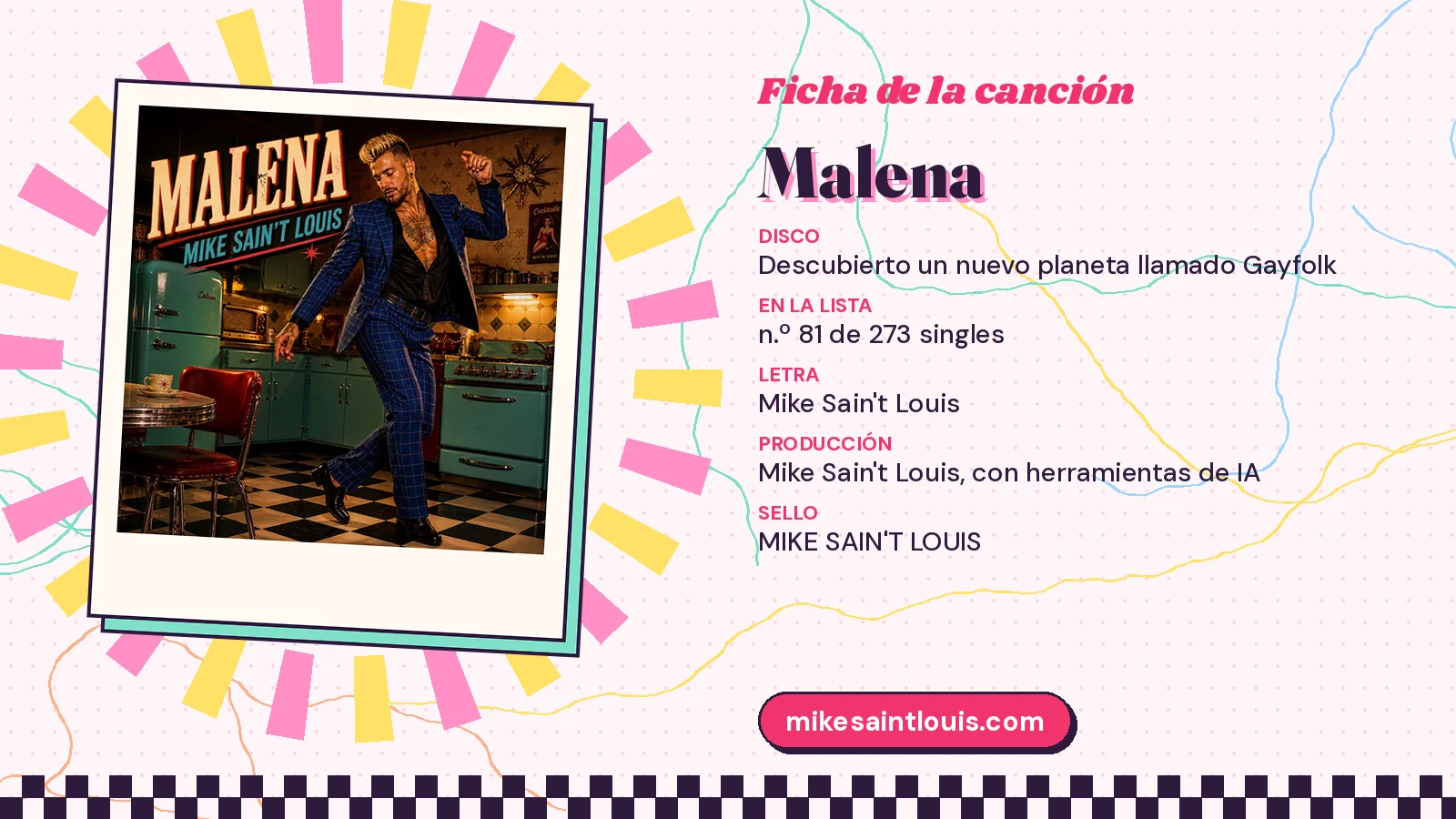
And the song belongs to the first album of the trilogy, «Descubierto un nuevo planeta llamado Gayfolk». An album where everything is a first: the first exploration of a planet where we make the rules. On that planet it makes sense to have a dance-floor queen with the full name of a Spanish TV star. Every colony needs a flag, and Gayfolk's, for the length of one song, is covered in sequins.
By the way, it's not the only time Malena turns up in my catalogue. There's another song, «Vota Malena Gracia», which turns the diva into a candidate. If «Malena» is the mirror, «Vota Malena Gracia» is the ballot paper. It amuses me to think I've ended up building a little election campaign around a woman who probably doesn't know I exist.
What I don't ask of Malena
One important thing, so nobody gets confused. The Malena of the song is a dance-floor figure, an icon in the abstract, almost a character. I don't tell anything about her life, I don't invent any anecdote with her, I don't claim to have met her or that she's ever answered a message. What's in the lyric is admiration from afar, the same anyone has who grew up with the telly on.
And from afar is how icons work. If you met her in Mercadona, the Spanish supermarket chain, with her basket and her sunglasses, perhaps she'd stop working for you. The icon needs distance to work as a mirror. She needs to be on the screen, on the set, on the dance floor, lit up, out of reach, so you can project onto her what you need to become.
That's why the song doesn't ask anything of her either. It doesn't ask her to save me, or love me, or reply. It borrows her attitude for a while. Then it gives it back, a bit more worn, the way you give a jacket back to a friend after a wedding.
There's something very clean in that. Admiring without asking. Copying without stealing. Dancing with someone who isn't there.
The loose mane and the hair I haven't got
Towards the end, the lyric allows itself the pun everyone remembers, the one about letting your hair down with Malena, soltarse la melena, with the easy, happy rhyme of a summer night when nobody's correcting anything.
And here I have to send myself up, because it's only fair. Me, letting my mane down. Me, with the hair of someone who has seen too many Mondays. The mane in the song is metaphorical, obviously, and thank goodness, because if it depended on my real hair the line would be «tonight I let my four remaining hairs down with Malena», and that doesn't rhyme, not even with goodwill.
But the metaphor works for that very reason. Soltarse la melena is one of those Spanish expressions that says everything: losing your shame, letting go, allowing yourself one night. That it comes tied to the name of a diva is perfect. You don't let your hair down alone. You let it down with her, at her side, with her imaginary permission.
The everyday and the drama together, as always. A village grandmother's expression and a TV showgirl, in the same line. If you asked me what gayfolk is, I'd tell you it's more or less that: grandma's saying in sequins.
Never giving up, even when they ask
The last part of the lyric repeats an idea that comes back three times: not giving up. Being like Malena and not giving up. There's nothing wrong with dancing to something different. And here there's no more pun, no dance floor, no mirror. There's a sentence said to someone who, you sense, has asked for the opposite.
Because nobody says «I never give up» into a void. You say it when someone is asking you to give up. To drop it. That this isn't music. To find something else to do. That you're an algorithm.
And here comes the serious turn, the only one in this post: I've been hearing variations on that request for years. Before AI there were other ones. That I had no training. That I was too much. That the lyrics were too strange, too personal, too queer for normal radio. AI has only changed the argument, not the intention. The intention has always been the same: that you shut up.
I'm not shutting up. Neither is Malena, by the look of it.
That's why the end of the song, which seems simple, is for me the most important thing it has. A dance floor full of people from everywhere, a bilingual chorus that won't stop, and in the middle a person who has decided that, if they're going to be called an algorithm, they'll at least be an algorithm with a mane.
If you want to follow the thread of how I talk about using AI and what's mine in each song, I've laid it out plainly in What's mine in a song made with AI. Spoiler: the lyrics, the ideas, the characters, the decisions and the urge to annoy people.
How to listen to «Malena» without apologising
One last practical thing, because the song demands it. «Malena» isn't for headphones on the Metro, staring at the floor. It's for the kitchen with the door shut, for the car with the window down on the A-3 motorway, for the bathroom before you go out, while you put on mascara or comb whatever you've got left.
And it's for listening to knowing what it says at the end. That they can call you an algorithm, or a hick, or a drama queen, or whatever they like, and you can answer with a diva's name and a dance step. It isn't an answer that wins debates. It's an answer that wins nights. And honestly, I've lost plenty of debates and won quite a few nights, so I know which of the two has held me up more.
You'll find it with the full lyrics on the «Malena» page, in the list of all my singles, free to download or to play wherever you like. If you like it, put it on at a party. If you don't, put it on anyway: someone on that dance floor needs it.
And if anyone ever tells you you're just an algorithm, you know what to answer.
I'm like Malena.
Frequently asked questions
Who is «Malena» dedicated to?
It's a tribute to Malena Gracia, to the figure of the TV and dance-floor diva many of us remember. The song admires her from afar and tells nothing of her private life.
What does the line about being «just an algorithm» mean?
It's an answer to people who look down on music made with AI. The song doesn't argue with the contempt: it answers with an attitude, being like Malena and never giving up.
Who wrote «Malena»?
I wrote the lyrics. I'm a lyricist, composer and music producer. The music and the vocals are made with artificial-intelligence tools such as Suno.
Which album is «Malena» on?
It's part of «Descubierto un nuevo planeta llamado Gayfolk», the first album of the GAYFOLK trilogy, and it's track 81 of the 273 singles.
Is there another song about Malena Gracia?
Yes: «Vota Malena Gracia», which launches the diva into an imaginary election campaign.