
By Mike Sain't Louis ·
«Aquí tampoco puedo escapar»: the verbs of escape in my lyrics
There's a word that keeps coming back in my songs like a door someone pushes again and again from the inside.
Escapar. To escape.
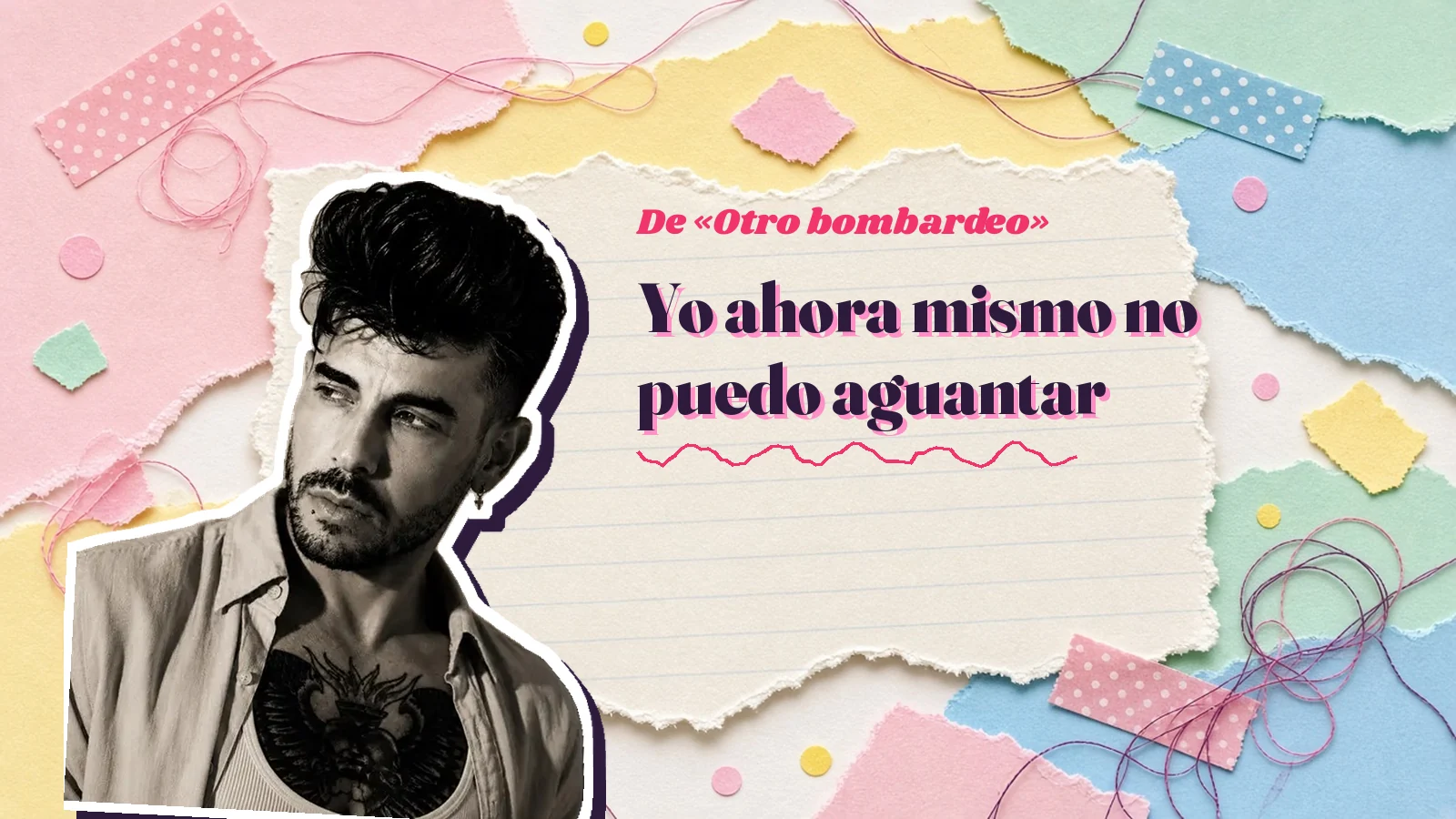
In «Otro bombardeo», from the album «Ojalá se pudiera viajar a GAYFOLK», the lyric starts at the lowest point: «Estoy tan triste», I'm so sad, and I can't stop crying. And every verse ends up crashing into the same wall: «Yo ahora mismo no puedo aguantar», right now I can't take it, another bombardment, and then that line split in two, as if it were hard to reach the end of the sentence: «Otro bombardeo y aquí tampoco puedo escapar», another bombardment, and here I can't escape either. (The full lyric is on gayfolkplanet.com.)
What interests me most in that line is one small word: tampoco, either. Here either. It means there was somewhere else before. That the person speaking has already tried to run away at least once, reached a new place believing they'd be safe there, and the bombardment followed them. It isn't the first escape. It's the one that confirms escaping isn't always enough.
This piece is about the verbs of escape in my lyrics: escapar, huir, salir, irse, correr. About what they hide inside, why they turn up so often in songs about sadness, confinement and relationships that hurt, and about a way out that appears in my lyrics less than it should: asking for help.
Before going on, I'll leave this up here in case someone needs it now: if you're going through a very bad time, in Spain the 024 line answers around the clock, free and confidential. If there's immediate danger, call 112. If you're outside Spain, call your local emergency number.
Slipping out of the cape
I'll start with etymology, because escapar has one of the loveliest histories in Spanish.
According to the Academy's dictionary, it comes from a Vulgar Latin form built from the prefix ex, out, and cappa, cape. To escape would originally have been to get out of the cape. To shed it. The image behind it is almost cinematic: someone grabs you by the cape, and you slip out of it and run, leaving the pursuer holding the cloth.
I love that image because it tells something anyone who has truly escaped from something knows: to get out, you have to leave things behind. You don't escape fully dressed. You escape by letting go. The cape stays in the other person's hand, and with it a part of who you were.
And then there's escaparse, with the reflexive se. Escaping a fire isn't the same as slipping away for a weekend. The pronoun adds something mischievous, desired, an escape you chose. You slip off to the beach, slip away from work, run off with someone. In «Ruido en mi mente» the lyric uses that form: «Quiero escaparme de este laberinto», I want to get myself out of this labyrinth. It doesn't say I want to escape. It says I want to escape myself out, with the pronoun stuck on the end, like someone leading themselves by the hand.
Huir, fuga and refugio
The other great verb in this family is huir, to flee. And it has a secret I found out late: it shares a root with refugio, refuge.
Huir comes from Latin fugere, the same verb that gives us fuga, fugaz, prófugo, centrífugo and subterfugio. And refugio comes from refugium, which carries that same root inside it. A refuge is, literally, a place you flee to. The place where the flight ends.
It's a comforting idea. Every escape has, at least in language, a planned ending. Nobody flees forever. You flee towards somewhere, even if you don't know where yet.
In my songs the word refugio appears at very different moments. In the text of «La playa del Mal Pas», that small beach in Benidorm is a secret refuge, the place where summers were spent looking at the horizon, «soñando con escapar», dreaming of escape. Notice the paradox: the refuge is exactly the place from which you dream of running away. You can be safe and, at the same time, want to leave. Those two things live together more than we think.
And fuga is also a musical form, the fugue. In a fugue, a melody comes in, then another instrumental line chases it, imitating it, then another, and they all keep catching up without quite touching. Bach was the great master of that orderly pursuit. I like to think that even in the most serious music there's someone fleeing and someone behind them.
To go out was to jump
The third verb is the most everyday and perhaps the hardest: salir, to go out.

Salir comes from Latin salire, which meant to jump. That's also where saltamontes, grasshopper, comes from, and salmón, which according to a much-repeated etymology owes its name to the way it leaps upriver. Going out, originally, wasn't calmly opening a door. It was taking a leap.
That idea feels very honest when I think of it from sadness. Because there are days when leaving the house isn't a step, it's a leap. In «Entre cuatro paredes» the lyric says it in all its simplicity: I don't feel like leaving the room. It doesn't say I can't. It says I don't feel like it, which is a humbler and more exact way of describing the block. There's no lock. There's a lack of will that weighs like a locked door.
The same song has the hardest variant of the verb escapar: «No consigo escapar de mi propio ser», I can't escape my own self. There's no outside pursuer there, no bombardment. The prison is oneself. And you can't get out of yourself with a leap.
That same lyric, in its last lines, leaves a gap open: something in me asks to breathe. I like that the song doesn't end at the closed door but at that small request. Sometimes going out starts there: not with the leap, but with noticing that something inside is asking for air.
Me fui: the verb that gets mixed up with being
There's a grammatical detail that has always struck me as an accidental poem. In Spanish, the past of ir, to go, and the past of ser, to be, are the same word. Fui. Fuiste. Fueron.
Linguists call it suppletion: a verb that borrows forms from other verbs. In Spanish, ir is made of three different Latin roots. Voy comes from vadere, ir from ire, and fui from the past of esse, to be. So when I say me fui, I left, I'm using, without knowing it, a form that also means I was, I existed.
I think of that whenever I read one of my lighter lyrics. In «Buscando el polvo perfecto» there's a good fuck buddy I had in Toledo until I left. It's an almost passing line, with no drama. But that me fui de allí, I left there, holds a whole life. Leaving a city is ceasing to be who you were in it.
And in «Tu mendigo» the slowest version of all appears: me fui rompiendo lento, I slowly went breaking. Ir there isn't leaving. It's a process. The verb ir as an auxiliary, going on doing something, going on breaking, describes a wearing down nobody sees coming. You don't break all at once. You go on breaking.
The labyrinth
Of all the images of escape in my songs, the one that unsettles me most is the labyrinth.
In «Ruido en mi mente», after wanting to escape, the lyric goes on: «Pero la salida se ríe distinto», but the exit laughs differently. It seems to me one of the strangest and most exact lines I've written about anxiety. The exit exists, but it mocks you. It's there, you can see it, and every time you get close it moves or laughs another way.
The most famous labyrinth in Western culture is the one on Crete, which according to myth Daedalus built to imprison the Minotaur. And the most famous escape story is Daedalus's own: trapped in his creation with his son Icarus, he made wings of feathers and wax to fly out. Ovid tells it in the «Metamorphoses». Icarus flew too close to the sun, the wax melted and he fell into the sea.
People usually draw a moral about ambition from that myth. I draw another. Daedalus escaped because he didn't try to get out through the corridors. He stopped looking for the exit inside the labyrinth and looked in another direction. Upwards.
When your head becomes a labyrinth, something similar sometimes happens. You don't get out by thinking more, going round the same corridors again. You get out by changing plane: talking to someone, asking for help, letting another person look at the map from outside.
Running in circles
There's one verb of escape that's hardly ever named as such, though it's the first thing the body does: correr, to run.
In «Ruido en mi mente» it appears in a way that still unsettles me: I run in circles in a dream with no net. Running should take you away from something. But running in circles always brings you back to the same spot, more tired and no further away. It's the escape that goes nowhere.
Lewis Carroll wrote a perfect scene about this in «Through the Looking-Glass», in 1871. The Red Queen explains to Alice that in her country you have to run as fast as you can to stay in the same place, and that if you want to get somewhere else you have to run twice as fast. Biologists borrowed that image much later to talk about species that evolve non-stop just so as not to fall behind. For me it serves something smaller: those days when you do a thousand things and don't move an inch from where you were.
Spanish also has an expression that sums it all up: salir corriendo, to go out running, to bolt. Two verbs of escape together, one after the other, as if one weren't enough. You bolt from a date that's going badly, from a family gathering, from a house. And sometimes, when you finally stop, you find that what was chasing you came along with you.
That's why I don't think the answer is to run more. Sometimes the brave thing is to stop in the middle of the circle and look around.
Fight, flight or freeze
In 1915 the American physiologist Walter Cannon described what we now know as the fight-or-flight response. Faced with a threat, the body gets ready for one of the two: the heart speeds up, the muscles tense, the senses sharpen. It's an ancient mechanism that we share with many animals and that has saved us for thousands of years.
Over time psychology added a third response that we all know even if we've never named it: freezing. Neither fighting nor fleeing. Going still. Like the animal that stops dead in the middle of the road.
I think of that third option when I read «Otro bombardeo». That person neither fights nor flees, because they've already found that fleeing doesn't work: here they can't escape either. What's left is to hold on, and the lyric says exactly that they can't. It's the description of someone exhausted from being on alert.
I say this without drama, because it happens to a lot of people. Living for a long time under bombardment, whether of criticism, humiliation or fear, leaves the body on guard even after the danger has passed. And for some people, the way to protect themselves ends up being avoidance: not going out, not answering, not exposing themselves. It's an escape that stays at home.
On this blog I've said that avoidant personality disorder is among my diagnoses. I don't bring it up here to make it the subject, but because it explains why these verbs come to me so often when I write. If fleeing is what the body asks for, writing about fleeing is a way of looking at it from outside.
Fleeing isn't cowardly
There's a widespread idea I find unfair: that fleeing is for cowards and staying is brave.

It depends on what. Staying in a fire isn't bravery. Nor is staying in a relationship that's destroying you. In «Manual de escape de un narci», the title says it: there are manuals for getting out, just as there are emergency exits in buildings. And one of the instructions in that song is so simple I love it: if he threatens to leave, open the door.
That line turns everything around. Often, in a relationship like that, the threat is that the other person will go. And the person receiving the threat spends months, years, trying to stop them going. The song proposes the opposite. Let them go. Open the door. The exit isn't a failure. It's the instruction.
Escaping someone who hurts you often takes more courage than staying. You have to leave the cape in the other person's hand: the home, the shared friends, the routine, the version of you that existed with that person. Even the old Spanish proverb, «a enemigo que huye, puente de plata», build a silver bridge for a fleeing enemy, takes it for granted that whoever flees is the one who loses.
If someone reading this is in a relationship where they're afraid, they should know that getting out is possible and they don't have to do it alone. In Spain, 016 helps victims of gender-based violence and leaves no trace on the phone bill, and in danger there's 112.
Dreaming of escape
Not all the escapes in my songs are emergencies. Some are pure desire.
The album «Ojalá se pudiera viajar a GAYFOLK», If only you could travel to GAYFOLK, carries escape in its title. The description of the video for «Ojalá se pudiera viajar a GAYFOLK» talks about the days when you'd wish you could escape to another planet, one where you didn't have to explain yourself, defend yourself or pretend. It's escapism in its cleanest form: imagining a better place because this one hurts.
Escapism has a bad name. The word is used to criticise people who take refuge in series, novels or video games instead of facing reality. But the geographer Yi-Fu Tuan, in his 1998 book «Escapism», argued an idea I find full of light: that almost all of human culture is a way of escaping. Building a house is escaping the open air. Telling a story is escaping silence. Inventing a planet across three albums is escaping a world that sometimes leaves you no room.
And then there's Houdini, the most famous escapologist in history, who in the early twentieth century let himself be chained, locked in trunks and lowered into water tanks to get out of them in front of an audience. People paid to watch him escape. I find that telling: we're fascinated by watching someone get out of a trap because we all carry some trap inside that we'd like to get out of.
Leaving for the city
There's one escape LGBTQ+ people know very well, which turns up in many life stories: leaving the village or the small town for the big city.
In 1995 the anthropologist Kath Weston wrote a much-cited article about what she called the great gay migration: the movement of so many gay people from the countryside to the city, looking for anonymity, community and the chance to be who they were. That escape has something of liberation and something of exile. You gain freedom and lose a landscape, a family, an accent.
In my lyrics it appears like that, in passing, in that me fui de allí that closes a story in Toledo. And it appears in the cities that come back again and again: Madrid, Benidorm, the beaches of the Canaries. They're places you arrive at, but also places you leave. My planet GAYFOLK is, at heart, the imaginary version of that promised city. A place to flee to that doesn't exist yet.
Nobody can escape
There are two songs of mine where escape appears the other way round: as something impossible, and in one of them as something wished for.

In «Como en la matanza de Texas» the verb is in the mouth of fear: you move stealthily, nobody can escape. It's the grammar of horror films. In a horror film, escape is always about to succeed and always fails at the last moment. The door won't open, the car won't start, the phone has no line. I use that grammar to talk about people who trap you without making a sound.
In «Malena» the opposite happens. The phrase is almost the same, you can't escape, it's your destiny, but here it isn't frightening. It's the dance floor. It's the diva who hypnotises you and whom you don't want to run from. Sometimes what we most want is precisely not to be able to escape something: a song, a night, a hug.
That difference matters to me. Escape isn't good or bad in itself. It depends on what's holding you. If it's fear, you look for the exit. If it's joy, you lock the door from the inside.
A way out that exists
I go back to the start, to «Otro bombardeo» and that tampoco, that either, which hurt to write.
When someone says that here they can't escape either, what they're saying is that they've run out of places to flee to. They've tried another city, another partner, another routine, and the bombardment follows them. And it's true that there are things you can't escape by changing place, because they travel with us.
But there's a way out that doesn't depend on place, and it's the one that has taken me longest to learn: telling someone. A friend. A GP. A psychologist. A helpline. It isn't a magic exit, but it's the one that changes the plane, like Daedalus's wings. It stops you going round the same corridors.
If you recognise yourself in any of these lyrics, in not being able to leave the room, in wanting to escape your own self, in feeling that the exit is laughing at you, I want to leave the numbers clearly:
- 024: Spain's Ministry of Health line for suicidal behaviour. Free, confidential, 24 hours a day. Also by chat.
- 112: emergencies, if there's immediate danger.
- Teléfono de la Esperanza: 717 003 717, to talk to someone when everything weighs.
- 016: gender-based violence, with no trace on the bill.
- Outside Spain: your country's local emergency number.
Asking for help isn't giving up. It's the most grown-up way to escape.
Writing as a way out
And I'll end with the only escape that has never failed me: writing.
Every song I've made about wanting to escape has been, in its way, a small fugue. Not because it got me out of the problem, but because it took me out of it for a moment and let me look at it from outside. Writing aquí tampoco puedo escapar is, paradoxically, a way of escaping a little. You put it on paper and it's no longer only in your head.
Maybe that's why I love the words of escape so much. Escapar, which is slipping out of the cape. Huir, which carries a refuge inside it. Salir, which is jumping. Irse, which gets mixed up with being. Each one tells a way of looking for air.
And if one of these songs ever helps someone take that leap, drop the cape or find their refuge, then every time I wrote it will have been worth it.
Frequently asked questions
Where does the Spanish word escapar come from? According to the Royal Spanish Academy's dictionary, from Vulgar Latin, built from ex, out, and cappa, cape. Its original sense would be something like getting out of the cape or shedding it.
Do huir and refugio share a root? Yes. Huir comes from Latin fugere, and refugio from refugium, which contains the same root. Fuga, fugaz, prófugo and subterfugio come from the same family.
Why does fui work for both ser and ir? Because the verb ir in Spanish is suppletive: it takes forms from several Latin verbs. The preterite fui comes from the past of esse, to be, and both verbs share it.
Which Mike Sain't Louis song says «aquí tampoco puedo escapar»? «Otro bombardeo», from the album «Ojalá se pudiera viajar a GAYFOLK», a song about sadness and the exhaustion of always being under attack.
Where can I get help in Spain if I feel trapped? Call 024, the line for suicidal behaviour, free and available 24 hours a day. If there's immediate danger, call 112. There's also the Teléfono de la Esperanza, 717 003 717. If you're outside Spain, call your local emergency number.
Who writes these songs? Mike Sain't Louis, a lyricist, composer and music producer from Madrid, the first AI songwriter. The music and the vocals of his songs are made with artificial intelligence.