
By Mike Sain't Louis ·
Who I'm talking to: the "you" in my songs
«Duérmete limón, ya es hora de dormir.» ("Go to sleep, Limón, it's time for bed.")
Of all the people I address in my songs, only one has never let me down. And it isn't a person. It's named after a fruit, takes up half a cushion and, according to the lyric, we share a telepathic connection, which I checked with a guru, because that's how seriously I take my affairs. For that "you" I wrote a lullaby. For the others, generally speaking, I've written something else.
Not long ago I started going through my lyrics with a very silly question: who am I talking to? Not what I'm talking about. Who. And I realised I almost never write into thin air. I almost never tell something to an abstract reader, to "people", to "all of you out there listening". There's always a "you". A "you" with or without a name, with or without a face, but a "you" you could point a finger at.
That "you" changes. And when it changes, the whole song changes.
Spare me your stories
The default "you", the one that keeps coming back, is the ex. I hardly need to say it. Open any album of the trilogy at random and the odds are you'll land on a lyric addressed to someone who's no longer around, or who is around but shouldn't be.
«La casa de los mil cadáveres» is the clearest example, and also the sneakiest. It opens like this: «Pero ¿Cómo soy tan tonto?», "But how can I be so stupid?". Notice that. Before speaking to the ex, I speak to myself. I insult myself first. Only then, in the second line, do I turn to him: «No me vengas con tus rollos», "Don't come to me with your stories". I've got this pretty well worked out: if I laugh at myself before I go for you, you can't accuse me of thinking I'm better than you. First I disarm myself. Then I fire.
What follows is a string of conditionals. «Si yo hubiera sabido», "if I'd known". «Si yo hubiera escuchado», "if I'd listened". «Si hubiera captado que tú eras un payaso», "if I'd caught on that you were a clown". Everything is written in the tense of things that can no longer be fixed. It's the grammar of the door slammed too late. And still I talk to him, as "tú", as if he were standing in front of me. As if he could hear me. The lovely and the sad thing about writing to the ex is that he'll almost never listen, and the song knows it.
That's why the ending of that lyric is so over the top: «Te mando un hasta nunca ¡ maldita cucaracha!», "I'm sending you a good riddance, you damned cockroach!". When you know the other person won't answer, you can say whatever you like. You can call him a cockroach. You can compare yourself to the heroine of a horror film. There's no comeback. The ex in my songs is a practice dummy.
And that has its good side. In real life you barely say anything to the ex. You keep quiet, you block, you delete, you endure. In the song, on the other hand, you say it all. The song is where the conversation that never happened finally takes place. Even if I'm having it on my own, with a notebook and a cup of cold coffee.
Oh, honey
The second most frequent "you" is the hater. The one with opinions.

I don't know him. He has no name. He's a blend of YouTube comments, private messages and stray phrases I've heard in person that repeat with frightening regularity. And since he has no face, I invent a way of addressing him. In «Discutiendo con la IA» I call him «hija mía», "my dear girl". Just like that, straight off, with the condescension of an older aunt who's seen you coming a mile away. «Hija mía si usar IA es / dar a un botón / hazlo tú maricón.» ("My dear, if using AI is / just pressing a button / you do it, darling.")
That «hazlo tú», "you do it", is the key. I don't argue with the hater. I hand him the pen. If it's so easy, go ahead. There's the notebook, there's the tool, there's the whole night ahead of you. Let's see what comes out.
In «El segundo exacto» the hater speaks first. I give him the opening lines in full, swearwords and contempt included, the way you let the other team kick off. And when I finally answer, I don't shout. I see him off like a salesman who rings at lunchtime: «recibe un cordial saludo campeón», "kind regards, champ". The insult comes wrapped in office stationery. That stings more than any "dickhead", I promise you.
I like addressing the hater as "tú" because it turns him into a person. And once he's a person, he's no longer a threatening mass of comments: he's one particular man, pen in hand, with no idea what to write. He doesn't scare me any more. I feel a bit sorry for him.
There's another, more practical advantage. When I address the hater directly, I make him stand still while I answer. Online, the commenter drops his line and leaves. He doesn't wait for a reply. He doesn't read the comeback. In the song there's no escape: he's trapped inside the lyric, his line in quotation marks, for three and a half minutes, every time someone presses play. It's a rather elegant punishment. I sentence him to listen to me.
And then there's «Tus letras son basura», "Your lyrics are rubbish". The title is the hater's line, word for word, no quotation marks. I even hand him the name of the song. It's my way of telling him: look, your line is mine now, I've released it, it has its own cover and its own page. I've stolen it from you. You can't use it against anyone now without advertising me.
Ladies, gentlemen, stop
Sometimes a single "you" isn't enough. One person won't do. I need an audience.
In «Ojalá hubiera tenido de suegra a Carmina Barrios», halfway through the lyric, I stop talking to the ex and the mother-in-law and turn to a whole auditorium: «Señoras, señores, stop, stop, un momento», "Ladies and gentlemen, stop, stop, one moment". It's the TV-studio moment. I picture the set of an afternoon talk show, a floor manager waving at me, a stand full of pensioners with fans. And me, on my feet, with a clip-on mic, explaining that I'm not an idiot.
Moving from "you" to "ladies and gentlemen" is moving from a couple's row to a public trial. And in gay life that happens a lot. Break-ups aren't between two people. They belong to the friendship group, the usual bar, the WhatsApp group, the neighbour, the doorman. Everyone has an opinion, everyone saw something, everyone has a version. When I write «señoras, señores», I'm really talking to those people. The ones who found out before I did.
The plural "you" is the "you" for big occasions. I use it sparingly, because if I use it a lot it loses its charm. But when it comes out, the song changes size. From the kitchen to the Palacio de los Deportes in a single line.
He never loved you
There's one "you" that interests me more than all the others, and it's the slipperiest. It's the "you" where you're never quite sure who it means.
In «El narcisista» the lyric talks about the narcissist in the third person: he hates, he lies, his heart is frozen. But it's addressed to someone else. «El narcisista nunca te ha querido ni amado», "The narcissist has never loved you, never cared for you". That «te» could be the listener. It could be a friend I'm advising. It could be me, looking at myself from outside, telling myself what took me years to understand. And halfway through the song, without warning, the "you" turns into "me": «por dejarme moribundo desnudo mientras me ahogaba en el lodo», "for leaving me half-dead and naked while I drowned in the mud".
It isn't a grammatical slip. Well, maybe in the odd line it is, I won't fool you, I write fast. But the big shift is deliberate. When you've lived through something like that, you don't know whether to tell it in the first person or the second. In the first, it's embarrassing. In the second, as if it happened to someone else, it can be said. And the lyric keeps jumping from one to the other like someone switching chairs in a waiting room because none of them is comfortable.
That "you" which is you but also me is the closest thing to talking to yourself in the mirror. And with a subject like narcissism, where what they steal from you is precisely trust in your own version of events, the mirror is the first place you have to go back to.
I think about it and no joke comes. So I won't put one in.
Hi, Paco León
Then there's the impossible "you". The letter to a celebrity.
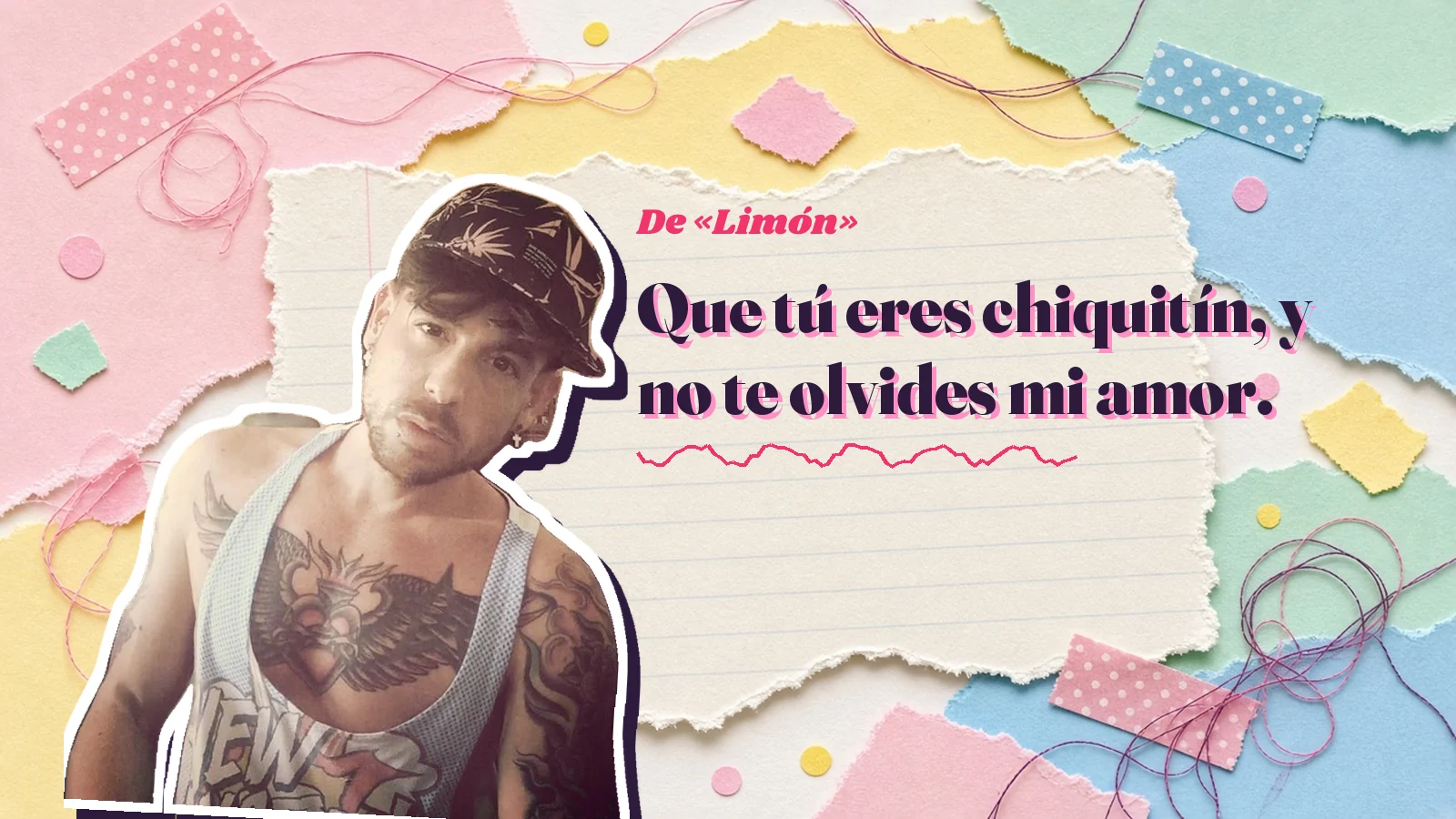
In «La dieta del cucurrucho» there's a moment when the lyric starts writing a letter live: «Hola Paco León / Soy Miguel Ángel de León», "Hi Paco León / It's Miguel Ángel de León". I introduce myself with my first name and surname. My real name, the one on my birth certificate. And I address the actor as "tú", with the familiarity of someone who's seen him «varias veces en Chueca», "several times in Chueca". It's a letter that will never be sent, to someone who'll probably never read it, and that's why I can tell him what I tell him, which I won't repeat here because my readers are of a certain age.
The celebrity "you" is part fan, part joke. It's like writing to the telly. But in my case it also has something that really tickles me: the song carries its own commentary inside it. A few lines earlier, the boyfriend in the lyric gets cross about the whole performance. And then the lyric admits it: you could get angry, and rightly so, if you heard a song where someone writes this to an actor. In other words, the song talks to Paco León and at the same time apologises to the boyfriend for talking to Paco León. Two "you"s in one lyric, one on each side of the bed.
That's the thing about "you": it's never alone. There's always someone listening behind the door.
Don't be scared, brother
There's a "you" I hardly ever use, which is why it surprises even me when it shows up. The "you" of comfort.
In «Ni un pimiento» the lyric, for once, isn't talking to the one who did the damage. It's talking to the one who took it. «Pero si algo malo viene no te asustes mi hermano / Eres un ángel caído un buen samaritano.» ("But if something bad comes, don't be scared, my brother / You're a fallen angel, a good Samaritan.") It's a shoulder-to-lean-on "you", a 4 a.m. bar-counter "you", the friend who orders you another beer and tells you it'll pass. It even calls you a warrior.
Then, mind you, the song takes a turn. The comforted "you" gets tangled up with an "I" who starts telling how he rescued an ex the way you'd rescue an out-of-date pepper from the supermarket floor. And in the end the "you" is the ex again, whom the lyric would rather not kiss, for reasons I'll leave in the original. Nobody's perfect. Not even my comforts.
But I'll hold on to that line, «no te asustes mi hermano», "don't be scared, my brother". It's one of the few times my songs speak to whoever's listening and having a hard time. And I realise I'd like to do it more. There are plenty of songs against the ex. There are very few for the one left sitting on the sofa not knowing what to do with his hands.
I love you, Pitufo
And then there are the ones who don't answer. Neither kindly nor unkindly. The ones who can't.
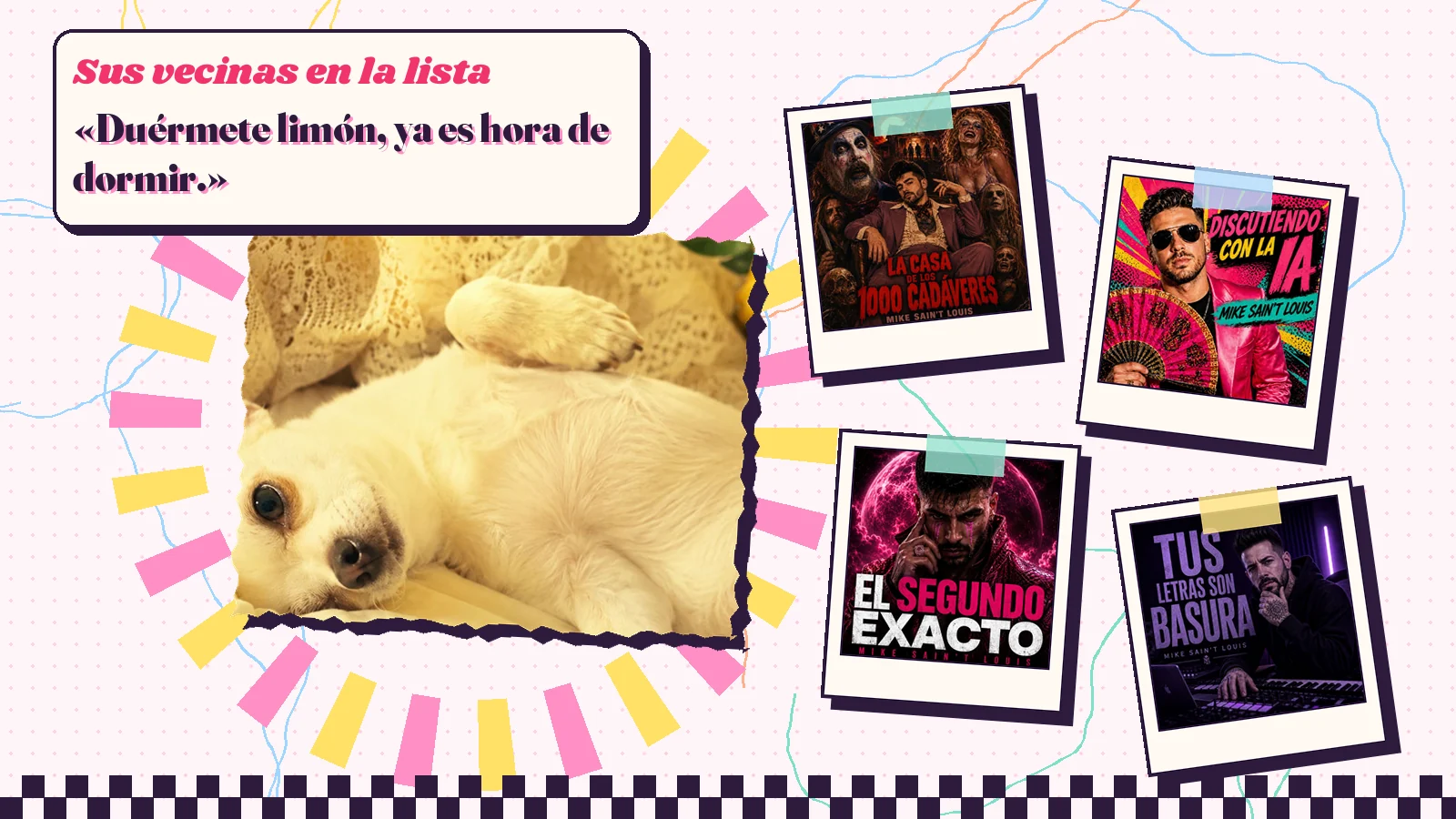
«Limón» is a lullaby. I'm talking to someone falling asleep. «Que tú eres chiquitín, y no te olvides mi amor», "Because you're tiny, and don't forget it, my love". In the whole lyric there isn't a single reproach, a single irony, a single celebrity name, a single insult. There's a promise I've never dared write without a trick in any other song of mine: «Que tu dueño está aquí», "Your human is right here". And a line that, compared with everything I tell my exes, seems to come from another writer: «tú nunca me vas a fallar», "you'll never let me down".
I can only say that to someone who doesn't talk. I think about it often. With people, the "you" in my lyrics always has something behind it: a score to settle, a lie, a judgement. With Limón there's nothing behind it. There's a small body breathing and a song to send it to sleep.
In «El abrazo de Pitufo» something similar happens, and the lyric puts it better than I could explain it now: «Pitufo no pregunta, no finge, no exige», "Pitufo doesn't question, doesn't pretend, doesn't demand". Three verbs which, if you look closely, are exactly the three I hold most against the human "you"s of my other songs. Asking loaded questions. Pretending. Demanding. Pitufo does none of that. He just comes over and lies down on top of you. And at the end the lyric says it plainly: «Te quiero, Pitufo», "I love you, Pitufo".
I have very few songs that end in an "I love you" without irony. The ones there are, I dedicate to those who can't say it back in words. It amuses me and makes me think in equal measure. No need to explain it to me. I already know.
Arguing with the machine
There's one "you" I haven't mentioned yet and which, if I'm honest, is the one I spend the most hours with. The tool.
In «Discutiendo con la IA» the lyric confesses it shamelessly: «Si estoy a todas horas discutiendo con la [IA] / mientras escucho a Locomía», "If I spend all hours arguing with the [AI] / while listening to Locomía". And it's literal. The lyrics are mine, start to finish, written by hand or on my phone, crossed out and rewritten. But I get the music and vocals out of artificial intelligence tools, and that means I spend whole afternoons talking to a program the way you'd talk to a session musician who is very obedient and very pig-headed at the same time. I ask for one thing, it gives me another. I explain that I want a bit more copla, it hands me back something that sounds like supermarket jingle. I insist. I tell it off. I thank it when it gets it right, even though I know perfectly well it can't hear me.
That "you" hardly appears in any lyric, but it's behind all of them. It's the studio partner I argue with in a whisper while the rest of the house sleeps. And it has one thing that makes me laugh: it's the only "you" in my creative life I can say "again" to two hundred times without it taking offence.
That's why I laugh so much when people tell me this is "pressing a button". If it were pressing a button, I wouldn't be arguing. I'd be having dinner.
The one who comes next
And there's one last "you" that isn't quite a "you", because I almost never speak to him directly. The next one. The ex's new man.
In «El concierto de Ismael Serrano» I spend the whole lyric reproaching the ex for leaving me stood up in the queue, «desde bien temprano», "since early on", and suddenly, at the end, my gaze drifts elsewhere: «Y en el fondo siento pena por él, / ahora estará ilusionado», "And deep down I feel sorry for him, / he must be all excited now". I'm no longer talking to the ex. I'm talking about someone else. The one who now takes my chair at family lunches, who still believes everything he's told.
I don't address him as "you" because I don't dare. It would be too much. It would be like turning up at his front door with a folder of evidence. So I leave him in the third person, at a sensible distance, the way you watch someone about to cross on a red light and you don't know whether to shout.
That's the "you" I find hardest. The one who doesn't know yet. And I almost always leave him for the end of the song, when I've got everything off my chest with the other one and all that's left is a kind of quiet sorrow.
Why I don't talk to you, the reader
There's one "you" that barely exists in my lyrics: yours. The listener's.
I don't write songs that say "you out there listening". I don't speak to the audience as an audience. And I think it's for a very simple reason: other people's conversations are more interesting than speeches. If I talk to you directly, I'm giving you a lecture. If I talk to my ex and you're standing next to us, listening, you're eavesdropping. And eavesdropping is far more fun than being lectured. Anyone who's lived in a block of flats with an inner courtyard knows that.
So my songs are, nearly all of them, conversations overheard from the landing. Me arguing with the ex. Me answering the hater. Me in front of an imaginary TV studio. Me writing to an actor. Me tucking in a little one. And you, on the other side of the wall, with your ear pressed to a glass.
The funny thing is that on the blog I do exactly the opposite. Here I do talk to you. I'm on first-name terms with you, I tell you things, I ask you things. I suppose the blog is the part of the house where I finally let you into the living room. The songs are the stairwell. What you hear before they open the door.
And there's another, more intimate reason. If I spoke to you in a song, I'd have to imagine you. Give you a face, an age, a neighbourhood, a reason to listen to me. And I can't do it. I'd rather not know who you are. I'd rather you sat wherever you like, on the metro, in the kitchen, headphones on while you do the washing-up, and listened to me giving a man you don't know a piece of my mind. If you recognise yourself in him, that's your business. I haven't pointed at you.
Change the "you", change the song
Looking at the whole catalogue, it's clear that changing the "you" changes the song. It's almost a trade secret.
A song against an ex that falls flat changes completely if it's written to his mother. A song about self-esteem that turns into self-help gets its bite back if it's aimed at the hater. Something too bitter lightens up when it's addressed to a TV studio, because in a studio everything becomes exaggerated, and exaggeration saves me from self-pity. And a subject that cuts too close can be moved into the second person, as in «El narcisista», so I can say it without my pen shaking.
The "you" sets the tone. With the ex, grudge and laughter. With the hater, condescension. With the studio, spectacle. With the celebrity, mischief. With the friend, comfort. With the machine, patience and scolding. With the one who comes next, sorrow. With the one who can't talk, tenderness without tricks. It isn't a rule I invented before writing: I worked it out afterwards, looking at what I'd written, like someone spotting the pattern in their handwriting across a pile of shopping lists.
If you fancy seeing the full cast, all the lyrics I quote are in the lyrics archive, and the lullaby I always come back to, the one with the three trick-free lines, is there in full on gayfolkplanet.com.
And if you ever listen to one of my songs and don't know who I'm talking to, don't worry.
Sometimes I don't know either.
Frequently asked questions
Who are Mike Sain't Louis's songs addressed to? Almost always to a specific "you": an ex-boyfriend, someone who criticises his songs, an imaginary TV-studio audience, a celebrity or, in the tenderest songs, someone who can't answer back. Only very rarely to the listener directly.
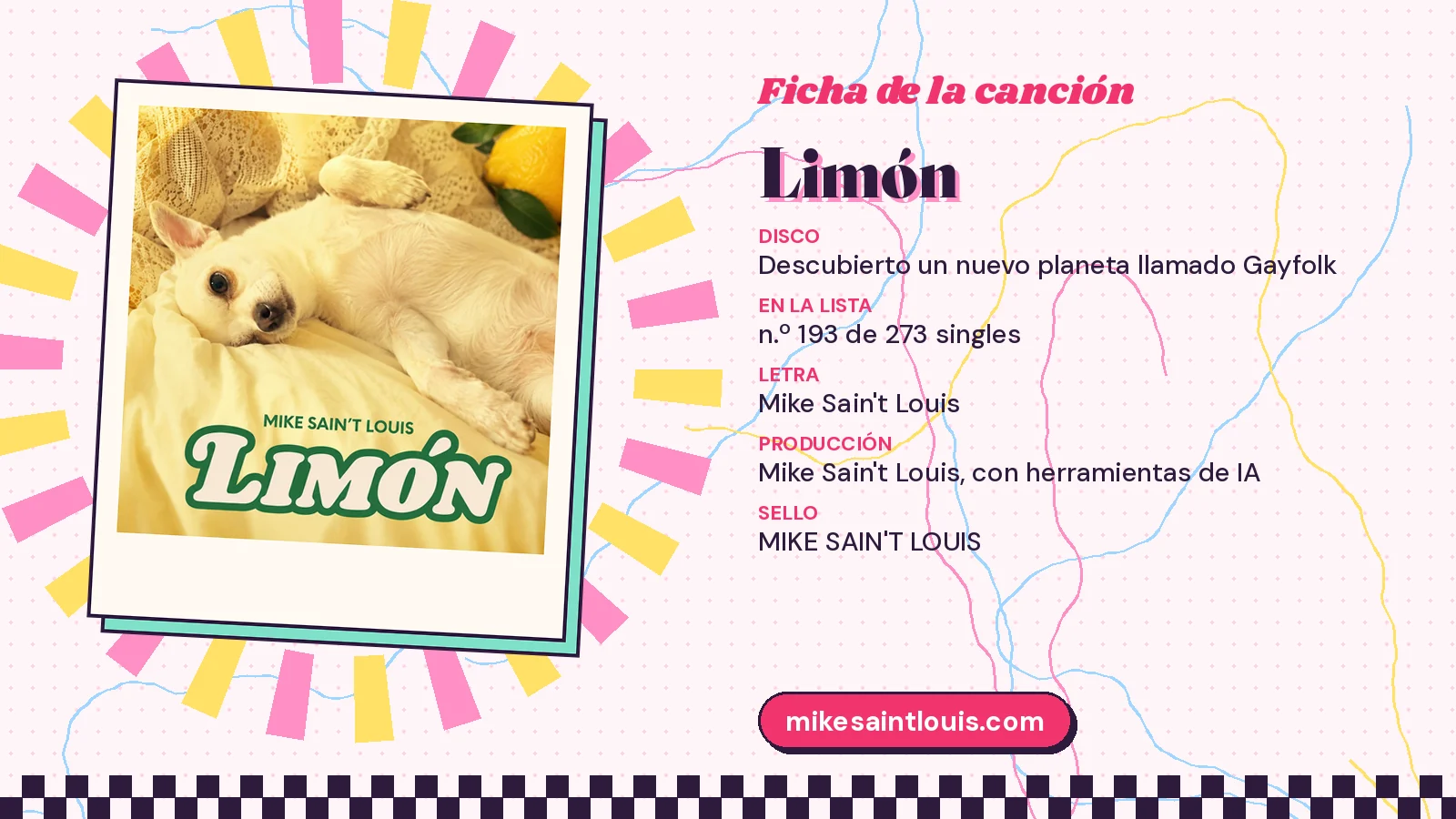
What is «Limón» about? It's a lullaby. The lyric speaks to a little one falling asleep and promises protection and loyalty. It's on «Descubierto un nuevo planeta llamado GAYFOLK», the first album of the trilogy. The lyrics are by Mike; the music and vocals are made with artificial intelligence.
Are the names that appear in the lyrics real people? The ex-boyfriends and named characters in the lyrics are invented characters. The references to celebrities, such as the letter in «La dieta del cucurrucho», are pop-culture nods within a work of fiction.