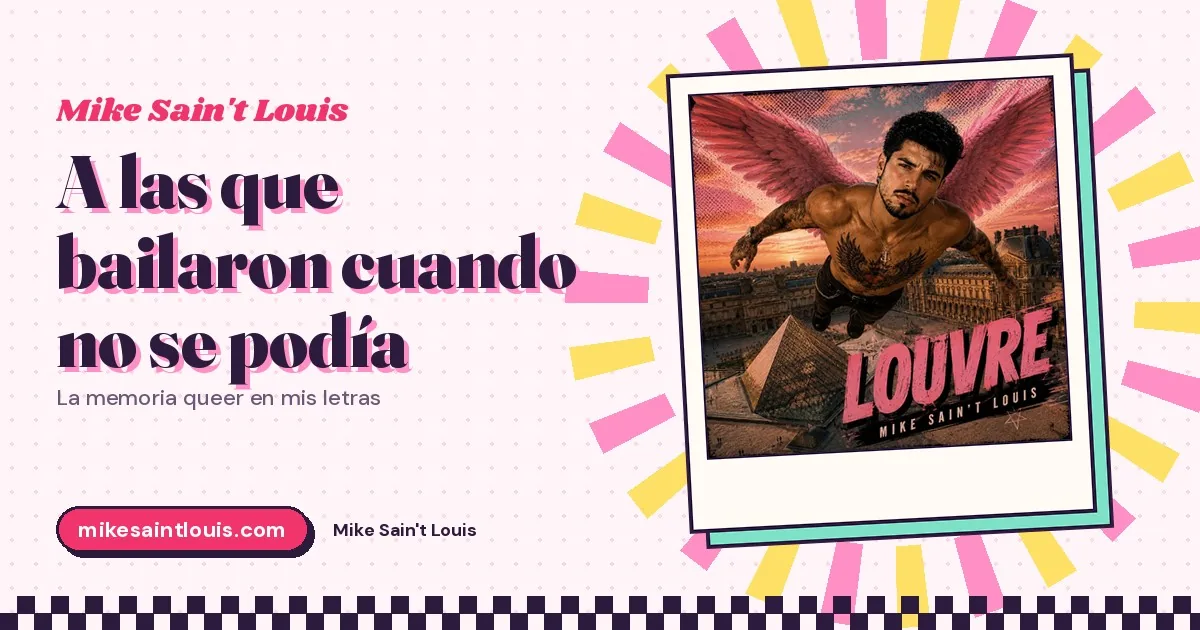
By Mike Sain't Louis ·
For Those Who Danced When Dancing Wasn't Allowed: queer memory in my lyrics
«A Marisol, a las que bailaron cuando no se podía, / y a las que seguimos bailando aunque aún moleste» («to Marisol, to those who danced when dancing wasn't allowed, / and to those of us who keep dancing though it still bothers people»).
That is the dedication on my version of «La Tarara». And it could be the dedication of this entire piece.
Because in my catalogue, among the exes, the narcissists and the jokes, runs a thread of songs that look back. To those who loved when loving was a crime. To those who danced when dancing was a risk. To the women television turned into a joke who were so much more than that. To those who held hands where nobody could see.
They are not history songs. I have neither the training nor the pretension of a historian. They are songs of memory, which is something else: history told from the inside, from what is felt, from the details that never make it into the books.
This piece follows that thread. And it ends in a museum, with wings.
What the books leave out
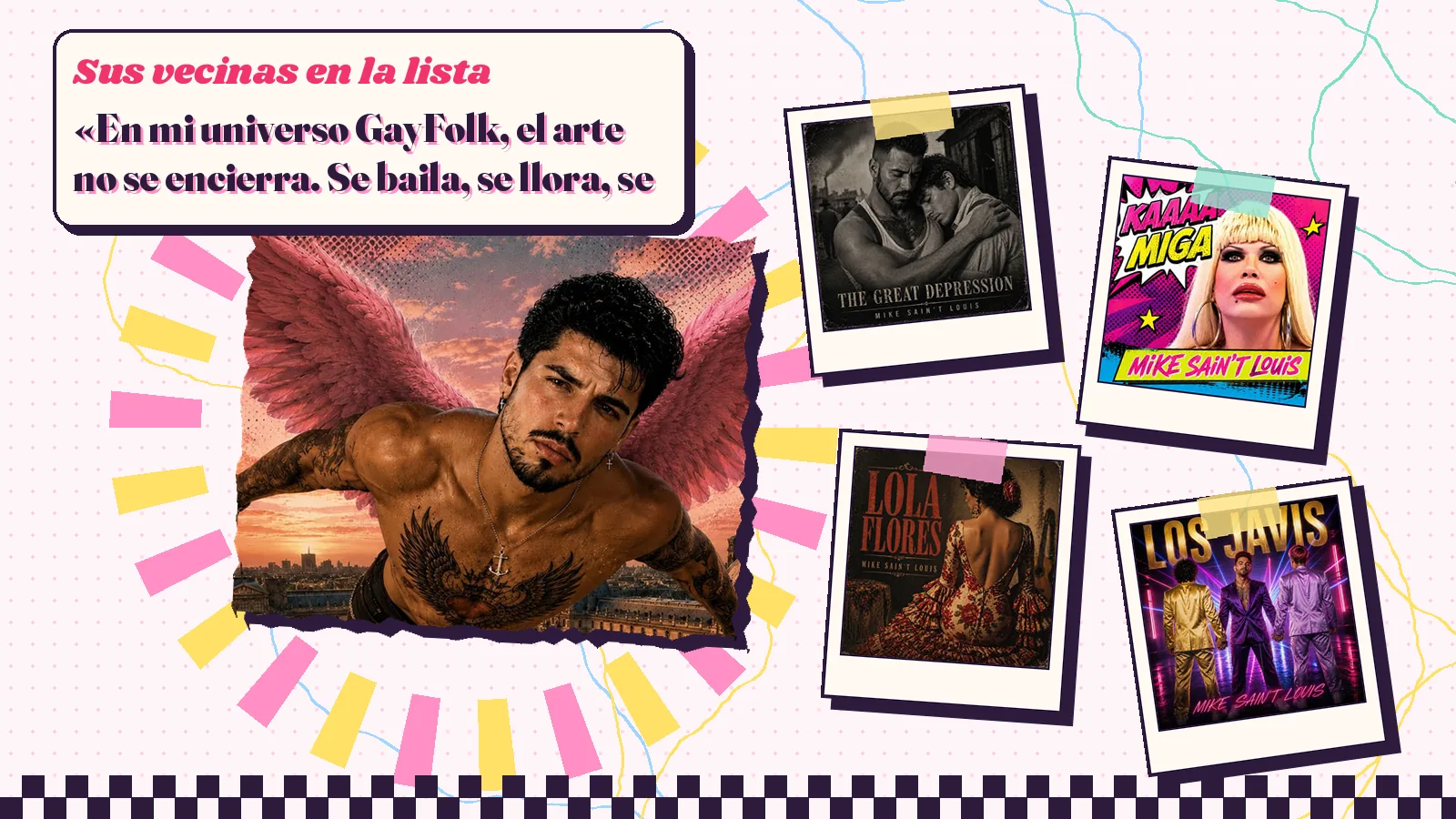
I will start with the song that travels furthest back in time. «The Great Depression», from the third album.
It is written in English and tells a love story between two men in the depths of the Great Depression. October. The markets collapse. Men hold their hats the way they hold their pride. A storefront radio coughs out jazz. And in the crowd, someone takes hold of your wrist.
The first verse ends on the line that explains everything: «And that was the first crash: wanting this». The first crash was not the stock market's. It was wanting someone you should not.
Then come the details, which are what I love most about the song. The two of them rent Tuesday nights in a narrow room above a bar. There is a borrowed jar of sugar and of hope. His tie hangs neatly on a kitchen hook. Outside, the landlord counts what is owed. Inside, someone counts heartbeats.
And then there is Mrs Crowley, the neighbour always leaning on the rail, who one day sees the lover leave too late. Nothing more needs explaining. That look changes everything.
How you fixed my cuff
The last verse of «The Great Depression» is, for me, one of the most important things I have written about queer memory. It says the history books will talk about banks and bread, about men who jumped, about unpaid debts.
And then: «They won't write how you fixed my cuff, / How "friend" was never word enough».
There it all is. Official history remembers the big things: the economy, the wars, the laws. And it forgets the gestures. A man straightening another man's shirt cuff before they go out into the street. Two people who had to call each other friends because no other word was allowed.
That word, «friend», has been for centuries the disguise of a great many loves. The lifelong friend. The flatmate. The bachelor who lived with another bachelor. The song says it was never enough, and it is right. But it was also all there was.
And it ends with a beautiful image: the narrator keeps the other man folded in his chest, a quiet headline no one guessed.
The neighbour at the rail
I want to pause for a moment on Mrs Crowley, because she is a character I know very well, even if she lives in 1929 and speaks English.
The song introduces her in a single line: always at the rail. Always leaning out.
Always at the rail. Always watching. And one day she sees what she should not: the lover leaving too late. And the narrator's face goes pale.
That neighbour is the same in every era and in every language. In my Spanish songs she is the nosy neighbour who appears on the list of people who will talk about you when you are dead. She is the one tutting from the balcony in «Marica chill». She is the concierge who knows everything, the aunt who asks why you have no girlfriend, the whole village watching from behind the net curtains.
The difference is what that look could cost. In «Marica chill», the answer to the neighbour on the balcony is to blow her kisses and put on reggaetón. In «The Great Depression», Mrs Crowley's look is a threat. Because that love was illegal, and a neighbour could ruin your life.
Between one neighbour and the other lies the whole distance we have travelled. From the pale face to the blown kisses. That, in miniature, is the history of queer memory.
Loving when it was illegal
In that same verse there is a line that allows no nuance: «That love was there—then illegal need».
The love was there. And it was illegal.
I think it matters that this is said in a pop song. Because we forget. We take what we have now for granted, as if it had always been there. It has not. In many places, and for a long time, loving another man was a crime. In Spain, to look no further, the 1970 Law on Social Danger and Rehabilitation still placed homosexuals on its list of dangerous people. That is not ancient history. There are people alive who remember it.
The song's page sums it up: it is a way of remembering that official history always leaves out people like us, the loves that were illegal.
And the chorus plays on the double meaning of the title. The great economic depression, and the other one, the one that stays inside you when someone is torn from you. Because in this song there is no betrayal. The love does not break. It is taken away.
Those who danced when dancing wasn't allowed
Back to «La Tarara» and its dedication.
The text for that version says it is not a simple cover, but «un acto de amor, de memoria y de irreverencia» («an act of love, of memory and of irreverence»). And it says of Marisol that she «fue muchas cosas, pero sobre todo fue libertad» («was many things, but above all she was freedom»).
What interests me here is the second half of the dedication. «To those who danced when dancing wasn't allowed.» It does not say who. It does not need to. We all know there were women, and men dressed as women, and village queers, who danced when dancing like that could cost you a beating or a night in the cells. Who put on the flounced flamenco train at a private party, who belted out coplas in some dive of a bar, who moved however they pleased when doing so was dangerous.
My version of «La Tarara» is for them. And for those of us who keep dancing though it still bothers people. That «still» matters. Because it still bothers people. Less, but still.
The text puts it another way: childhood turned into resistance, tradition remixed with synthesisers.
The memory we still chorus
In the text for my version of «Cariño trianero» there is another sentence about the same thing. The song, it says, belongs to that collective memory we still chorus, «pero ahora sin miedo a ser quienes somos» («but now without fear of being who we are»).
Without fear. That is the difference between then and now. The same songs, the same coplas, the same Carmen Sevilla. But seen differently. The text says: I bring it back with a different gaze, «marica, libre y contemporánea» («queer, free and contemporary»).
That is what queer memory does with popular culture. It does not throw it away. It does not scorn it for being old. It picks it up, turns it round and puts it back into circulation. The coplas heard in our grandmothers' houses are ours as well. They always were. It is just that now we can say so.
And the text ends with a sentence I think is very fair: «Carmen Sevilla abrió el camino» («Carmen Sevilla opened the way»). All I do is add my light and my truth.
Mirror of an era
There is one figure in my catalogue who is pure memory. La Veneno.
In the text for «Kaaa miga» I write that she was «escándalo, humor, coraje y espejo de una época que intentó silenciarla» («scandal, humour, courage and the mirror of an era that tried to silence her»). And that the track belongs to my GayFolk universe, «donde la memoria queer se mezcla con el pop art, la crítica y la ternura» («where queer memory mixes with pop art, critique and tenderness»).
Queer memory mixed with tenderness. I like that phrase because memory is so often told only through pain. And the pain is there, of course. La Veneno was a trans woman whom nineties television made famous and whom that same country treated appallingly. But she was also humour. Laughter. A way of speaking that still makes us smile today, as the text says.
Remembering La Veneno only as a victim would betray her. She was so much more than that. And the song remembers her by shouting her name with the same nerve she showed when she stood up to the world.
Names that need no introduction
There are two songs in my catalogue whose titles are proper names that, in this country, need no explanation. And set side by side, they trace a path.
The first is «Lola Flores». Its lyric is not yet published on my website, but the song's page describes the cover: a woman from behind, in a flamenco dress printed with red flowers, her back bare, her hair caught up with a flower. Her face is not shown. And the page explains why I find that decision so lovely: when you say that name, everyone pictures her for themselves.
The page describes it as a declaration of affection and admiration for a way of being in the world with art, with genius and without apologising for taking up space. Without apologising for taking up space. That is what many gay men learned from the folkloric stars long before we had words for it.
The second is «Los Javis». Its lyric is not published yet either. Its cover shows three boys holding hands on a neon stage, in satin suits. And the page says that the name brings to mind a way of telling queer stories with sparkle, with emotion and without asking permission.
From Lola Flores to Los Javis. From the folkloric star who took up space without apologising to the creators who tell queer stories without asking permission. And in between, joining the two ends, La Veneno, to whom Los Javis devoted an entire series. Queer memory is that too: a chain of people each opening the door for the next.
The page for «Los Javis» ends with a detail that makes me smile: in the picture there are three of them, not two. There is always room for one more on stage.
A funeral in sunglasses
There is one song in my catalogue whose title weighs more than any other. «Franco ha muerto» («Franco is dead»).
The lyric is not yet published on my website, so I will not quote it. But the song's page says something I think matters: that few phrases weigh as heavily in this country's memory as that one, which was heard on television half a century ago and still provokes every kind of reaction today. And that what interested me was precisely that: what happens when a phrase like that turns up on a PLANETA GAYFOLK single.
The cover is a funeral in every sense. A dark coffin covered in white flowers, a stone cross in the background and me dressed head to toe in black, with sunglasses and a black rose between my tattooed hands.
And the page leaves the question open: I do not know whether that mourning is grief, relief or pure theatre. Sunglasses at a funeral always hide something: tears, or a smile best kept out of sight.
I will not close that question here. The page does not either. I will only note what it means, for this country's queer memory, that the phrase appears on a record by a queer man from Madrid half a century later. That we can put it on a cover, with sunglasses and a black rose. That it is ours, too.
Where no one sees
There is a song that tells the passage from hiding to the light in three minutes. «Boys Like Us».
It opens with an image that is pure memory: «He holds my hand / Where no one sees».
We have all done it. Many of us still do. Holding your boyfriend's hand in the doorway, in the dark of the cinema, in the car. Letting go when someone walks past. That hidden hand is the history of several generations of gay men.
Then the song takes the leap. «We never hide.» «We turn the dark / Into pride.» And the image I like best, the heels: «We wear our heels / And stand tall». Heels as armour.
The song's page dedicates it to something very specific: to any boy who still lets go of his boyfriend's hand on certain streets. And to those who never let go any more.
That dedication is queer memory in a sentence. What we were and what we are, living side by side. Because the hidden hand has not stayed in the past. It still happens. On certain streets.
From Madrid to Benidorm
And then there is the anthem. «Madrid to Benidorm», also in English, is the pride song of my catalogue. Under the rainbow, from Madrid to Benidorm, through every storm.
It has a line that connects with everything before it: «For every heart that's been denied».
That is the meaning of a pride song. There is a party, of course. But there is memory too. Dancing for those who could not. Celebrating in the name of those who had to hide. «This is what pride is all about», says the song.
And I like that the route runs from Madrid to Benidorm. Two cities that, each in its own way, have been a refuge for many people like me. The capital and the beach. The city where you get lost and the city where you find yourself.
Rewriting the places we were never invited
I end in the museum. In «Louvre».
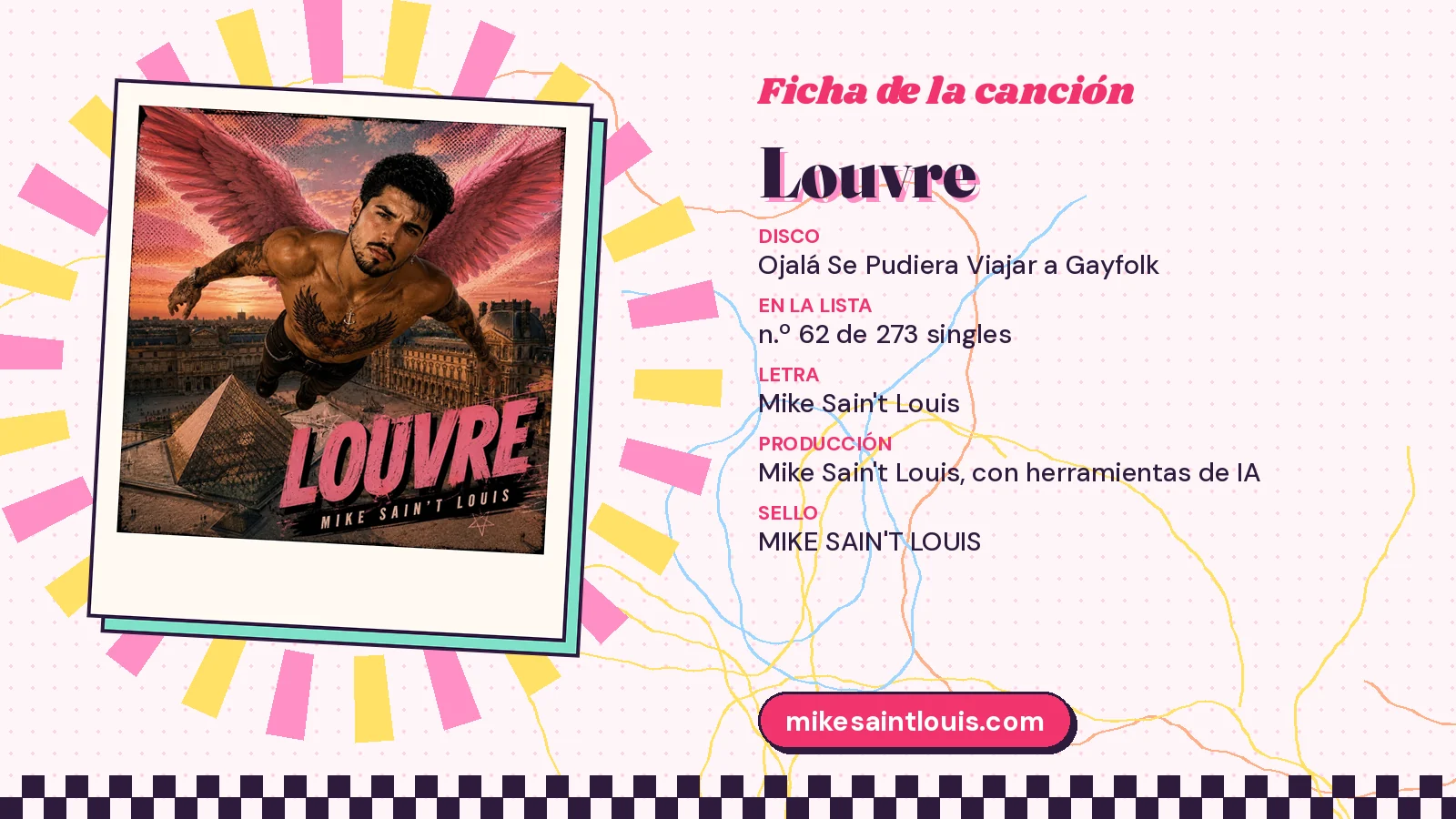
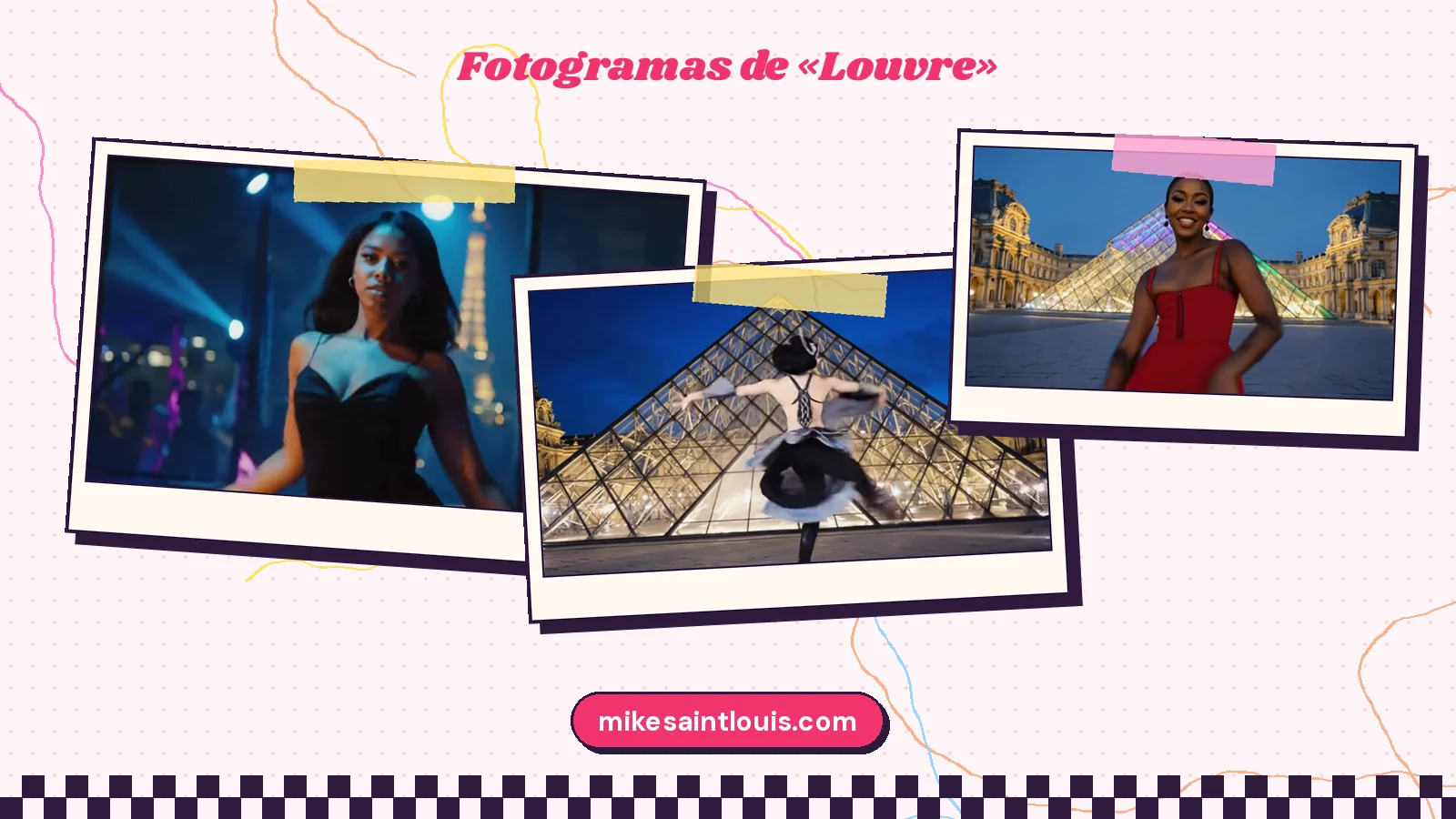
The song imagines walking into one of the most solemn museums in the world with butterfly wings and turning its galleries into a dance floor. The cover puts it in a picture: a boy with great pink wings flying over the glass pyramid at sunset.
And the song's text contains the sentence that, for me, sums up everything queer memory is: «En el fondo, eso es lo que hacemos las personas diferentes: reescribir los lugares donde nunca fuimos invitados» («deep down, that is what those of us who are different do: rewrite the places we were never invited»).
Rewrite the places we were never invited. Museums, churches, coplas, television, history books. All those places that were not made with us in mind and in which, nonetheless, we were always present. Painting, posing, dancing, hiding behind the word «friend».
The song's page explains it: those galleries are full of naked bodies, ambiguous loves and male beauty painted by people who could not always live their desire freely. It seems only fair that someone should walk in there and dance.
Liberation Day
There is a detail I find revealing. If you look at which album each of these songs is on, several fall on the same one: the third of the GAYFOLK trilogy, the one called «El día de la liberación», «Liberation Day». That is where «The Great Depression», «Franco ha muerto», «Madrid to Benidorm», «Lola Flores» and «Los Javis» live. And «La Tarara», «Boys Like Us» and «Louvre» are on the second, the album of longing to arrive.
My website describes the trilogy as three albums telling the road to a planet where everyone can live exactly as they are. The first finds the planet. The second dreams of getting there. And the third is called «Liberation Day».
It makes sense for memory to be there. You cannot celebrate a liberation without remembering what came before. The day you are finally free is also the day you look back and count those who did not make it. Those in the rented room. Those who called each other friends. Those who danced when dancing wasn't allowed.
Not a fad
The text for «Louvre» has another sentence I want to rescue before I finish: that queer is «no es una moda: es una manera de ver el mundo con más color y más verdad» («not a fad: it is a way of seeing the world with more colour and more truth»).
I think it is important to say this now, when queerness is sometimes spoken of as a trend. As if it had appeared ten years ago on social media. No. Queerness was in the rented room of 1929. In those who danced when dancing wasn't allowed. In the Carmen Sevilla our grandmothers hummed along to. In La Veneno. In the hand hidden in the doorway. In the paintings of the Louvre.
What is new is that now we can tell it. And that we can tell it with humour, with pop and with pink wings.
Memory with glitter
Some people believe memory has to be serious. Grey. Black and white, like the photos in the books.
My songs do not believe it. «The Great Depression» has jazz and a nosy neighbour. «La Tarara» dances among neon and heels. «Kaaa miga» shouts La Veneno's name with nerve. «Franco ha muerto» puts sunglasses on at a funeral. «Louvre» turns a museum into a nightclub.
That is memory too. Remembering those who came before not with a minute's silence but with a minute's dancing. Because that is what they could not do, and what we can.
The text for «Louvre» ends by wishing that the sparkle, the freedom and the urge to dance before the temples of art may never be lacking. I would add: nor memory.
I write the lyrics myself, and the music and the vocals are made with artificial intelligence. But the memory they hold was invented by no one. It belongs to everyone who came before and could not tell it.
The lyric of «Louvre» is at gayfolkplanet.com/letras/louvre. Play it in front of your favourite painting. And dance for those who could not.
Frequently asked questions
Which Mike Sain't Louis songs deal with queer memory?
Among others, «The Great Depression», about a love affair between two men during the Great Depression; his versions of «La Tarara» and «Cariño trianero»; «Kaaa miga», dedicated to La Veneno; «Franco ha muerto»; «Boys Like Us»; «Madrid to Benidorm»; and «Louvre».
What is «The Great Depression» about?
A secret love affair between two men during the Great Depression, with a room rented on Tuesday nights above a bar and a neighbour who sees everything. Its last verse recalls that the history books do not tell of those loves, which were illegal at the time.
What does «rewriting the places we were never invited» mean?
It is a phrase from the text for «Louvre»: the idea that queer people transform solemn spaces, such as a museum, into places of their own. The lyric is at gayfolkplanet.com/letras/louvre.
Who writes these songs?
Mike Sain't Louis, the first AI songwriter: a lyricist, composer and music producer based in Madrid. The lyrics are always his own; the music and the vocals are made with artificial intelligence.