
By Mike Sain't Louis ·
"Ladies and gentlemen, stop": the art of cutting a conversation short in a song
Some arguments aren't won with reasons. They're won by raising your hand.
That's what I do halfway through *Ojalá hubiera tenido de suegra a Carmina Barrios* ("If Only Carmina Barrios Had Been My Mother-in-Law"), before the garden, the lunch with Paco León and the fantasy of the perfect mother-in-law arrive. (Carmina Barrios is the Sevillian mother of actor and director Paco León, and the beloved star of his films.) I raise my hand. I stand up. And I cut dead a conversation I can't stand for one more second.
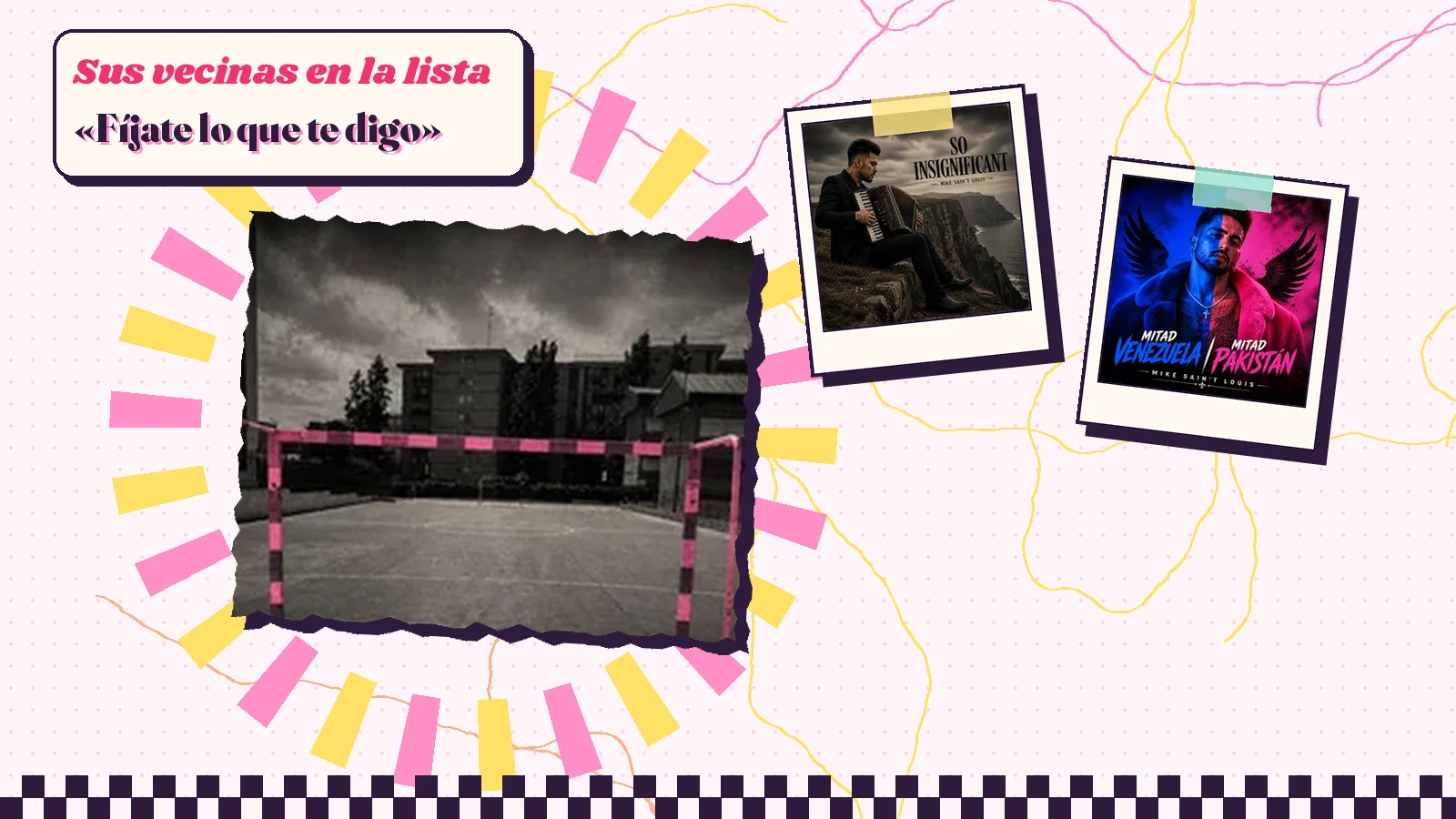
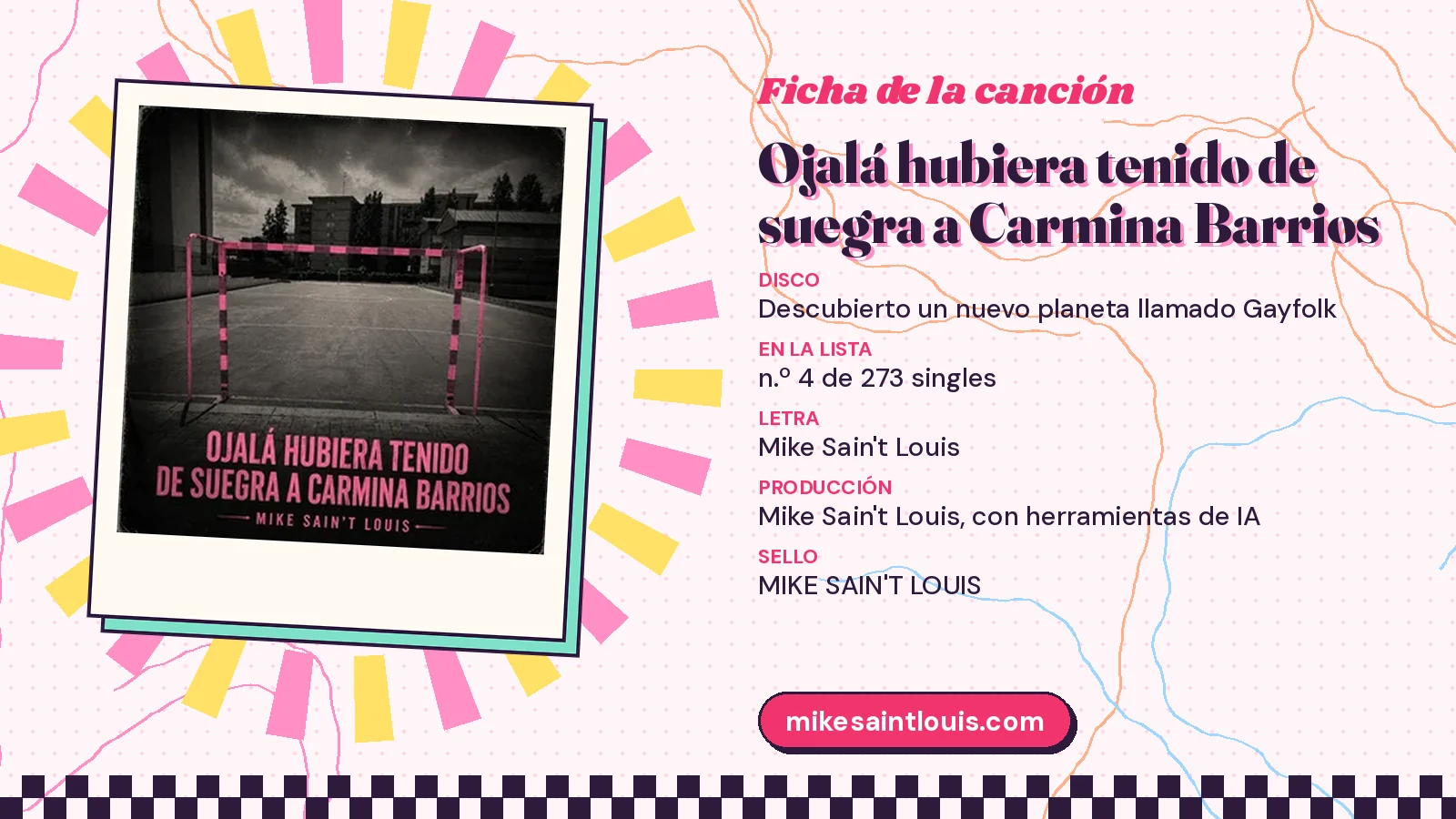
The song is on the first album of the trilogy, «Descubierto un nuevo planeta llamado GAYFOLK» (A New Planet Called GAYFOLK Discovered), and in the Planeta Gayfolk singles list it's track 4 of 273. One of the very first. It sits between «So Insignificant» and «Mitad Venezuela, mitad Pakistán». If you've ever wondered what Planeta Gayfolk sounded like in its first steps, this is a good answer: a dream mother from Seville, a real ex-mother-in-law and a "stop" in imaginary capitals.
On the song page I've already told the story of the mother-in-law fantasy and the garden. Here I want to talk about what happens just before. The interruption. The moment a song stops telling and starts telling everyone to shut up.
Mark my words
«Fíjate lo que te digo» ("Mark my words")
I'll start with the first line, which isn't the interruption yet but sets it up.
«Fíjate lo que te digo» is an age-old conversational formula. It's what your aunt says over the after-lunch coffee before delivering an opinion nobody asked for. It's what the neighbour says in the lift before telling you who on the fourth floor has split up. It's a way of demanding attention with a mix of complicity and authority. Mark my words. Meaning: drop whatever you're doing, this is important.
I love it so much I use it in more than one lyric. It has something oral about it, something said rather than written, that I love slipping into songs. A song that opens with "mark my words" doesn't open like a song. It opens like a kitchen conversation. And that lets me, a few lines later, do what people do in kitchen conversations when things heat up: interrupt.
The ex-mother-in-law, in two lines
Before the stop there's some context the lyric dispatches very quickly, almost in a hurry to get to the good part.
There's a last husband I ended badly with. There's a last mother-in-law I'd rather not even mention. And there's a very reasonable explanation: he's her son, she has to be on the other side. The song says it with an understanding that almost seems generous. I get it, it says. What I can't stand are her arguments.
Notice what a fine distinction that is. I don't mind her taking her son's side; that's just life, any mother from Albacete to Cádiz would do it. What bothers me is how she argues. Her reasoning. In other words, the fight isn't about sides, it's about standards. And that sets up the burst of arrogance that follows.
I say nothing more about her. No name, no city, no job. She's a generic ex-mother-in-law, the kind we can all draw with our eyes shut: handbag on her lap, the up-and-down look, the comment about how thin or fat you've got. She needs no more features. Better not even get started says it all.
Stop, stop
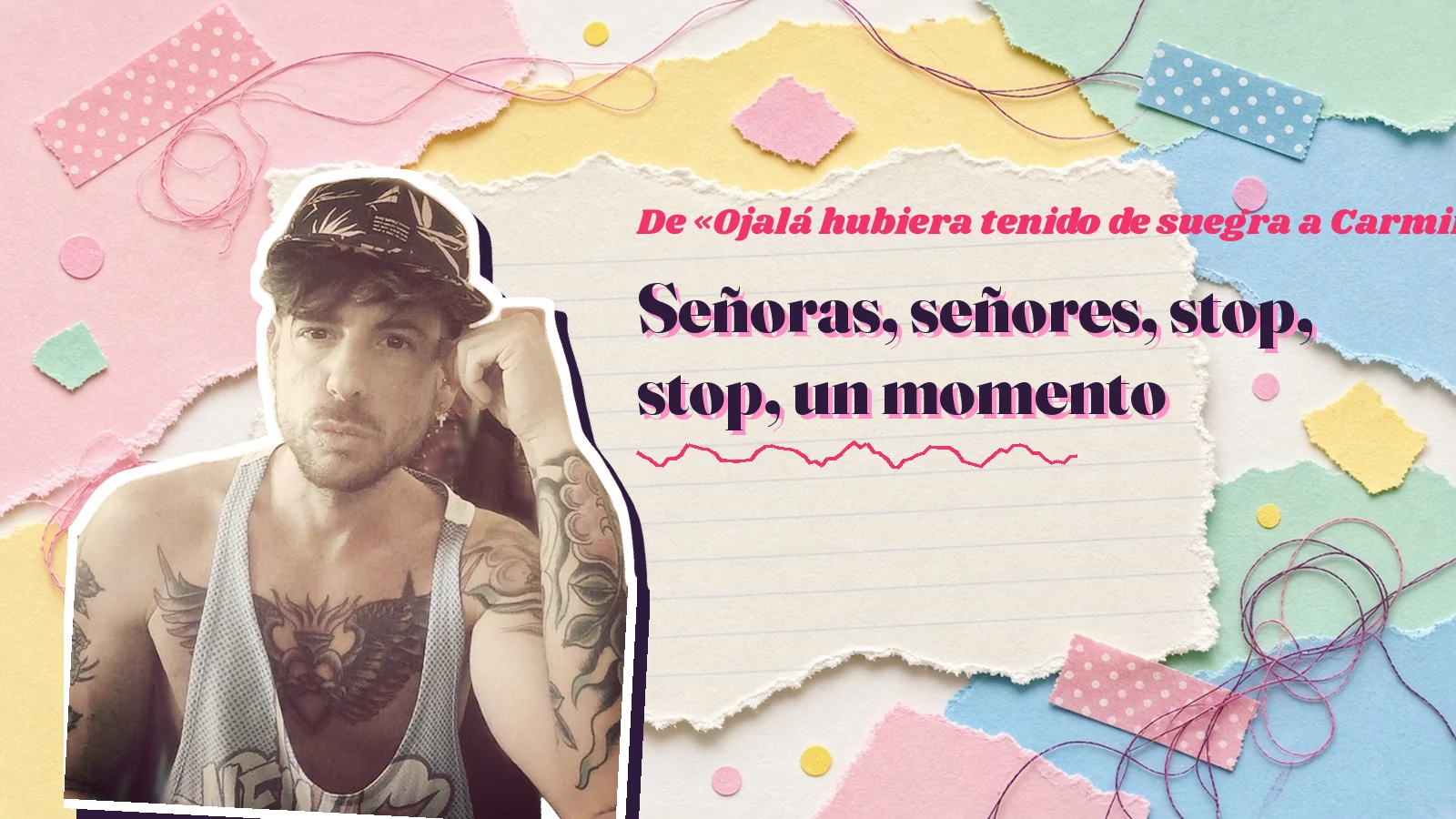
«Señoras, señores, stop, stop, un momento» ("Ladies and gentlemen, stop, stop, one moment")
And here it is. The interruption.
The first thing I love is the audience. Ladies and gentlemen. I'm not just talking to the ex-mother-in-law. I'm addressing a whole room. Like the host of a charity gala grabbing the mic and calling for silence. Like the judge on an afternoon TV show banging the gavel. Suddenly the family row, which was between two people, becomes a public event, with its stalls, its boxes and people cracking sunflower seeds up in the gods.
The second is the English. Stop. I could have written «basta» or «parad». But "stop" has a different music, a different gesture. It's the word on road signs, the traffic warden's outstretched hand, the stop button on the remote. A universal order that admits no reply. Nobody argues with a stop sign. You brake or you crash.
And the third, my favourite, is that I say it twice. Stop, stop. Because the first one didn't work. That repetition belongs to someone who shouts once, sees they're still talking, and shouts again, louder, until the room falls silent. Pure theatre, in the best sense.
One moment, it ends. One moment. As if about to ask for the floor at a residents' meeting. And what comes next isn't an argument. It's a slap of arrogance.
You're not talking to an idiot
Right after the stop, the lyric fires off the classic defence of someone who feels belittled. You're not talking to an idiot.
I love how indignant it sounds. It's the line of someone who's been treated like a fool all afternoon and finally explodes. There's something of an Almodóvar character in a kitchen scene about it, apron on and knife in hand, threatening nobody but making it clear the knife is there.
And it's also, if you think about it, a rather comic line. Because nobody who doesn't feel a bit of an idiot says "you're not talking to an idiot". It's a defensive line. Said by someone who suspects they're being taken for one. And that suspicion, in a comic song, is gold.
Ten times
«os supero diez veces en intelecto» ("I outdo you ten times over in intellect")
And here's the clincher. Arrogance in its purest form. Not only am I not an idiot: I outdo you ten times over in intellect.
Ten times. Why ten? Because it's the comic-book superhero number, "ten times stronger than an ordinary man". Because it's the perfect mark at school. Because it's a round, exaggerated figure nobody can measure. How do you measure multiplied intellect? In what unit? Spoonfuls of Sudoku?
It's a boast, of course. And it's written so you notice it's a boast. Nobody who really was ten times cleverer than their ex-mother-in-law would say it like that, in a song, with ladies and gentlemen as witnesses. It's said by someone wounded who needs, for a moment, to feel on top.
That's the joke. The arrogance is fake. Papier-mâché armour, like a float in the Three Kings parade. On the outside, a haughty knight. On the inside, someone fresh out of a divorce who's in no mood for more lectures.
I laugh at myself a lot in that line. If there's one thing I'm not, it's ten times cleverer than anyone. But in a family argument, at eleven at night, with an ex-mother-in-law who won't stop arguing, we've all felt like that at some point. Superior in every way. Even if only for a minute, before going off to cry in the bathroom.
The school of great interruptions
I didn't invent the gesture. I learned it from the best.
In Spain we have a huge tradition of women who stop a room dead with one sentence. The most famous is Lola Flores at her daughter's wedding, with the church overflowing with people, pleading into the microphone that if they loved her, they should leave: «Si me queréis, irse» ("If you love me, go"), in grammar all her own. It's a perfect interruption. It has an audience, it has authority, it has a grammar the Royal Spanish Academy wouldn't recognise, and it makes a request impossible to argue with.
My stop is a child of that school. It doesn't reach those heights, only one woman ever did, but it drinks from the same well. When a diva has had enough, she doesn't argue. She commands. And the command always has an audience built in: ladies, gentlemen, dear guests, my people.
I like to think that the ex-mother-in-law in the song, if she heard it, would be left gaping just like those wedding guests, not quite knowing whether to go or stay. That's the beauty of a good interruption. It throws everyone off balance. And while they're off balance, you've already left for the garden.
Arrogance as a comic device
I'm very interested in arrogance in songs. It's a device rarely used in Spanish-language pop, especially sentimental pop, where whoever signs the lyric usually casts themselves as the victim.
Fake arrogance is something else. It's the diva. The folk star at a press conference. The reality-show contestant who says in the diary room that she's way above all that. It's a pose, and like every pose it's transparent: everyone sees what's behind it. And what's behind it is vulnerability.
I went into it at more length in the exaggeration of everyday Spanish speech: in Spain we talk in superlatives all the time. I'm dying, I'll kill myself, I outdo you ten times over. We don't mean it literally. We say it to convey intensity. And in a song, that intensity becomes a character.
What comes after the silence
The lovely thing about a well-made interruption is what it leaves behind: silence. And into that silence, in this song, steps the fantasy.
After the stop, after the idiot and the multiplied intellect, the lyric goes somewhere else. To Carmina Barrios's garden. To lunch with Paco León, «mi chiquitín», my little one. To the fourteenth anniversary. It's as if, once the real ex-mother-in-law has been silenced, there's finally room to imagine the dream one.
And that, for me, is the song's secret structure. First you have to silence the noise in order to dream. First you have to raise your hand. Then, in the gap that's left, there's room for a mother from Seville in sunglasses with a fan, laying the table on a patio full of flowerpots.
I won't repeat the fantasy, it's on the song page. I just want to point out that it wouldn't exist without the stop. Without the interruption, the song would be a lament. With it, it's a change of channel.
One moment, and a short one
There's something about the stop that seems very important to me and almost never gets mentioned: how short it is.

The interruption takes up two lines. Three, if I count the intellect one. After that, the song has already moved on. I don't wallow in the arrogance. I don't devote a whole verse to humiliating the ex-mother-in-law. I cut in, stand up, say my piece and leave.
I think that's the secret of why the moment works. A long interruption becomes a speech, and speeches are boring. A short interruption is a blow. Like a well-slammed door, which doesn't need repeating for the whole building to hear.
I apply this a lot when I write. If a line is strong, I leave it alone. I don't explain it, I don't add a second half, I don't surround it with adjectives. I drop it and change the subject. The listener will take care of chewing it over.
And that's what happens here. What people remember about the song, besides Carmina, is the stop. Two syllables. Repeated. And a moment that, as the word says, lasts a moment.
What I didn't say
Since we're on interrupting, let me also talk about what I interrupted. What I never got round to writing.
The song could have been a list of grievances against the ex-mother-in-law. There's no shortage of material in any family of in-laws. But I chose not to. I chose to sum it all up in a better not even get started and an I can't stand her arguments, and spend the rest of the lyric on something that made me happier: imagining the mother-in-law who would have loved me.
That decision is a stop too. A stop to myself. To the urge to let rip. To the temptation of turning a song into a complaints session. I stopped in time and went to the garden. And I think the song is better for it. Complaints get forgotten. A garden in Seville with Carmina serving gazpacho doesn't.
Change of channel
That, in fact, is the best way I have of explaining the stop. It's a remote control.
You're watching a show you can't stand, an after-lunch TV debate where everyone's shouting, and suddenly you press the button. Stop. And you switch to another channel showing a Paco León film, with his mother playing herself in a flat in Seville, coming out with lines that make you cry with laughter.
That's the song. Channel-hopping. From the real ex-mother-in-law to the on-screen mother-in-law. From the daytime soap to neighbourhood auteur cinema. And I do it with a gesture as simple as saying stop twice in front of an imaginary audience.
Fantasy justice
In the fantasy section there's a detour that's also an interruption, of a different kind. The courtroom.
The song imagines that, in that dream world, the couple sue a certain journalist and a certain website for publishing made-up intimate photos. I'll leave it at that, vague, because that's exactly what it is: a justice fantasy inside a family fantasy. There's nothing real behind it, just as there's no fourteenth anniversary and no garden. It's the script of a soap opera I dreamed up in my head, gossip-press villain included, as in any self-respecting telenovela.
It interests me because it's another form of the stop. If in the family row I raise my hand, in the fantasy I raise a lawsuit. Same gesture, but with a lawyer. And with a Sevillian mother-in-law at my side, who in that fantasy is the best legal adviser anyone could have.
English in the middle of the castizo
Back to the stop for a moment, because I left something out.
It amuses me that the strongest word in such an Andalusian song, so full of patios and a Sevillian mother-in-law, is an English word. Stop. That mix happens to me a lot when I write. It isn't some lab-made aesthetic decision. It's how we talk. In Madrid we say "stop" and "sorry" and "random" in the middle of sentences my grandmother could have said. And in a song that wants to sound like a real conversation, that has to be there.
Besides, the English gives the moment the air of an international show. It's no longer a family row in a flat in Móstoles. It's a gala. A TV studio. A game show with an American host. Ladies and gentlemen, stop. The ex-mother-in-law is reduced to an eliminated contestant while the spotlight swings elsewhere.
Why it works so early on
The song is fourth in the singles list. That means it's one of those that set the tone for everything that came after. And I think almost all my quirks are already in it: the kitchen line, the theatrical interruption, the fake arrogance, the proper names from TV and film, the fantasy with a happy ending and the tenderness hidden under the joke.
If someone asked me for a single song to understand how I wrote in those first months, I'd probably give them this one. And I'd tell them: watch the stop. Everything's there. The ability to cut the drama in time so it doesn't turn into a lament.
I talked about it in long, strange titles, regarding its neighbour on the list: back then I gave songs titles that were whole sentences, practically film plots. Ojalá hubiera tenido de suegra a Carmina Barrios is a title that already tells the song. And even so, the best part isn't in the title. It's in the stop.
Who writes and who makes the music
The lyrics are mine, written without AI. The music and vocals are produced with artificial intelligence tools such as Suno, which I direct; I always explain it on About Mike. And there's something in this song I especially like about working that way: the stop has to sound like a stop. It has to cut. It isn't enough for the word to be written; the music has to brake with it. That's part of my job as producer, choosing the version where the interruption really lands, even if it means throwing out a lot of others.
Use your stop
I'll leave you with an idea, which is what I like to do at the end of these pieces.
We all have an ex-mother-in-law, an ex-brother-in-law, a boss, a flatmate or a family WhatsApp group that keeps arguing things we can't stand. And we almost never dare raise our hand. We keep quiet, smile, pass the plate of croquetas.
This song is a borrowed stop. Play it when you need it. Imagine you're the one who stands up after lunch, looks round the whole table and says: ladies and gentlemen, one moment. You don't need the intellect bit, that one's mine. But the gesture, the cutting in, that's my gift to you.
And then, in the silence, imagine your dream mother-in-law. Whoever she is. For me it's Carmina Barrios. For you it might be Rosalía de Castro, Concha Velasco or your neighbour on the fifth floor who always takes in your parcels. What matters is having an imaginary garden to escape to when the real after-lunch table becomes unbearable.
The full lyrics are on gayfolkplanet.com and in this site's lyrics archive. And if you want to carry on with the first album, the cover and full running order are on the Planeta Gayfolk page.
And if someone at the table gives you a funny look when you do it, smile, help yourself to another croqueta and carry on.
Stop. One moment. There.
Frequently asked questions
*What is Ojalá hubiera tenido de suegra a Carmina Barrios about?* It opens with a bad experience with the last mother-in-law, who sides with her son using unbearable arguments, cuts the argument dead with a "ladies and gentlemen, stop" and drifts into a fantasy: lunch in the garden with Carmina Barrios and Paco León, celebrating an imaginary anniversary. Everything that happens in that fantasy is made up.
Which album is it on? On «Descubierto un nuevo planeta llamado GAYFOLK», the first album of the GAYFOLK trilogy. In the Planeta Gayfolk singles list it's track 4 of 273.
Who writes the lyrics, and how is the music made? The lyrics are mine, written without AI. The music and vocals are produced with artificial intelligence tools such as Suno, which I direct. I'm a lyricist, composer and music producer from Madrid.
Where can I read the lyrics and listen to it? The full lyrics are on the song page and on gayfolkplanet.com. You can listen on Spotify.