
By Mike Sain't Louis ·
Let the puppet talk: ventriloquism, fairy tale and revenge in «Doña Rogelia»
“This is the tale of how, once upon a time…”
That’s how the bedtime stories you heard as a child begin. And it’s how «Doña Rogelia» begins, a song meant to put nobody to sleep and to wake an entire audience with a slammed door.
I love that first line because it’s a trick. It prepares you for a story with a wolf and a little girl in a red hood, and what arrives instead is a fairground introduction, a list of defects with percentages and, at the very end, the most famous old lady in Spanish ventriloquism serving as the yardstick for somebody’s oral hygiene. If that isn’t a camp fairy tale, I don’t know what is.
In this post I won’t go through the lyric line by line; the song already has its own page on the blog for that. I want to talk about something that has obsessed me for a while and that this song puts right in front of me: ventriloquism. The art of letting the puppet talk.
And, as usual, for the record: the market-stall supervisor in this song is a character. One of those bargain-bin villains who wander through several of my lyrics like a supporting actor who turns up every season.
The puppet who said it all
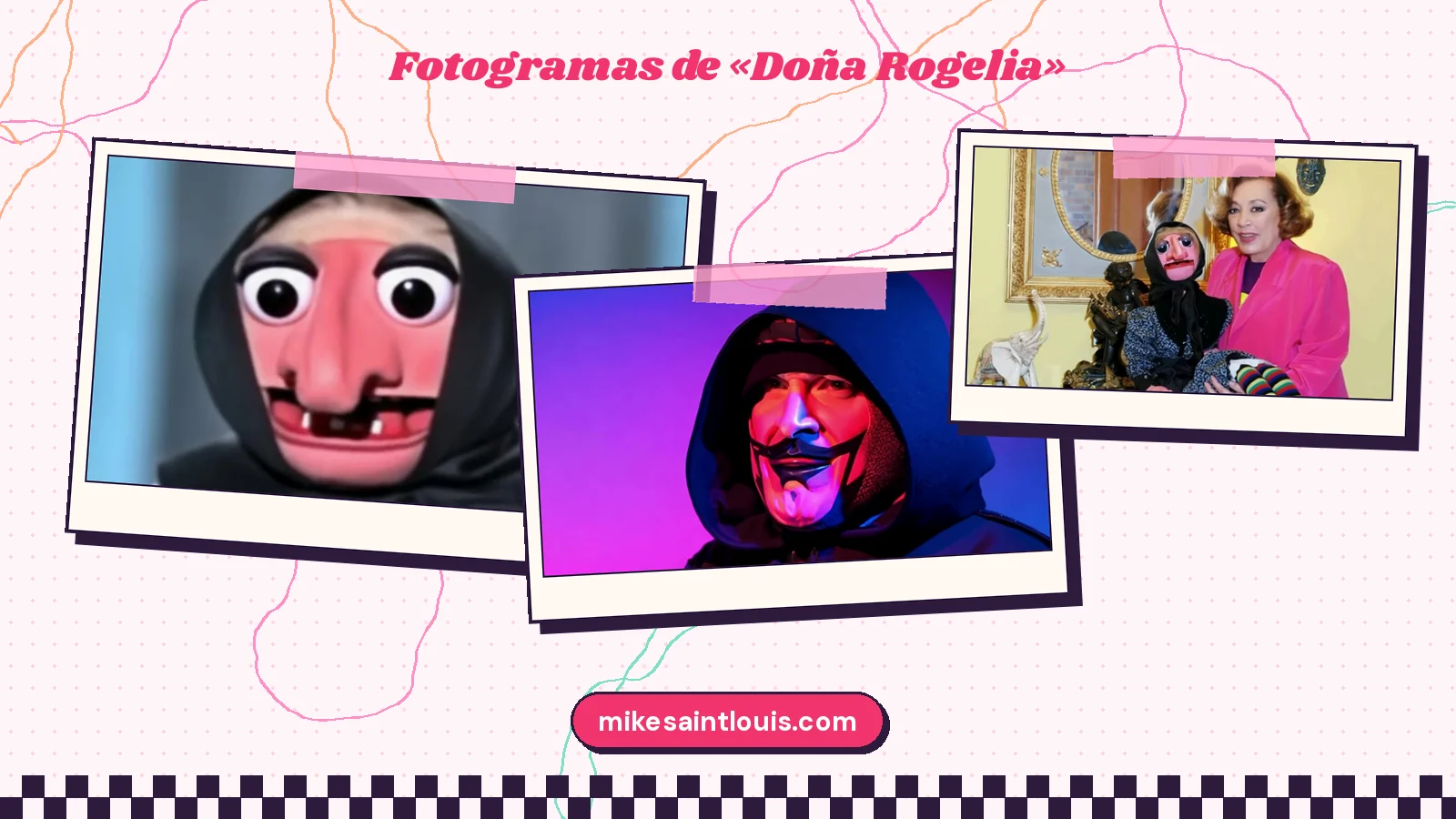
For years, on Spanish television, there was an elderly lady made of cloth who said the most outrageous things with perfect calm. Doña Rogelia, the ventriloquist Mari Carmen’s puppet. A granny with a bun, glasses and a viper’s tongue, who came out in family viewing hours with things no flesh-and-blood person would have dared say on a TV set.
That was the trick. Because the puppet said it, it could be said. The ventriloquist would look shocked, as if somebody else were to blame, and the audience laughed twice: at the outrage and at the face.
I think that kind of humour is one of the cleverest there is. Because, as well as being a joke, it’s a displacement. The person responsible for the line isn’t the one saying it but an invented character. And that small gap between the person and the puppet is what lets you tell the truth without getting lynched.
When I write, I do something very similar.
Characters who say what I wouldn’t
My songs are full of narrators who go way over the top. Who insult people by name, who shout, who play the saint or the diva, who tell someone to go somewhere I won’t repeat here. You might wonder whether I’m like that. The honest answer is: a bit, yes. But not that much.
What I do is what Mari Carmen did with her cloth granny. I hand the line to a character. The character has permission to exaggerate, to be unfair, to be cruel for three minutes. I, the author, stay behind looking as if butter wouldn’t melt.
It isn’t cowardice. It’s a tool. Some things, said in the first person and in earnest, would sound like score-settling and make nobody laugh. Said by an unhinged character, to a fiesta rhythm over a beat you can dance to, they become something else: satire, collective catharsis, something the listener can shout along to while thinking of their own market-stall supervisor.
That’s the puppet’s cheap trick. And I say cheap with all the affection in the world.
The fairy tale as a frame
Back to the first line, because it’s the other half of the trick.
Opening with “this is the tale of how, once upon a time” places everything that follows in the realm of fable. It’s no longer a direct message to anyone: it’s a story with a moral. And fables have rules. The clever-clogs who thinks he’s superior ends up humiliated. The thief ends up with nothing. The one who laughs at everyone becomes the laughing stock.
The song follows those rules to the letter. Art, says the narrator, has made the character insignificant and not very important. And he says it with a storyteller’s solemnity, as if reading the end of “The Emperor’s New Clothes”, when someone finally says out loud that the king is naked.
I love mixing that children’s-story tone with vocabulary you’ll never find in a children’s story. It’s another form of ventriloquism: the narrator dresses up as a kindly grandpa reading by the fire, and under the costume is a queen with a very wicked tongue.
Ladies and gentlemen, the supervisor
There’s a moment in the lyric that works like a circus act: “Presenting, from the street market, the supervisor.”
It’s the compère’s formula. The ringmaster who strides into the centre of the ring in a top hat, raises an arm and announces the next act. Except that here the act being announced is the villain, and the introduction is a public humiliation under the spotlight.
That device, turning the other person into a show-business turn, comes to me a lot when I write. In «Carta de recomendación» there were acts and performances. In other songs there are TV sets, contests, galas. I think it comes from something that amuses me enormously: the idea that anyone’s love life, however small, is structured like a television programme. There’s a host, a contestant, an audience, a commercial break and a final eviction.
What tickles me most about this particular introduction is where the description goes. “From the street market, the supervisor.” Category first, job title second, like the posters at old travelling fairs: “All the way from Albacete, the bearded lady.” That order turns the job into an attraction. He isn’t a man who supervises: he’s a curiosity on display.
The seconds section
Among the lines of the introduction there’s one I think is among the best I’ve written, not because it’s pretty but because it’s exact: the character is stock from the seconds section, returned by a previous customer.
Anyone who has been to an outlet, a department-store sale or a neighbourhood appliance shop knows the seconds section. The corner where everything with a dent piles up, with a torn box, with a button that doesn’t work. Products someone bought, took home, tried and returned. Now waiting for a less demanding buyer, marked down, with a yellow sticker.
Turning a person into a factory second is cruel, I know. But it has a precision I love. It doesn’t say the character is bad. It says he has already been tried out, that someone sent him back, and that if you buy him now it’s at your own risk. A consumer warning in a single sentence.
That’s where the ventriloquism kicks in again. I wouldn’t say that about anyone over dinner. The song’s narrator would. And the audience laughs because we all know somebody who lives in the seconds section and thinks he’s the shop window.
No more stealing the suits
There’s a line, in the middle of the mockery, that shifts the tone: the narrator asks the character what he’ll do now that he can’t steal the suits and the clothes any more.
There’s nothing fairy-tale about that sentence. It’s concrete, domestic, almost a shared-flat inventory. And that concreteness makes the fable turn realistic for a moment. Behind the fairground introduction there’s something that really happened inside the story: a raided wardrobe, clothes that kept disappearing, the feeling that what was yours wasn’t entirely yours.
Suits, incidentally, are an object that keeps returning in my catalogue. In «Que no pienso decir que mis trajes son de Zara» the suits are from SHEIN and the narrator is proud not to lie about it. Here the suits are the loot of someone who has lost access. Together the two songs make almost a diptych: clothing as the battlefield of a relationship that’s over.
I find it very honest that heartbreak can be measured in garments too. It isn’t all broken hearts. Sometimes it’s blazers that never come back.
The coarsest line and the correction
The ending of the song is, for me, the clearest lesson in ventriloquism in my entire catalogue.
First the narrator comes out with the coarsest line in the lyric, a sexual invitation in the form of an insult that I won’t reproduce here. It’s the peak of the rage, the moment the character completely loses it.
And immediately afterwards he corrects himself. He’s horrified at what he’s just said. “What am I saying?” No way, he more or less says, and explains why: that mouth must have more bacteria than Doña Rogelia.
That twist is pure ventriloquist routine. It’s exactly what Mari Carmen did when her puppet said something outrageous: she looked scandalised, covered her mouth, distanced herself. The narrator does the same with himself: says the unspeakable thing and then is scandalised by it. And into the scandal he slips something even more outrageous, the puppet’s hygiene.
The result is that the final revenge isn’t a threat. It’s a joke. And the joke leaves the character worse off than any threat could, because it leaves him ridiculous. As the song page says, it’s the camp way to round off a revenge. I’d add: it’s the ventriloquist’s way. The way of someone who says the worst thing and then looks at the audience as if to say “wasn’t me”.
Insignificant and not very important
Near the start of the lyric there are two adjectives I love for how small they are. Art, says the narrator, made the character insignificant, and not very important at all.
It doesn’t say art destroyed him. It doesn’t say it sank him or ruined him. It says it shrank him. And for someone who lives on looking big, that’s far worse than any catastrophe.
I think of characters we all know: the one who thinks he’s king of the office, the section manager with managing-director airs, the self-important man strutting round the street market with his clipboard and his key ring. What frightens them most isn’t punishment, it’s indifference. The day people stop looking at them. Going from leading man to scenery.
The song does exactly that. It takes the spotlight off him. And it does it with the very tool the character despised: art, “something you don’t even know what it is”, as the narrator tells him with all the disdain in the world.
That line amuses me because it’s revenge with a class edge, the small kind. The man who laughed at the guy who wrote songs, who did weird things with AI, who wasted his time on lyrics, ends up as raw material for one of those songs. I already answered that contempt in «Tus letras son basura» (“Your Lyrics Are Rubbish”), and this song is, in part, another answer, a later one. Late, but it rhymes.
Let the audience know
There’s another line I consider key in the lyric, even though it’s one of the crudest. The narrator delivers a scatological insult and adds: let the audience know.

That word explains everything: audience. The song isn’t addressed only to the villain. It’s addressed to a full house. There’s a crowd watching, the narrator knows it, and he calls them as witnesses.
That’s very ventriloquist too. The puppet never talks just to the ventriloquist: it talks to the audience. The outrageous line is only funny if someone hears it. And the villain’s humiliation only works if someone is there to see it.
I’m very interested in that public dimension of songs. When a lyric of mine comes out, it stops being something I think about at home and becomes something other people hear, discuss, share. The audience exists. And knowing it exists changes how you write. It makes me think about the listener, about whether they’ll laugh, whether they’ll recognise their own bargain-basement supervisor. The song is written for them as much as against him.
And there’s something freeing in that for anyone who has put up with someone like this in silence. For a long time nobody knew. Now the audience knows. Even as a fairy tale, even with invented names, the story is no longer a secret.
Why a puppet
Anyone who goes through my catalogue will see how many of my songs refer to Spanish television of the eighties and nineties, to figures younger people may not know. I do it a lot. And with «Doña Rogelia» I’ve taken it all the way to the title.
The reason is that those figures are a shared language. For many people my age in Spain, saying Doña Rogelia summons a specific image, a specific tone, a specific kind of humour. There’s no need to explain her. You name her and she appears, bun and glasses and all, in half the country’s heads.
And for those who don’t know her, the name is funny in itself. Doña Rogelia sounds like the neighbour on the fifth floor, a granny in a quilted dressing gown, a lady who knows everything about everyone on the street. A name that brings a whole character with it even if you don’t know where it comes from.
Putting that name in the title and saving it for the last line is like saving the best joke for the end of a long Sunday lunch. The whole song is heading there. And when it arrives, the tale is over.
A gallery of ladies
Going through my titles, I notice I have a little gallery of ladies. «Doña Rogelia». «María Teresa de Calcuta». «Lola Flores». «Malena». «Judith Bécker». «Licenciada en Derecho». Real women, fictional women, cloth puppets and job titles with university degrees, all hung on the same wall like family portraits in the hallway of a village house.
I didn’t plan it. It just happened. But I think it makes sense. Many gay men of my generation learned humour, exaggeration and drama by watching ladies: folk divas on television, grandmothers in the kitchen, neighbours on the landing, presenters in shoulder pads. They were allowed the grand gesture that was denied to us. And we copied it in secret.
That’s why, when I need someone to have the last word in a song, I often give it to a lady. Doña Rogelia is the extreme case: she isn’t even a woman, she’s a puppet impersonating one. And still she has more authority to close this tale than any other character I can think of.
Art, the slow avenger
There’s an idea in the lyric that I think is the most serious of all, even though it comes wrapped in mockery. The idea that art, like karma, sometimes takes its time, but never fails against con men.

I don’t know if it’s true. Probably not always. Plenty of con men die rich and applauded. But I believe that on a small scale, in each of our lives, there is something to it. Whoever makes art has a tool the other person lacks: they can tell the story. They can give it shape, put rhythm into it, turn it into something other people hear. And the con man, who lived by controlling the narrative, suddenly finds the narrative is no longer his.
That’s what the song celebrates. Not that the other person suffers, but that he no longer owns the story.
That’s also what «Karma» is about, with its vowel stretched to infinity. Both songs share that vengeful patience of someone who knows how to wait. And they share the certainty that when the moment comes, you celebrate in style, which in my case means with a beat and backing vocals made with AI.
Behind the puppet
I’ll finish with a confession about my own craft, which fits this business of ventriloquism rather well.
I write the lyrics, without AI. The music and vocals I make with artificial intelligence tools. I go into detail on my About page. And come to think of it, that has something of ventriloquism about it too. Anyone listening to my songs hears a performer who isn’t me, saying words that are mine. There’s a puppet, and there’s someone behind it pulling the strings.
Some people find that strange, or a cheat. To me it’s an ancient tradition with new tools. Ventriloquists, puppeteers, playwrights, lyricists writing for others: they have all put their words into other mouths. I do it with a technology that didn’t exist before, but the gesture is the same.
What matters to me is that the words are mine. That the fairy tale, the compère, the seconds section and the puppet with bacteria all come out of my head. The puppet can be made of cloth, of wood or of algorithms. I decide what it says.
If you’d like to meet the rest of the characters I’ve set talking, they’re all in my lyrics, and in the full discography you can see which album each of them lives on. «Doña Rogelia» is on «Ojalá se pudiera viajar a GAYFOLK», the second album of the trilogy. It also has its own page on the blog, with the full lyrics.
A fairground moral
Every fairy tale has a moral, and this one is no exception. Mine is small and homespun.
When someone hurts you and you can’t tell them what you think, invent a puppet. A character, a cloth granny, a storyteller with a wicked streak. Give the line to them. Let them exaggerate, insult, be scandalised at themselves. And you stay behind, looking as if you know nothing.
You’ll find that, said by the puppet, it hurts less and is funnier. And that the audience, which is always there even when you can’t see it, laughs with you.
And they all lived happily ever after. Except the supervisor, who went back to the seconds section.
Frequently asked questions
Who is Doña Rogelia?
In the song, she’s the punchline of the final line: the narrator compares the villain’s mouth with that of Doña Rogelia, the famous elderly puppet of the ventriloquist Mari Carmen, hugely popular on Spanish television. The full lyrics are at gayfolkplanet.com/letras/dona-rogelia.
Is the market-stall supervisor a real person?
No. He’s a fictional character who turns up in several of Mike Sain't Louis’s songs as a recurring villain.
Which album is it on?
«Ojalá se pudiera viajar a GAYFOLK», the second album of the GAYFOLK trilogy.
Who made the song?
The lyrics are by Mike Sain't Louis, lyricist, composer and music producer from Madrid. The music and vocals are made with artificial intelligence tools.