
By Mike Sain't Louis ·
“In case the insurers ask”: heartbreak on official letterhead
“In case the insurers ask, he isn’t five foot nine: he wears lift insoles.”
Of all the lines I’ve ever smuggled into a song, that’s the one I still can’t read with a straight face. Not because of the insoles, although those help, but because of the insurers. What insurance company is ever going to ask how tall somebody’s ex is? None. That’s exactly why it works. It’s a line with a rubber stamp on it, a letterhead, the smell of a public counter at nine in the morning, dropped into the middle of a sentimental settling of scores.
This post is about that: why I wrote «Carta de recomendación» (“Letter of Recommendation”) in the language of official documents rather than the language of love songs. About what happens when you take the violins away from heartbreak and give it the hum of a laser printer instead.
First, something that matters to me. The ex-husband in the song is a character. The market-stall supervisor, the man from El Médano, the one with the contact lenses: he’s a work of fiction, assembled from soap-opera flaws the way you’d build a telenovela villain. The narrator is a character too, even if he speaks in the first person and borrows my sharp tongue. I’ll say it once and leave it there: nobody here is reporting anybody. Somebody here is writing.
The language of the counter
There’s a register of Spanish we all recognise even though nobody speaks it at home. It’s the language of certificates and reports, of complaint forms and insurance claims. “Hereby.” “To whom it may concern.” “Let it be recorded.” A language without blood in it, written so that it seems written by no one.
Which is precisely why I love giving it a pulse.
When I started turning this lyric over, I knew what I had to work with: an ex with more layers than a supermarket onion, a new partner with no idea what they’d walked into, and a narrator who has climbed out of the well and looks back with that odd blend of fury and glee. What I didn’t have was the shape. A standard break-up song would open with a broken heart, an empty bed, rain against the window. That’s been done. Rocío Jurado did it better than me, so did Isabel Pantoja, so did half of Spain with a guitar.
So I asked myself what document actually exists, in real life, for warning one person about another. The answer was sitting in every job centre in the country: the letter of recommendation. That sheet your old boss signs to say you’re punctual, responsible and a real team player, even if you rolled in late every Monday.
I flipped it. A reference letter, yes, but addressed to the next victim. A letter that doesn’t recommend. It warns.
Age amended, nationality under review
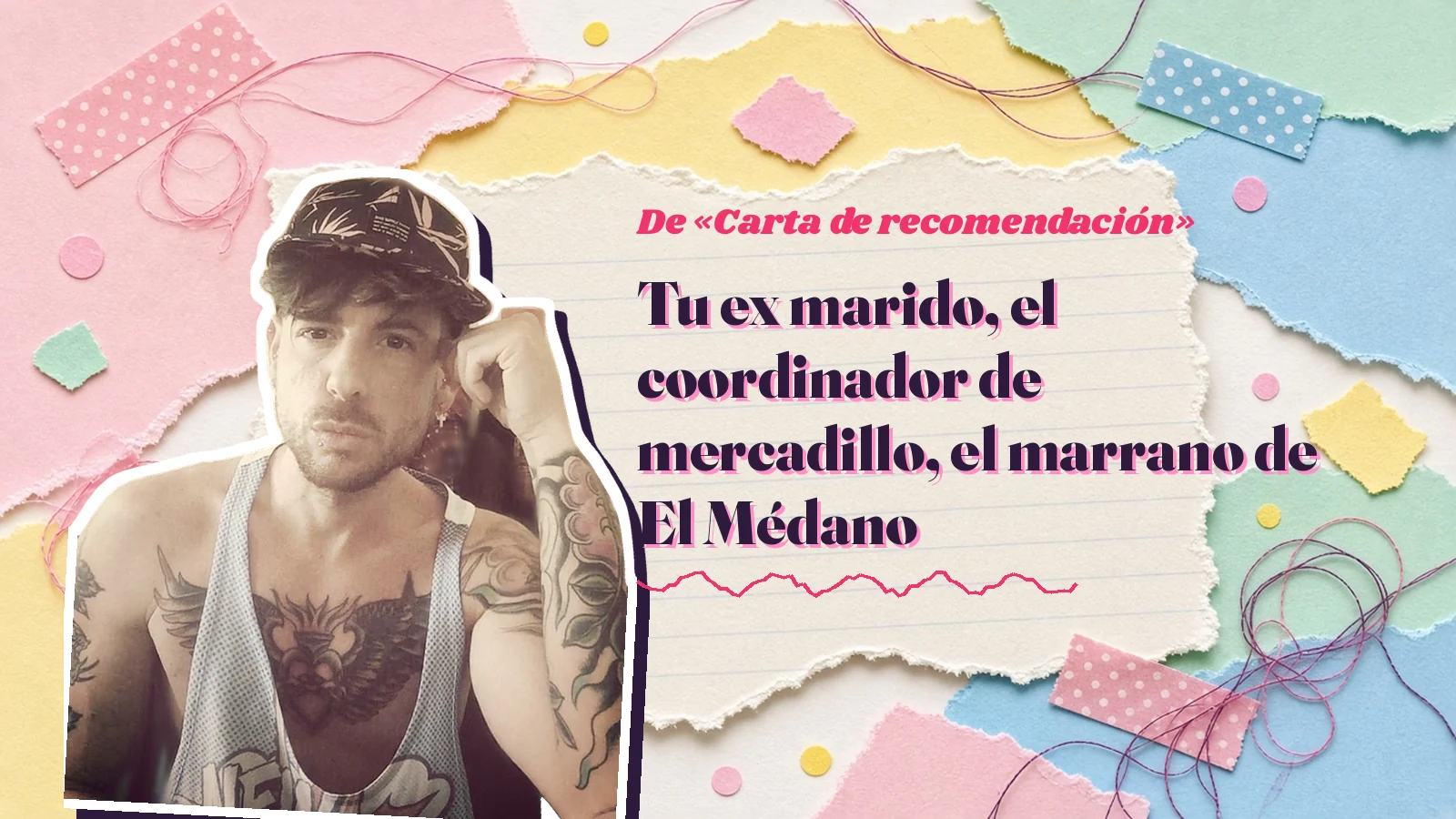
The first thing any report does is identify the subject. Name, age, origin. So the song opens the way a case file would: “Your ex-husband, the market-stall supervisor, the pig from El Médano.” Job title and nickname, with home address thrown in, all in a single line.
Then comes the date of birth, and with it the song’s first erratum. The subject claims he’ll turn thirty-five on the ninth of February. The narrator corrects him: fifty-three. I adore that swap because it’s the laziest lie in the world. He hasn’t even invented a new age, he’s just turned the digits round. Like wearing your T-shirt inside out and hoping no one spots the label.
After that, nationality, which spends the whole lyric under permanent review. He says one thing about his mother, the narrator suspects another, and in the end the narrator doesn’t even trust his own suspicion, tossing in a mark my words that already carries its own doubt. That phrase is pure stairwell gossip. It’s what your aunt says when she tells you something she doesn’t know but somehow knows.
Mark my words. Three syllables worth a notary’s seal.
I love writing like that, with the stock phrases you hear in the queue at the bakery. Some people think lyrics should sound like poems. I think they often sound better when they sound like the neighbour. It happened with «La vecina cotilla» and it keeps happening: gossip has a grammar of its own, and it’s deeply musical.
Appendix I: inventory of parts
If the letter is a report, the middle of the song is the appendix. That list of enclosures nobody reads, which is always where the real dirt is.

The appendix to this letter has a bit of everything:
- coloured contacts that turn ordinary eyes into blue ones;
- dye in the hair and the beard to cover the grey;
- insoles for a few extra centimetres;
- an outstanding dental quote for six thousand euros;
- teeth brushed three times a day, which in this context already looks suspicious.
As I wrote it I realised I was drawing up an inventory of parts, like the one for a second-hand car. The ex is a vehicle with a respray and a clocked odometer. And the letter is the roadworthiness test nobody gave him in time.
It also tickled me that nearly all of the appendix is cosmetic. There are no great crimes on that list. There’s dye, there are insoles, there are lenses. It’s a catalogue of small vanities. And that’s what makes it so funny: the narrator has spent years beside someone, and what he’s collected isn’t spectacular trauma but receipts from the chemist.
Careful, though: the lyric doesn’t stay at the dressing table. Between the lenses and the insoles there are heavier lines. Money, for instance. The character makes a show of being loaded, of being rich, and two lines later comes the flat accusation about the cash he helped himself to. That’s where the song stops talking about cosmetics and starts talking about accounts. And in love, the accounts always hurt more than the grey hairs.
Not covered by your policy
Back to the insurers, my favourite part.
Putting an insurance company into a break-up song is admitting something hardly anyone says out loud: long relationships are paperwork too. There are joint accounts and tenancy agreements, policies, bills in both names, a car one of you paid for and the other one drives. When a couple breaks, the paperwork breaks with it. Nobody writes boleros about that.
I wanted to write about it, even as a joke. Because the joke lets you see the wound underneath: after seven years, what’s left to divide isn’t lovely memories. It’s admin.
That’s why the line is addressed to the insurers and not to the new partner. It’s as if the narrator already knows that the next person who’ll need this information isn’t a lover but a loss adjuster.
For me, the comedy lives in the tone. The line doesn’t shout. It doesn’t insult. It informs. It’s the coldest moment of the letter, and that’s why it’s the cruellest.
The first days, the seventh year
There’s one detail in the lyric with nothing cosmetic about it, and it turns the report into a prophecy. The calendar.
In the first days, according to the letter, it’s all fire. Three times a day, with the new partner convinced they’ve won the lottery and telling themselves how lucky, how marvellous. Then the time jump, no transition, the way a series flashes “seven years later” in white on black: “In seven years he’ll flick you away like a cigarette end.”
I wrote that line thinking of the leaflet inside a medicine box. You know the format: common side effects, uncommon side effects, rare side effects. Here the common effect is the honeymoon and the long-term effect is the cigarette end. Any pharmacist would read it out with exactly the same blank face.
I’m fascinated by that way of telling time in a song. There’s no verse for year two, none for year four, none for the crisis in year six. Only the beginning and the end. The listener fills in the middle with their own life. And almost anyone who has been in a relationship like that can fill that gap unaided.
Seven years is a long time. It’s also nothing at all.
Cc: the boss
Another thing about reports: there’s always someone in copy. And this letter copies in half the world.
The character bad-mouths his best friend. He bad-mouths his mother. And at work he plays both sides: he trashes the boss to the colleagues and the colleagues to the boss. I wrote it almost as a diagram, with the rhythm of a ping-pong rally, because that’s how that kind of person operates: returning the ball to whoever happens to be in front of them.
There’s a character I know well from fiction in there. He’s the schemer of the afternoon telenovela, the one hiding behind the curtain to listen in before scurrying off to tell the other drawing room. I’ve put him in a market-stall waistcoat and shaved off the moustache, but it’s the same man.
What I enjoy most is that, in the middle of all that intrigue, the narrator is gossiping too. He’s doing exactly what he condemns: talking about someone behind their back, in lavish detail, to a third party. The whole letter is gossip. Gossip on headed paper, but gossip.
And as the writer, I have a ball with that contradiction. Perfect narrators bore me. I’m drawn to the ones who are right and also slightly unbearable. Like me on a Tuesday.
The thousand-euro executive
There’s a closing line in the report that is pure workplace sarcasm. The character thinks he’s an executive, and the letter slaps his payslip on the table: a thousand euros. A market-stall supervisor with boardroom airs.
That contrast is something my lyrics crave almost every time. The man who thinks he’s rich and is paying in instalments. The man who brags about an expensive suit he bought somewhere else entirely. That’s also the story of «Que no pienso decir que mis trajes son de Zara», practically this song’s first cousin: same universe, same kind of character, different garment.
The everyday is what stings. A specific salary, a specific shop, a specific town. If I write “a dishonest person”, nobody laughs. If I write that he thinks he’s an executive on a thousand a month, even the people on a thousand a month laugh. Especially them.
Signed and stamped: act two
Every report ends with a signature. This one comes with theatre.

“The first act starred me. Now comes act two.” It’s the moment the narrator stops being a complainant and becomes an usher. He’s telling the newcomer: take your seat, your part is starting, it’s the same show and I already know how it ends.
I love writing break-ups in the vocabulary of the stage. I’ve done it in other ways in other songs on the planet. Here the theatre is useful as well: it turns resentment into distance. Whoever talks about acts is no longer inside the play. He’s in the stalls, programme on his knees.
And then the farewell, the least bureaucratic thing in the whole letter: good luck, followed by a maricón. Two words of good wishes and one that changes the meaning of both. You can’t read it without hearing the tone: not quite affectionate, not quite cruel, a bit of each, the way these things get said in a Chueca bar at three in the morning.
The postscript that wasn’t in the envelope
If the song ended there, it would be a neat little satire. It doesn’t end there.
After the last line on headed paper, the song opens out. An instrumental stretch, wordless murmuring, and then a phrase that comes back and back, first in Spanish and then in English: you’re frozen. And in the middle, the only line in the whole song without a grain of irony: “I wish I could melt your heart.”
I call that part the postscript. It’s what you add by hand, below the signature, once the official document is finished and you realise you haven’t said what you actually meant.
Everything before it was the file. This is the grief.
It matters to me that it’s there. Because a letter like this without the postscript would only be a clever act of revenge. With it, it becomes something else: you can see that the narrator loved this person, that he tried, that he stood too long in front of a closed door. The word frozen also turns up in «El narcisista», with that useless flamethrower, and that’s no coincidence. Cold is one of my obsessions whenever I write about people who won’t let themselves be loved.
Repeating it in English was a production decision and a decision about meaning at once. The change of language makes the phrase sound further away, like an echo from another room. As if the narrator were no longer saying it to the ex but to himself, under his breath, to make himself believe it.
Making a form funny
People often ask why so many of my lyrics are shaped like something other than a song. A letter, a list, a report, a contest, a press release. The short answer is that the song form bores me when I use it without thinking.
The long answer has to do with how I work. I write the lyrics, without AI. The music and the vocals I make with artificial intelligence tools, and there I direct, choose, discard, start again. I explained it at more leisure on my About page. When a text has a very strong shape, like this letter, the production has a map: I know the opening has to sound like a reading, like a document recited in front of a notary, and that the ending has to open into something else. The shape of the text tells me how the song has to sound.
Here, the contrast between the almost spoken text and the murmured coda was the key. If everything had been equally melodic from the first bar, the joke of the report would have been lost. I needed the first part to sound dry, like paper being read aloud, so that the second could sound like what it is: a frozen heart and someone breathing on it.
And then there’s the pleasure, which is no small thing. I have enormous fun writing like this. Slipping into the skin of a resentful civil servant with an excellent memory. Hunting for the coldest word for the hottest thing. It’s a game of registers, and I’m the type who plays.
The rest of the case file
This song isn’t on its own. It belongs to a little archive of characters who have crept into my catalogue: the supervisor, the ex with the suits, the narcissist who never thaws, the cushion husband.
That last one, by the way, appears in the letter too. Near the end, the lyric talks about ending up in tears over a cushion husband who sank to the level of a sock. Two household objects to measure someone’s fall. If that rings a bell, it’s because «No quiero otro novio cojín» and «El calcetín» come from the same obsession of mine with measuring love in things from around the house. The cushion that decorates and holds nothing up. The sock that vanishes in the washing machine and nobody misses.
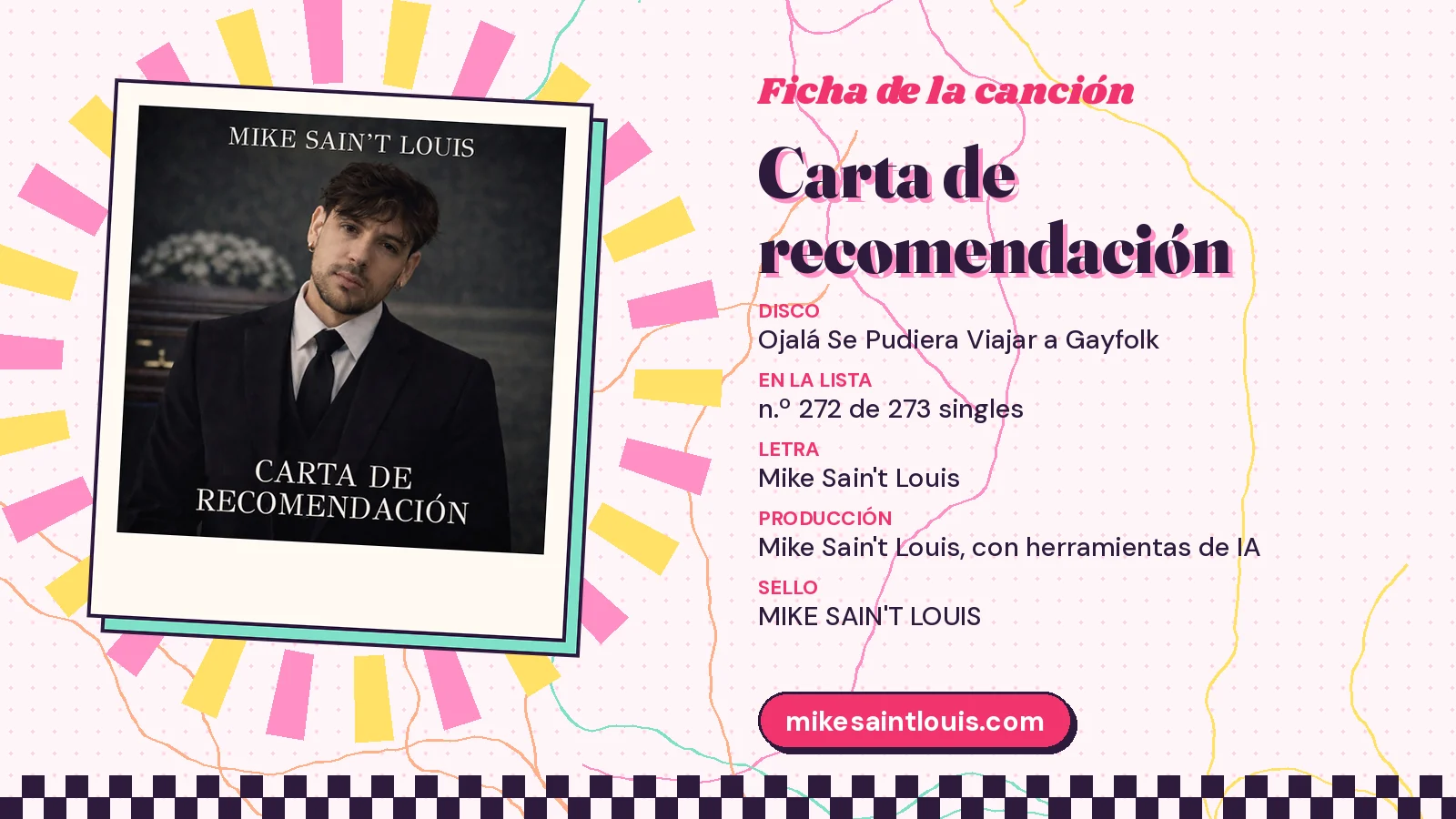
If you fancy reading those lyrics one after another, they’re all in order in my lyrics, and in the full discography you can see which album each one lands on. «Carta de recomendación» is on the second record of the trilogy, «Ojalá se pudiera viajar a GAYFOLK», the album of longing and slammed doors.
And if you want to follow the thread of this universe of characters, «Doña Rogelia» is another piece of the same puzzle, with a different tone and a different kind of venom.
What the letter leaves out
One last thing, and it’s about what I didn’t write.
With a letter like this, the temptation is to put everything in. Every grievance, every message, every bad night. When you write from anger, the list never ends. And I realised, while writing it, that the song only worked if I left most of it out. That’s why there’s a point in the lyric where the narrator cuts himself short and sums up the rest as an endless number of things he won’t go into. It’s an admission that the appendix could run for hours, and that the narrator chooses to stop.
That’s the most elegant moment in the whole letter. More than the cigarette end, more than the insoles. It’s the narrator shutting the filing-cabinet drawer before all the papers slide out.
A report that tells everything is a rant. One that stops in time is a song.
And then, of course, it doesn’t quite stop, because it’s me and I like a final flourish. Back come the dentist and the grey hair and the money, like someone who has already sealed the envelope and tears it open again to add one more thing. That’s very much a letter written in the heat of the moment. Very three in the morning. Very human, even if a machine produces it afterwards.
For anyone about to send their own
If you’ve read this far because you’re thinking of writing a letter like this to your ex’s new partner, here’s some advice from a friend at the bar: don’t send it.
Write it. Fill it with coloured lenses and insoles and dental quotes. Put it on headed paper if you like. Read it aloud in the living room in a notary’s voice and laugh until it hurts. Then put it away. Or turn it into something else: a drawing, a joke, a song.
I turned mine into a song because that’s what I know how to do. But the real letter, the one that matters, is the one you never post. The lyric says it itself with its act two: the show goes on without you.
You’ve already left the theatre. It’s cold outside, but you can breathe.
Frequently asked questions
What is «Carta de recomendación» about?
It’s a reference letter in reverse: the narrator, a fictional character, writes to his ex-husband’s new partner to warn them what he’s really like. An amended age, coloured contacts, lift insoles, and a final coda of sadness about a frozen heart. The full lyrics are at gayfolkplanet.com/letras/carta-de-recomendacion.
Are the characters real people?
No. The ex-husband, the market-stall supervisor and everyone else in the song are fiction, and so is the narrator.
Which album is it on?
«Ojalá se pudiera viajar a GAYFOLK», the second album of Mike Sain't Louis’s GAYFOLK trilogy.
Who made it?
The lyrics are by Mike Sain't Louis, lyricist, composer and music producer from Madrid. The music and vocals are made with artificial intelligence tools.